
Infineon Deepens China Layout: Shanghai Innovation Space Officially Opens, Three Business Architecture Optimized
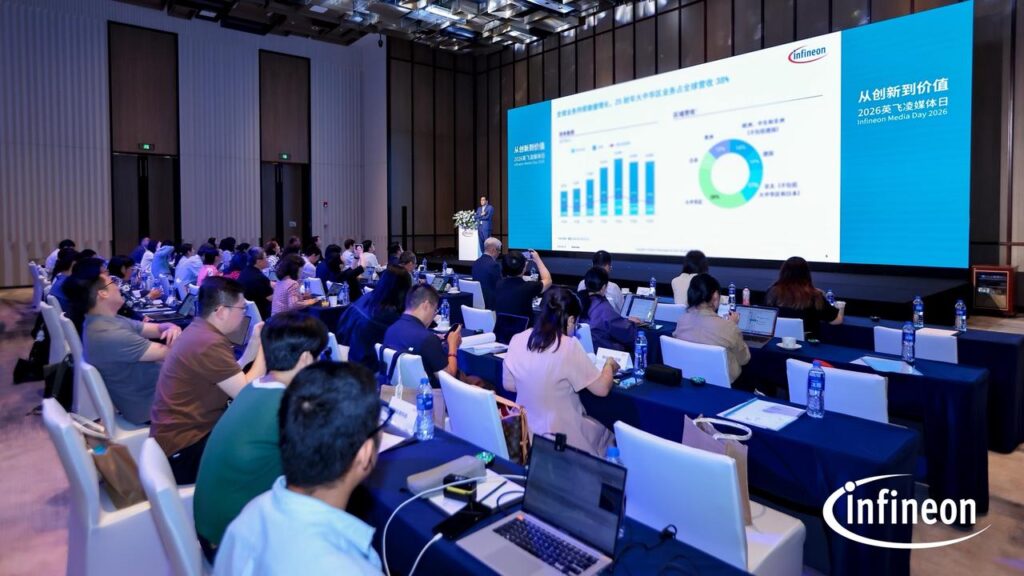
With the explosive growth in AI computing power demand and the rapid evolution of industries such as smart mobility and software-defined vehicles, the supporting role of underlying semiconductor technology is becoming increasingly prominent.
On 6 month 30 day, Infineon announced the official opening of its "Infineon Innovation Space" at its Greater China headquarters in Shanghai, marking a further deepening of its full-industry-chain layout in China. Facing the wave of变革 (transformation) in computing and power infrastructure, this tech giant leading in automotive and power semiconductors is attempting to fully connect the value chain from underlying chips to end applications by accelerating the construction of a local innovation ecosystem.
In the past 2025 fiscal year, Infineon's global business maintained steady growth momentum, with Greater China accounting for 38% of total global revenue. With a rich product portfolio, Infineon holds a top position in the automotive electronics, power semiconductors, and general microcontroller markets. Specifically:
- Automotive Electronics: Ranked first in market share for six consecutive years, with a 2025 market share of 12.8%.
- Discrete Power Semiconductors and Modules: Ranked first globally for many years, with a 2024 market share of 17.4%.
- Microcontrollers: Ranked first for two consecutive years, with a 2025 market share of 23.2%.
At the same time, Infineon is accelerating its layout in emerging businesses. It has previously acquired Marvell's automotive Ethernet and sensor businesses to promote the deployment of the RISC-V architecture in the automotive sector. This year, Infineon will also acquire part of AMS OSRAM's business to expand its presence in the sensor field. Furthermore, starting from 7 month 1 day, Infineon optimized its organizational structure, consolidating its original four business units into three: Automotive Electronics, Power Systems, and Terminal Intelligence. This allows Infineon to focus more on key applications and achieve higher decision-making efficiency.
Deepening the 'In China, For China' Strategy to Build a Local Innovation Ecosystem
As the localized strategy of 'In China, For China' officially took effect in 2026, Infineon comprehensively strengthened its four core capabilities in local production, innovation, ecosystem, and operations over the past year. In terms of production and innovation, the company promoted the localization of its product portfolio with a dual-wheel drive of 'products + services', strengthened the construction of its AI system application team, connected the entire process from product definition to mass production, and thus achieved faster new product introduction and precise customer response.
In terms of ecosystem building, in addition to continuously expanding the Hong Kong robotics laboratory, the Shanghai Innovation Space officially launched yesterday is equipped with dedicated collaboration venues and professional experimental equipment. It will assume multiple functions including innovation exchange, joint development, and industrial science popularization. At the level of localized operations, Infineon's distribution center in China is undergoing continuous upgrades. The center obtained AEO certification from the Shanghai Customs in 1 this year and is expected to officially commence operations in 8 of 2027. Upon completion, it will become Infineon's largest single-building finished goods distribution center globally.
Focusing on 'From Grid to Core', Three Main Business Segments Empower AI
Facing the surge in computing power and electricity demand triggered by the current AI wave, Infineon relies on its full-chain layout of 'From Grid to Core' to provide complete solutions covering power generation, transmission and distribution, energy storage, data center infrastructure, as well as physical AI applications such as new energy vehicles and robots. This strategy is fully reflected in its three core business segments.
In the automotive business segment, Infineon has focused on laying out RISC-V architecture, the AURIX TC4x series MCUs, and millimeter-wave radar products aimed at centralized vehicle architectures. In terms of application, it is actively advancing into emerging fields such as flying cars, AI chassis, and L3-level autonomous driving.
In the industrial and infrastructure sector, the company has ranked first globally in power semiconductors for 22 consecutive years. It is leading the development of renewable energy, power infrastructure, and intelligent computing centers through technological innovation, building a closed loop from innovation to delivery via customized services.
In the consumer, computing, and communications business segment, Infineon closely revolves around AI data center power architectures, deeply collaborating with leading customers across the entire AI power industry chain. For example, addressing cloud service providers' (CSPs) extremely high requirements for computing power and energy efficiency, the company's full-chain成套 solutions can reduce total machine energy consumption by more than 15%. Furthermore, to meet the challenges of higher power density and faster response speeds in the AI era, Infineon has also introduced innovative solutions such as its first high-voltage battery backup unit and ultra-thin back-mounted vertical power supply technology.
Infineon Greater China President Pan Dawei emphasized that China not only holds significant advantages in electric mobility and energy infrastructure but is also a key engine for the development of AI and data centers. Looking ahead, Infineon will continue to empower customer growth with hardcore technologies, working together with industry partners to achieve sustainable development.