

MoWorld 2.0 Advances Chinese 4D World Model, Accelerating Deployment on Huawei Ascend
By Jiang Si Qi
At the World Internet Conference on November 4, Moxin Technology founder and CEO Chen Tianrun, alongside representatives from the national AI application pilot bases for embodied AI, cultural tourism, and spatiotemporal geographic information, officially released MoWorld 2.0, a 4D world model natively built on Huawei Ascend.
On November 4, at the World Internet Conference forum themed 'Developing New Quality Productive Forces: Strong Incremental Growth Driven by AI,' Chen Tianrun, Founder and CEO of MoXin Technology, joined representatives from three National AI Application Pilot Bases—focusing on embodied AI, cultural tourism, and spatiotemporal geographic information—to officially release MoWorld 2.0, a 4D world model natively built on Huawei's Ascend platform.
According to IT Home, following the launch of MoWorld 1.0 in July, the new MoWorld 2.0 integrates physical rules—including gravity, elasticity, buoyancy, illumination, and thermodynamics—and object properties such as rigid bodies, soft bodies, fluids, and deformable bodies into spatial modeling. This enhances interactive capabilities and generates 4D Gaussian assets that support simulation, real-time rendering, and repeated reuse.
Reports from China Economic Net indicate that the model's real-time inference performance has improved from a peak of approximately 50 frames per second in version 1.0 to about 70 frames per second. The rendering speed for 3D and 4D Gaussian assets now exceeds 500 frames per second, while mobile rendering tests have also achieved approximately 100 frames per second.
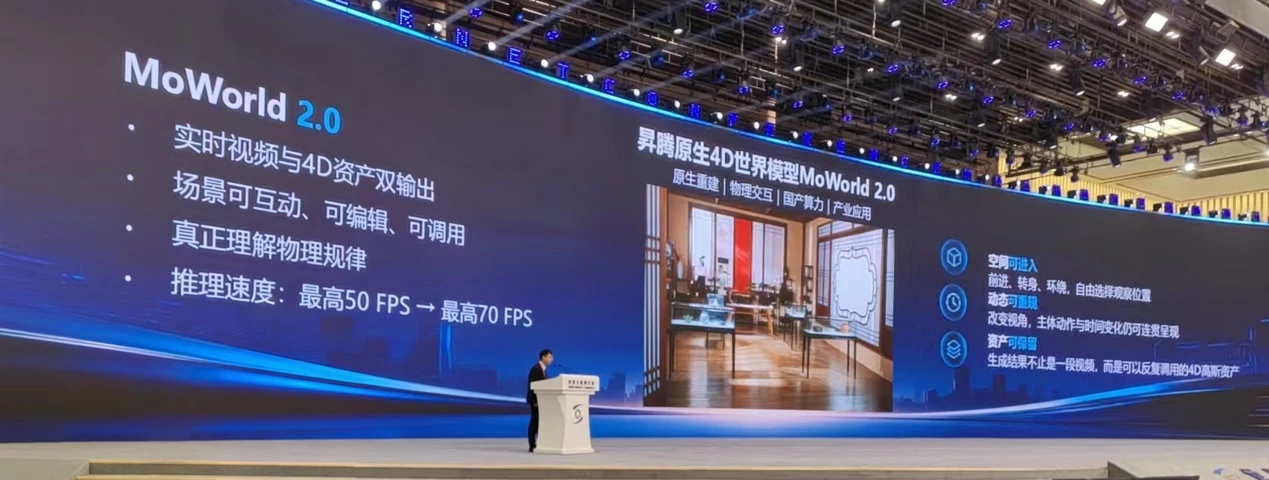
The reports also note that, leveraging its multi-physics modeling capabilities, MoWorld 2.0 goes beyond merely generating spatial layouts and object appearances; it can perform real-time modeling and inference for object interactions, external forces, and environmental changes.
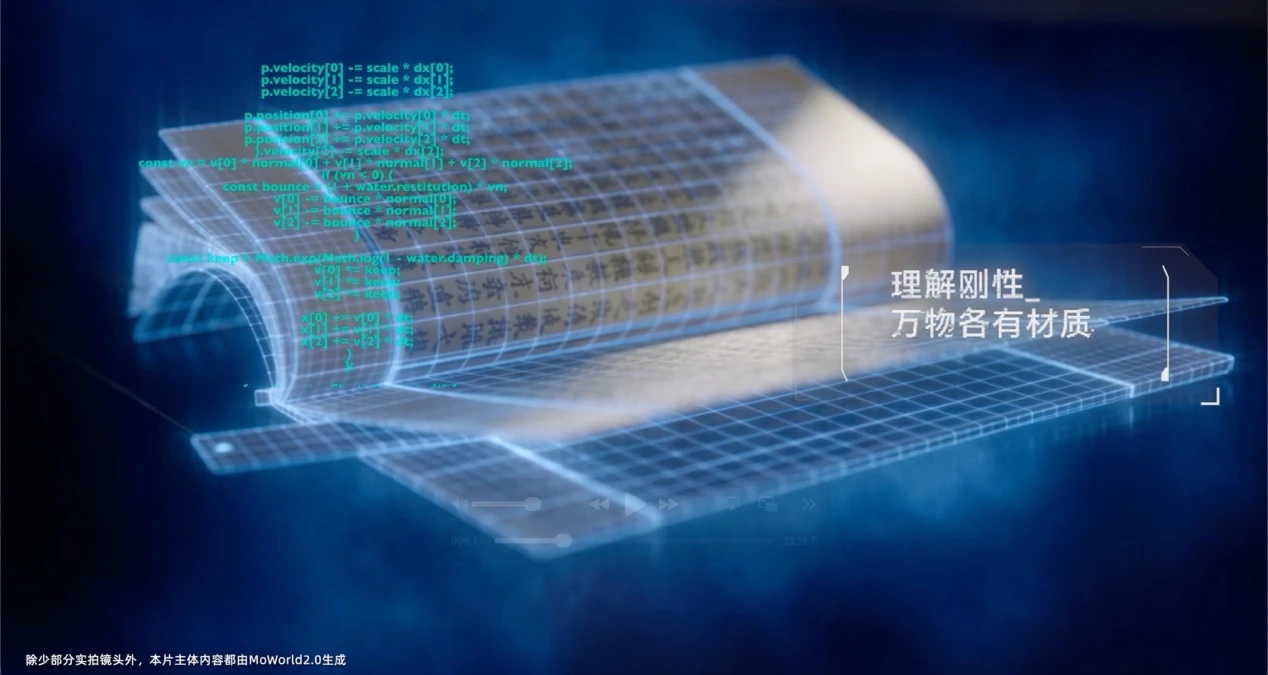
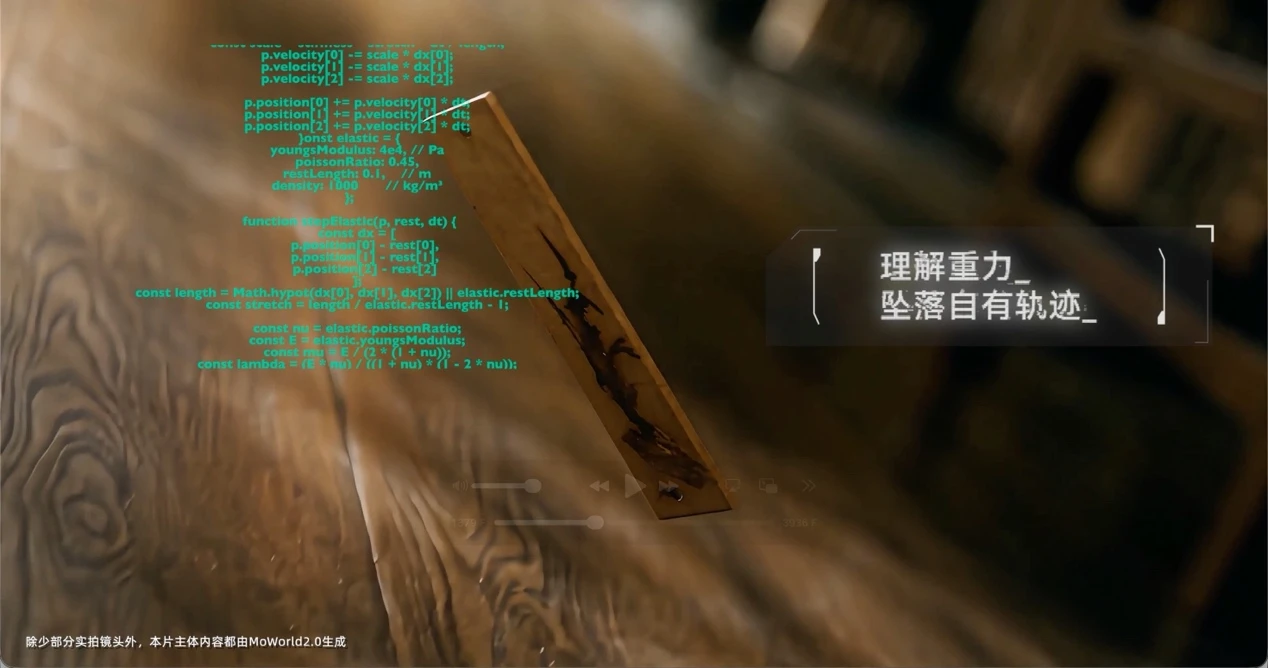
Both China Economic Net and IT Home cited an on-site demonstration case simulating the entire process of a gentle breeze turning book pages and a bookmark falling. To achieve this, the model must simultaneously process the wind's force and angle, the flexible properties of materials like Xuan paper, the bookmark's own weight, and the rigid-body properties and contact dynamics of the floor.
According to IT Home, MoWorld 2.0 has completed training and deployment on a domestic Ascend computing infrastructure. MoXin Technology and Huawei teams are continuously collaborating on innovations in long-sequence training, multi-NPU collaborative scheduling, and inference system optimization to further enhance the model's training efficiency, inference speed, and real-world deployment capabilities. Based on MoXin Technology's internal testing, the inference cost of this approach can be reduced to as low as 30% of comparable GPU-based solutions.
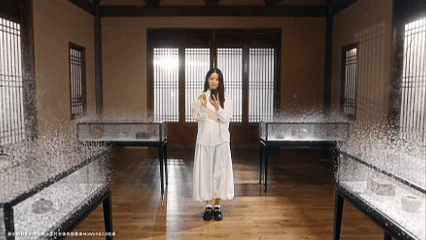
On the application front, China Economic Net and IT Home report that MoXin Technology is collaborating with partners to progressively roll out application validation, real-world scenario deployment, and product delivery using the MoWorld model across sectors including embodied AI training, autonomous driving, industrial digital twins, film and television content production, and cultural tourism.
For embodied AI training, MoWorld 2.0 can generate virtual environments with built-in spatial structures and basic physical feedback, allowing robots to undergo iterative trial-and-error and review. In autonomous driving simulation, the model generates various long-tail traffic scenarios—such as rain, snow, damaged road surfaces, and sudden obstacles—within a unified 3D/4D space, providing highly reproducible testing environments. For industrial digital twins, real-world settings like factory production lines and mines can be converted into editable spatial assets to support layout adjustments, retrofit simulations, remote collaboration, fault modeling, and digital training. Meanwhile, in urban and rural planning, cultural tourism, and film and gaming, the model facilitates plan visualization, digital scenic area construction, and storyboard pre-visualization.
According to China Economic Net, "Mo Xiao Chong," unveiled at Huawei's new device launch event this October, is a flagship consumer application of MoWorld 2.0. Users can upload a few photos of their pets to generate a 4D digital pet avatar featuring spatial structure and supporting multi-view inspection and interaction. The solution employs a cloud-edge collaborative architecture. MoWorld 2.0 is trained on the Ascend platform to yield an edge-optimized version with approximately 600 million parameters. The Kirin chipset handles edge inference, the cloud generates high-quality 4D assets, and the smartphone performs the final rendering, interaction, and display. The report also noted that Moxin Technology will partner with three national AI application pilot bases to deepen collaboration in interactive simulation and embodied training, cultural digital assets and immersive experiences, 3D data production, and rapid large-scene reconstruction.
Earlier media reports indicate that Moxin Technology has completed five funding rounds this year, raising a total of RMB 2 billion. The investor pool includes state-backed firms such as Shenzhen Capital Group and Zhejiang Capital Group, alongside multiple industrial investors. The company's valuation is approaching RMB 10 billion. Meanwhile, market sources indicate that a new funding round is currently underway.