

Robot Data Supply Chain Restructures as Buyers Prioritize Task Complexity Over Volume
By Xiong You Di
Data collection intermediaries report that robot training clients are now evaluating task complexity segment by segment, effectively halving per-hour payouts for mixed-difficulty videos. As model companies shift from bulk purchasing to demanding specific, high-quality task data, the million-hour data supply chain is undergoing a painful restructuring.

A middleman who organizes data collection teams for robot training data orders recently told us that business is becoming increasingly difficult. Although the contract stipulates a rate of RMB 50 per hour, videos must pass basic quality checks before clients evaluate the task complexity of each segment. Simple and medium-difficulty clips may no longer be compensated, with only complex tasks included in the final settlement.
If complex segments account for only half of the total collection time, an order originally priced at RMB 50 per hour effectively drops to just RMB 25.
According to him, sellers cannot accurately predict how tasks will ultimately be classified when signing contracts and organizing collection. Even after personnel have been assigned and equipment deployed, the actual revenue generated from an hour of work may remain unknown until final acceptance.
Behind this order lies the robot training data business, which has gradually emerged over the past two years.
In September this year, OpenAI released GPT-6 Astra, demonstrating enhanced capabilities in specific three-dimensional spatial tasks. At the Bund Summit around the same time, Wang Qian, founder of X Square Robot, stated that since early 2025, OpenAI and Anthropic have been procuring large volumes of robot data and establishing small-scale data factories.
However, understanding three-dimensional space does not equate to the ability to manipulate the physical world. To teach robots how to fold laundry or operate tools, internet text and video are insufficient; models must also learn how actions are executed and how to interact with physical objects.
Having robots repeatedly practice in real-world environments is costly and results in slow iteration cycles. Consequently, many model companies have opted to learn from humans first. Data suppliers organize personnel equipped with cameras and sensors to record tasks such as cooking, folding laundry, and maintaining equipment. The raw footage is then filtered, annotated, and processed to extract motion information, transforming it into training data suitable for robot models.
This has given rise to a new wave of data suppliers specializing in organizing personnel, equipment, and physical scenarios, some of which have already reached a data production scale of millions of hours.
In August 2026, Mifeng Technology announced it had produced over 1 million hours of non-embodied data, and its 20,000th MEgo data collection device officially rolled off the production line. In September, Midcentury claimed to possess more than 2 million hours of first-person data assets. In October, Maxinsights announced the completion of a USD 30 million seed funding round, disclosing that it had collected over 2 million hours of real-world data, of which approximately 1.5 million hours met its defined standards for model usability.
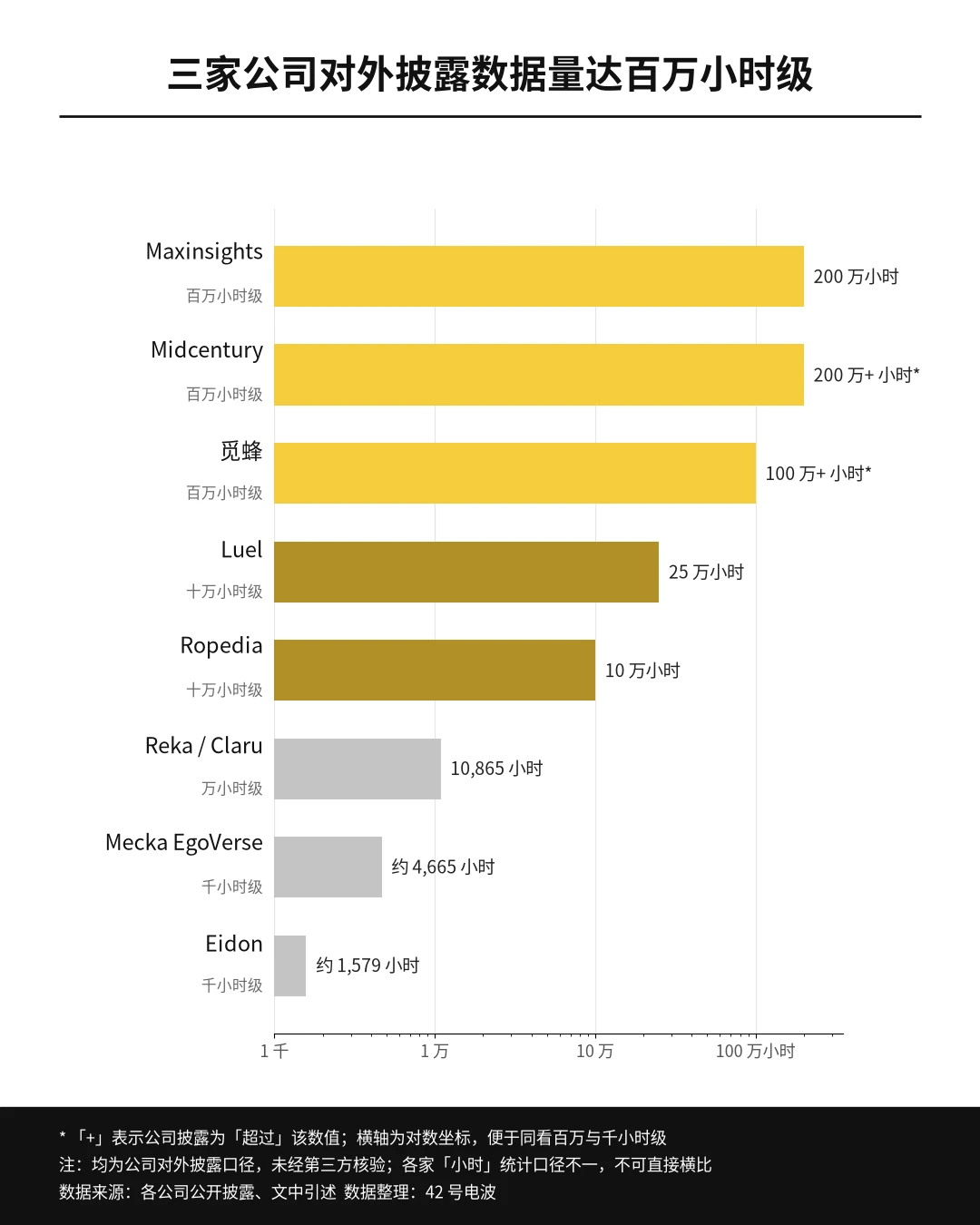
The data production network is expanding rapidly, but the positions different companies hold within the supply chain, along with the commercial value they can capture, are beginning to diverge.
Role differentiation behind order flows
Model labs submit data collection requirements, which are taken up by data companies directly serving the labs and then subcontracted to collection organizers in various regions. These organizers are responsible for providing personnel, venues, and equipment. The recorded videos are then filtered, synchronized, and annotated. For some datasets, hand trajectories must be extracted or 3D motion information reconstructed before the data can finally enter the model training pipeline.
A company's position in this chain depends largely on its existing capabilities.
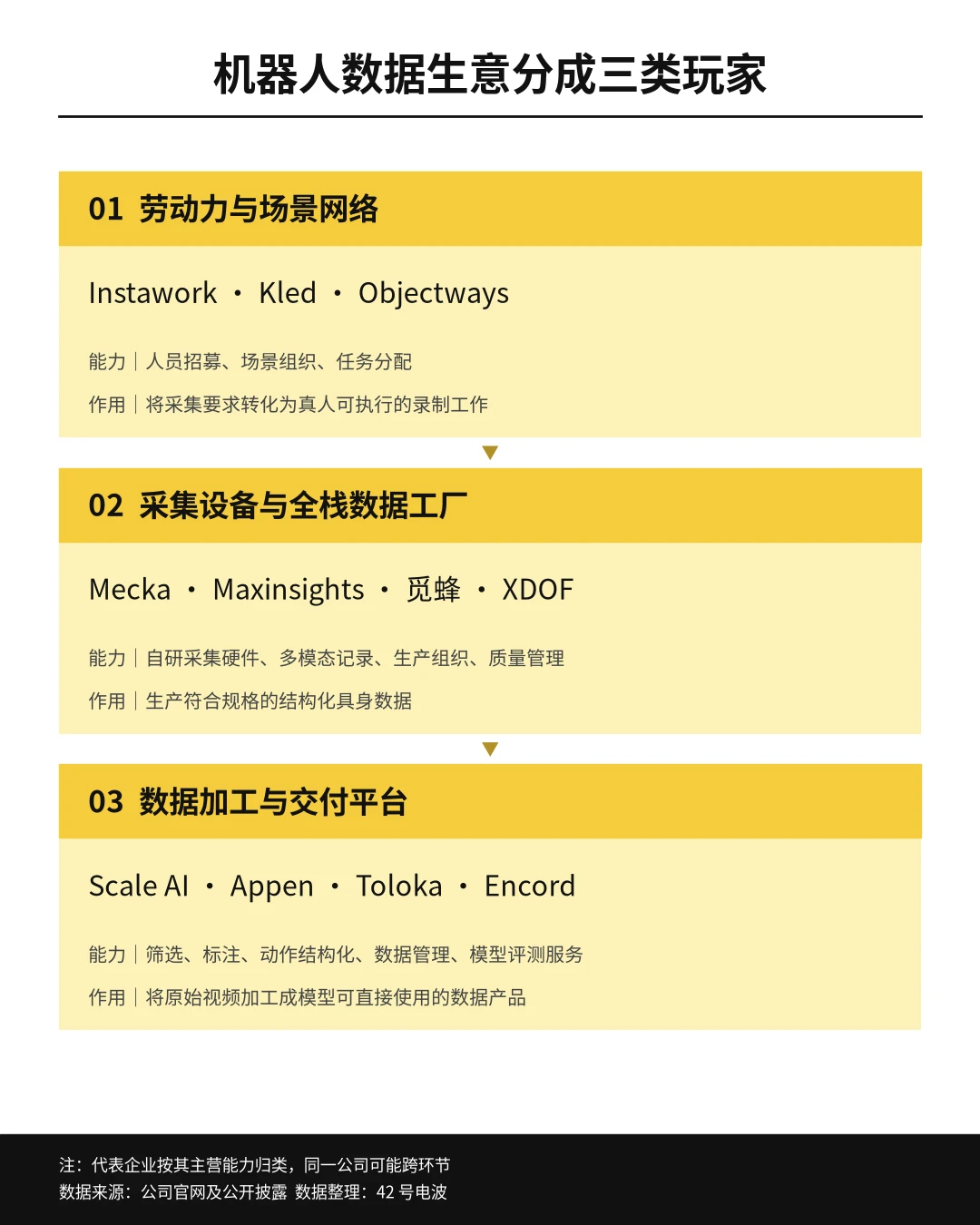
One type leverages its existing capabilities in labor organization.
One domestic real-world scenario data supplier previously operated in the large model data business.
They organize personnel to record language data in Cantonese, Spanish, Portuguese, and other languages, while also taking on orders for specialized fields such as finance and highly difficult math problems. To produce these complex math problems, they even need to recruit gold medalists from the International Mathematical Olympiad.
This kind of business hinges on organizational capability: sourcing the right people, training them to execute tasks to specification, and managing quality assurance and delivery.
This framework remains highly applicable after the shift to embodied data. If a client needs factory data, the company sources factories and workers familiar with on-site operations; if it needs household data, it dispatches personnel into real homes. Data collectors wear cameras to record their first-person perspective while completing tasks, with equipment and personnel reconfigured around each specific order.
According to the founder, the transition has been relatively smooth, and the original large model data business has not stopped either, noting that "there are plenty of orders."
While the data itself has evolved from language and text to human manipulation videos, the underlying organizational model remains similar: model companies set the requirements, and data suppliers break those requirements down into discrete tasks that can be executed by human workers.
Overseas, Instawork is also leveraging its existing workforce management capabilities. Originally a flexible staffing platform for the food service, hospitality, and logistics industries, it has now extended its labor network into robotics. It provides first-person videos from real-world scenarios and organizes multimodal data collection, teleoperation, and UMI data production.
This same organizational capability also extends to the deployment phase, with Instawork providing on-site operators, training, and operational support for already deployed robots.
Kled, meanwhile, operates on a task-based platform model. AI labs submit data requirements, and the platform assigns tasks to qualified contributors, optimizing match efficiency through task recommendations, acceptance rates, and regional data. In September 2026, Kled announced that its contributor network had surpassed 500,000 people.
Another category of companies already possesses data processing tools and an established client base of large model developers.
Traditional AI data service providers like Scale AI and Appen are extending their existing capabilities in data annotation, quality management, and customer service into the robotics sector.
Scale AI, which began in autonomous driving data processing, announced in September 2025 that it had produced more than 100,000 hours of robot data and maintains data service relationships with companies such as Physical Intelligence, Generalist AI, and Cobot.
In March 2026, Scale AI partnered with Universal Robots to integrate its data engine into industrial robot training. In October, the company collaborated with Hugging Face to release the FineART dataset, which further breaks down robot operation logs into subtasks featuring timestamps and language descriptions.
Encord occupies a somewhat unique position: it purchases raw data from collection networks while simultaneously providing processing and management services to model and robotics companies.
Procurement conditions published on its website indicate that upstream suppliers do not need to perform annotation tasks such as drawing bounding boxes or segmentation masks. Instead, they provide data samples, collection capabilities, existing data scale, and hourly rate quotes, while separately specifying the terms for existing data versus custom collection, and for exclusive versus non-exclusive licensing.
Raw data production and end-client services can be handled by different companies.
Another category of companies integrates equipment, data collection, processing, and delivery into a single production system.
Maxinsights organizes data collection personnel across multiple countries, breaking the data production process down into collection, inspection, annotation, screening, and delivery stages. According to the company, it recruits personnel through local human resources agencies and directly manages the collection process.
Mifeng organizes its data production around MEgo devices, integrating task distribution, device allocation, quality verification, and payment settlement into a unified online workflow through its Mifeng Pai platform.
Mecka, by contrast, develops its own multi-sensor data collection hardware and deploys field teams in real-world environments, subsequently using proprietary models to perform motion tracking and 3D reconstruction.
While they all appear to be selling data, they are actually operating several distinct lines of business. They may collaborate within the same supply chain or compete for the exact same data contracts.
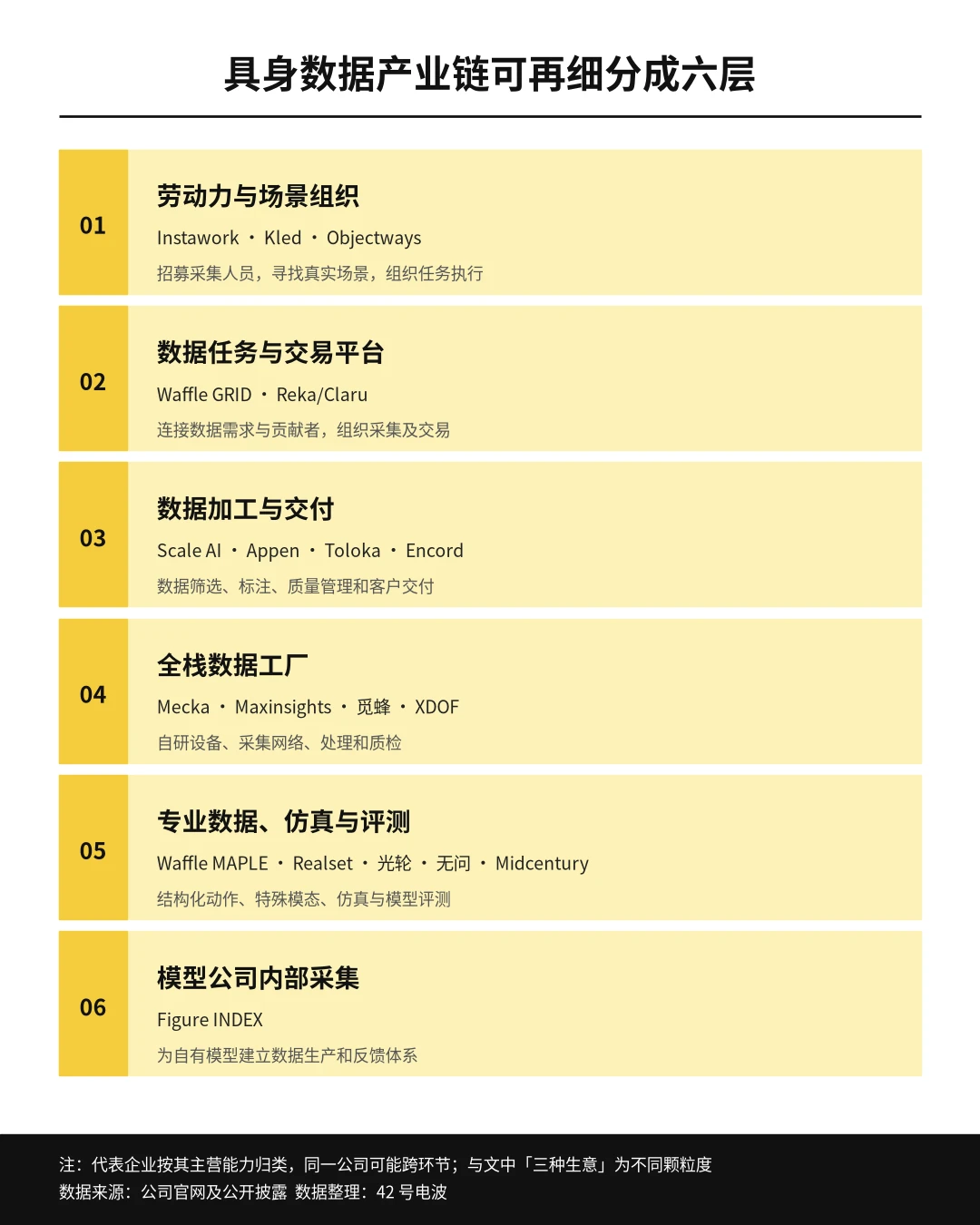
A Long List of Suppliers, a Short List of Buyers
Tracing the order chain upstream reveals that while the data supply network is vast, the end buyers capable of consistently absorbing large embodied data orders remain highly concentrated.
Two leading domestic ego data suppliers told us that their respective largest customers are all overseas foundation model companies.
Sam Padilla, co-founder of the now-defunct robotics data startup Eidon AI, once estimated that across major laboratories worldwide, there are likely only 20 to 50 decision-makers authorized to approve million-dollar data purchases.
Publicly disclosed supplier relationships also reveal these data flows.
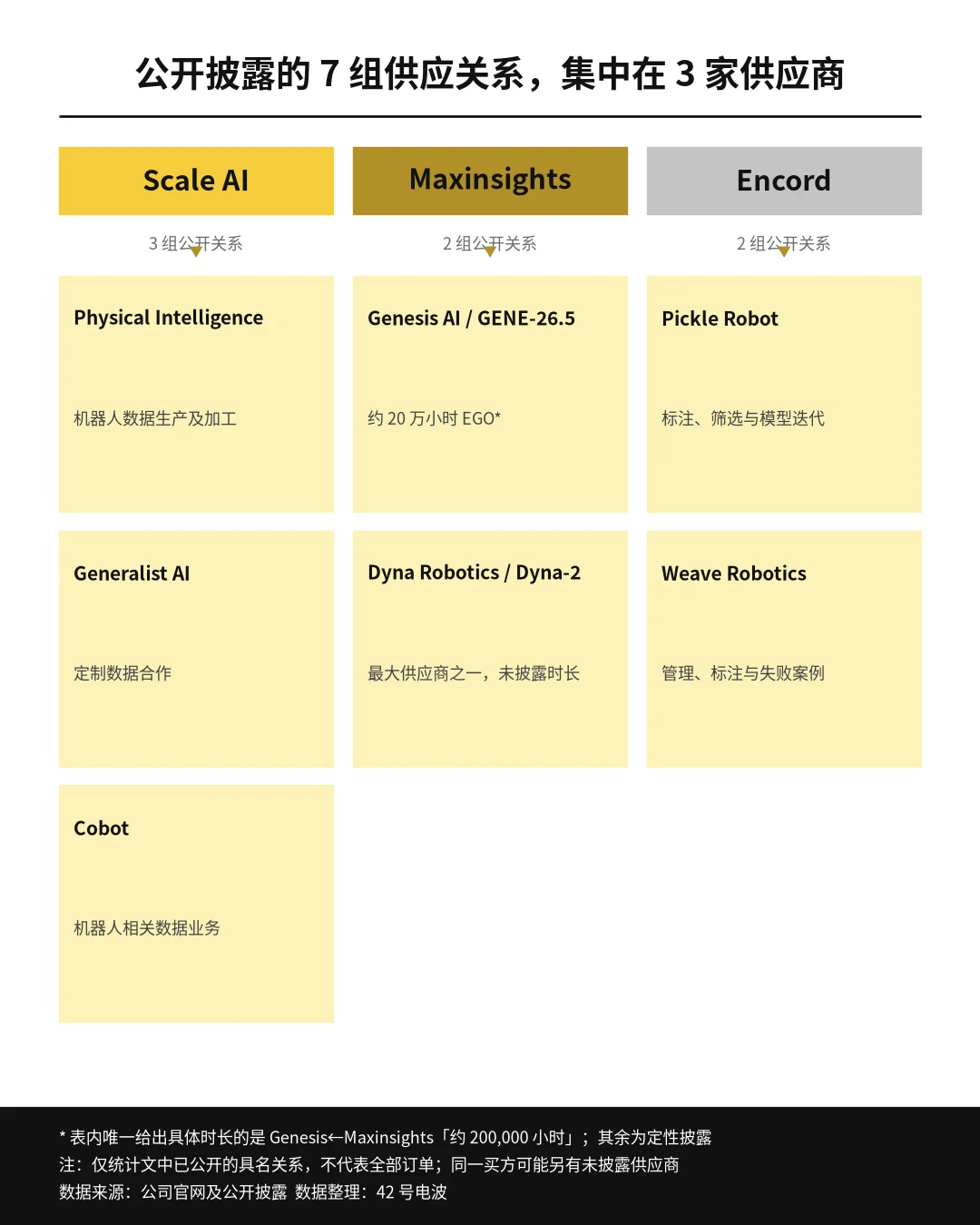
In such a highly concentrated buyer landscape, early opportunities in the data business stemmed from information asymmetry.
Being well-connected was a distinct advantage: securing laboratory requirements earlier allowed companies to rapidly mobilize personnel, venues, and equipment to win contracts and manage subcontracting.
However, for the core service providers interfacing with these laboratories, the value proposition has long extended beyond simply securing contracts. The real challenge lies in translating vague model requirements into executable task standards for data collectors, while maintaining data consistency across multiple layers of subcontracting.
The founder of a leading Chinese data supplier divides this market into two distinct worlds: "Securing contracts is the better part; that is the upstream. But downstream execution is just a race to the bottom on price."
As supply continues to flood the market, channels undercut one another, making the simple model of scaling headcount increasingly unprofitable. Meanwhile, the demands of the core buyers themselves are also evolving.
Entering the Deep End
Industry insiders tell us that many laboratories that previously procured large volumes of generic egocentric data have already concluded their first round of purchasing. New orders are increasingly skewed toward specific scenarios and tasks. Even for custom data collection, where pricing is still quoted on an hourly basis, buyers are now scrutinizing the content: what exactly is this one hour of video capturing?

Large-scale, diverse human manipulation data remains crucial, but for foundation model developers, the marginal returns of homogeneous manipulation videos are declining. As early as September, many orders for collecting household scenario data had already been suspended across the market.
As leading model companies expand their procurement scale, they are seeking to define data composition and delivery standards with greater specificity. In a September media briefing, Yao Maoqing, chairman of Mifeng Technology, revealed that some top clients now require 50,000 to 100,000 hours of data delivered weekly, with some already requesting volumes in the tens of millions of hours. At the same time, certain clients are shifting from evaluating multiple suppliers simultaneously to forming more stable, designated partnerships.
One reason he cited is that mixing data from different sources makes it difficult to maintain consistent quality and specifications, thereby increasing the complexity of subsequent data cleaning and training.
When Figure launched its INDEX data collection platform, it disclosed a set of metrics alongside the total video volume: approximately 373 task types, 1,146 manipulated object types, and 116 environment types per 1,000 hours of video. Figure reduces highly repetitive content through deduplication, task quotas, and distribution adjustments.
In August 2026, the defunct U.S. budget carrier Spirit Airlines attracted bids from multiple AI companies during its bankruptcy asset auction. Google won the bid for the corporate data with USD 10 million, while Mercor offered USD 7.5 million.
The assets they targeted include approximately 100 million internal emails, 500 million Microsoft Teams messages, and extensive records covering corporate operations, finance, human resources, and project management.
The value of these records lies in preserving the context of how a company handles real-world work: how tasks are initiated, how different departments collaborate, how problems are resolved, and what outcomes are ultimately achieved. micro1, an AI data company that participated in the bidding, announced in October that it plans to invest USD 1 billion over the next year to procure and license corporate operational data. It will use this data to build reinforcement learning environments that simulate real business processes.
This illustrates that AI companies need more than just massive volumes of real-world records; they also aim to extract task processes for training and evaluation.
For companies that have already deployed robots, these requirements become even more granular. Logistics robotics company Pickle Robot purchased Encord's services primarily to address issues such as incomplete package contour annotations and overlapping polygons, thereby reducing the need for engineer review and rework. Meanwhile, Weave Robotics must continuously update its task definitions as its robots enter diverse residential and commercial laundry environments, addressing failure cases that were not previously covered.
In public discussions, Yao Maoqing noted that some leading clients now require hand pose reconstruction accuracy at the millimeter level, with some even setting a standard of 5 to 7 millimeters. They also have specific requirements for frame rate, time synchronization, spatial localization, and semantic annotation.
Suppliers are iterating their products toward finer granularity and multimodality. Mifeng categorizes data into bare-hand Ego, Ego+Wrist, and Ego+UMI; Guanglun Intelligence organizes multi-view data collection by task scenario; and Maxinsights has introduced the MaxGlove sensor glove to add force and weight perception.
Tasks previously left to model companies are now being sold as products by data suppliers. Companies such as Encord, Scale AI, and Guanglun Intelligence have begun incorporating data management, quality control, and model evaluation into their own products or services to varying degrees.
However, increasingly specific requirements from buyers do not necessarily translate into higher profits for suppliers.
One data supplier told us that during the first collection round for a project, over 1,000 data samples were gathered, but only about 300 ultimately passed acceptance. The same task might need to be repeated up to three times, and the client's standards can change on a monthly basis.
"The client doesn't just want data; they want us to do the trial and error for them," another supplier said.
For model companies, adjusting collection tasks and filtering criteria is part of the process to find effective training data. But for the teams doing the actual collection, the costs of personnel, equipment, and venues are already locked in once production begins.
Processing complex multimodal data also carries significant compute costs. A data cleaning practitioner told us that in his workflow, hand pose reconstruction is highly compute-intensive: processing one minute of video requires a single GPU to run for about three minutes.
The risks of a capital-intensive approach are starkly illustrated by the failure of Eidon AI.
Operating for over two years, the company pivoted to robot training data in 2025. It developed upper-body tracking devices, finger-tracking gloves, and first-person video capture solutions, deploying personnel to perform tasks in real households.
In a post-mortem following the shutdown, co-founder Sam Padilla noted that it took the team about five months—from shipping the first batch of tracking devices to accumulating approximately 3,000 hours of data. Half of this consisted of pure first-person video, while the other half comprised data recorded synchronously with the tracking devices. However, potential customers expected delivery at a similar scale every month, or ideally, every week.
Eidon’s pricing was not cheap. Video combined with motion tracking data, sold in 1,000-hour blocks, cost approximately USD 60 per hour. Data containing more granular finger movement information was priced at up to about USD 100 per hour.
However, Padilla calculated that compensation for data collectors accounted for only about 10% of the selling price. The remaining revenue had to cover device manufacturing, damage and replacement, cross-border shipping, assembly, quality assurance, discarded recordings, and investments in R&D and operations.
Even harder to predict is the exact type of data customers will require in the future. In his post-mortem, Padilla noted that Eidon chose to derive human joint angles using inertial sensors, but different laboratories have significant disagreements over data formats. For a company that has already invested in device R&D, manufacturing, and a cross-regional data collection network, these discrepancies cannot be resolved simply by adjusting task lists. If model companies pivot their data strategies, some of these upfront investments become difficult to repurpose.
Sticking to generic egocentric data leaves a company vulnerable to price undercutting by crowdsourcing networks. Moving up the value chain to build hardware, capture multimodal data, and establish closed-loop governance makes the business more capital-intensive, forcing the company to absorb all trial-and-error costs. The core challenge of this business has thus shifted from simply producing enough data to continuously generating the specific data customers need while amortizing costs.
Buyers are building their own factories
As model companies become clearer about their exact needs, they are also reevaluating which parts of the pipeline to keep in-house.
Figure AI initially procured data from external sources. However, it later determined that third-party suppliers struggled to simultaneously meet the Helix model's requirements for collection speed, task diversity, and sample consistency. Consequently, the company built an in-house data production system tightly integrated with its training closed loop. Four months after the launch of INDEX, the platform had amassed over 44,000 weekly active contributors, accumulated more than 16 million uploaded videos, and paid contributors approximately USD 15 million.
Unlike one-off dataset purchases, this approach allows model teams to dynamically adjust collection tasks based on training feedback, specifically targeting and filling sample gaps.
Tesla is taking a similar approach with Optimus: part of the data comes from recordings of factory employees performing real-world tasks, while the rest consists of high-quality manipulation demonstrations provided by dedicated data collection teams. Tesla also plans that, once it has a sufficient fleet of robots, it will use Optimus Academy to enable the robots to practice autonomously, generating training data from both their successes and failures.
Home robotics company Sunday Robotics has similarly integrated data collection capabilities into its internal operations. When Sunday announced the completion of its USD 165 million Series B funding round in March of this year, it disclosed that its data operations team had grown fivefold. The company treats its proprietary Skill Capture Glove, real-world scene data collection, model training, and robot evaluation as a cohesive internal system, aiming to continuously accumulate proprietary data through future robot deployments.
Building in-house capabilities does not mean becoming entirely self-sufficient. Generalist continues to collaborate with multiple external data factories simultaneously, comparing data from different sources in its research and using model performance gains to determine what to collect in the next round.
A similar path has emerged in China. Ant Lingbo and Jianzhi Robotics plan to collaborate on data collection for the entire LingBot series of embodied models, jointly developing dedicated data collection hardware. Jianzhi has previously developed the GenDAS data collection device and data governance platform. Unlike simply purchasing off-the-shelf data, this type of partnership deeply aligns the supplier's hardware and production processes with the pace of model iteration.
Model developers are now keeping core functions such as task definition, data standardization, and training feedback in-house. This shift has already caught the attention of financial institutions.
Nomura Securities stated in a global robotics research report that independent data collection firms may have only a roughly three-year window for sustained data gathering, projecting that the number of data suppliers in the market will begin to decline by the end of 2027. Furthermore, as data factories and overseas crowdsourcing networks expand, collection prices are likely to remain under pressure.
Model companies may not handle all data collection in-house, but they will retain top-level decision-making authority, reshaping the opportunities available to third-party data suppliers. To survive, these suppliers must prove that their capabilities are more efficient than in-house development, or that they can provide specialized resources and services that clients cannot easily build internally.
More long-term changes, however, may come from the robots themselves.
As real-world deployment scales up, task failures, manual takeovers, and recovery procedures present an opportunity to become new data sources. However, establishing a continuous data feedback loop akin to autonomous vehicle fleets will still depend on the scale of robot deployments, data quality, and the effectiveness of model training.
Yet for today's suppliers, the sheer volume of data hours they can produce is only one measure of competitiveness.
Consider the channel partner's order mentioned earlier. He has no way of knowing how much revenue a single hour of work will ultimately generate, because which data actually makes it into the final settlement depends largely on the buyer's acceptance criteria.
Meanwhile, buyers are using training and experimentation to determine exactly what the next batch of data should capture.
Reaching a million hours marks the beginning of the scale narrative, not the end of the business.