

PrimeBot Rolls Out 5,000 More Personal Robots in 14 Days, Surpassing 10,000-Unit Milestone
By Jiang Si Qi
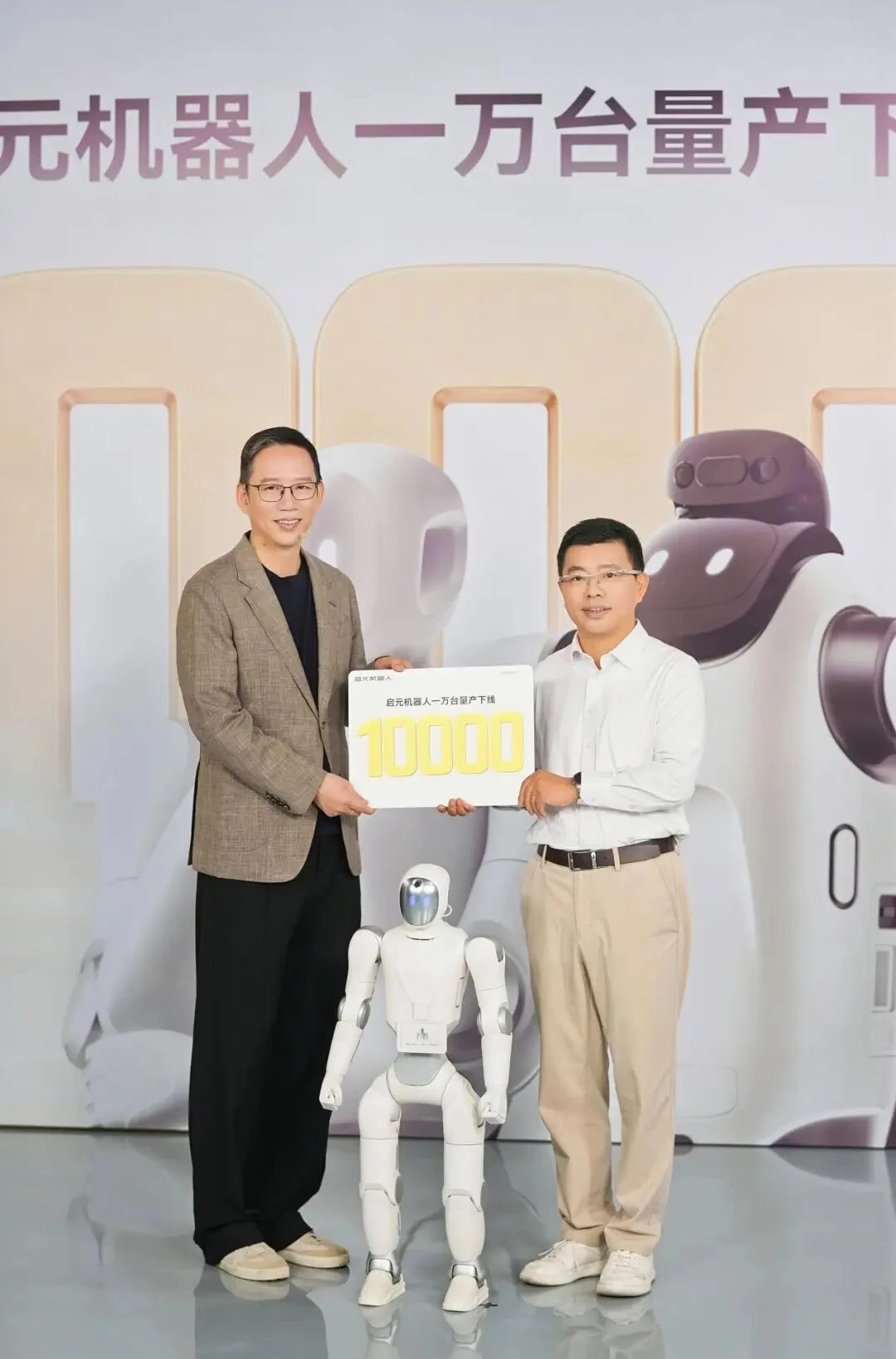
PrimeBot, under Shangwei New Material, has surpassed a combined 10,000 units rolled off the production line for its Q1 and T1 personal robots, with the 10,000th unit delivered to Wu Xiaobo. The leap from 5,000 to 10,000 units took just 14 days, highlighting an accelerating production ramp-up at its Kunshan assembly plant operated by Lens Technology.
PrimeBot, a subsidiary of Shangwei New Material, has reached a mass production milestone. The combined production of its Q1 and T1 models has exceeded 10,000 units, with the 10,000th unit—a PrimeBot Q1—delivered to Wu Xiaobo. It took only 14 days to produce the 5,000th through the 10,000th units, demonstrating an accelerating ramp-up in mass production.

PrimeBot's complete robot factory officially entered the mass production phase in October this year. The production line employs a manufacturing system that combines automotive-grade standards with 3C-scale manufacturing volumes, and assembly is handled by Lens Technology's Kunshan facility. Preparations for moving into this facility began in late August, and the first unit rolled off the line in late September. The facility has now stabilized at a daily output of 100 units. As in-house semi-automatic and automated equipment is progressively deployed, the facility is planned to guarantee a monthly capacity of over 10,000 units each for the PrimeBot Q and T series.
Both products officially went on sale on September 20, with base models starting at RMB 19,999. The PrimeBot Q1 Explorer Edition is priced at RMB 26,999, and the PrimeBot T1 Pro is priced at RMB 29,999. Deliveries of the first batch of robots began on October 1 across seven cities, including Shanghai, Shenzhen, and Hangzhou.
Positioned as a personal robot, the PrimeBot Q1 stands 88 centimeters tall and features a foldable design that allows it to fit directly into a backpack. It is equipped with 22 compliant force-controlled degrees of freedom across its body. The product offers extensive customization options: users can program interactive movements, modify the robot's appearance using 3D printing, and adjust its personality, posture, and voice timbre.
The PrimeBot T1 focuses on a morphable form factor. It stands approximately 100 centimeters tall and weighs 16.3 kilograms including the battery. It can switch between a wheeled-legged humanoid form and a quadruped form, autonomously changing its configuration based on terrain conditions. It also features active obstacle avoidance and identity recognition capabilities, with a battery life of approximately 2 to 3 hours.
According to operational data, PrimeBot's current monthly active user rate exceeds 98%, with daily peak online rates surpassing 40%. The average daily online time per user reaches 3 hours, and the average number of daily interactions per user exceeds 100. It should be noted that total production volume does not equal actual sales or delivery volume; exact sales, delivery figures, and related revenue have not yet been disclosed at this stage. An announcement from Shangwei New Material cautioned that this business currently accounts for a low proportion of the company's total revenue and remains in the cycle of scaling up mass production and commercial validation. The impact on revenue and profitability for 2026 cannot yet be predicted.
In terms of product iteration, PrimeBot has completed its first over-the-air (OTA) update since the launch of the Q1 and T1, optimizing nearly 50 functional experiences. Notably, the PrimeBot Q1 has added six official characters, including Story Magician and Science Explorer, to further enrich interactive gameplay.