

Tesla Confirms Optimus Production and Early Ramp in Q3 Earnings
By 江思奇
In its third-quarter 2026 earnings report released on October 21, Tesla confirmed that the first production-quality Optimus humanoid robots have rolled off the line at its Fremont factory, marking the start of an early ramp for the California project.
Tesla Q3 Earnings Confirm Humanoid Robot Production, Optimus Enters Early Ramp-Up
Tesla's latest third-quarter earnings report delivered a clear update on its robotics progress: Optimus has begun production in Fremont, marking the start of an early ramp-up for the California project.
On October 21, U.S. local time, Tesla released its third-quarter 2026 earnings report. The company stated that the first batch of Optimus units meeting mass-production quality standards has rolled off the line in Fremont. Existing manufacturing processes are now capable of producing units for commercial sale, though both hardware and processes will continue to iterate. Meanwhile, construction continues on the Optimus project in Texas, alongside an expansion of the infrastructure supporting the training of autonomous AI systems for both vehicles and humanoid robots.
For a humanoid robot, the engineering required to manufacture the hardware differs significantly from that needed to make it perform useful work. The former involves product design, components, and manufacturing processes, while the latter relies on real-world interaction data, software training, and task execution capabilities. Ultimately, all these elements must converge on a single physical machine.
Tesla has structured the integration of these efforts: early production units will be used for internal training data collection and feature development. The manufacturing initiatives at both locations are advancing in phases, while shared compute infrastructure simultaneously supports both vehicles and humanoid robots.
Therefore, this initial production run is best understood within the context of the broader development cycle. The factory beginning to produce physical units creates new conditions for subsequent R&D, but it is the seamless integration of training, manufacturing, and infrastructure that will ultimately determine how far Optimus can progress.
Auto factories begin building robots
The changes in Fremont are first taking shape on the factory floor. Space previously dedicated to producing the Model S and Model X is now being repurposed for Optimus manufacturing. Tesla confirmed in its latest earnings report that the production line for scaled manufacturing is now operational, with the first batch of robots rolling off the line at this facility.
In the first quarter, Tesla announced plans to build the first-generation Optimus production line on the site of its existing automotive assembly line in Fremont, while simultaneously preparing for the second-generation line in Texas. During the second quarter, the company disclosed that it had decommissioned the Model S and Model X manufacturing lines to begin installing equipment for the robot production line. By the third quarter, production had commenced in Fremont, continuing the facility retrofitting progress established over the previous two quarters.
Optimus is now utilizing production space within Tesla's existing factories. Decommissioning legacy automotive lines, installing new equipment, and launching robot production each require physical adjustments to the facilities and machinery. Through this process, Tesla is redirecting a portion of the manufacturing resources previously dedicated to its automotive business toward humanoid robots.
While Tesla's automotive manufacturing experience provides a foundation for factory setup and production organization, the structural design and components of humanoid robots still require specific adaptations for manufacturing. The assembly methods for various components and the necessary process updates following product revisions must be practically implemented on the shop floor. Once the production line is operational, it provides the physical environment needed to continuously refine and validate these manufacturing processes.
In its official Chinese release, Tesla described this batch of Optimus units as 'the first humanoid robots to reach mass-production quality,' noting that current manufacturing processes are already capable of producing units ready for official market release. The company emphasized its manufacturing capabilities and product quality, while noting that it will continue to refine both the hardware and the production workflows.
Structural adjustments to the robot's physical body must be translated into the production phase. Furthermore, manufacturing insights gained from running the production line may influence subsequent design and process choices. Hardware design and manufacturing workflows must be tightly integrated to ensure that improved product iterations can consistently roll off the assembly line. Consequently, while confirming the start of production, Tesla has maintained its commitment to continuously iterating on both the hardware and the manufacturing processes.
The manufacturing status table in the earnings report provides specific positioning for these initiatives: the California Optimus project is listed as 'Early Ramp,' while the Texas project remains in the 'Construction' phase. The latter encompasses factory building, infrastructure development, and equipment installation, meaning the two sites are currently executing work at distinctly different stages of development.
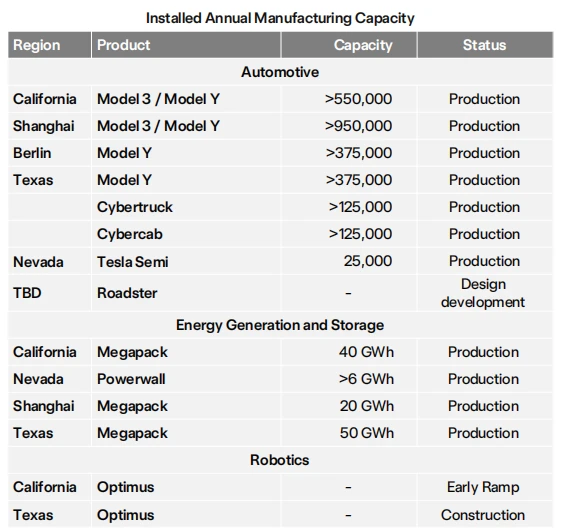
The two facilities also have distinct design targets. In the first quarter, Tesla stated that the first-generation Fremont line was designed for an annual capacity of 1 million units, whereas the second-generation Texas line targets a long-term annual capacity of 10 million units. These figures represent planned scale, which is a separate milestone from the initial production progress achieved this quarter.
In the third quarter, the annual capacity column for both Optimus projects remained marked as '-'. The quarter confirmed that production has started in Fremont and the California project has entered the early ramp phase; however, previous design targets cannot yet be recorded as realized capacity. Only by evaluating the current manufacturing status alongside long-term plans can one accurately gauge the project's present stage of development.
The footnotes in the manufacturing table also list factors affecting production rates, including equipment uptime, component supply, and downtime for factory upgrades. These factors explain why a ramp-up period is necessary even after the production line is built: while the equipment can begin operating, continuous material feeding, assembly, and upgrades must be coordinated to gradually increase actual output. Tesla has not explicitly attributed these general factors as the current bottlenecks for Optimus, but they establish the conditions under which the company defines its manufacturing progress.
Upcoming manufacturing efforts will take place across both operational production lines and facilities still under construction. The Fremont facility must continue scaling production and integrating hardware improvements into its manufacturing processes, while the Texas site needs to complete the construction of its factory building, supporting infrastructure, and equipment installation. Advancing these two projects in parallel will allow Tesla to gradually realize its previously outlined production line plans.
From retrofitting existing automotive production lines to rolling out the first batch of mass-production-quality robots, the Fremont facility is now taking on the actual manufacturing of Optimus.
Robots still need to learn new skills after rolling off the line
Where do these newly manufactured robots go next? Tesla outlined a plan in the second quarter: initial Optimus units will be deployed internally at the Optimus Academy to collect training data and continue feature development. Consequently, early production also serves the critical role of supplying hardware for subsequent R&D.
In the context of embodied AI, the physical robot itself is an integral part of the development environment. The software must ultimately interact with objects, the ground, and the surrounding space through a physical body; how the robot moves and the physical consequences of its interactions depend entirely on the hardware and the environment. Continuously supplying physical machines is therefore a prerequisite for feeding these real-world interactions into subsequent R&D.
Once off the production line, these robots can also serve as tools for developing the next set of capabilities. The production line supplies the hardware, while internal R&D teams use these units to collect interaction data and continue software development. According to Tesla's previously stated plans, manufacturing and capability development converge at this stage, meaning the value of these early units extends beyond their physical form to include their active role in this ongoing development.
The software capabilities required for Optimus extend far beyond simply commanding a set of joints to follow predefined trajectories. On its official AI and robotics webpage, Tesla describes the ultimate goal as a general-purpose bipedal autonomous robot capable of performing unsafe, repetitive, or tedious tasks, listing essential software functions such as balance maintenance, navigation, perception, and physical world interaction.
These capabilities must be coordinated within a single physical body. Consider picking up an object from a table: the robot must determine the object's location, navigate its body closer, and then use its hand to make contact and manipulate the object. This illustrates the relationship between perception and action, but the actual degree of proficiency must be evaluated through performance in real-world tasks.
A stable hardware supply enables the team to continue development on physical robots, while software advancements dictate which tasks these machines can perform. Production volume and feature development each serve a distinct purpose. Only through continuous coordination between the two can the robots rolling off the production line progressively approach Tesla's product goals.
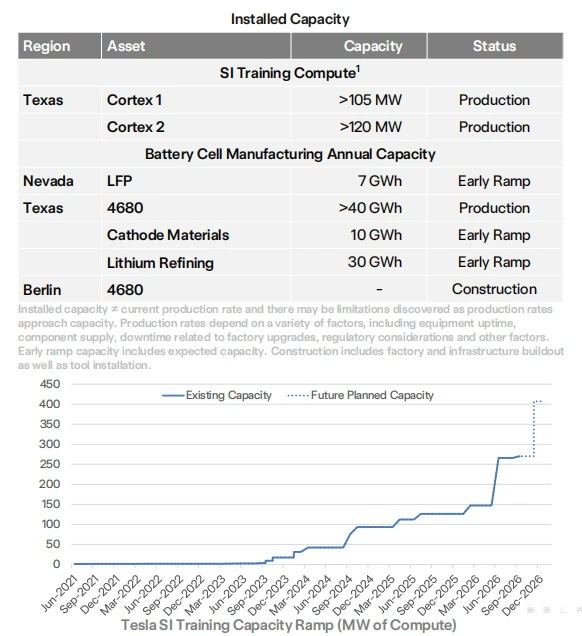
The infrastructure supporting software training continued to expand in the third quarter. Tesla plans to build training compute infrastructure with a total power capacity of 400 MW by the end of 2026, simultaneously supporting the training of autonomous AI systems for both vehicles and humanoid robots. This target integrates the computing resources required for robot software development into the company's broader expansion plans.
The currently listed Cortex 1 and Cortex 2 facilities are both located in Texas, with capacities exceeding 105 MW and 120 MW, respectively, and both are fully operational. The earnings report illustrates expansion progress using two trajectories: existing facilities and future plans, with the 400 MW figure representing the year-end target. The MW metric here refers to power capacity, describing the scale of the computing infrastructure.
The vehicle autonomy business achieved new operational milestones this quarter. The Cybercab, Tesla's autonomous electric vehicle, joined the autonomous ride-hailing fleet in Austin on September 3. By the end of the quarter, the cumulative unsupervised driving distance for Tesla's autonomous ride-hailing service approached 3.22 million kilometers, reaching eight times the total recorded at the end of the previous quarter.
Service hours in Austin have been extended from 6:00 a.m. to midnight, and Tesla plans to reduce wait times by increasing the number of vehicles and optimizing dispatch algorithms. The vehicle autonomy business continues to refine its operations in real-world scenarios, while Optimus advances early-stage production and feature development. Both share the same training infrastructure but pursue distinct products and missions. Because the robot must execute physical interactions using its bipedal locomotion and manipulators, the software must continue to be developed specifically around these tasks.
For Optimus, the production line determines where the machines come from, while data collection and software training continue to dictate what the machines can do.
Concurrent Development of Chips and Power Infrastructure
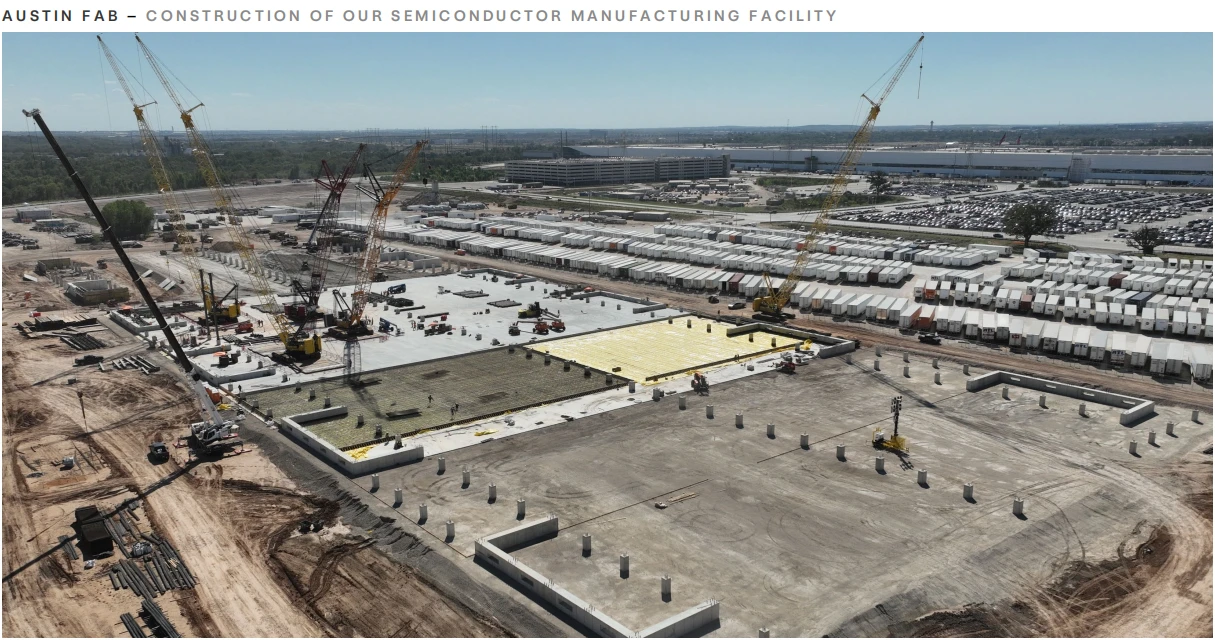
Beyond training facilities, Tesla is also constructing the Austin Fab. The third-quarter earnings report noted that construction at the Austin semiconductor fab is ongoing, with the company planning to begin equipment commissioning in 2027. As a semiconductor manufacturing project, its timeline extends well beyond this year's training facility expansion.
As computing facilities expand, power supply must keep pace. In its third-quarter earnings report, Tesla stated that grid capacity and power supply constraints are increasing deployment opportunities for Megapack. Official Chinese communications also highlight it as a solution to meet the power demands of superintelligent infrastructure. Consequently, building out training resources requires not only computing hardware but also ensuring data centers have a continuous power supply.
The Texas energy storage Gigafactory is already in production. Tesla further clarified in official Chinese communications that the facility has begun Megapack 3 production. Meanwhile, the first batch of Megapack energy storage systems built entirely with Tesla's in-house lithium iron phosphate cells has been delivered. Beyond computing facilities, the company is also advancing its energy storage systems and cell supply chain.
Specific use cases for Megapack include providing power support for large data centers, smoothing peak electricity demand, helping new projects meet grid interconnection requirements, and enhancing grid stability. Tesla believes these applications can also reduce reliance on local fossil fuel power generation. Behind the expansion of computing capacity, power access and supply conditions remain critical engineering challenges to resolve.
In the third quarter, Tesla's capital expenditure reached USD 4.732 billion, a 110% year-on-year increase, while R&D expenses stood at USD 2.761 billion. Building factories and computing facilities requires different categories of investment compared to software and hardware R&D. These figures span Tesla's multiple business lines, with the robotics project advancing as part of the company's broader investment strategy.
Capital expenditure this quarter was lower than the USD 5.789 billion recorded in the second quarter, while R&D expenses rose from USD 2.371 billion to USD 2.761 billion. Manufacturing, computing facilities, and software development each follow distinct investment cycles. As Tesla builds infrastructure to support its long-term business and continues to increase R&D spending, the earnings report does not break down the specific funding allocation for individual projects.
Funding sources are equally critical to sustaining these projects. In the third quarter, Tesla generated USD 6.263 billion in operating cash flow. After deducting USD 4.732 billion in capital expenditure, free cash flow stood at USD 1.531 billion. This marks a return to positive free cash flow from the previous quarter's negative USD 1.092 billion, indicating that operating cash flow covered capital expenditure for the period.
This provides the company with financial flexibility to advance multiple construction initiatives. By the end of the quarter, cash, cash equivalents, and short-term investments totaled USD 45.447 billion. For projects with varying timelines—such as manufacturing, computing facilities, and semiconductors—cash reserves and operating cash flow jointly form the foundation for sustained investment.
Meanwhile, Tesla continues to rely on its core operations to generate revenue and profit. In the third quarter, the company reported revenue of USD 28.046 billion, and GAAP net income attributable to common stockholders was USD 787 million, down 43% year over year. The simultaneous increase in investment and decline in profit illustrate that engineering progress does not automatically translate into immediate financial returns.
Operating expenses for the quarter totaled USD 4.776 billion, up 39% year over year. In its operating income discussion, Tesla cited SI, along with other R&D projects, stock-based compensation, and selling, general, and administrative expenses as the primary drivers of this increase. R&D expenditures, capital expenditures, and operating expenses that include stock-based compensation are distinct financial categories, each carrying different cash flow implications.
In the automotive business, software is already influencing product sales. The adoption rate of driver-assistance software in newly delivered vehicles in North America exceeds 75%. In its operating income discussion, Tesla also highlighted the growth in automotive services and other sales, driven by increased FSD subscriptions, as a favorable factor. While this represents established business progress on the vehicle side, generating commercial returns from Optimus will require gradual realization as product development and real-world deployment advance.
In its quarterly outlook, Tesla stated it will continue to adjust its product mix to capitalize on future monetization opportunities driven by cost reductions, scale, and services, while investing in businesses like robotics through R&D and capital expenditures. For Optimus, the production line startup marks a completed milestone, but production expansion, feature development, and the construction of supporting facilities must still be seamlessly integrated moving forward.
Connecting these developments reveals a more concrete engineering framework behind Optimus: the Fremont factory produces the physical machines, while internal training setups and computing infrastructure support capability development; meanwhile, chip and energy storage facilities represent longer-term infrastructure investments. Consequently, the robotics project is now integrated with Tesla's manufacturing, software, and energy businesses, with various initiatives advancing on distinct timelines.
Future progress with Optimus will be driven by the continuous production of physical machines, the gradual development of new capabilities, and the sustained engineering investments supporting both.