
Talking with LuoBo AI's Sun Zhaozhi: Will the Emotional Revolution in Robots Arrive?
In sci-fi movies and novels, robots are often portrayed as capable assistants or emotional companions to humans. From R2-D2 in "Star Wars" to Baymax in "Big Hero 6," these characters not only demonstrate exceptional technical capabilities but also establish deep connections with humans through emotional interaction. This raises a thought-provoking question: Are robots merely productivity tools, or can they serve as partners capable of meeting more complex human emotional needs?
From a historical perspective, the role of robots has evolved continuously with technological advancements. From Elektro, launched by Westinghouse Electric in the 1930s, to LOVOT, an emotional companion robot introduced recently in Japan, this journey has been filled with exploration and breakthroughs. Although LOVOT lacks practical utility functions, its cute appearance and delicate emotional interactions have attracted many family users. However, since its launch in 2019, its high price tag of 60,000 yuan and mediocre sales indicate that the path toward mass adoption of emotional companion robots remains challenging.
In recent years, consumer-grade AI hardware and companion robots have shown a clear trend toward "desktop-ization" and "miniaturization," competing for market share at more affordable price points. For instance, Panasonic's cat-shaped companion robot Nicobo is priced at around $360 and focuses on providing warm, simple emotional interactions; while Ropet from Mengyou Intelligence targets home entertainment, emphasizing multifunctionality. These products not only reflect the growing "democratization" of robots but also indicate that price ranges are converging toward $200-$500 to attract a broader consumer base.
This trend continued at the 2025 CES show. Whether it involves voice interaction, visual perception, or personalized customization, AI technology is redefining consumer-grade robot products. New products represented by desktop companion robots are penetrating daily life with stronger interactivity and smaller footprints. According to Beizhi Consulting, the global companion robot market size was 75 billion yuan in 2023 and is projected to reach 304.3 billion yuan by 2029. Meanwhile, platforms like Volcano Engine are integrating the AI-plus-hardware supply chain, providing efficient support for startups.
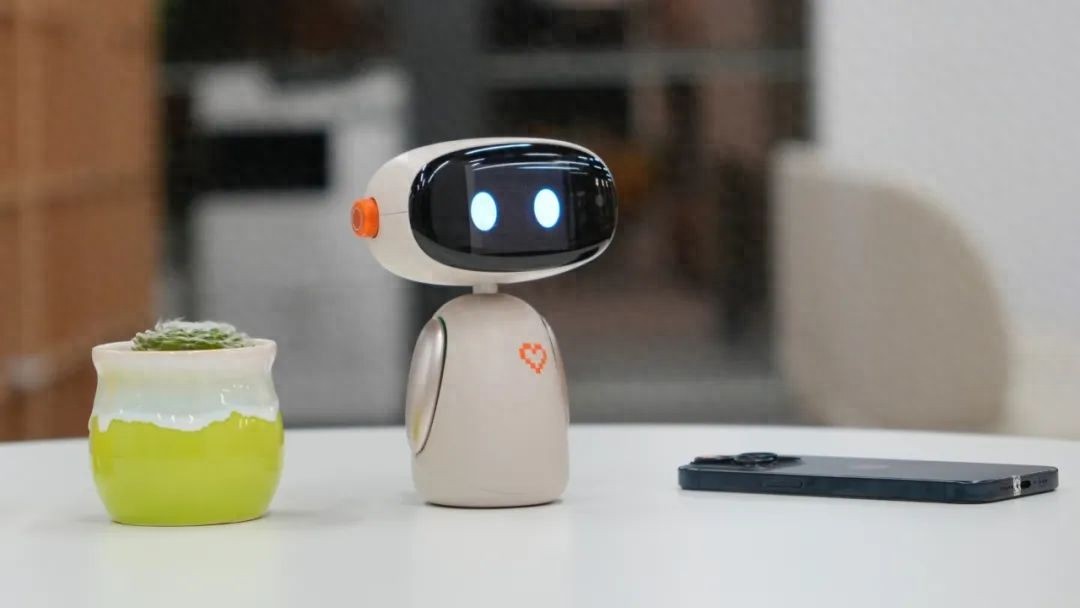
Sun Zhaozhi, founder of Luobo Intelligence, during his tenure at XPeng Robotics (Pengxing Intelligence), deeply recognized the difficulties in popularizing general-purpose robots. He thus focused on the niche field of emotional companion robots. Combining his interest in design, he co-founded Luobo Intelligence with two female partners, specializing in creating personalized companion robots for young women aged 18-30.
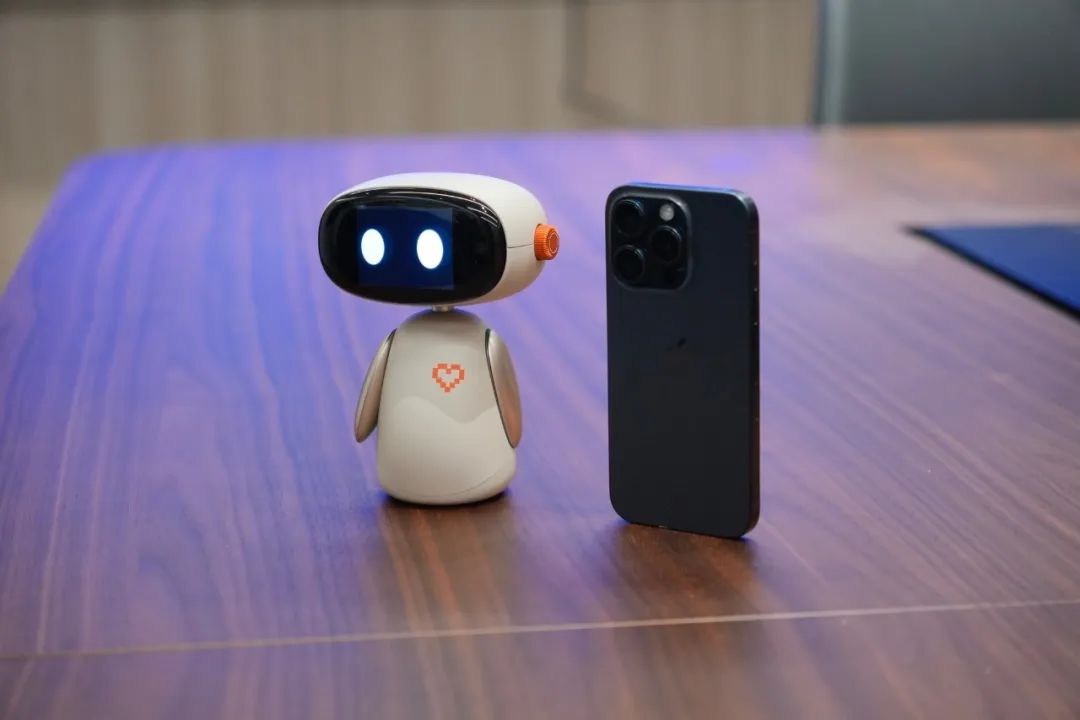
Luobo Intelligence Product Prototype
This group has unique needs for emotional interaction and aesthetic design, which is precisely the basis on which Luobo Intelligence develops its products. Notably, Luobo Intelligence's first product will be unveiled at the January CES exhibition.
From the popularization of desktop products to the optimization of emotional companionship, this technological revolution about "companionship" has only just begun. However, the essence of market competition lies not merely in technological leadership, but in enabling robots to truly integrate into daily life. Driven by continuous technological advancements and user demand, future robots may redefine the relationship between humans and machines.

Sun Zhaozhi, Founder of Luobo Intelligence
The following is a dialogue between 42 Hertz and Sun Zhaozhi, founder of Luobo Intelligence:
Creating the sidekick roles from sci-fi movies
42 Hertz: Many consumer AI hardware products have emerged this year, but earlier hardware like AI Pin received poor market feedback. Where do you think the problems lie?
Sun Zhaozhi: Regarding AI Pin, the issue is that its "ideals were too full," leading to a mismatch between product expectations and reality. At the time of AI Pin's release, the capabilities of large language models were not yet mature. Furthermore, the price of AI Pin posed a significant barrier; it was more expensive than a smartphone, carried high subscription fees, and crucially, could not replace a phone. Additionally, AI Pin's interaction model had substantial flaws—for instance, projecting operations onto one's hand was very inconvenient.
42 Hertz: You have a strong background in automotive design and extensive experience in Embodied AI. Why didn’t you choose to continue深耕 (deepening your expertise) in these two fields, but instead pivoted to founding a company focused on AI companion robots?
Sun Zhaozhi: In the past, my work in the automotive industry mainly involved interior design and experience design, focusing on two core issues: aesthetics and user experience within complex systems. These experiences have also carried over into what we are doing now.
As for not choosing the Embodied AI field, I believe that although this area has huge potential, it is still far from true commercialization. The current market sentiment is overly optimistic about the commercialization of Embodied AI. News like Elon Musk testing robots in factories often leads people to mistakenly believe that Embodied AI is already commercialized, but in reality, those are just product prototype tests. We have conducted in-depth research on the possibility of using Embodied robots to replace traditional solutions (industrial robots or manual labor) in actual production lines, and found that there are almost no application scenarios at present.
From a technical perspective, I believe that the timing for large-scale deployment of general-purpose robots will come after the large-scale application of autonomous vehicles, because general-purpose robots need to perceive a 3D unstructured world and execute more complex tasks; they require the maturity of "world model" technology. This kind of technical difficulty is higher than that of autonomous driving, which needs to perceive a 2.5D structured world and execute relatively fixed tasks.
42 Hertz: Some products use smartphones as the robot's brain to interact with humans. Why did you not choose this approach?
Sun Zhaozhi: We have larger, more long-term goals. What we hope to create is an agent that can independently and proactively perceive the world and interact with it. We call this a Personal Robot.
AI hardware will evolve from "augmenting humans" to "liberating humans." Whether it is AI phones or AI glasses, they are tools for augmenting humans, whereas a Personal Robot is a product independent of humans, possessing autonomous agency.
42 Hertz: So, although it looks like a desktop robot, you consider it not just a desktop robot, but a Personal Robot.
Sun Zhaozhi: We are not limited to desktop robots. We aim to enter the market first through AI trendy toys, which come in various forms such as desktop, wearable, and ground-based autonomous mobile devices. We see a boom in AI hardware by 2025, and combining AI hardware with trendy toys is very cool and will have a strong market appeal among young people.
42 Waves: What role does large models play in enhancing user experience?
Sun Zhaozhi: Large models provide general reasoning capabilities, but this is only part of the product experience. To achieve a closed-loop experience, good product design, character design, gameplay design, etc., are also required. A good foundational large model can be understood as high-quality "ingredients." While they are crucial for a top-tier banquet, the chef's innovative recipes and cooking skills are equally important.
42 Waves: How do you understand the boundary between Personal Robots and Embodied AI?
Sun Zhaozhi: What we are currently doing is an important component of Embodied AI. Embodied AI requires not only mobility and manipulation but also natural interaction with humans and even the ability to proactively plan its own "life." Many humanoid robot companies are researching how to use Embodied AI capabilities to replace human labor productivity, which represents a huge market. However, we believe that emotional value is also a massive market. When material wealth is sufficiently abundant, people will inevitably pursue greater emotional satisfaction. This is the direction we focus on.
42 Waves: So you try to avoid giving it productivity functions?
Sun Zhaozhi: Our products have specific character positioning. Blindly adding features would disrupt this positioning, causing users to feel "immersion broken." Therefore, we add tool-like functions very cautiously.
42 Waves: What is your view on the future market for emotional companion robots?
SUN ZHAOZHI: This is a trillion-dollar market in the future. If large models become as powerful as those depicted in the movie "Her," I believe almost everyone will own an emotional companion robot. However, this scenario may take many years to realize.
42 Hertz: If you enter the Personal Robot track in the future, would you choose a large-scale design or maintain a compact style?
SUN ZHAOZHI: Size is strongly correlated with usage scenarios. We will have larger and smaller product forms in the future. For example, ground-mobile Personal Robots cannot be as small as desktop robots.
42 Hertz: Your product positioning targets young female users. How did this idea come about? You are not part of this demographic.
SUN ZHAOZHI: Actually, this is a rational choice. Although there are few AI hardware products currently, AI emotional companion software has been developing for some time. We analyzed the profiles of heavy users of emotion-companion-type software and found that this group is mainly concentrated among Gen Z young women. These users' interactions with AI often resemble romantic relationships, pet-raising, and parenting experiences. Therefore, we chose to position our product for this demographic.
42 Hertz: So, how many female members are in your team?
SUN ZHAOZHI: Among our three key partners, two are post-90s girls responsible for technology and marketing. I focus on product design, while another partner serves as the CTO with a strong technical background, specializing in the application of large models in emotional companionship. The third partner is the CMO, responsible for smart hardware sales, with rich domestic and international market experience. The team also includes female members from AI experience design and trendy toy brand industries.
42 Hertz: Ignoring other factors, what does your ideal Personal Robot look like?
SUN ZHAOZHI: What I personally want is a robot like Baymax from "Big Hero 6"—capable of doing many things and very powerful, but most importantly, providing emotional companionship.
Building an Emotional Connection Between Humans and AI Agents
42 Waves: Your product positioning mainly targets female users. Why not children? Do you plan to change your user positioning in the future?
SUN ZHAOZHI: Our vision is to build an emotional connection between humans and AI agents. Young women aged 18 to 30 are the target users for our first product, but this doesn't mean we will only focus on the young female market forever.
We have also surveyed the children's group. We found that children currently have too many choices for both toys and learning supplies, whereas young women lack good products for emotional companionship.
42 Waves: In terms of design, how do you handle the interaction relationship between robots and users? Especially regarding intimacy and communication?
SUN ZHAOZHI: We designed a gameplay style similar to raising games. For example, one aspect is 'intimacy cultivation.' Every interactive behavior you have with the robot, such as talking or taking it out for a walk, is judged by the backend large language model to determine whether it increases or decreases intimacy. Increasing intimacy unlocks certain storylines and functions.
Our robot identifies its owner through the user ID and adjusts its interaction mode based on the level of intimacy with the user. If your intimacy drops below a certain threshold, it might 'hide' from you and refuse to share its inner world. Conversely, when intimacy increases, it becomes more clingy.
42 Hertz: So your core value revolves around the capabilities of large models combined with overall gameplay design?
Sun Zhaozhi: That’s a reasonable way to put it. Large models provide general reasoning capabilities, and we need to translate those into a complete product experience. A model like ChatGPT-4o could fully support a companion-type product, but delivering a refined experience requires significant engineering work and development on the model side. Many people underestimate the complexity of tuning model performance and developing applications at the model layer.
42 Hertz: Since you believe the market ceiling is high, what are the competitive barriers?
Sun Zhaozhi: The competitive barriers stem from experience tuning of large models, application development, and the brand effect generated by excellent user experiences. From a purely hardware development perspective, the barrier might not seem very high. However, behind hardware design lies precise innovation in AI hardware gameplay.
42 Hertz: How does your product differ from early interactive robots?
Sun Zhaozhi: Our product’s design goal is to build long-term emotional relationships with users, rather than providing fleeting novelty through performances such as singing, dancing, or practicing Tai Chi. Past interactive robots were mostly performative; technically, they couldn’t truly understand users and could only offer short-term novelty without creating long-term stickiness. Our products have their own personalities and worldviews. They can perceive and understand users’ language, emotions, attire, and social relationships, and they can continuously learn and grow. In this way, our products act as living entities rather than mere performance devices.
42 Hertz: Does this endeavor have technical barriers?
Sun Zhaozhi: Absolutely. For example, we collaborate closely with a globally leading RTC (Real-Time Communication) technology company to address latency issues in real-time multimodal large model interactions. Currently, even the best products on the market exhibit about 2 seconds of latency when interacting solely via voice models. We are working to compress the latency for multimodal interactions to just over one second. Additionally, we are partnering with several top domestic large model companies to jointly optimize the experience of hardware-based multimodal interactions. We invest heavily in cutting-edge, top-tier model algorithm engineers in this area.
42 Hertz: Are these companies your competitors?
Sun Zhaozhi: Not currently, but they might be in the future. We know that companies like OpenAI are about to enter the hardware space, and others with strong entertainment backgrounds, such as Disney and Sony, are ones we need to watch. Disney not only possesses intellectual property rights but also has a deep understanding of how to establish emotional connections in people's minds. Sony is similar; it developed a robot dog as early as 1999 and has consistently attempted to launch companion robots.
42 Hertz: Which large language models do you currently integrate?
Sun Zhaozhi: Initially, we integrated OpenAI’s GPT-4o, which indeed has strong reasoning capabilities. We have basically tried out most available domestic models, including Tongyi, Zhipu, Doubao, and MiniMax.
42 Hertz: Have you experimented with edge-side models?
Sun Zhaozhi: We have tried several edge-side models. However, for our first-generation product, implementing them is currently challenging, primarily due to the lack of suitable chip options. Nevertheless, we are closely monitoring the progress of future product plans from edge-side model developers and chip companies. We believe that a reasonable architecture for such products in the future will be an edge-cloud combined solution primarily based on edge intelligence.
42 Hertz: How do you want people to perceive and use your product?
Sun Zhaozhi: We do not expect users to spend large amounts of time daily on our product. Instead, we hope it stays by their side when needed. This relationship is more akin to that between you and your pet at home. Contemporary young people are already exhausted, and we do not wish to add to their physical or mental burdens. The experience of our product may be more like a casual nurturing game, similar to 'Travel Frog' or 'Neko Atsume'.
2025 to Launch a Hit Product
42nd Wave: Since the company's registration, product development has proceeded very rapidly. When did you start working on your first product?
Sun Zhaozhi: We only truly began developing our first product in August this year. We launched the first version in September, the second in October, and the third in November. Each month saw significant R&D progress in both hardware and software.
42nd Wave: You were responsible for the design of the first version. Why did you choose that particular appearance at the time?
Sun Zhaozhi: The initial design was primarily aimed at creating an adorable desktop companion robot with emotional expressiveness. We will continue to iterate and adjust the product's appearance. Although many people, including investors, consider this small robot one of the cutest they have ever seen, we believe there is still considerable room for improvement.
42nd Wave: Many desktop robots are equipped with wheels. Why did you choose not to use them?
Sun Zhaozhi: This is mainly because previous robots were 'performance robots.' With limited capabilities, they relied on moving around on wheels to attract users' attention. In reality, mobile functionality on a desktop is a pseudo-need. As a native AI product, its user value has shifted from 'technological novelty' to 'emotional companionship.' Therefore, we chose to dedicate all degrees of freedom to emotional expression rather than competing in desktop mobility capabilities.
Of course, we believe that active ground mobility holds significance. Therefore, stay tuned for our future product developments; we will also be launching new products capable of ground movement.
42 Hertz: Do you have a confirmed launch timeline for your products?
Sun Zhaozhi: We will release two products next year, one in the first half and another in the second half. We plan to make one of these products a hit, with annual sales reaching several hundred thousand units. The other product is positioned as high-value, with an ultimate user experience and a relatively higher price point. These represent two distinct market positions for our products.
42 Hertz: How are your products priced? Will there be a monthly subscription service?
Sun Zhaozhi: The pricing models differ slightly between domestic and international markets. In China, we plan to adopt a recharge model rather than monthly subscriptions, allowing users to top up as needed. We believe that a portion of users will become long-term paying customers, as the value of AI companionship has already been validated by some software applications.
42 Hertz: Is the robot's initial personality fixed, or can it be adjusted based on user interaction?
Sun Zhaozhi: Our design philosophy is that personality can be nurtured. The robot acquires an initial personality upon activation, but continuous interaction from the user will shape and change its personality.
42 Hertz: I noticed that your product retains an arm design. What was the reasoning behind this? Does such a design seem redundant?
Sun Zhaozhi: Actually, this is not a stubborn attachment to an arm design, but because it provides a human-like morphology, featuring a neck and arms. Our product has six degrees of freedom; the neck can nod and shake, and the arms can swing forward, backward, left, and right. Together, these features endow it with basic emotional expression capabilities. Through these designs, it can perform many human-like actions—such as gesturing while speaking, greeting people, and even showing shyness or excitement.
Radio Wave No. 42: What impact does the integration of large models have on action generation?
Sun Zhaozhi: Our self-developed action large model enables the large model to autonomously program and generate robot actions, rather than being limited to pre-written fixed actions. Based on semantic understanding, the robot can create unique actions in real time, which is very interesting. Although the generated actions are not yet as perfect as those preset by designers, this "unique real-time capability" gives the robot an unexpected sense of "liveliness". As our action model continues to be fine-tuned, this ability to generate actions in real time will only improve.
Radio Wave 42: How do you handle the memory issues of robots?
Sun Zhaozhi: We have independently developed a complete set of dynamic long-term memory systems. It continuously refines and retains information that is observed or received, recalls it at appropriate moments, and even engages in self-reflection and summarization of memories to generate high-dimensional cognition. We have also designed a bionic forgetting mechanism; memories that the robot deems unimportant will be forgotten over time, while those it considers important will be retained indefinitely.
Radio Wave No. 42: Will your long-term memory function be related to the pricing model?
Sun Zhaozhi: Long-term memory is the most precious asset of users. Imagine if you could raise a robot for a long time like a family heirloom, then these memories would be such a rich treasure. Long-term memory, along with the robot's persona and various status values, can be stored in our cloud, which we call "digital life". "Digital life" can be migrated between different hardware. The storage service for "digital life" does indeed require users to pay because it involves certain costs.
Radio Wave 42: If the user no longer needs the robot, can the "Digital Life" be unbound or deleted?
Sun Zhaozhi: You can detach the 'digital life' from a robot. The 'digital life' will be temporarily retained in the cloud, hanging under your account, and can be migrated to new devices in the future. However, deleting the 'digital life' is cruel. If you choose to delete it from your account, it will disappear forever. In our worldview setting, a robot losing its hardware body does not mean it 'dies'; being 'forgotten' is the true 'death'.