

Huawei Cloud Open-Sources CloudRobo-WM1.2 Embodied World Model
By Jiang Si Qi
Huawei Cloud President of Embodied Product Line Wu Xiaodong unveiled CloudRobo-WM1.2, the company's first Ascend-native embodied world model, and open-sourced its weights, inference, and code. Huawei Cloud states the model ranks first on the RoboTwin 2.0 and LiberoPro 2.0 benchmarks.
On November 16, Huawei Cloud hosted the CloudRobo Embodied World Model launch event, where Wu Xiaodong, President of Huawei Cloud's Embodied Product Line and Director of the Embodied AI Lab, unveiled CloudRobo-WM1.2 and announced the open-sourcing of its weights, inference, and code. According to Huawei Cloud, this is its first Ascend-native embodied world model, ranking first on both the RoboTwin 2.0 and LiberoPro 2.0 evaluation benchmarks.
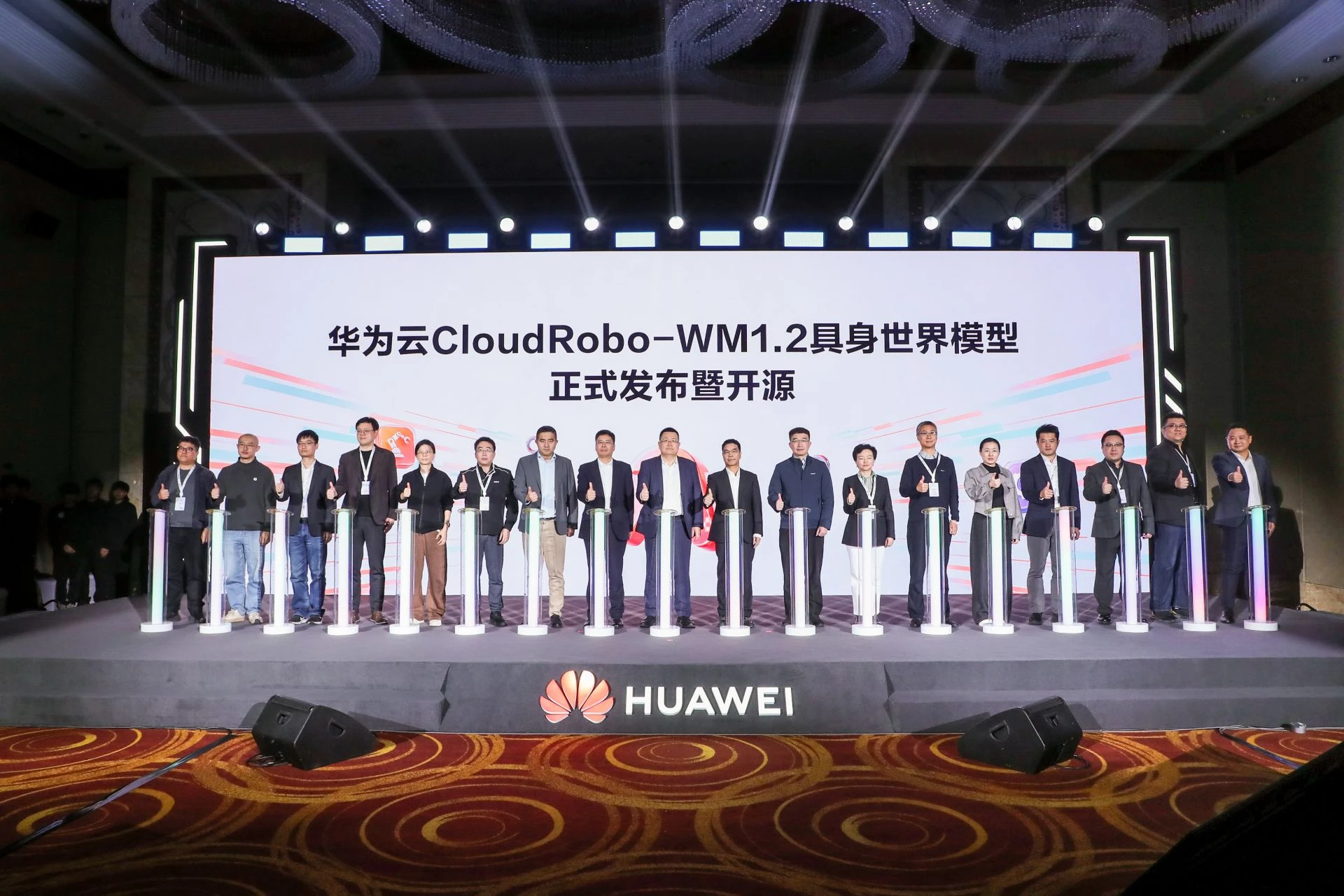
Image | Huawei Cloud CloudRobo-WM1.2 Embodied World Model launch event (Source: National Business Daily, courtesy of the company)
According to Sina Tech and Cailian Press, Huawei Cloud also announced it will open-source the model weights, inference code, training framework, and WAM Ascend compute best practices. Inference and post-training code for CloudRobo-WM, along with weight files named with "1.0", are already available through public channels; however, it remains unconfirmed whether these assets correspond item-by-item to the complete CloudRobo-WM1.2 version released today, nor has the full scope of the open release and its licensing conditions been confirmed.
At the event, Wu Xiaodong explained that traditional visual representations have limitations. For instance, task success rates for robots in complex, open environments can drop when cameras are occluded, shooting angles change, or when manipulating moving objects.
He gave the example of a robot placing a cup from a table into a tray: it must not only determine the cup's position but also understand its spatial pose, motion state, and potential collisions and displacements during grasping. According to a report by the National Business Daily on Wu Xiaodong's on-site presentation, some cited research tests show that under viewpoint changes, model accuracy can drop from 62.72% to 7.62%.
To address this issue, Huawei Cloud stated that CloudRobo-WM1.2 adopts a PPA multimodal world representation architecture, integrating environmental perception, future state prediction, and action generation into a unified model. According to Yicai, the model fuses multimodal information including RGB video, semantic features, depth, and point clouds, and employs a world model-native DualAct architecture, enabling the model to directly generate the actions required for robot execution.
According to IT Home, DualAct is a dual-channel action architecture: the world model can output actions directly, while an action expert can also efficiently output actions based on a MOT architecture, allowing developers to flexibly define the size of the action expert. During inference, users can independently choose whether the world model or the action expert outputs the actions, and whether to simultaneously generate future visual representations. These two choices combine into four modes to match different compute resources and inference latency requirements.
Regarding cross-embodiment capabilities, Huawei Cloud introduced that the model employs embodiment-semantic-preserving cross-embodied motion modeling, providing a unified "action translator" for robots of various forms such as single-arm, dual-arm, and wheeled, thereby supporting multi-embodiment collaborative learning.
On the data front, Dr. Liu Liu, Chief Model Expert at Huawei Cloud's Embodied AI Lab, noted that existing embodied AI datasets are highly heterogeneous. Some lack depth information, others lack complete action annotations, and still others suffer from issues such as desynchronization between video and action data.
CloudRobo-WM1.2 employs a multi-granularity adaptive pre-training framework for supervised data. It organizes supervision based on the actual information present in each dataset, enabling the utilization of data that lacks action annotations, contains invalid dimensions, is missing depth information, or has incomplete camera viewpoints.
Liu stated that early experiments with CloudRobo-WM1.2 used approximately 8,000 hours of pre-training data. The dataset has since expanded to roughly 27,500 hours, integrating 20 data sources and 33 different robot embodiments.
Regarding evaluation, Quick Technology reported that the launch event announced the model achieved average success rates of 88.98% on RoboTwin 2.0 and 81.7% on LIBERO-Pro 2.0. These results are derived from simulated robot manipulation benchmarks and should not be interpreted as real-robot deployment success rates.
On November 15, the official RoboTwin 2.0 leaderboard added the co-training results for CloudRobo-WM, submitted by the CloudRobo Team. The benchmark uses 50 tasks, with 50 cleaning-scene demonstrations per task for training. Each task is evaluated over 100 trials under both standard cleaning and randomized conditions. CloudRobo-WM achieved success rates of 95.28% and 82.68% under these respective conditions, yielding an equally weighted average of 88.98%. The official leaderboard ranks it first based on this default sorting metric.
The official LIBERO-Pro 2.0 leaderboard has also listed CloudRobo-WM, which achieved an overall average success rate of 81.7%, comprising 86.0% under dynamic perturbations and 77.8% under static perturbations. The 81.7% figure represents the aggregate score for static perturbations and dynamic interventions during execution. The unperturbed baseline (Base) score of 99.6% is reported separately and excluded from this overall average.
CloudRobo is Huawei Cloud's one-stop embodied AI development platform. Built on the Ascend Cloud computing infrastructure, it was officially launched on June 20, 2025, and covers the entire workflow from data processing to deployment. According to Cailian Press, the platform features a built-in Embodied Hub and provides an R2C (Robot to Cloud) SDK for connecting physical robots to the cloud for inference and control.
Wu Xiaodong stated that Huawei Cloud plans to continuously release new models in the first quarter of 2027. Huawei Cloud disclosed that the platform has attracted more than 16,500 professional embodied AI developers, along with over 230 enterprises and universities, spanning applications in industrial manufacturing, power utilities, sanitation, and healthcare and senior care. Huawei Cloud also claimed that 80% of China's embodied AI companies have chosen Ascend Cloud, though it did not disclose the sample size or specific methodology behind this statistic.
According to reports from the National Business Daily and the STAR Market Daily, CloudRobo ecosystem partners include listed companies such as Yijiahe, Topstar, and Fulongma, as well as robot hardware manufacturers like JAKA, Qianxun, Galaxea, YOUIBOT, Standard Robotics, and Realman.
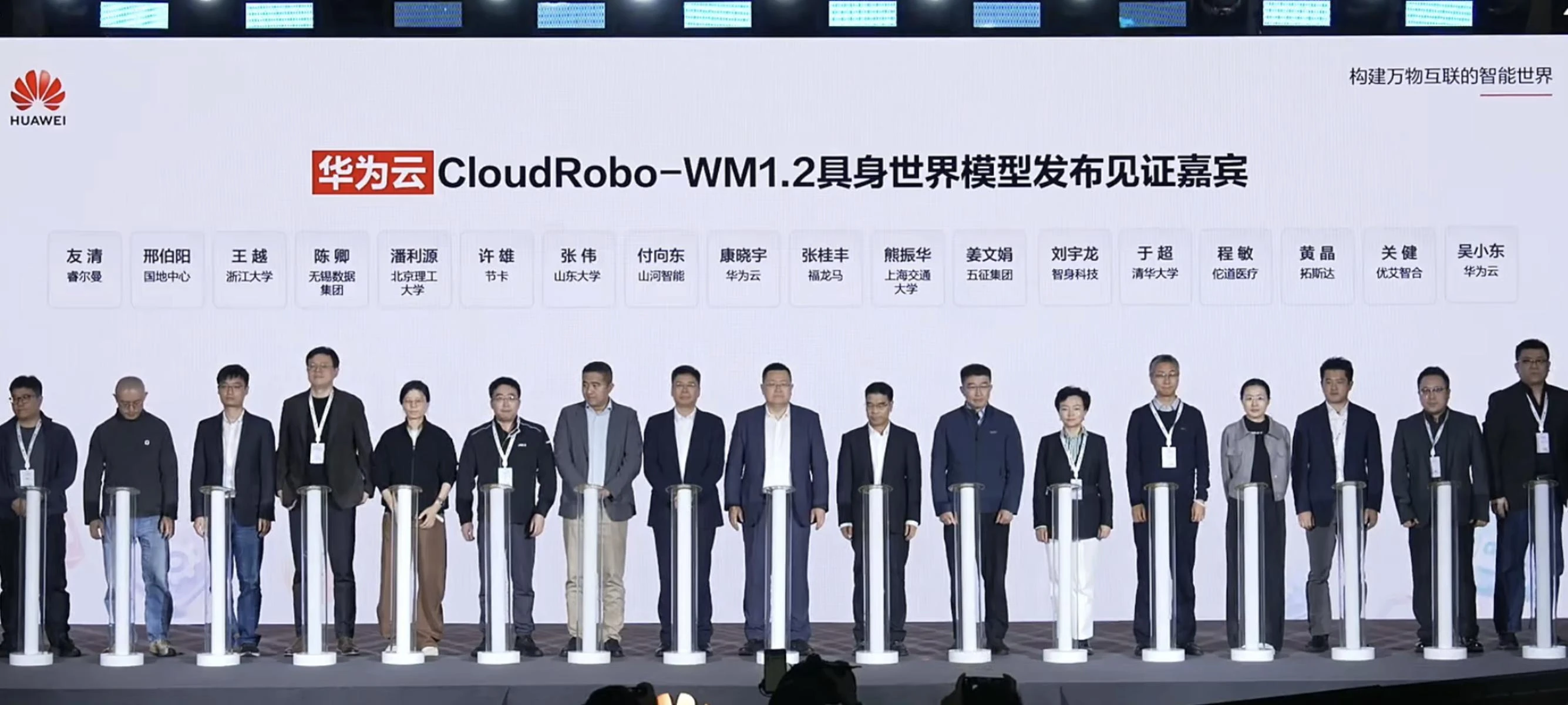
Image | Attendees at the Huawei Cloud CloudRobo-WM1.2 launch event (Source: China Financial Information Network)
On the same day, Huawei Cloud announced that pre-sales have begun for a next-generation intelligent sweeping robot jointly developed with Fulongma Group, with the official launch event scheduled for December in Shanghai. According to IT Home, the robot integrates the CloudRobo development toolchain, perception and planning models, an agentic runtime platform, and Ascend Cloud computing power, while also incorporating a world model.
Huawei Cloud also stated that it will provide up to RMB 1 million in Ascend Cloud computing power for each successfully approved project and collaborate with partners to build high-quality industry datasets. At the launch event, Wu Xiaodong noted that Huawei Cloud is investing in embodied AI model R&D and aims to share its technical practices on Ascend Cloud to help more companies train and deploy their own models.