

AgiBot Open-Sources AGIBOT WORLD 2026 Embodied Reasoning Dataset Covering Nine Scenarios
By 江思奇
On October 22, AgiBot open-sourced the fourth installment of the AGIBOT WORLD 2026 dataset, focusing on embodied reasoning as the first release in its AI WAVE series. The dataset covers nine logical reasoning scenarios and provides both high-level question answering and low-level action trajectories, enabling robots to make decisions and execute operations based on task goals, environmental conditions, and execution history.
AgiBot open-sources the AGIBOT WORLD 2026 embodied reasoning dataset.
On October 22, AgiBot open-sourced the fourth dataset in the AGIBOT WORLD 2026 series, titled 'Embodied Reasoning,' marking the first release in the AI WAVE series. This dataset covers nine categories of logical reasoning scenarios and provides both high-level question-answering and low-level action trajectories. This enables robots to make decisions and execute corresponding actions based on task objectives, environmental conditions, and execution history.
This dataset focuses on four factors: item quantity, occlusion relationships, spatial occupancy, and task progress. It introduces varying states and constraints for identical tasks to capture the corresponding decision-making and execution processes. For example, to restock a hotel room minibar to exactly three bottles, a robot must first distinguish between empty and full bottles, verify the current count, and then determine how many to remove and add. Similarly, when searching for items across multiple drawers, the robot must remember previously checked locations to avoid redundant searches.
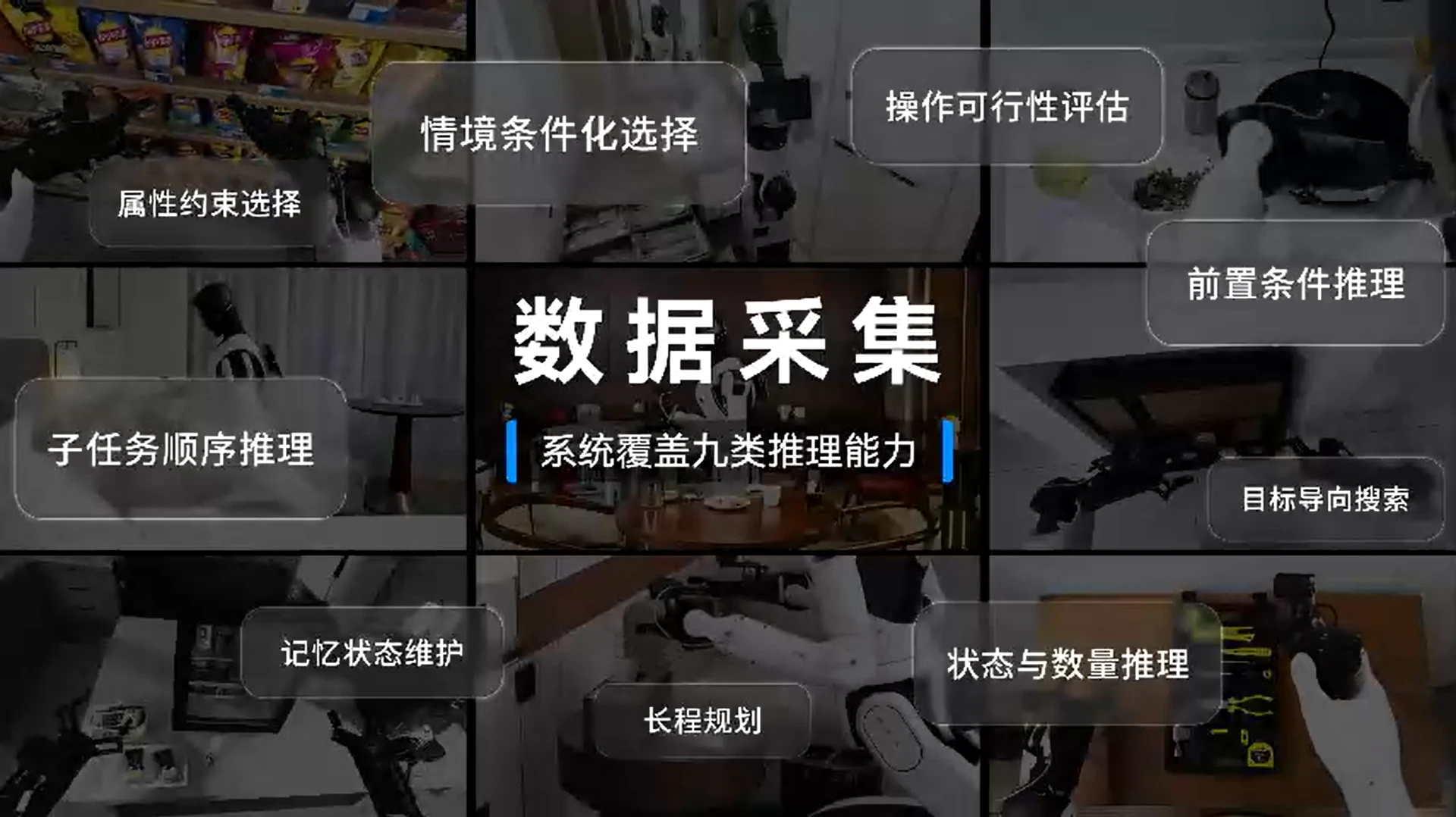
The dataset evaluates nine capabilities: attribute constraint selection, context-dependent selection, action feasibility assessment, precondition reasoning, goal-directed search, state and quantity reasoning, long-horizon planning, memory state maintenance, and subtask sequence reasoning. Tasks are categorized into easy, medium, and hard difficulty levels, progressively introducing requirements such as quantity judgment, precondition handling, multi-subgoal planning, and long-horizon state maintenance. The dataset includes both successful and failed execution samples, with annotations detailing execution outcomes such as item selection, placement locations, and quantities, thereby supporting research on recovery from execution deviations.
For annotation, the dataset records complete tasks and their execution progress using task instructions, task frames, subtask intervals, and action steps. Dense prompts provide detailed action descriptions that specify the target object, manipulated parts, left- and right-arm coordination, motion trajectories, and expected outcomes, all paired with real-robot actions. Spatial annotations—including bounding boxes, points, and lines—further delineate target areas, contact points, and operation paths, directly mapping linguistic instructions to specific physical locations.
Researchers can leverage this data for joint training, end-to-end training, and coordinated decision-making and execution training for embodied agents. In this framework, the agent selects subgoals based on the current context and execution history, executes operations via an action policy, and subsequently updates the task state and adjusts future plans based on execution outcomes.
AgiBot has already utilized this dataset to train its upcoming agent framework and next-generation foundation model. Future releases in the AI WAVE series will showcase related research outcomes, along with the deployment of these robots in real-world environments such as convenience stores.