
D-Robotics Closes USD 400 Million Series C, Accelerating Embodied AI Commercialization

D-Robotics has completed another large-scale financing round.
D-Robotics has secured its largest funding round to date.
On September 17, D-Robotics announced the completion of a $400 million Series C financing round. This round was led by Future Asset, with Meituan Strategic Investment, Hefei State-owned Assets Investment, Nanshan Strategic Emerging Industry Investment, Jingquan Capital, and other government investment platforms participating as co-investors. Institutional investors including Cathay Capital, Huamei International Investment Group Co., Ltd., GF Xinde, Beyond Moore, and the Xinchuang Phase II Fund under Qihang Investment also joined as co-investors. Existing shareholders such as Hillhouse Venture Partners, 5Y Capital, Linear Capital, Huangpu River Capital, Vertex Growth under Temasek, Prosperity7, Hexuan Capital, Yunfeng Capital, Meituan Dragon Ball, Jiuyang Family Office, Dunhong Asset, Kailian Capital, Boidian Capital, Jiuhe Ventures, Chuxin Capital, Digital Future, and Gengxin Capital continued to increase their stakes.
This is yet another large-scale financing round completed by D-Robotics in the past year or so.
In 2025, D-Robotics completed a $100 million Series A financing round; in March this year, the company completed a $120 million Series B1 financing round, and in April, it secured an additional $150 million Series B2 financing round, bringing the total Series B financing to $270 million. Including the latest $400 million Series C round, D-Robotics' publicly disclosed financing amount since 2025 has reached $770 million.
As the financing scale continues to expand, D-Robotics' valuation has further increased. In early September, Yu Kai, founder and CEO of Horizon Robotics, revealed in a public speech that D-Robotics' latest financing valuation exceeded USD 3 billion.
Compared to previous rounds, this financing occurred at a node where D-Robotics' commercialization accelerated further.
According to D-Robotics, in the first half of 2026, the company's revenue grew several times compared to the same period last year, and the cumulative shipments of the Sunrise series chips exceeded 8 million units; meanwhile, its embodied intelligence business has also entered the mass production shipment stage.
From chip shipments and customer onboarding to the expansion of the developer ecosystem, several lines that D-Robotics has laid out around its robot computing platform over the past few years are now simultaneously entering the realization phase.
After the new round of financing, the company plans to further strengthen the full-compute-segment product layout of Sunrise chips and build a full-link software platform that integrates data collection, model training, simulation verification, and inference deployment.
For D-Robotics, the next goal is no longer just about selling more chips, but entering mass production alongside a growing number of robot products. From chips and development tools to model deployment and the robot development ecosystem, D-Robotics is further extending its position toward "embodied AI infrastructure."
01 Revenue grew several times in the first half, mass production extended to new categories
From the perspective of shipment structure, mature categories such as robot vacuums and robot lawnmowers still constitute D-Robotics' current scaled-up business foundation. When the company completed its Series A financing in May 2025, it disclosed that cumulative shipments of the Sunrise series chips had just exceeded 5 million units, with Ecovacs and Narwal being among its important customers.
More than a year later, this number had grown to 8 million pieces.
Mature robots still constitute the basic foundation for D-Robotics' current mass production, but new variables have emerged: this chip and software system, which has already undergone large-scale shipment validation, is extending to humanoid robots, industrial wheeled robots, and more complex robotic products.
In the next-generation robotics market, the Sunrise S600, released in November 2025, has become a representative product for D-Robotics as it extends into higher computing power demands.
Compared to past computational solutions designed around single robot categories, the S600 aims to address the more complex computing needs of the embodied intelligence era: carrying intelligent decision-making, environmental perception, and real-time motion control on a single chip, while providing an integrated edge-cloud development toolchain to reduce the development complexity for robotics companies in hardware integration, model deployment, and system debugging.
The commercialization path for the Sunrise S600 from its release to mass production has gradually become clear over the past few months.
In July this year, D-Robotics disclosed that the Sunrise S600 had reached cooperation agreements with over 20 customers, covering directions such as humanoid robots, industrial wheeled dual-arm robots, 3C flexible operations, embodied large models, and full-modal perception. Most projects were then in the stage of true-machine adaptation and scenario testing.
For robotics chip companies, the journey from Design-in and true-machine adaptation to truly following the complete machine into mass production involves multiple stages including software and hardware debugging, reliability verification, and productization. Only when customers begin mass production can chips achieve sustained shipments.
Two months later, this progress moved forward another step.
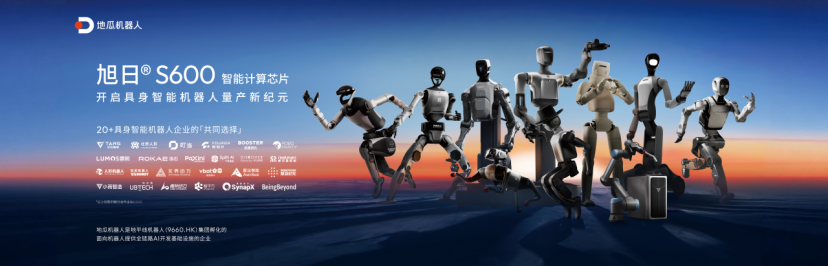
According to the latest disclosure by D-Robotics, the Sunrise S600 has now been adopted by over 20 customers including TARS, Qianxun Intelligence, X Square Robot, BeingBeyond, UBTECH, Pacini Sensing, Beijing Humanoid Robot Innovation Center, Humanoid Robot (Shanghai) Company, and Xiaoyu Smart Manufacturing. Most projects have entered the mass-production shipment stage. Some specific projects equipped with the Sunrise S600 have also provided mass production timelines. For example, the Embodied Tiangong 3.0 from the Beijing Humanoid Robot Innovation Center has completed Sunrise S600 computing power adaptation and plans to start scaled mass production delivery in the second half of 2026.
Notably, these customers are not concentrated in a single physical form but are distributed across multiple directions such as humanoid robots, industrial wheeled robots, 3C flexible operations, embodied large models, and full-modal perception. According to D-Robotics, its customer coverage rate in the field of embodied intelligence has now exceeded 50%.
This means that Sunrise S600's transition from customer onboarding to mass production is not occurring in a single product form or scenario, but is advancing simultaneously across multiple robot categories and application directions.
From its release in November 2025 to entering true-machine adaptation and mass production validation for over 20 customers by July this year, and now with most projects entering mass-level shipments, Sunrise S600 is moving from early-stage customer onboarding toward more direct commercial realization.
For D-Robotics, this also signals the emergence of new mass production increments following mature robots.
02 After Financing, Extending from Chips to Software
With commercialization accelerating, D-Robotics plans to continue investing the funds raised in this round into two directions.
One is chips.
Currently, D-Robotics has formed a product layout around the Sunrise series covering different computing power needs, and the served products have gradually extended from relatively mature consumer robots to industrial robots, humanoid robots, and more emerging intelligent hardware.
As robot forms continue to diversify, the differing demands for computing power, power consumption, and costs among various products are becoming increasingly pronounced.
Mature consumer robots prioritize cost and power efficiency; humanoid robots and industrial operational robots, however, must simultaneously process multi-channel sensor data, perform large model inference, execute task decision-making, and achieve real-time motion control.
Therefore, following this round of financing, D-Robotics will continue to strengthen its product layout across the full spectrum of computing capabilities for the Sunrise chip.
Another direction is software.
Compared to traditional robots, developing next-generation robots based on large models involves more than just determining whether a model can run on a single chip. From data collection and model training to simulation testing, model deployment, and final execution on the robot, there is an entire development pipeline behind it.
D-Robotics plans to further build a full-chain software platform that integrates data collection, model training, simulation verification, and inference deployment, extending chip capabilities further into the upstream and downstream of robot development.
The S600 already demonstrates this approach. Beyond the chip itself, its product ecosystem includes an integrated edge-cloud development toolchain. According to previously disclosed information, D-Robotics has collaborated with over 100 industry partners to adapt solutions around the S600, covering hardware components, perception modules, controllers, software algorithms, and the development ecosystem.
It is reported that the company has already carried out adaptation with hardware manufacturers such as Bosch Semiconductor and GigaDevice, integrated solutions with sensing manufacturers such as SmartSens and OmniVision, and simultaneously collaborated with Tier 1 robot teams in the automotive industry, including Luxshare Precision, Zixing Technology, Jinmai Electronics, and Huaqin Technology, to develop mass-production-level controller solutions based on Sunrise S600.
For robotics companies, this early completion of hardware-software adaptation reduces repetitive low-level work during the overall machine development process.
For D-Robotics, this also means that its relationship with customers is no longer limited to a one-time chip purchase, but extends further into product development, adaptation, and mass production processes.
Therefore, in the use of funds for this financing round, D-Robotics has listed both full-compute-segment chips and full-link software platforms as key investment directions.
03 Behind 100,000 Developers, Seeking the Next Batch of Mass-Production Products
If the Sunrise S600 corresponds to customers entering the mass-production stage, then the DGP Gravity Plan targets earlier-stage product increments.
Behind this lies a reality of the robotics market: compared to cars and smartphones, robots have not yet formed an absolutely dominant, unified product form. From robot vacuums and lawnmowers to companion robots and industrial wheeled robots, and now humanoid robots, many new categories are still simultaneously in the product exploration phase.
For an underlying computing platform company, it is difficult to predict in advance which form will become the next million-unit market. A more realistic approach is to enter the product development processes of more startups and developers as early as possible. The DGP Gravity Plan was created for this purpose.
This year, D-Robotics further upgraded this plan. Unlike simply providing hardware and technical support to developers, the upgraded DGP now extends across the entire product development cycle of robotics startups, offering support ranging from product R&D, supply chain selection, and market promotion to financing roadshows.
Currently, this program has served companies such as Lexiang Technology, Yinghansi, Qiuzhi Technology, Luobo Party, Sibowei Vision, Langji Intelligence, Qingyu, Xunling Technology, Taoyue Technology, and Oula Wanxiang. It covers open-source humanoid robots, embodied models, and products closer to the consumer market, such as AI sports coaches, AI imaging, and home companionship, cumulatively involving 10 cutting-edge robot and smart hardware directions.
According to D-Robotics, several of these products have entered niche markets and achieved scaled mass production and shipment.
Beyond DGP, D-Robotics is also expanding a broader developer and education ecosystem. According to the company, more than 500 small and medium-sized makers, over 500 educational institutions, and more than 100,000 developers from over 20 countries are developing on the D-Robotics platform, cumulatively creating hundreds of different forms of intelligent robot products and serving millions of users globally.
For D-Robotics, which has consecutively completed multiple rounds of financing, the dimensions by which the market observes it are also changing.
In earlier stages, the number of developers, cooperative clients, and new product launches were important indicators for measuring the growth speed of a robot computing platform company.
With the cumulative shipment of the Sunrise series breaking 8 million units, the S600 beginning mass-level shipments, and the company's revenue in the first half of the year growing several times year-on-year, commercialization results are becoming a more direct measure.
From entering more clients to scaling up alongside more clients will become the most noteworthy variable for D-Robotics' next stage of growth.