

UBTECH Launches Thinker-Sim Platform for Embodied AI Simulation, Data Synthesis, and Evaluation
By Jiang Si Qi
Unveiled on November 2, Thinker-Sim integrates real-to-sim-to-real scene digitization, large-scale data synthesis, and robot capability evaluation into a single system, with a single 8-GPU node synthesizing 390 hours of simulation data daily.
On November 2, UBTECH launched Thinker-Sim, an embodied AI simulation platform. Centered on a Real2Sim2Real workflow, the platform integrates real-world scene digitization, large-scale simulation data synthesis, and robot capability evaluation into a single system. A single 8-GPU node can synthesize 390 hours of simulation data per day.
The platform addresses three practical bottlenecks in embodied AI training: the high cost of real-world data collection, the complexity of building simulation environments, and the long cycle for algorithm validation. The Real2Sim2Real workflow involves first transferring real-world scenes into the simulation, batch-generating training data and validating robot capabilities within the simulated environment, and finally deploying the trained models back into the real world.
Scene reconstruction is the first step in this workflow. The platform relies on its proprietary Thinker-GS high-fidelity scene reconstruction algorithm to convert real-world scene captures and 3D reconstructions directly into simulation assets.
In an industrial factory setting, for example, the platform performs 3D reconstruction of the actual production line to replicate the facility's spatial layout, structural environment, and visual details, creating a static background scene. It then loads foreground assets such as robots, production equipment, and personnel according to the specific needs of training, data collection, or algorithm evaluation, assembling them into an interactive simulation environment. For commercial service scenarios, the platform can generate a digital twin of a commercial exhibition hall for robot training and deployment validation.
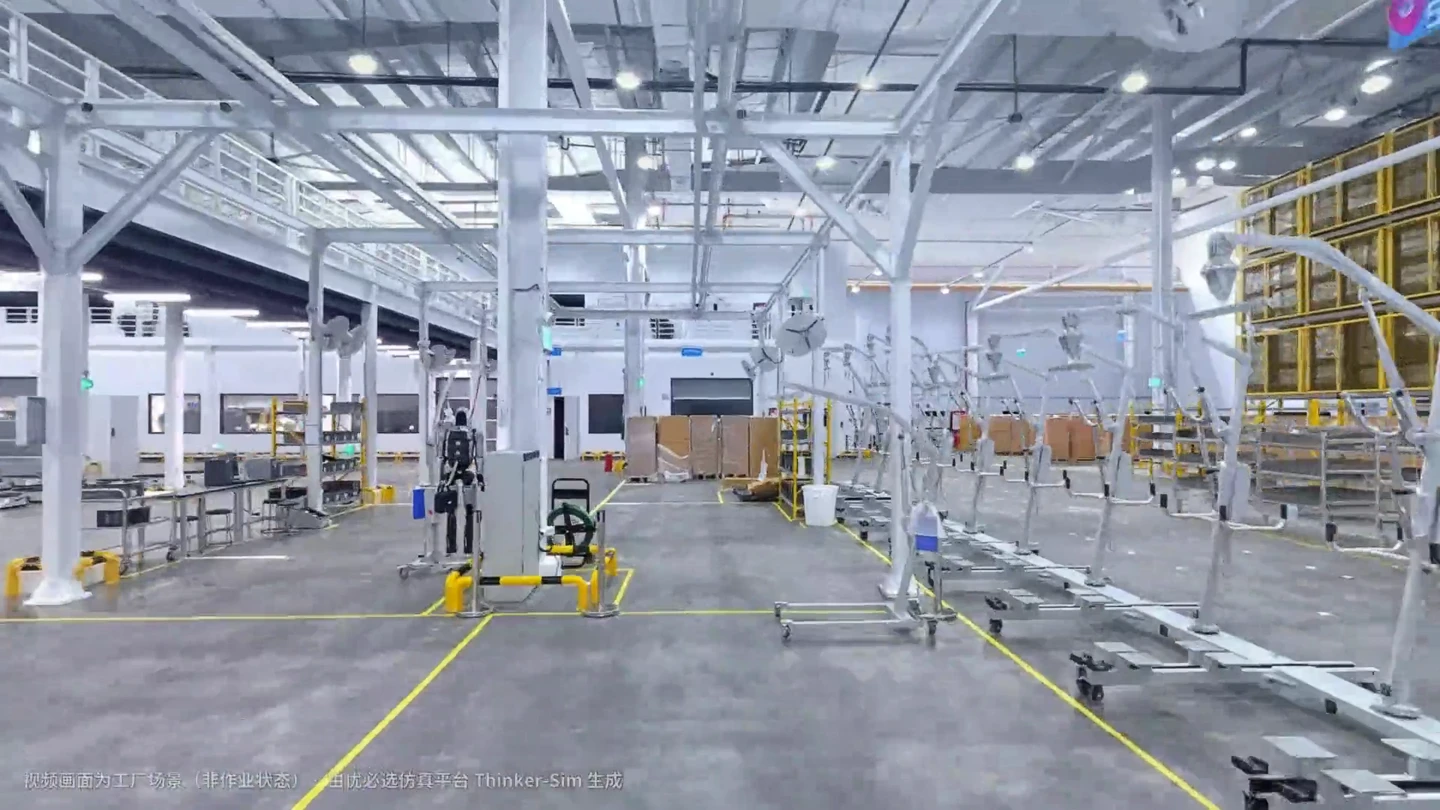
Image | A factory simulation scene generated by Thinker-Sim, shown in a non-operational state (Source: UBTECH, via IT Home)
Objects within the simulation environment also require batch production. To address this, the company has built a comprehensive, end-to-end automated generation system for SimReady assets. This system encompasses text- and image-driven batch generation of 3D assets, low-poly topology optimization, visual material generation, and automatic collision body configuration. Compared to traditional simulation modeling, this pipeline reduces the costs associated with manual modeling and asset processing while maintaining both the visual realism and physical interaction capabilities of the assets.
The data synthesis phase relies on a proprietary high-performance rendering engine, a large-scale parallel simulation architecture, and specialized data synthesis algorithms. The company disclosed three key metrics: the proprietary rendering engine achieves a 67.3% improvement in rendering efficiency; a single 8-GPU node yields a daily simulation data synthesis capacity of 390 hours; and a proprietary high-performance communication module used for software-in-the-loop (SIL) and hardware-in-the-loop (HIL) communication delivers an efficiency increase of more than 400%.
The evaluation module features a unified simulation validation framework that covers typical robotic tasks such as perception, navigation, and manipulation, supporting standardized testing for various algorithms and models. The platform allows for random perturbations in scenes, lighting, textures, and materials to verify algorithm generalization and robustness in dynamic environments.
At the operational level, users can launch a simulation simply by selecting a task template and configuring parameters, or they can freely combine scenes, robots, algorithms, and evaluation components using a visual workflow. According to the company, this zero-code mode covers more than 90% of target simulation scenarios. The platform also integrates the proprietary Ulab-Agent, enabling users to issue commands in natural language while the agent automatically handles scene creation, environment randomization, and task orchestration.
The name Thinker was previously used for UBTECH's embodied AI foundation model.
In late January this year, UBTECH open-sourced Thinker, a 4-billion-parameter embodied AI foundation model, on GitHub and Hugging Face (under the CC BY-NC-SA 4.0 non-commercial license, fine-tuned from Qwen3-VL-4B). The company also stated that it has achieved extensive deployment of the model on the Walker S2 for scenarios such as factory material handling and workpiece sorting.
In this release, UBTECH stated that Thinker-Sim will continue to strengthen the foundational capabilities related to embodied AI foundation models, providing infrastructure for the scaled deployment of humanoid robots in industrial and commercial scenarios.