
The First Embodied AI Stocks in the US and China: What Routes Have Unitree and Agility Taken?
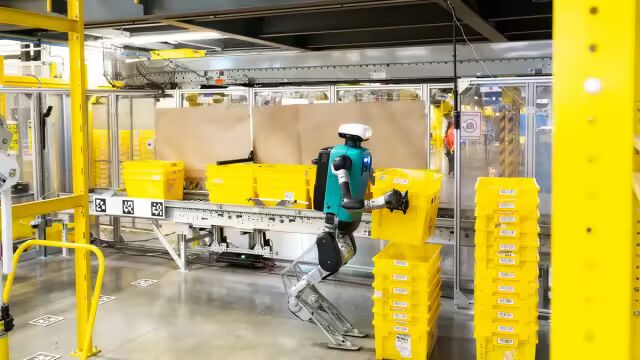
On June 24, 2026, Agility Robotics, a humanoid robot company based in Oregon, USA, announced that it would merge with special purpose acquisition company (SPAC) Churchill Capital Corp XI and list on the Nasdaq via a reverse merger. After the transaction is completed, the merged company will begin trading under the ticker symbol AGLT.
This deal values Agility at approximately $2.5 billion pre-money equity, equivalent to about 18 billion RMB. According to the announcement, the transaction is expected to bring in over $620 million in cash for Agility, including approximately $420 million from the Churchill Capital Corp XI trust account and about $200 million in PIPE investment led by Foxconn.
Not long ago, China's humanoid robot company Unitree Robotics also stood at the door of the capital market.
On March 20, 2026, Unitree Robotics' STAR Market IPO was accepted by the Shanghai Stock Exchange; on June 1, the company's initial listing application was approved at the listing committee meeting; on June 2, Unitree Robotics submitted for registration. According to the prospectus, Unitree plans to publicly issue no less than 40,446,400 shares, with the proportion of new shares not less than 10% of the total share capital after issuance, aiming to raise 4.202 billion yuan. Roughly推算 based on a minimum issuance ratio of 10%, Unitree corresponds to an issued market capitalization in the range of 42 billion yuan, with the final result subject to the issuance price and outcome.
One is located in Oregon, USA, originating from the Dynamic Robotics Lab at Oregon State University; the other is in Hangzhou, China, having gained global recognition through quadruped and humanoid robots. Agility and Unitree: one sprinting towards the Nasdaq, the other towards the STAR Market.
But these two companies are not telling the same story.
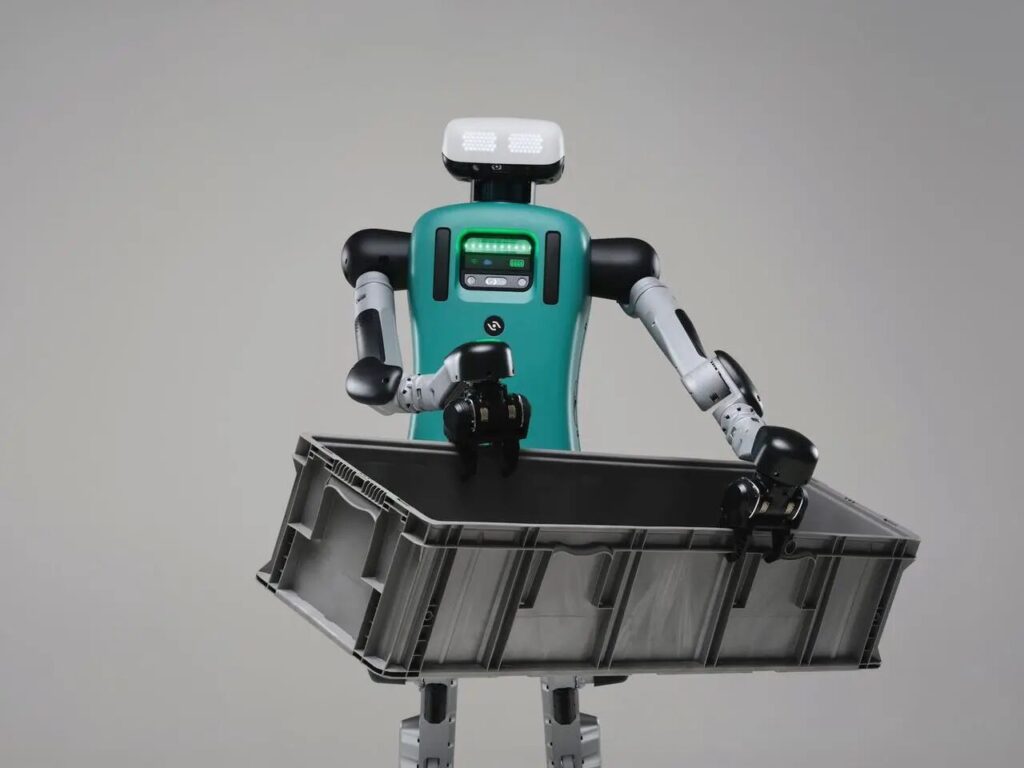
Agility's core product, Digit, has carried strong vertical scenario characteristics from the beginning. It targets repetitive labor such as material handling, sorting, and shelving/unshelving in manufacturing, warehousing, and logistics. Around Digit, Agility has also developed the cloud-based dispatch platform Agility Arc, the Robot-as-a-Service (RaaS) service model, and integration capabilities for enterprise WMS, MES, and other systems. In other words, what Agility wants to sell is a robotic replacement solution that can enter warehouses and factories and integrate into workflows.
Unitree's approach is entirely different. Rather than locking humanoid robots into a single predefined role, it initially expanded laterally around the robot platform itself. From quadruped robots to the H1, G1, and R1 models, Unitree focused on building out the hardware foundation for Embodied AI—making it affordable and scalable—so that developers, research institutions, and industry clients could then explore diverse applications based on this base.
Therefore, the most interesting aspect of comparing the leading US and Chinese Embodied AI companies lies not in their valuations, but in the divergence between their general-purpose and specialized approaches.

Agility's 'Specialization': A Step-by-Step Push Toward Logistics and Manufacturing with Digit
Agility's 'specialization' was not explicitly outlined in its initial business plan from the start.
The company was founded in 2015, emerging from the Dynamic Robotics Lab at Oregon State University. Agility's first product was not today's Digit, but rather Cassie.
Cassie functioned more as a bipedal walking experimental platform. It lacked an upper body or arms, focusing instead on validating dynamic gaits, leg structures, and bipedal control capabilities. In other words, Agility initially concentrated on 'how robots can walk stably like humans,' even demonstrating that stable walking did not necessarily require a humanoid form—their early bipedal design resembled an ostrid-like gait.
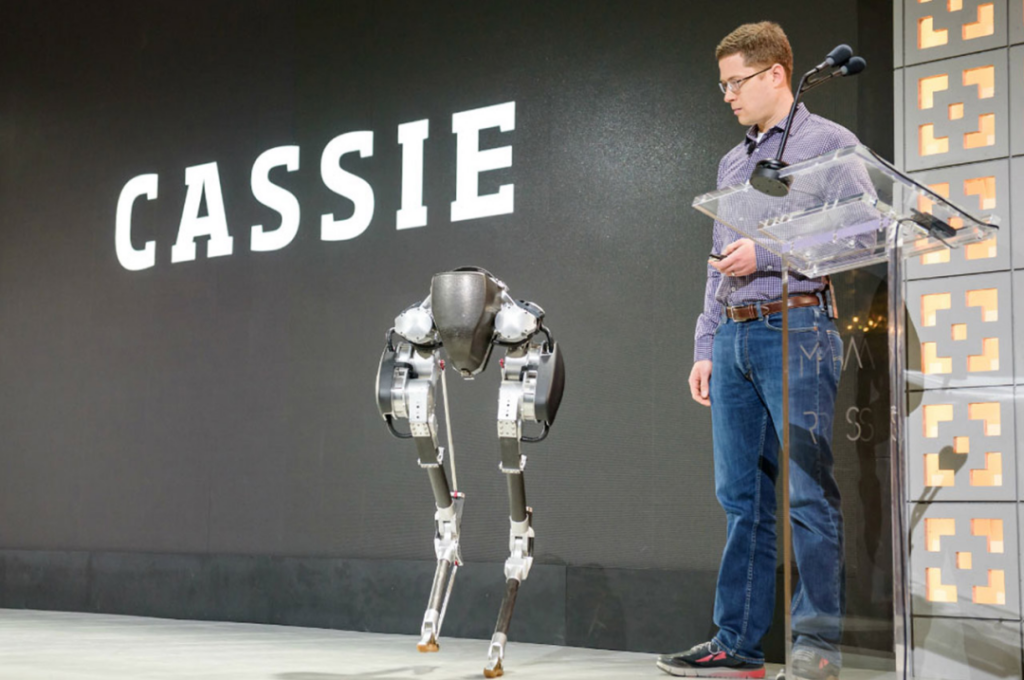
Digit was built on the foundation of Cassie.
Around 2019, the first-generation Digit entered the public eye. Compared to Cassie, it featured a torso, arms, and sensors, transitioning from a "bipedal platform capable of walking" to a "humanoid robot capable of handling objects."
The early Digit sparked considerable imagination, such as Agility's collaboration with Ford, which explored combining autonomous driving vehicles with humanoid robots. The vision involved autonomous vehicles delivering packages to a destination vicinity, after which Digit would unload them from the vehicle, walk to the door, and complete the final leg of delivery. This was one of Digit's most representative early commercial pilots, indicating that Agility initially did not confine itself entirely to warehouse logistics.
But last-mile delivery was never Digit's main focus.
A significant shift occurred around 2021. Agility began redirecting Digit's focus from outdoor delivery to material handling within warehousing, logistics, and manufacturing environments. The reasoning was pragmatic: compared to open roads and residential doorsteps, warehouse and factory settings are more controlled, tasks are more standardized, and ROI is easier to calculate.
In 2023, Agility unveiled a new version of Digit at the ProMat exhibition in Chicago and announced the construction of RoboFab. Located in Salem, Oregon, Agility defined RoboFab as the world's first factory dedicated to humanoid robots, with a planned annual production capacity of 10,000 Digit units.
This milestone was crucial. It signaled that Digit was no longer just a pilot product but had entered the "ready for mass production" phase.
After 2024, Digit began to truly enter commercial deployment.
The most typical case is GXO Logistics, a contract logistics company headquartered in Greenwich, Connecticut, USA, and one of Agility's early commercial deployment customers for Digit. In June 2024, GXO signed a multi-year RaaS (Robot-as-a-Service) agreement with Agility to deploy Digit in its SPANX fulfillment facilities. There, Digit did not perform complex or flashy tricks; instead, it handled very specific tasks: removing周转箱 (totes) from mobile robots and transferring them onto conveyor belts. In November 2025, Agility disclosed that Digit had moved over 100,000 parcels in its commercial deployment at GXO.
Collaboration with Toyota represents another case closer to factory scenarios. In February 2026, Agility announced a commercial RaaS agreement with Toyota. Building on previous pilots, Toyota's Canadian division plans to use Digit within its factories to support manufacturing, supply chain, and logistics operations, handling repetitive and high-load tasks.
This case demonstrates that Digit is not only entering warehouses but also beginning to integrate into the automotive manufacturing system.
Another partner is Amazon. The Amazon Industrial Innovation Fund participated in Agility's $150 million Series B financing round in 2022. Subsequently, Amazon tested Digit in warehouse scenarios, focusing on verifying its adaptability in existing warehouse environments, including tasks such as moving items and loading/unloading shelves. However, to date, Amazon's collaboration resembles a pilot scenario with a potential major customer rather than a fully scaled-out implementation.
Therefore, Agility's product roadmap is actually quite clear: Cassie first solved bipedal walking; early Digit addressed anthropomorphism and material handling capabilities; later versions of Digit shifted toward warehouse logistics; RoboFab addressed mass production readiness; and Digit v5 began taking on larger-scale orders and stronger load requirements.
According to the merger announcement between Agility and Churchill Capital Corp XI, Digit has cumulatively operated for over 65,000 hours across nine customer facilities. Agility's SPAC filing has also disclosed that the company has secured over $300 million in multi-year orders, including a three-year order for 1,000 units of the Digit v5 framework.
But this number requires cautious interpretation.
The multi-year orders exceeding $300 million are tied to milestones such as subsequent deliveries, performance benchmarks, and certifications. Digit v5 is not just about making the robot more human-like; it is also addressing gaps in payload capacity, safety, battery life, maintainability, and mass production delivery.
This is Agility's core characteristic: not only selling a standalone robot, but also selling a complete solution for job replacement.
Digit serves as the execution end, responsible for mobility and handling; Agility Arc acts as the dispatch platform, managing multiple robots, assigning tasks, monitoring status, and integrating with enterprise systems; the RaaS (Robot-as-a-Service) model allows customers to pay for services and deployment rather than purchasing the robot outright.
This combination makes Agility's "specialization" more concrete: placing robots into specific roles within manufacturing, warehousing, and logistics, proving they can work, be dispatched, integrate into workflows, and deliver measurable ROI.
But "specialization" comes at a cost.
Entering each factory or warehouse requires Agility to navigate on-site processes, safety certifications, system integration, workstation adaptation, and maintenance services, thereby transforming the robot into an integral part of corporate workflows. This is far more challenging than simply shipping out a Digit unit.
It must prove a narrower, harder question: Can Digit first become the inaugural robotic employee in manufacturing and logistics scenarios?

Unitree's "Tong": Deploy the Robot Platform First
If Agility is about putting Digit into specific roles, then Unitree takes a different approach: first creating a hardware platform that is sufficiently affordable, stable, and easy to diffuse.
The story of Unitree is already very familiar to everyone.
In 2016, Unitree Robotics was founded in Hangzhou. It first gained global recognition for its quadruped robots. Products like Go1, Go2, B1, and B2 have propelled quadruped robots from laboratories and high-end industrial settings into scientific research and education, developer communities, security and inspection applications, industry testing, and even a portion of the consumer market.
This route is typical: first, turn complex robots into mass-producible products, then open up the market through price and shipment volume.
On humanoid robots, Unitree has continued to employ this approach.
In 2023, Unitree released the H1. The H1 serves more as the company's technical flagship in the humanoid robot direction, focusing on showcasing high-dynamic motion capabilities, full-size bipedal structure, and whole-body control capabilities. Subsequently, Unitree launched the G1, further lowering the price threshold for humanoid robots. Then came the R1, where Unitree adopted a more aggressive low-price strategy, transforming humanoid robots from being affordable only to 'a few laboratories and enterprises' to something that 'more developers and customers can try.'
This is clearly different from Agility's approach.
It must answer another question: Can humanoid robots be mass-produced and sold to enough people?
The prospectus of Unitree Robotics provides an intuitive result for this route.
In 2025, Unitree achieved revenue of 1.699 billion yuan with a net profit attributable to shareholders of 278 million yuan; that same year, its humanoid robot shipments exceeded 5,500 units, generating 868 million yuan in humanoid robot revenue. In the humanoid robot industry, which is still largely in the R&D, pilot, and loss-making stages, these figures are rare.
According to Unitree's prospectus disclosure, its product lines include quadruped robots, humanoid robots, and component products. Quadruped robots lay the foundation for motion control and body engineering, while humanoid robots transfer these capabilities to more complex bipedal, dual-arm, and full-body control. The component business further strengthens Unitree's control over core components and the supply chain.
This is the underlying logic behind Unitree's "universality". It first builds the robot body into a universal platform, allowing different customers to conduct secondary development and seek out scenarios. Research institutions can use it for algorithm validation, developers can use it for application exploration, and industrial clients can use it for inspection, guidance, exhibitions, training, and scenario pilots.
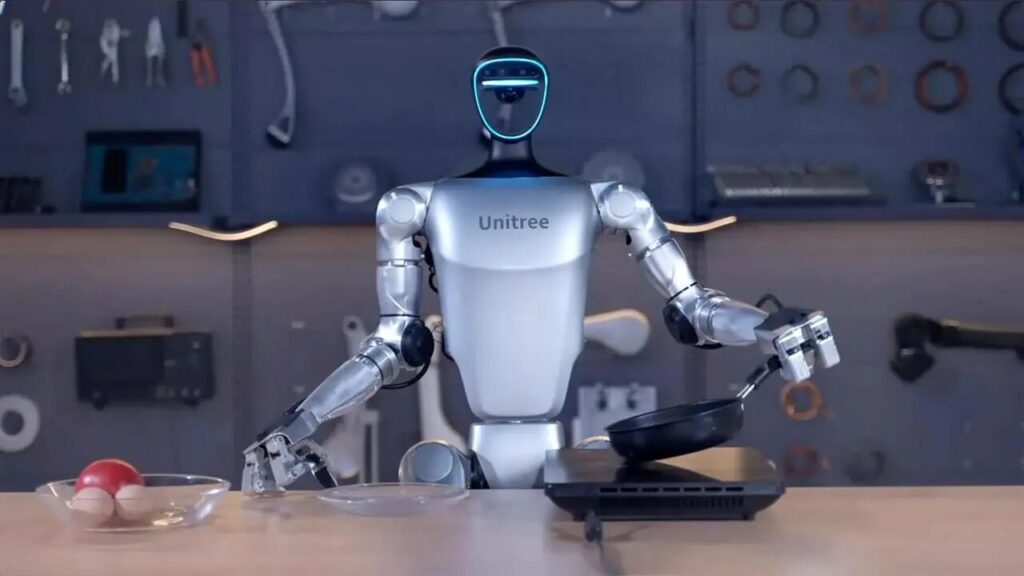
Therefore, Unitree's advantage does not lie in deeply dominating any single scenario, but rather in rapid product rollout, low pricing, and early establishment of ecosystem entry points.
This also explains why Unitree robots often appear in various scenarios that do not seem like "serious industrial" settings: Spring Festival Gala stages, developer videos, exhibition sites, research laboratories, and industry demonstrations. They may not all directly prove large-scale commercialization, but they can quickly expand hardware installation bases, allowing more people to come into contact with, use, and develop humanoid robots. This is the value of horizontal expansion.
Unitree's "general-purpose" approach doesn't mean it lacks direction; rather, it avoids locking in a specific direction prematurely.
It first builds the hardware foundation for Embodied AI, then waits for researchers, developers, industry clients, and ecosystem partners to grow applications around it. What it aims to prove is that in the humanoid robot industry, making the base unit affordable, stable, and scalable is itself a viable commercialization path.
However, the "general-purpose" strategy also has its own challenges.
According to the reply to inquiries from the Shanghai Stock Exchange, from January to September 2025, revenue from Unitree's humanoid robots was composed of 73.60% from scientific research and education, 17.39% from commercial consumer use, and 9.01% from industrial applications. This indicates that while Unitree's humanoid robots have been sold, the majority of its revenue still comes from scientific research, education, and secondary development needs. The proportion derived from high-frequency, essential industry demands such as manufacturing, logistics, and inspection remains relatively low.

One Builds Vertical Lines, the Other Lays Horizontal Lines
Comparing Agility and Unitree side by side, the most obvious difference lies in their initial commercialization strategies.
Agility first selected a sufficiently specific scenario, then deepened its products, software, services, and customer relationships layer by layer around that scenario.
Unitree took the opposite approach. It first built a hardware platform for its robots that is sufficiently affordable, mass-producible, and easily scalable, allowing various customers, developers, and industry partners to explore applications.
This represents two distinctly typical divergent strategies.
Agility wrote the vertical line first, embedding Digit into scenarios such as manufacturing, warehousing, and logistics, continuously narrowing its scope around tasks like material handling, transfer, loading/unloading, and sorting. The narrower the boundary, the more clearly defined the problems the robot needs to solve: how many boxes it can move today, how many trips it completes, which WMS systems it integrates with, whether it can reduce manual labor, and whether it can enhance safety.
The advantage of this approach is that value becomes easier to articulate.

For enterprises, questions such as whether a robot can replace specific repetitive tasks, increase throughput, reduce workplace injury risks, and achieve ROI within a few years are all measurable via KPIs.
Thus, Agility's 'specialization' should not be simply understood as conservatism; rather, it involves embedding Embodied AI into a calculable business model.
This also explains why Agility developed Arc, promoted RaaS (Robot-as-a-Service), and integrated with enterprise systems like WMS and MES. Because once inside factories and warehouses, robots cannot merely walk; they must be scheduled, monitored, maintained, and incorporated into existing workflows.
Digit as a physical platform is only the first step. What truly transforms it into a 'workplace robot' are the underlying software, services, and process adaptations.
Unitree takes a horizontal approach first. It avoids binding humanoid robots to a single workstation too early, instead broadening both the core capabilities and price tiers of its platforms. From quadrupeds to humanoids, from high-dynamic motion performance to more affordable humanoid products, and from complete machines to components, Unitree is more like laying a hardware foundation for Embodied AI.
The advantage of this route is faster diffusion speed.
As robot prices drop, product matrices expand, and development barriers lower, research institutions, developers, schools, industry clients, and integrators can all participate more easily. Not every client may immediately identify a rigid-demand scenario, but a sufficiently large installed base of hardware provides fertile ground for application exploration and ecosystem growth.
Thus, Unitree's concept of 'versatility' ('通') does not simply mean selling hardware.
It is more akin to betting on a hardware platform logic: first allowing robots to spread out like drones, smart electric vehicles, or development boards, and then enabling developers, algorithm companies, industry clients, and system integrators to jointly discover use cases.
The business model of this route focuses on shipments, cost control, and product iteration in the short term; while in the long term, it hinges on whether the ecosystem, software, data, and industry applications can take root and grow.
Using a T-shape as a metaphor, Agility and Unitree have started with opposite approaches.
Agility drew the vertical line first: diving deep into a single vertical scenario, turning robots into solutions for specific job roles. Unitree drew the horizontal line first: expanding outward on general-purpose hardware, pushing robots toward more customers and possibilities. One first proved that robots can take up jobs; the other first proved that robots can go on shelves.

Each Has Its Winning Move, and Also Its Ceiling
Agility and Unitree are not competing on the same track.
One first puts robots into jobs; the other first builds robots into a platform. One trades specialized scenarios for certainty, while the other trades general-scale deployment for possibility. Because their routes differ, their strengths, weaknesses, and the reasons behind them also vary.
Agility's winning move lies in having sufficiently hard-core scenarios.
Manufacturing, warehousing, and logistics may not be the most glamorous fields for humanoid robots, but they might be the earliest ones where cost-benefit analysis makes sense. These areas feature repetitive labor, material handling needs, workplace injury risks, and corporate budgets dedicated to long-term automation investments. If robots can operate stably in these scenarios, they can significantly reduce manual handling, increase throughput, lower safety risks, and integrate with existing enterprise workflows.
This route was shaped by conditions in the U.S. market. High labor costs and strong demand for warehouse and logistics automation characterize the United States, where enterprise clients are accustomed to paying for clear ROI. For Agility, as long as it can demonstrate that Digit is more stable, safer, and more predictable than human workers in a given role, it has the opportunity to absorb robot costs through high-value scenarios.
The ceiling of Agility is also precisely derived from this vertical route.
The harder the vertical scenario, the higher the entry barrier. Every client site has its own processes, systems, workflows, safety standards, and personnel collaboration methods. For Digit to move from one facility to another, it requires re-adaptation, deployment, and ongoing maintenance.
This slows down the pace of scaling.
The merger agreement between Agility and Churchill Capital Corp XI highlights that over $300 million in multi-year orders is a significant signal. However, these orders must be converted into deliveries, then into revenue, and finally into repeat purchases. Each intermediate step requires validation across reliability, cost, certification, and customer satisfaction.
Therefore, Agility's weakness lies in whether its scenarios can be replicated. It has already found a path of deep penetration, but it still needs to prove that this vertical line can grow into a sufficiently large commercial scale.
Unitree's winning move is its massive scale.
Its advantage lies in making the robot body accessible, usable, and widely disseminable. Quadruped robots have established a foundation in motion control and supply chain, while humanoid robots continue to push price bands downward. The component business further strengthens control over core parts. Unitree follows a typical Chinese hardware route: rapid engineering iteration, fast supply chain response, and quick price reductions.
The benefit of this approach is that the market opens up earlier.
When humanoid robots are no longer equipment that only a few enterprises and laboratories can afford, research institutions, schools, developers, integrators, and industry clients will all begin to experiment. Not every attempt may create a rigid demand, but a sufficiently large installed base of hardware will bring more algorithm validation, application exploration, content dissemination, and ecosystem partners.
But selling more general-purpose bodies does not mean that industry applications have become deep enough. Yu's next step lies in whether scale can crystallize into rigid demand.
If humanoid robots mainly remain within scientific research education, developer exploration, and demonstration experiences, they can certainly generate revenue, but it will be difficult to support a larger embodied AI narrative.
Therefore, Agility's and Unitree's advantages come from the soil of their respective markets; their shortcomings also stem from that same soil.
The US market has given Agility vertical scenarios, high labor costs, and enterprise automation budgets, making it easier for them to tell a clear story about 'robotic labor'; but it also forces them to face high standards for safety, delivery, certification, and client processes.
The Chinese market has given Unitree a complete supply chain, rapid engineering iteration, and lower costs, allowing it to roll out robots faster; but it also compels them to answer one question: When hardware is no longer scarce, where are the scenes that can sustain continuous payment?
This is the true divergence of the 'generalist vs. specialist' route.
The next hurdle for Agility is whether its "specialization" can be replicated.
The next hurdle for Unitree is whether its "generality" can be deployed.
One aims to replicate job-specific solutions across more warehouses and factories, while the other seeks to advance general-purpose robots into more essential application scenarios. The outcome of this rivalry between China's and the US's leading embodied AI stocks will not be determined by who goes public first or whose videos are more sensational, but by a simpler metric:
Which company can ensure that its robots are continuously purchased, continuously used, and repeatedly repurchased.