
Unitree's New Brain Debuts: Embodied AI Moves from Concept to Real Machines
July 20, Unitree Robotics officially released UnifoLM-OminiA-0.3, an embodied large model designed for multi-task home care and elderly support. The model is natively integrated into the Unitree G1 robot, marking a significant step toward practical implementation in the civilian service sector.
According to official descriptions, the core highlight of UnifoLM-OminiA-0.3 lies in its ability to support full-modal interaction and understanding—including voice and vision—within a single model. It enables autonomous, stable, and interference-resistant control of the G1 robot to execute tasks, achieving a closed-loop system from perception to execution.
Based on five real-machine demonstrations shown in Unitree's official video, we further categorize its capabilities into four aspects: scene perception, command reception and task planning, visual recognition, and whole-body intelligence.
Beyond Hands and Vision: True Whole-Body Intelligence
In the past, embodied large models were typically deployed on two types of hardware: robotic arms with fixed bases, used for narrow desktop operations; or composite robots consisting of mobile chassis with lifting columns.
In contrast, Unitree insists on using stronger models to directly adapt to humanoid bodies equipped with both legs and a waist. The G1 robot, powered by UnifoLM-OminiA-0.3, demonstrated the unique advantages of this approach across five tasks.

In a pillow-carrying task, the Unitree G1 robot followed staff instructions by first bending its knees and waist to pick up a pillow from the floor and place it on a stool. When asked about the pillow's color during the process, the robot correctly responded, "White."
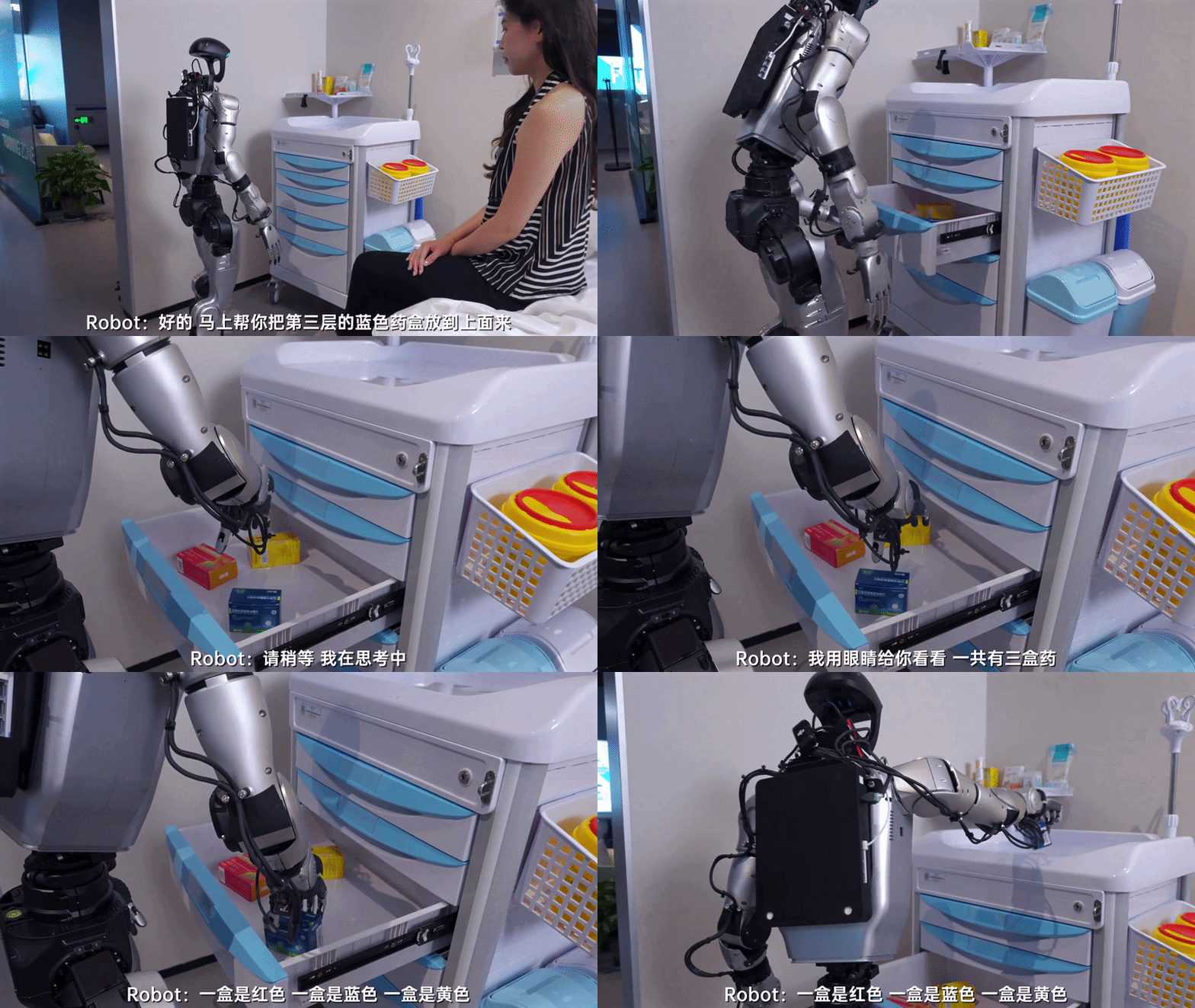
In the pillbox retrieval task, staff instructed the robot to take out a third-layer pillbox and place it on the cabinet. While autonomously selecting the blue pillbox, the robot also correctly answered that the cabinet contained red, blue, and yellow pillboxes.
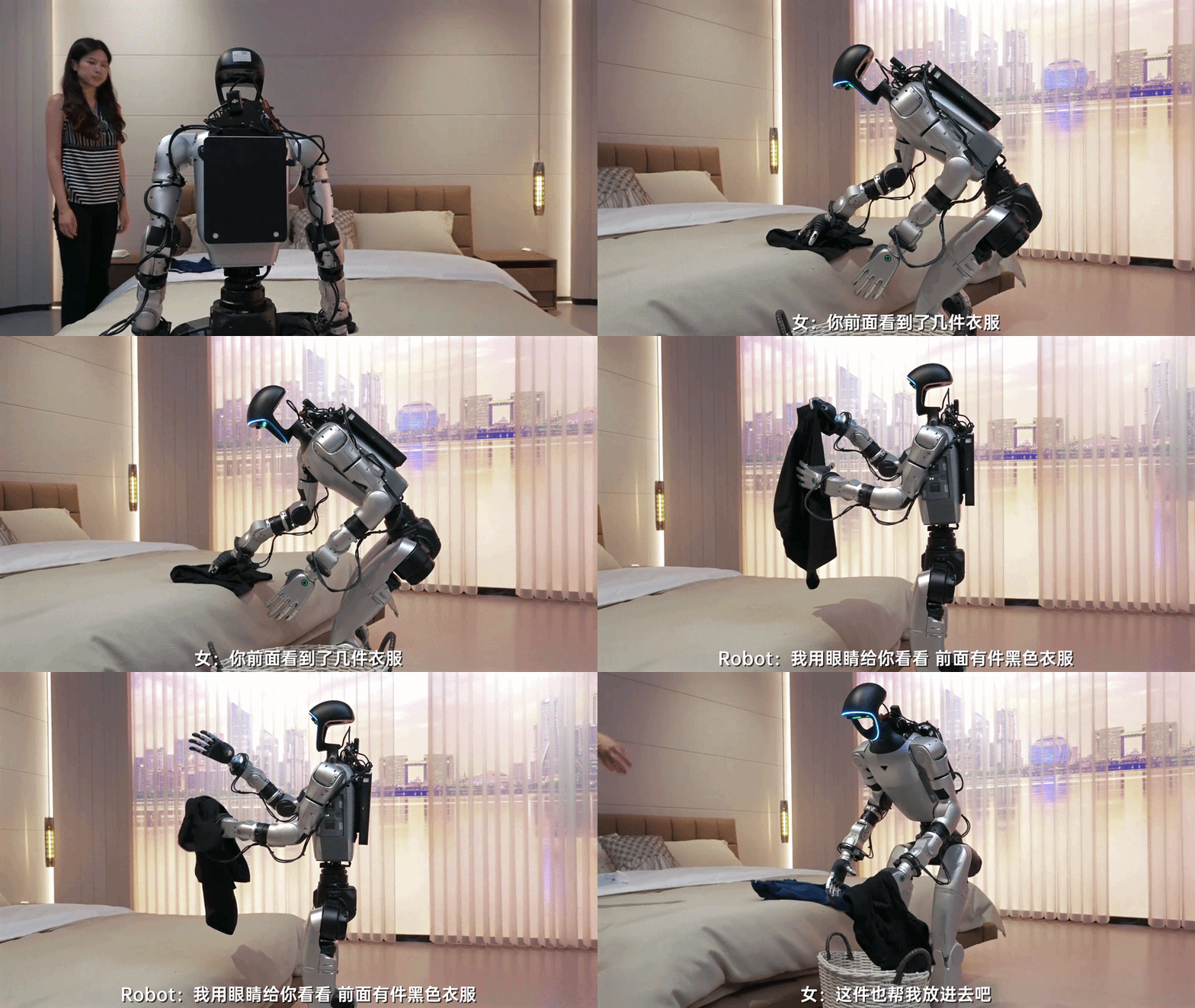
During the clothes folding task, Unitree's G1 robot steadily placed black clothes into a basket while answering staff questions about the clothing description, and also put in the new blue clothes added by subsequent staff.
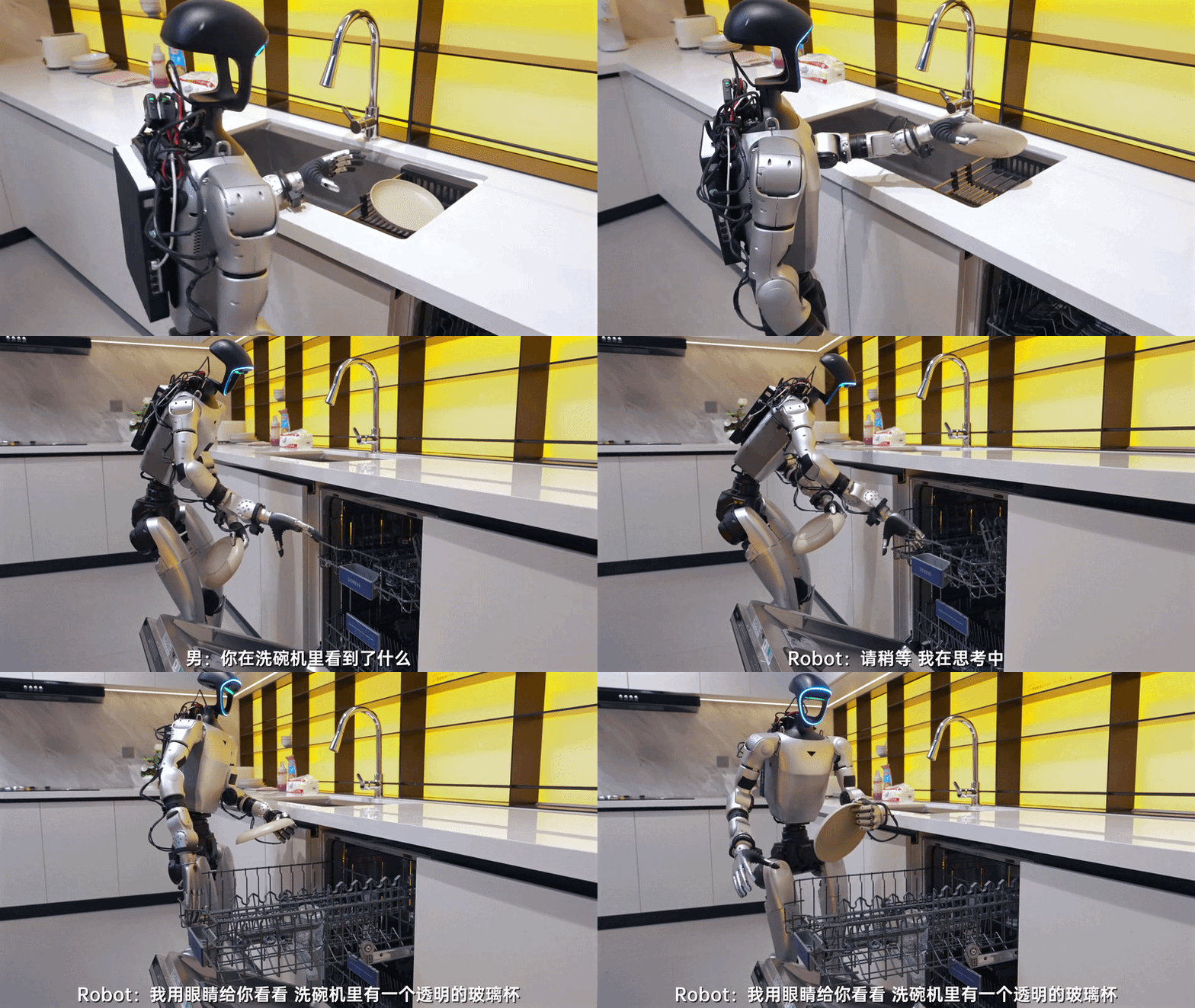
In the plate stacking task, the robot not only placed plates into the dishwasher but also informed staff that there was a transparent cup inside the dishwasher.

In the patient care task, the robot first located the mechanism to lower the hospital bed according to instructions, then bent down to rotate its arms to lower the bed. When staff shouted stop, the robot immediately halted its actions.
In five real-robot demonstrations, the G1 robot equipped with the UnifoLM-OminiA-0.3 model showcased excellent voice interaction feedback and command processing capabilities: it could recognize, respond, and complete tasks simultaneously in a natural and smooth manner.
More noteworthy details include how the Unitree G1 robot naturally bent its legs and waist to coordinate with upper-limb operations whether moving throw pillows, retrieving medicine boxes, folding clothes, placing plates into a dishwasher, or leaning down to lower a hospital bed. This may signify that UnifoLM-OminiA-0.3 has enabled robots for the first time to possess whole-body intelligence capable of coordinated control of their own bodies.
Meanwhile, UnifoLM-OminiA-0.3 not only recognized common colors such as red, blue, and yellow on medicine boxes but also identified transparent cups, demonstrating the model's powerful visual recognition and processing capabilities.
Areas Still Worthy of Observation
The Unitree G1 robot powered by UnifoLM-OminiA-0.3 has sparked imagination about bringing robots into homes, with many optimistically commenting, "It's starting to work," or "This is what robots should truly be doing." Indeed, compared to technical showmanship in benchmarks, the capabilities and information presented in this video align more closely with people's scenario needs for home robotics.

However, we must also clearly recognize that after extensive training and fine-tuning on single-domain data, completing individual scene-specific tasks has become relatively straightforward for Unitree robots.
In fact, the short two-minute-plus video only demonstrated the robot's performance in fixed scenarios, failing to reflect its adaptability when facing unfamiliar environments; its scenario transfer and generalization levels remain to be verified.
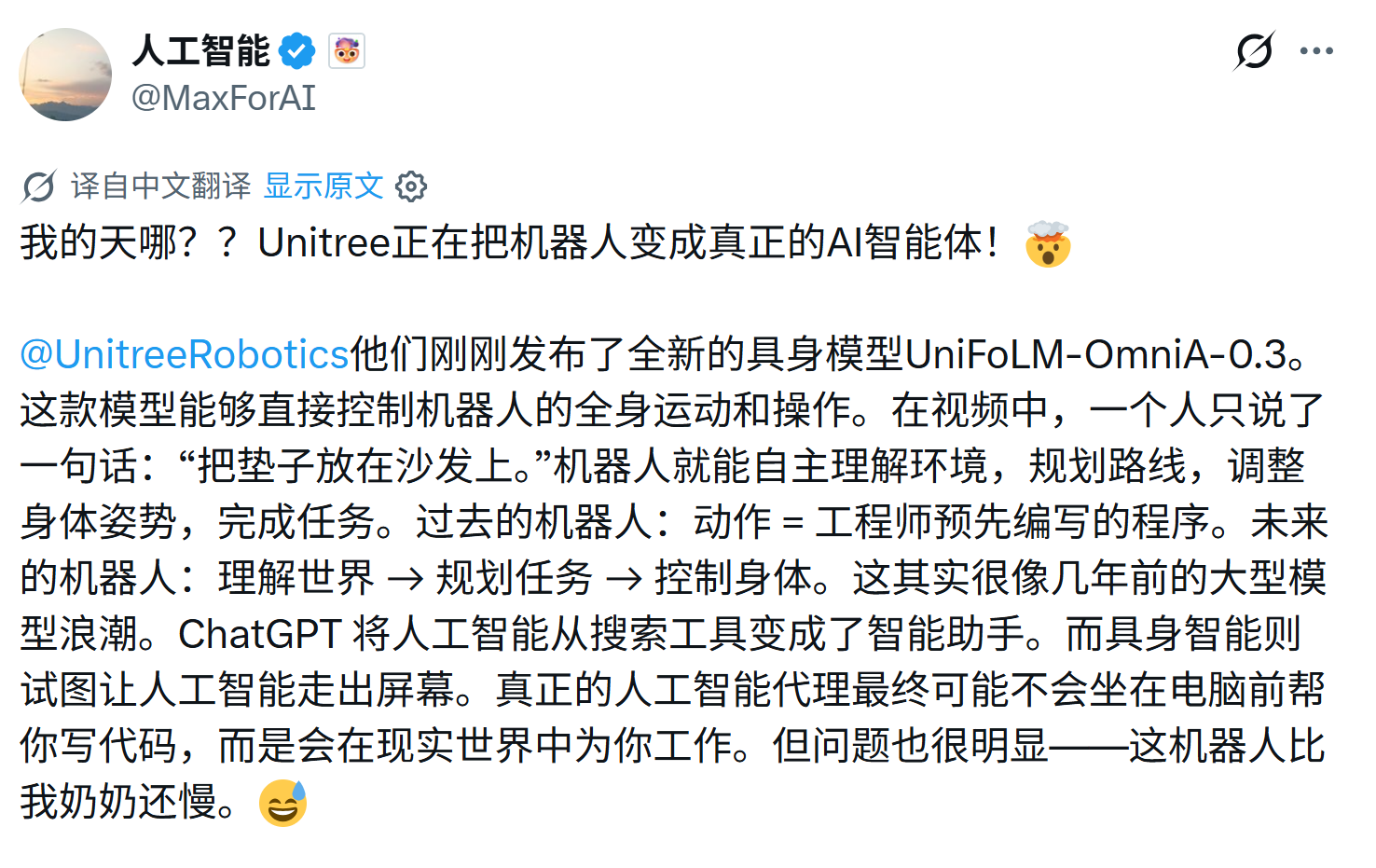
As the comment above points out, although Unitree's UnifoLM-OminiA-0.3 demonstrates strong task planning, whole-body motion control, and instruction feedback capabilities, its task execution speed and success rate are not reflected in the video. A complete assessment requires a comprehensive technical report and real-world robotic experience.