
Behind the Unitree Controversy, NVIDIA's New Computing Power Business
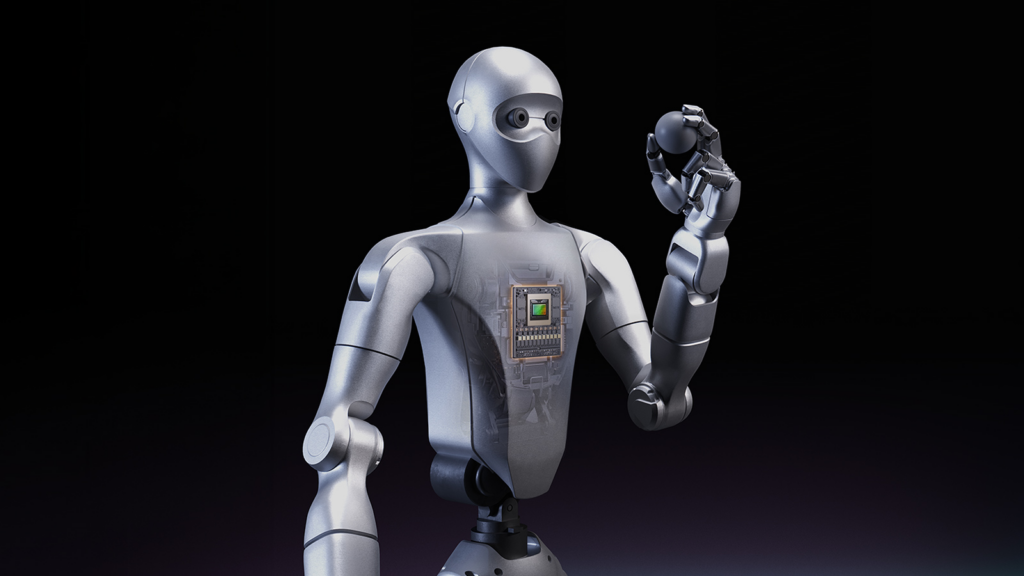
During GTC 2026, NVIDIA unveiled the Isaac GR00T Reference Humanoid Robot for academic research. According to public information, this reference design utilizes a Unitree H2 Plus humanoid robot body, powered by the NVIDIA Jetson AGX Thor computing platform, equipped with Sharpa's five-finger dexterous hand, along with the Isaac GR00T foundational robot model and development stack. The initial batch of products is planned to be supplied to universities and research institutions.
On the surface, this appears to be a standard hardware collaboration: NVIDIA provides the computing platform and software stack, while Unitree supplies the humanoid robot body, jointly launching a scientific research reference platform.
However, the situation quickly became more complex. On one hand, Unitree nearly completed its approval process for an IPO on the STAR Market at the same time, with its prospectus explicitly allocating significant funds toward the R&D of intelligent robot models and robot bodies. Capital markets naturally linked these two events: Unitree is not just a Chinese humanoid robot body manufacturer but is also entering NVIDIA's Physical AI ecosystem.
On the other hand, regulatory discussions in the United States surrounding Chinese robot products are intensifying. Bipartisan members of Congress have proposed the 'GUARD Act' (GUARD Act) to require security agencies to review Chinese humanoid and quadruped robots, while the Department of Defense 1260H list requires restrictions on contracting and procurement. Such policy signals increase uncertainty for Chinese robotics companies like Unitree in the U.S. market.
Unitree, at the center of the controversy, has faced intense scrutiny. However, focusing solely on Unitree risks underestimating the significance of this event. For NVIDIA, Unitree is neither its only partner nor irreplaceable. What it truly aims to validate is another matter: whether the robot era can establish a 'CUDA ecosystem' for robot training, much like the large model era, thereby extending the compute business.

NVIDIA Seeks Body Entry Points
Nvidia is unlikely to enter the humanoid robot manufacturing business itself, as this would not align with its past successful trajectory.
In the era of large models, Nvidia is not OpenAI, Anthropic, or Google DeepMind. However, these companies cannot bypass GPUs, CUDA, NCCL, and TensorRT when training and deploying models. While Nvidia has not occupied the model and application layers, it has secured the underlying compute layer and development ecosystem.
The same logic applies to the robotics era.
Nvidia does not need to build the largest number of humanoid robots; instead, it aims to become a foundational platform supplier for the robotics industry. Different manufacturers can develop their own bodies: Unitree, Figure, Agility, Boston Dynamics, and NEURA can all create their own mechanical structures, joints, motors, controllers, and complete products. However, as long as these bodies integrate with Isaac, GR00T, Cosmos, Jetson, and Newton, the vast majority of computation in the robot training and deployment chain will return to Nvidia's platform.
Therefore, Unitree plays the role of a body entry point in this matter. This entry point has two characteristics.
First, Unitree possesses cost and engineering advantages. Compared to many Western humanoid robot companies, Unitree is more adept at transforming complex robots into purchasable, deliverable, and iteratively improvable hardware products. The H2 Plus official website shows that it is equipped with the Jetson T5000 onboard computing module. Paired with dual Sharpa Wave dexterous hands, it achieves 75 degrees of freedom and targets scientific research and secondary development scenarios.
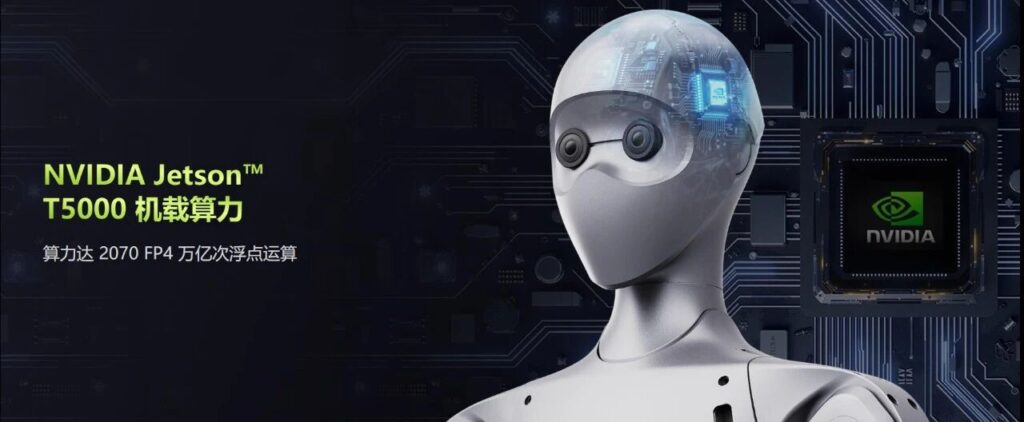
Second, Unitree already has a researcher base. Products such as G1, H1, and H2 have gained visibility among university students and developer communities. If Nvidia wants to quickly introduce foundational robot models like GR00T into laboratories, it needs a body platform that is sufficiently affordable, open, and expressive. This is why Nvidia places reference designs first in academic research scenarios. While the scientific research market may not be the largest, it influences standards. Papers, open-source code, benchmarks, and experimental paradigms often emerge first from universities and research institutions. By having institutions like Ai2, ETH Zurich, Stanford, and UCSD use these reference designs first, Nvidia is essentially competing for the default development environment for robotics research. Defining standards is a key step in anchoring long-term markets; once standards are established, future robots will be deeply bound to Nvidia's technology stack from the outset.

What's Missing Isn't Just the Embodiment, But Also the Data
Having an embodiment only solves the first layer of the problem. The real challenge in robot training lies in data.
Large model training has a natural advantage: the internet has already accumulated massive amounts of text, images, and videos. Language models can learn language from human-written text and world knowledge from web pages and videos. However, robots require real-world physical interaction actions—such as how hands grasp cups, how feet find balance, how joints distribute torque, how paths are adjusted when hitting table edges, and how to compensate when objects slip.
Even more troublesome is that these robot action data are inherently fragmented.
Human videos come in one format, motion capture data in another, teleoperation data in yet another, and simulation trajectories in a fourth. Different robot embodiments vary in joint counts, degrees of freedom, hand structures, and sensor configurations. A human raising their arm cannot be directly converted into control commands for a specific humanoid robot; nor can an action learned by one robot be directly transferred to another.
Therefore, for large-scale pre-training of robots, the first step is to solve the question of 'how to represent actions.'
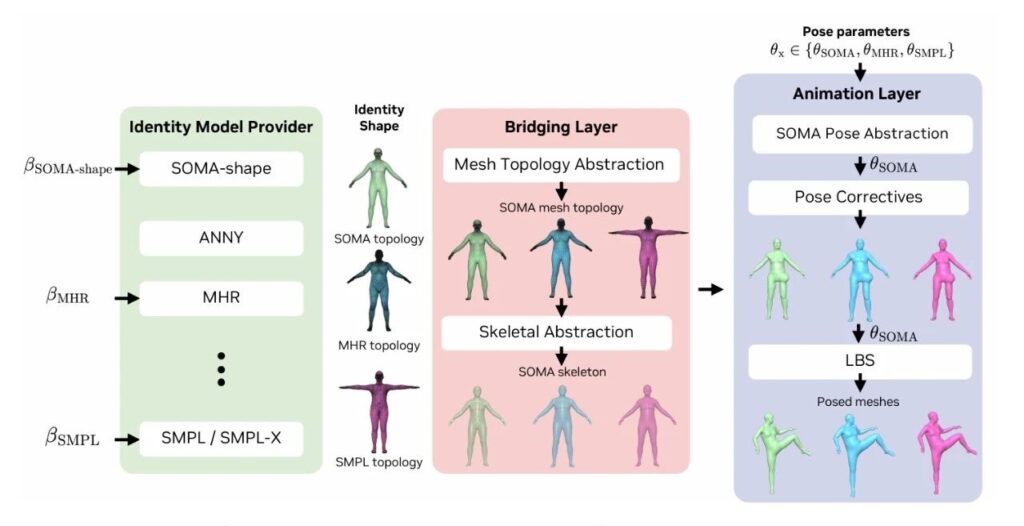
This is the significance of work like Nvidia's SOMA-X. It aims to solve the incompatibility issues between different parameterized human body models, such as differences in mesh topology, skeleton structure, shape parameters, and unit conventions among models like SMPL and SMPL-X. The paper proposes enabling different human body models and motion data to enter a unified representation layer through unified meshes, unified skeletons, and unified pose abstractions. If robots are to learn human movements, they must first convert human motions into a unified, computable, and transferable representation. Otherwise, the more data there is, the messier the formats become; the larger the model, the harder it becomes for training to converge on usable actions.
From this perspective, robots need not only a physical entity but also a "data entity." The physical entity determines which machine the actions ultimately execute on; the data entity determines how actions are recorded, generated, transformed, and reused within the training system.

Isaac Newton Becomes an Embodied AI Training Ground
The name of Isaac Newton, the father of modern physics, seems to have been integrated into NVIDIA's robotic technology system: Isaac Lab handles the robot learning and training pipeline, while the Newton solver manages physical simulation and computation.
This may not necessarily be a deliberately designed naming significance by NVIDIA, but as an industrial metaphor, it is very accurate.
The world robots face is still a Newtonian physical world. Gravity, friction, contact, collision, inertia, joint constraints, and torque limits do not disappear simply because model parameters grow larger. Language models can trial and error in token space, but robots must bear the consequences of their actions in the physical world. Therefore, action data alone is insufficient; actions must also be tested and hardened within a physical environment.
Isaac Lab is located here. It is Nvidia's training framework for robot learning, used to organize reinforcement learning, imitation learning, motion control, and manipulation tasks. The direction of the latest Isaac Lab 3.0 Beta is clear: multi-physics backends, pluggable renderers, Warp-native data pipelines, and kit-less installation modes. These changes indicate that Isaac Lab is evolving from a "training tool on Isaac Sim" into a more independent robot training platform. Newton solver operates at a lower level. It handles collision, contact, joints, friction, constraints, differentiable physics, and other issues. Newton v1.3.0 was released in 2026 year 6 month, adding and strengthening capabilities such as solver reset for reinforcement learning, SDF/hydroelastic collision, ray query, USD/MJCF asset import, and viewer/rendering.
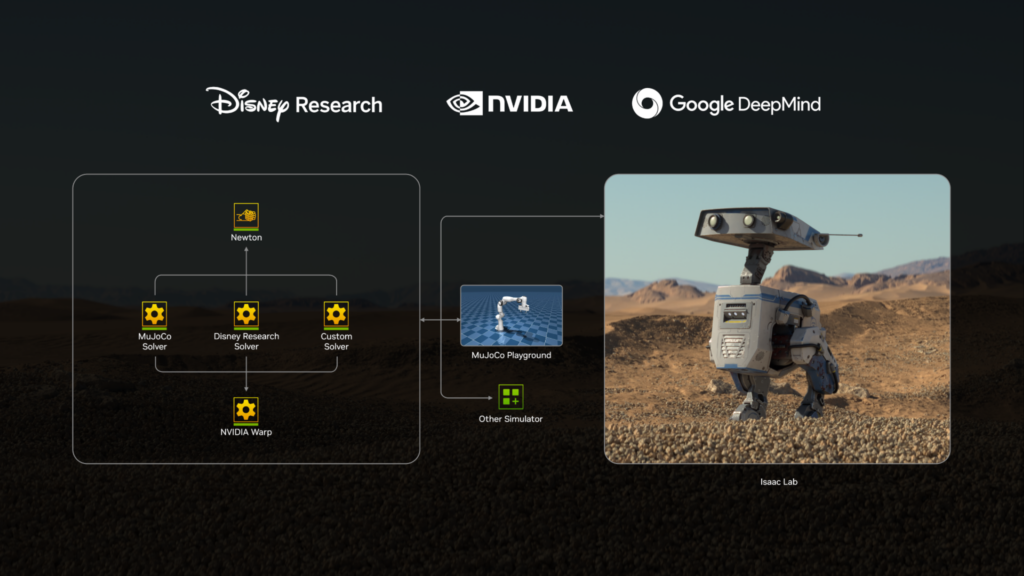
These features are not well-suited for generating hype at product launches, but they determine whether robot training can be engineered.
If SOMA-X solves the problem of how to uniformly represent actions, Isaac Lab and Newton solve the problem of how to train, verify, and optimize these actions under physical rules. Because the hardest part of the robotics industry is not making simulation videos look good, but ensuring that policies trained in simulation can still work on real-world robots. The gap between simulation and reality is the hard problem for Physical AI.
It is precisely in this sense that the name Isaac Newton becomes a fitting metaphor. What Nvidia aims to do is not simply equip robots with a chat model, but rather build a "physical school" for them: first converting movements into data, then feeding that data into simulations, allowing policies to experience sufficient physical consequences within a virtual world, and finally transferring them to real-world embodiments.

NVIDIA's Robot Training Stack Is Taking Shape
Put these components together, and you can see Nvidia's real technology stack running through the entire robot training pipeline.

The robot body provides the real-world carrier, action representation provides the data format, GR00T connects perception and action, Cosmos supplements world models and synthetic data, Isaac Sim provides a simulation environment, Isaac Lab organizes training, Newton handles physics, and Jetson is responsible for deployment. At the base level, everything returns to GPUs and CUDA. This is Nvidia's familiar business structure. It doesn't necessarily own end-user applications, but it aims to control the development pipeline. As long as the development path is defined by it, the more the industry advances, the more computing power demand will flow back to its platform.

Physical AI is a narrative; essentially, it comes back to computing power
Nvidia is very good at creating concepts.
AI Factory, Omniverse, Digital Twin, Physical AI, World Foundation Model, World Action Model—these terms carry Jensen Huang's distinctive narrative style. They are grand, smooth, and convincing enough for investors and developers to believe that the next wave of innovation is underway.
But if we put it more directly, Nvidia is still doing what it does best: turning the next technical challenge into the next demand for computing power. In the era of large language models, GPU demand comes from tokens. Models need to read more text, generate more content, and process larger contexts, which requires more training and inference computing power.
In the era of robotics, GPU demand will come from actions.
Behind one action lies not just an action command. It requires perception input, language understanding, action generation, physical simulation, policy training, failure replay, real-body validation, and edge-side real-time control. Computing power is required at every step.
The NVIDIA GR00T N1 technical report, "An Open Foundation Model for Generalist Humanoid Robots," reveals that training these robot foundation models uses a hybrid dataset of real robot trajectories, human videos, and synthetic data. It employs a vision-language-action architecture to connect understanding with action generation. Cosmos 3 takes this further by integrating language, images, video, audio, and action sequences into a unified world model framework designed to serve Physical AI.
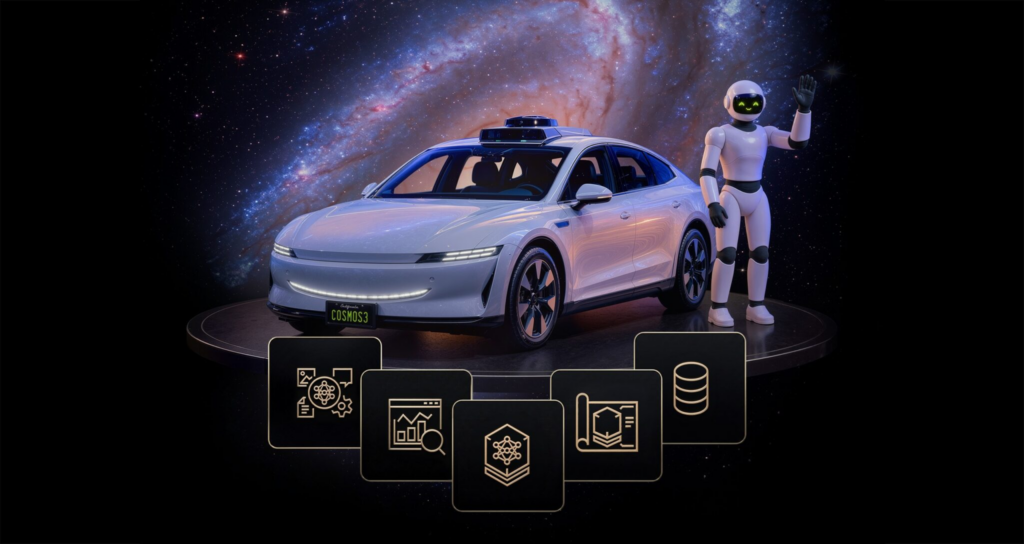
The more complex the actions, the more simulations are required; the more simulations there are, the greater the GPU consumption; and the higher the GPU consumption, the more stable NVIDIA's business becomes. NVIDIA aims to expand the AI compute narrative from tokens to actions.
Newton once abstracted the physical world into computable laws. Today, NVIDIA seeks to abstract robot actions into trainable compute workflows. From human actions to unified representations, from unified representations to simulation-based training, from simulation training to real-world embodiment, and from real-world embodiment back to data回流. Each step is being software-ized, platform-ized, and GPU-ized.
This is not merely a robotics story; it represents NVIDIA's strategic layout to drive compute growth from the linguistic domain to the physical world.
Unitree provides a sufficiently concrete embodiment sample, making this narrative tangible for the first time; works like SOMA-X provide a unified entry point for action data; Isaac Lab and Newton enable action training within physics simulations; while Cosmos and GR00T connect world models with robot foundation models.
Ultimately, all of this leads back to the same question: As robots multiply, so do actions, simulations, and training workloads—who will provide the compute power?
NVIDIA has already provided its own answer.
It doesn't necessarily have to build robots, but it must turn robots into a new computing business.