

Apple's AI Roadmap Is Clear, But Far From a Closed Loop

At the first press event since John Ternus took over as CEO, the opening remarks skipped product announcements to address a fundamental question: What should a device truly prepared for AI look like?
His criteria were specific: it must understand personal context, stay with you constantly, feature a processor capable of running models locally while also connecting to cloud-based models, offer a sufficiently large screen, include high-quality cameras and microphones to see and hear your surroundings, provide all-day battery life, require no learning curve, and seamlessly integrate with your other devices, apps, and services. The answer, he concluded, is the iPhone.
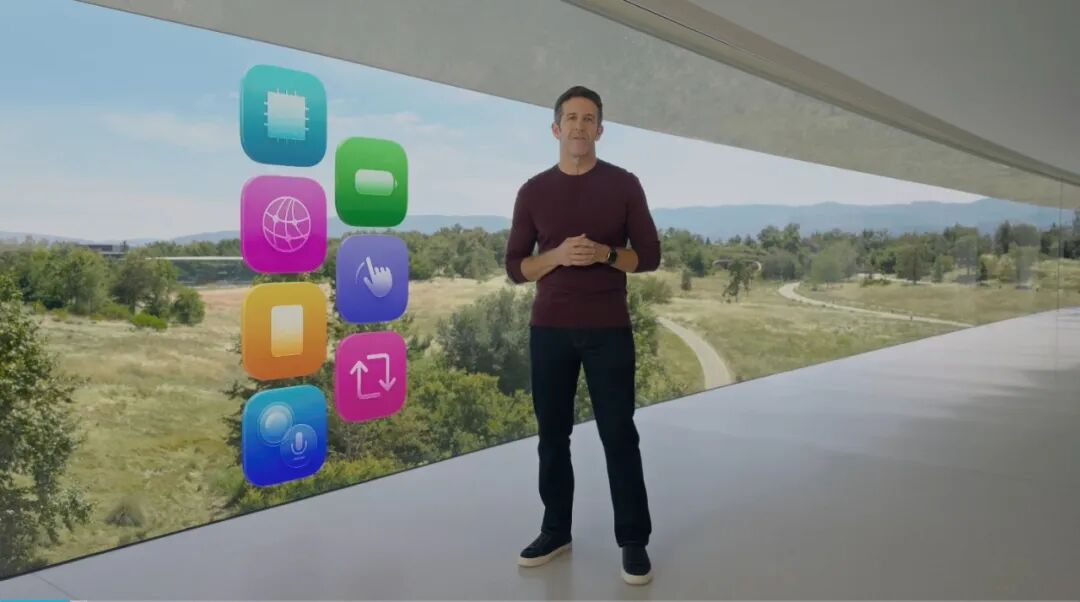
John Ternus then gave the iPhone a brand-new definition: Intelligent Personal Hub.

Apple’s Latest Answer on AI
The contradiction Apple aims to resolve is concrete: a genuinely useful AI needs access to your personal data—emails, photos, schedules, and location—while ensuring that this information remains private and secure. Placing everything within a single system creates inherent tension; keeping all processing on-device limits model size and capability to light tasks, whereas relying entirely on the cloud requires data to leave the device. Furthermore, the iPhone serves as a central hub for app data.
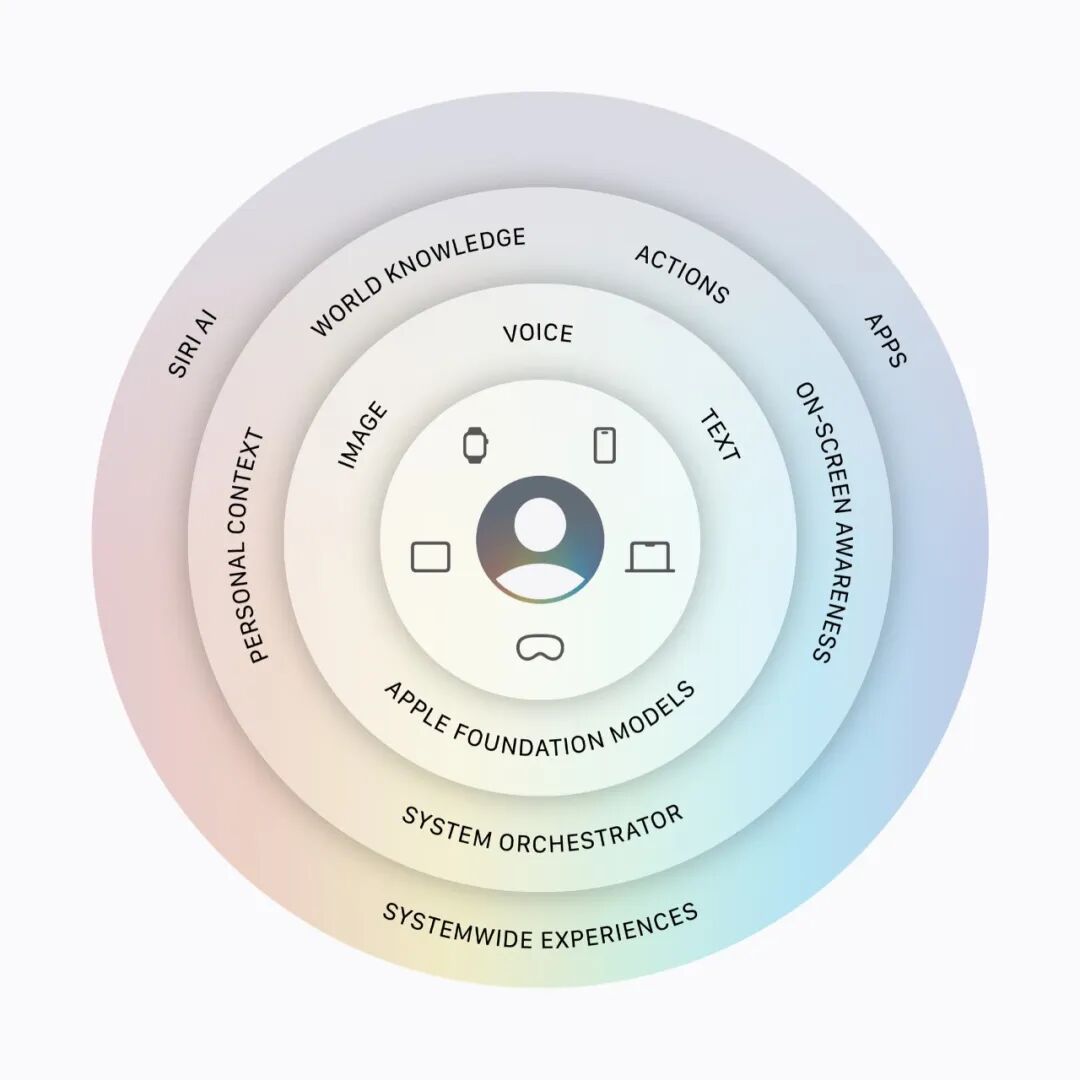
Apple Intelligence is designed to resolve this contradiction. It divides capabilities into three layers, each with distinct tasks and constraints.
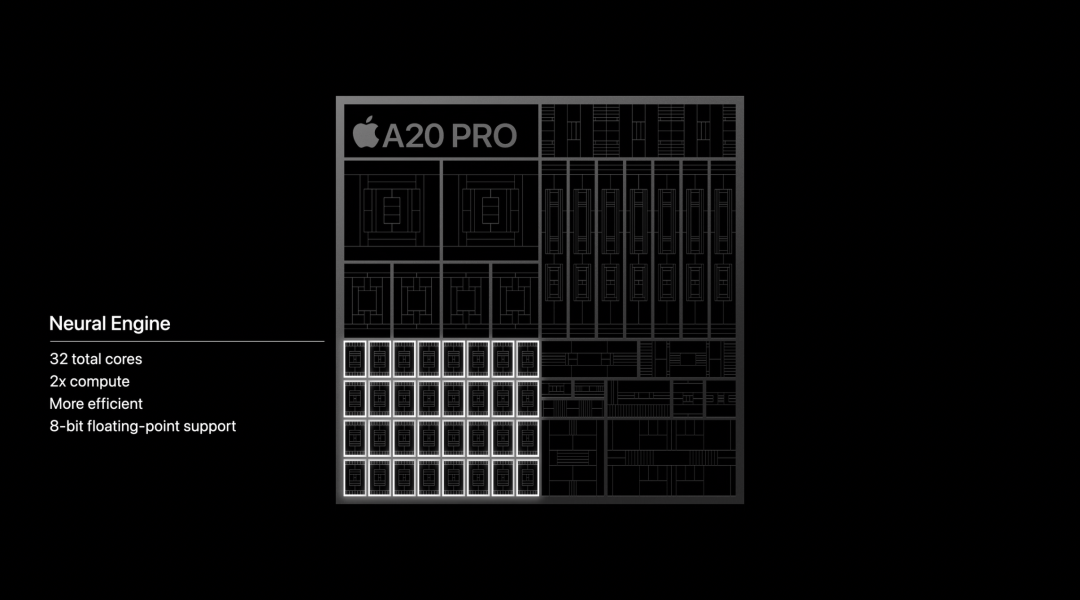
The bottom layer runs on-device, utilizing Apple’s own edge models. This generation of Apple Foundation Models 3 comprises a family of models; the edge tier includes two variants: AFM Core, a 3-billion-parameter dense model handling lightweight tasks such as dictation, summarization, and image understanding; and AFM Core Advanced, a 20-billion-parameter model that operates sparsely. In the latter, weights remain in flash memory until requested, activating only 1 billion to 4 billion parameters per inference. This serves as the default layer, where most requests are resolved. The capacity of this layer is ultimately determined by the chip, positioning the A20 Pro as the critical upgrade target for this generation. Its sole objective is to enable on-device models to perform more valuable tasks. Its significance lies not in benchmark scores, but in whether the definition of a "personal intelligence hub" can be established.
The middle layer is Private Cloud Compute (PCC), Apple’s self-built server cluster, which handles requests exceeding on-device capabilities. This layer hosts larger models: Cloud, which processes most cloud-based requests; ADM 3 Cloud, specialized for image processing; and Cloud Pro, which manages complex reasoning and Agent tool invocation. The most powerful variant, Cloud Pro, runs on NVIDIA GPUs.
The most significant aspect of this layer is not its compute power, but five strict requirements Apple has imposed: stateless computation, where data is used solely for the immediate request, deleted immediately afterward, with no logs retained or use for training; architectural enforcement of these promises, rather than reliance on goodwill; no privileged runtime access, meaning Apple engineers have no backdoors to retrieve data; untraceability, where requests are routed through third-party relays to mask IP addresses, metadata contains no personally identifiable information, and includes a one-time anonymous credential; and verifiable transparency, where the software images running on servers are public, and devices verify the server’s cryptographic proofs before sending data, rejecting transmission if verification fails. This framework is open to security researchers, offering up to $1 million for discovering methods to remotely read request data.
The top layer is the model interface layer. Apple provides a unified access method, allowing on-device models, PCC-hosted models, and third-party local or cloud models to enter the same session without requiring rewrites of upper-layer logic.
This year, the architecture underwent a change: the heaviest tasks—complex reasoning and Agent tool invocation—are no longer confined to Apple’s own data centers. Some workloads have migrated to Google Cloud, utilizing Intel TDX and NVIDIA confidential computing, with root trust anchored in Google’s Titan chips. Apple states that its security requirements have not been lowered; it retains control over the software, attestation mechanisms, and transparency protocols.
This design serves at least three purposes for Apple: preventing the upper limits of AI capabilities from being constrained by mobile device compute power; ensuring that every step data takes off-device follows clear, externally auditable rules; and allowing developers to bypass building their own models by directly calling into the system layer.

Let Apps 'Live' Within the System
With the architecture explained, let’s look at the three core AI capabilities Apple is prioritizing this year. Their division of labor is remarkably distinct.
Personal Context addresses a more comprehensive understanding of the user at the system level. It aggregates personal information scattered across various apps into context that the system can retrieve. Developers need only model their content as App Entities and submit them to Spotlight’s semantic index. This allows the system to locate files by semantic meaning, even if you cannot recall the exact filename.
Onscreen Awareness addresses what the 'AI sees.' Content displayed on the screen previously belonged solely to the respective app. Apple provides developers with a mechanism to associate interface elements with Entities. This enables users to point to the screen and say, 'this photo' or 'this report,' and the system knows exactly which item they are referring to.
App Actions address what 'AI can do.' Developers expose application actions using App Intent, allowing Siri to invoke them directly. This enables apps to complete tasks in the background without necessarily coming to the foreground.
These three capabilities share a common contract: App Schemas. These are standard structures defined by Apple to inform the system of an item's type and an action's purpose. Their value lies in advancing the model's language understanding, meaning applications no longer require code rewrites.
Consider this example. You say, "Send last week's meeting minutes to Mary." The system first locates the document in Spotlight's semantic index, where it is stored as an Entity; then identifies which contact corresponds to Mary; determines whether to use email or WeChat; and finally invokes the appropriate app Intent to send the file in the background. Throughout this process, you may never have opened the files app.

The interaction of "open the app first, then find the button" is being replaced by "state what you want to do, and let the system decide which app to call." Traffic distribution used to occur on the home screen, in search, notifications, and the App Store; now there is an additional layer of distribution that sits further up the stack.
Apple stated that Siri AI can already collaborate with more than 300,000 apps upon launch. However, this figure merely indicates coverage, not that all 300,000 apps are deeply integrated for operations. Merely exposing a "open page" action is entirely different from allowing Siri to check orders, modify information, or complete payments.

The threshold for the next era is not about building a single device
Outside this architecture lies another, more heated battle. The current AI hardware boom has seen the industry burn through capital for over two years.
Humane's AI Pin raised USD 240 million at its 2024 launch, appeared on TIME's list of annual inventions, and was terminated two years later—with cumulative sales under 100,000 units, a return rate exceeding 40%, and eventual acquisition by HP for USD 116 million. Rabbit R1 followed a similar trajectory. Meanwhile, lighter products with more specific scenarios gained traction: 31 new models of AI glasses were launched in the first five months of 2026. According to IDC, global shipments of smart glasses reached 3.566 million units in Q1 2026, a year-on-year increase of 130.1%.
On form factors, the industry has already paid its tuition: devices either grow out of existing wearing habits or must offer users a very specific reason to adopt them. But even if a product succeeds, a more fundamental problem remains unsolved.
The value of personal context is proportional to the volume of data it can access. A ring knows whether you slept well; glasses know what you see; a watch knows your heart rate and location. Individually, each piece of information is useful, but they are scattered across different brands, accounts, and clouds. Any company focusing on a single-point device holds only one fragment — and that fragment alone is hard for AI to truly understand you.
Privacy is the flip side of the same coin. In Meta’s earlier class-action lawsuit over training data, outsourced annotators were accused of accessing sensitive images captured by users. Single-point devices collect precisely the most intimate data, yet often lack the capability to ensure end-to-end security. The data must be uploaded to its own cloud, which lacks the scale and trust infrastructure of Apple’s.
Thus, the barrier has never been about whether a device can be built. Only collaboration within the same brand and ecosystem offers the chance to truly leverage personal context: when data flows within a unified system, AI can piece together fragmented information into a complete picture of a person. Apple is the only player in this industry that controls everything from chips and operating systems to services.
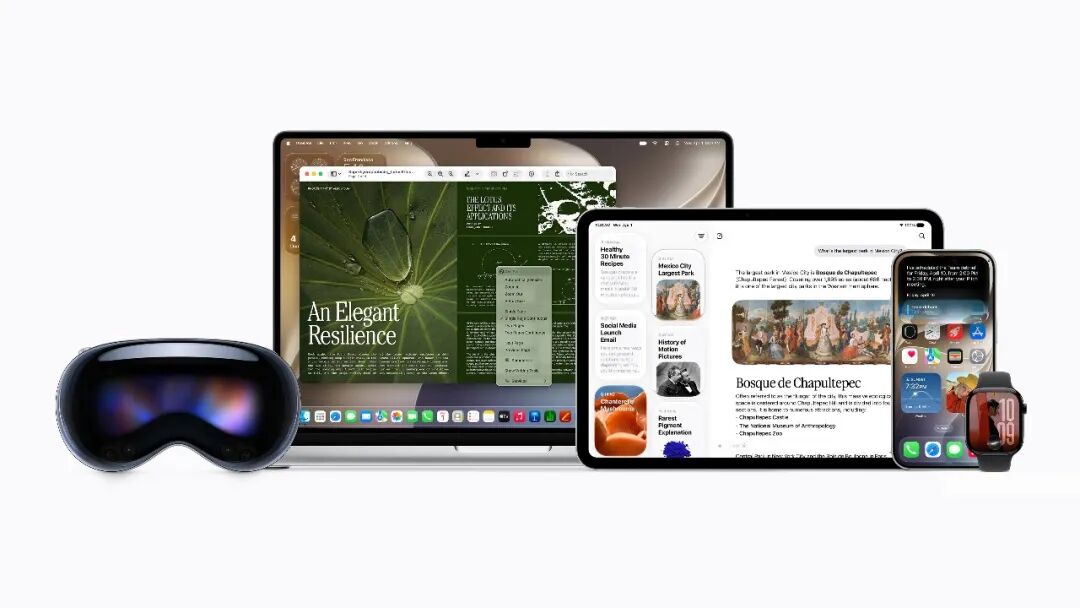
It doesn’t need to build a new device; it simply needs to turn existing devices into a set of distributed context nodes: iPhone provides screen, camera, location, and account identity; Watch is worn on the body, capturing voice and health signals; AirPods sit in the ears; CarPlay covers driving scenarios; home cameras cover indoor spaces; and Apple Vision Pro knows where you are looking. Then, let Siri maintain a consistent relationship across these nodes. This is a rewrite of Steve Jobs’ “digital hub” concept for the AI era.

Privacy boundaries have become Apple’s own “ceiling.”
This generation of the Apple Watch best illustrates the point. The so-called "audio intelligence" refers to the watch converting surrounding speech into text, and then performing several functions on that text: Live Rewind allows you to double-tap the Digital Crown to transcribe content from the past 15 seconds; Siri Recap generates titles, summaries, and key points for a conversation at your specified times and locations; and Sound Recognition continuously identifies alarms, doorbells, and baby cries.
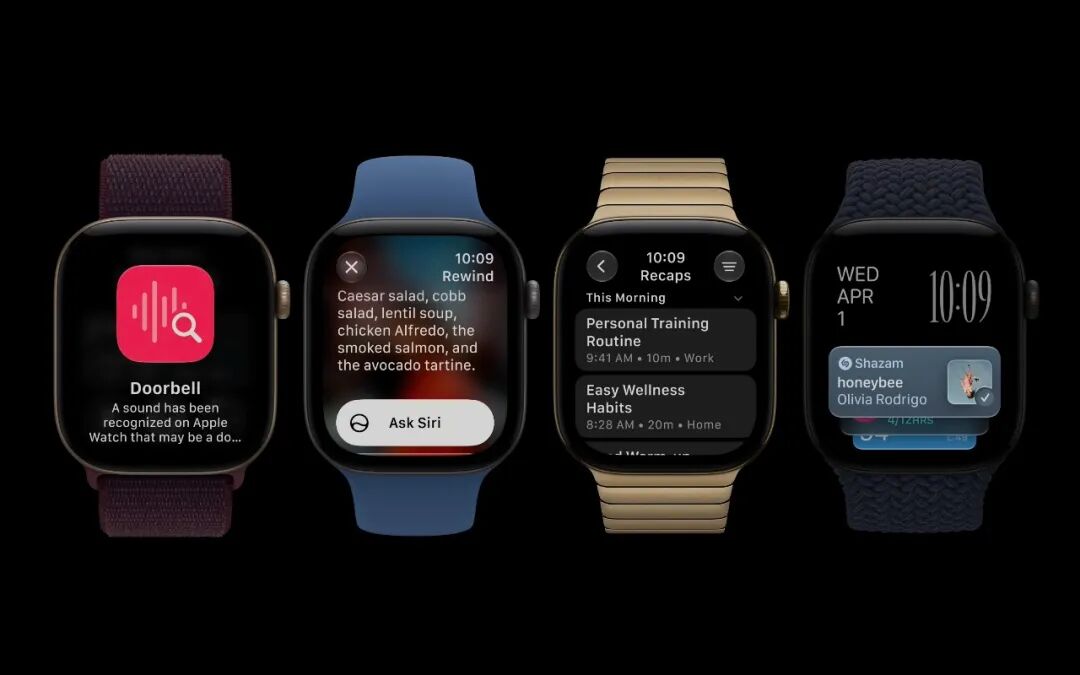
The first two are for conversation, and the third is for environmental monitoring. Wearing it on a wristwatch offers ready-made advantages: it stays on the wrist long-term, doesn't occupy the hands, and doesn't require being taken out like a phone; data collection is processed to be sufficiently imperceptible.
But Apple provides ample privacy protections. The S11 chip dedicates a hardware-isolated region where raw audio does not form recordings accessible to the system or apps; data is deleted immediately after processing, and Apple itself cannot access it. Transcription and summaries are end-to-end encrypted during iCloud synchronization, and this feature requires users to activate it manually.
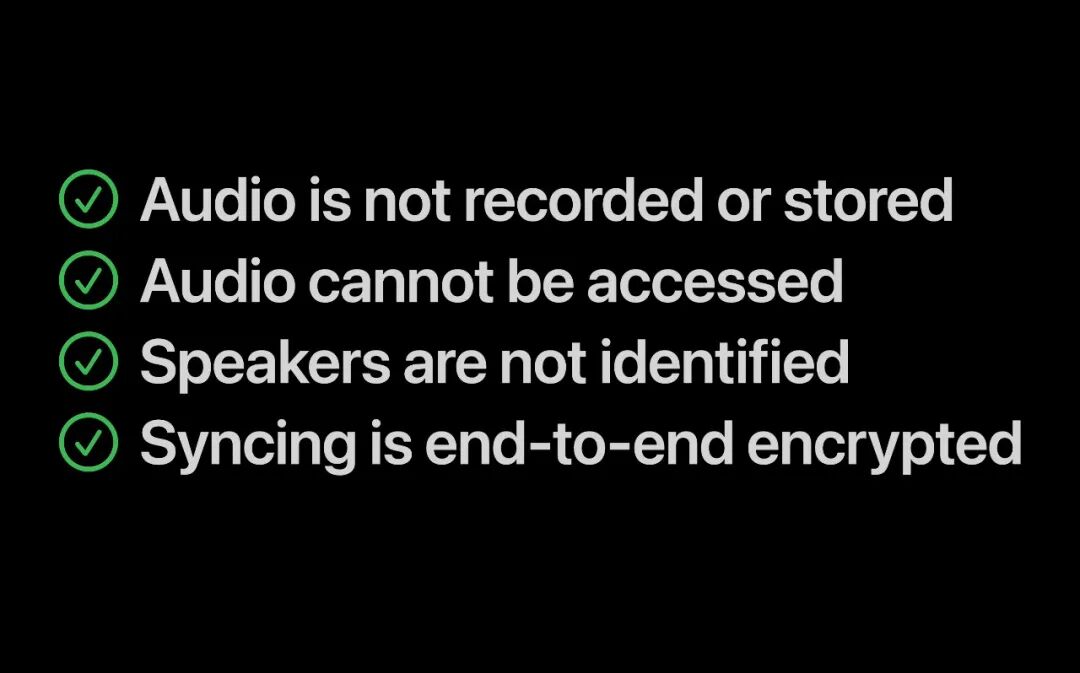
The same document also included another statement from Apple: it will not perform speaker identification.
This statement, which sounds like a privacy commitment, simultaneously defines the upper limits of functionality. Without distinguishing who is speaking, the transcription becomes a subjectless narrative where it is unclear which sentences were said by family members and which by colleagues. Since there are often multiple people nearby, determining what to do when mishearing occurs makes this approach largely unusable in meeting scenarios. Furthermore, pure transcription combined with summarization is one of the lowest-barrier AI capabilities available today.
Additionally, compared to other wearable devices, a watch is clearly not the optimal form factor for capturing audio. The wrist is tens of centimeters away from the mouth, the microphone baseline is short, and the space available for beamforming is limited; moreover, wrist movements introduce noise. In contrast, the temples of glasses are close to both the mouth and ears, while earphones place their microphones directly at the ear canal opening—this is why AI-powered audio glasses can use microphone arrays to distinguish speakers.
To distinguish 'who said what and when,' the source material must first be preserved, even if only stored locally in encrypted form. What Apple provides for Live Rewind is a rolling buffer that is discarded after use. Every step deeper into functionality collides with the safety boundary it has drawn itself.
Although Apple appears to be moving quickly in this area, privacy—placed at the forefront—has ultimately become a self-imposed 'height restriction.'

The roadmap is clear, but it is still far from a closed loop.
Viewing these moves together, Apple has indeed charted a clear path.
On the device side, the A20 Pro combined with AFM Core Advanced enables smartphones to handle long-term inference for the first time, simultaneously satisfying latency, offline capability, and privacy requirements. On the cloud side, Apple uses PCC to offload unprocessable tasks, supplements capability limits with models co-developed with Google, and retains trust through software verification and transparent mechanisms. Surrounding this core is an ecosystem of devices—watches, earbuds, glasses, computers, car systems, and cameras—where AI flows between nodes rather than being confined to a single box.
The direction of this path is clear, but the new capabilities released today primarily serve the app ecosystem: enabling smoother invocation of 300,000 apps and making existing system information easier to utilize. Apple clearly recognizes AI's value for productivity; the Mac screen, Health data, and content Siri drafts point toward the same direction, but these represent the next step, not the current one.
So, returning to the initial question: Has Apple been constrained by its own privacy commitments? The 'height restriction' is real, and the depth of functionality ceded is also real. The temporary unavailability of Siri AI in mainland China is merely the most convenient excuse; remove the geographic factor, and the substantive issues remain just as significant.
The other side of this issue is that few companies simultaneously control chips, operating systems, models, application interfaces, and entire hardware product lines — and the path to a personal intelligence hub is viable only for such firms. The constraints remain in Apple’s hands; it alone decides when and how much to loosen them.
By Yisong
Edited by Yisong

Source: Future Devices