

Ant Group’s LingBot Open-Source Robot Brain Surpasses 2.2 Million Downloads at Wuzhen Summit
By Jiang Si Qi
At the 2026 World Internet Conference in Wuzhen, Ant Group’s embodied AI subsidiary LingBot showcased its fully open-source robot foundation models and a smart pharmacy deployment developed with Guoda Pharmacy.
From November 2 to 5, the 2026 World Internet Conference Wuzhen Summit was held in Wuzhen, Zhejiang Province. The theme of this year's summit is 'Open Source and Openness, Co-building and Sharing: Joining Hands to Build a Community with a Shared Future in Cyberspace.'
According to Cover News, LingBot, Ant Group's embodied AI subsidiary, debuted its fully open-source general-purpose robot brain at the summit. It also showcased a smart pharmacy solution jointly deployed with Guoda Pharmacy. In the nine months since its open-source release, the LingBot series has surpassed 2.2 million cumulative downloads and accumulated more than 33,000 GitHub stars. Notably, the full-stack model for the general-purpose robot brain won the 'New Light' Product Award at the 'Light of the Internet' Expo, while the smart pharmacy deployment scenario secured the 'New Shine' Scenario Award.
The report notes that the open-source wave continues to expand outward, moving from early applications in language models, code generation, and content creation to robotics perception, prediction, and action in the physical world. The robotics industry has long struggled with complex hardware morphologies and fragmented task scenarios, forcing many research teams to train bespoke robot 'brains' for specific robot models and use cases.
LingBot's approach to breaking this bottleneck is an open embodied foundation model strategy. The team has globally open-sourced core models covering spatial intelligence, dexterous manipulation, and environmental feedback. They have built a comprehensive full-stack capability designed to help robots 'see more clearly, think more distinctly, and act more efficiently,' with the goal of reusing the same intelligent capabilities across diverse robot morphologies, tasks, and scenarios. At the summit, the team also simultaneously unveiled the Brain Full-Stack 2.0 model matrix.
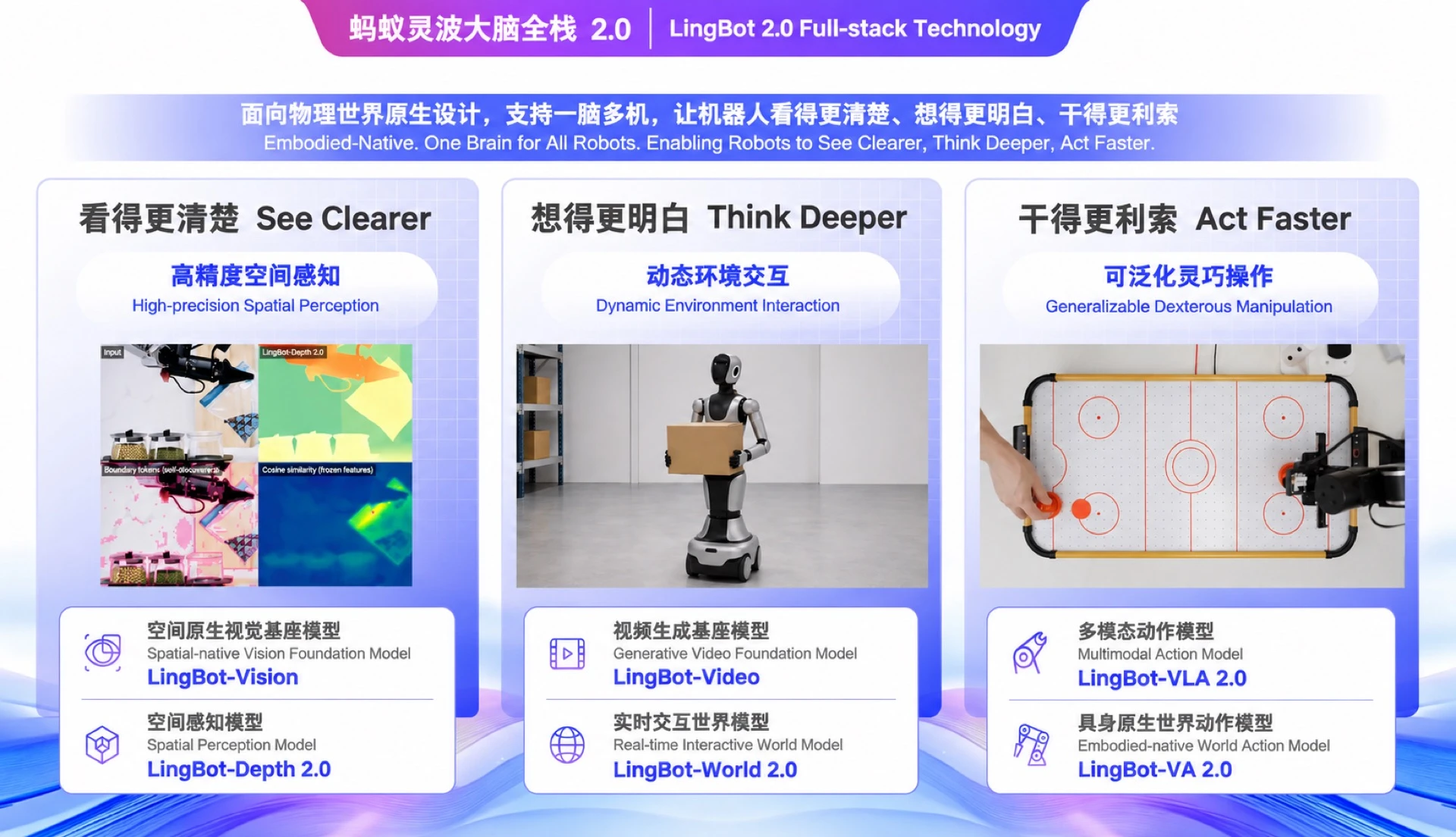
According to available data, work related to the LingBot series has been cited by teams at Physical Intelligence, Generalist AI, and others. Stanford University's OpenWAM project has reused and adapted LingBot-VA. In South Korea, the FastOPD research project used LingBot-VLA as a teacher model to explore training pathways for lightweight robot models. Meanwhile, the Swiss Federal Institute of Technology in Lausanne (EPFL) leveraged LingBot-Map to conduct 3D reconstruction research on coral reefs.
Regarding the toolchain ecosystem, the report mentions that LingBot-VLA and LingBot-VA have been adapted for the LeRobot robotics development platform. The LingBot-Vision code has been merged into the main branch of the timm visual backbone model library, and LingBot-World is supported by the two major open-source inference engines, vLLM and SGLang. NVIDIA has also integrated LingBot-World into its own open-source world model inference library, FlashDreams.
On the open-source community front, the online preliminary round of the first LingBot Embodied Foundation Model Challenge has just concluded. According to Cover News, this preliminary round attracted 1,855 teams and 3,252 contestants from 648 universities and enterprises across 13 countries.
At the summit, LingBot partnered with Guoda Pharmacy to showcase the smart pharmacy solution at the Wuzhen World Internet Science and Technology Museum. The booth replicated a real pharmacy environment with densely stocked shelves. The robot can autonomously navigate narrow aisles just 80 centimeters wide, completing the entire workflow from order reception and intelligent sorting to product delivery. This solution is already in routine commercial use across multiple Guoda Pharmacy stores in Shanghai. Without requiring any changes to the original shelf layouts or product displays, the robot seamlessly integrates into the existing operational system to assist pharmacists with high-frequency, repetitive sorting tasks.
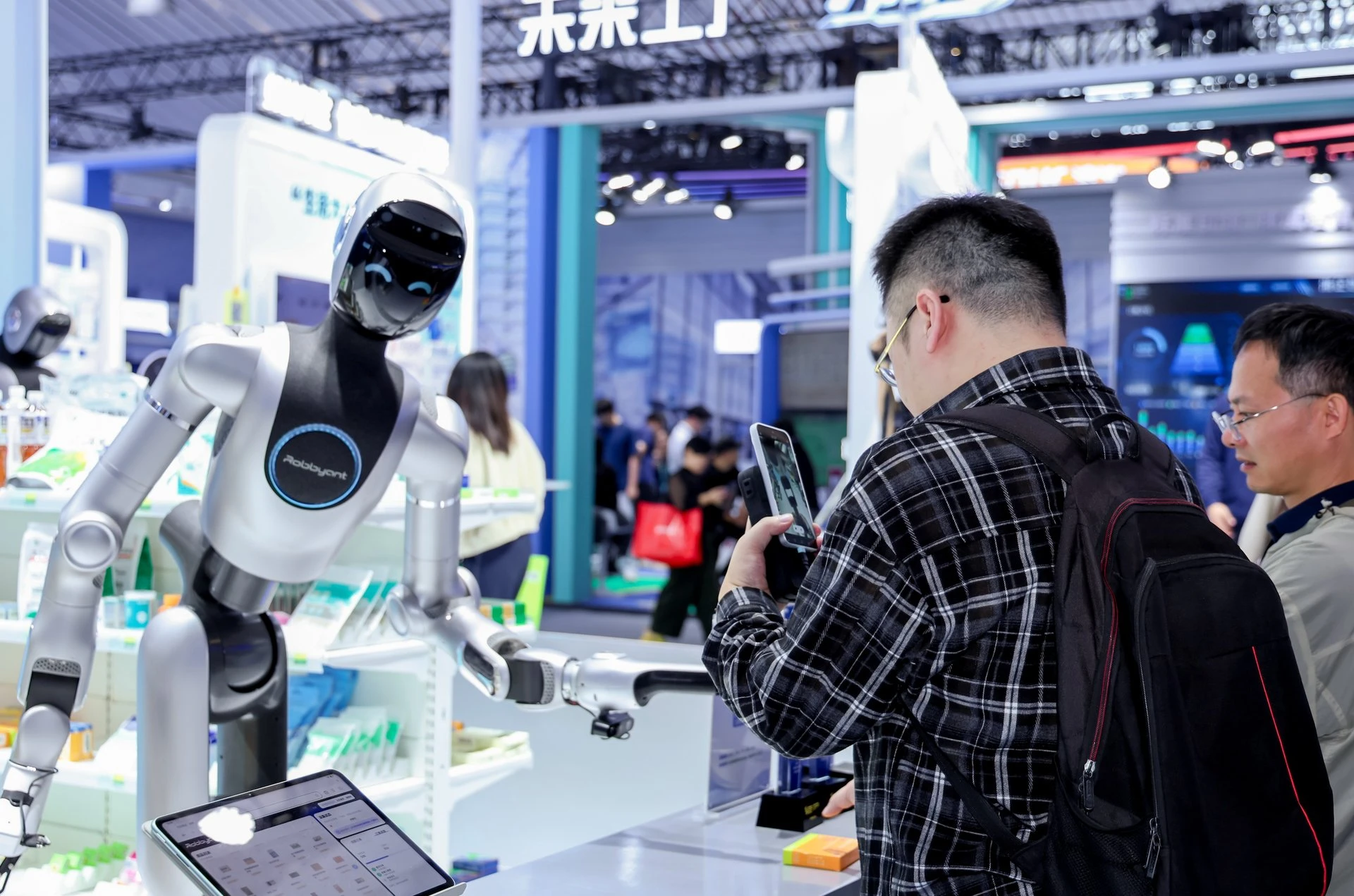
Beyond the pharmacy use case, reports indicate that Ant LingBot is collaborating with partners including Longsheng Weirui, Dema Technology, and De'er Xiangwang to expand into industrial material loading and unloading, as well as logistics sorting. Simultaneously, the company is partnering with robot hardware manufacturers such as Leju and Taihu to validate the general capabilities of its "one brain, multiple robots" architecture. The team has also signed a memorandum of understanding with the Arab Federation for Digital Economy (AFDE) to deploy this general-purpose robotic brain in the Middle East, targeting industry scenarios such as retail, logistics, and hospitality.