

Ball Screw Suppliers Await Tesla's Production Ramp-Up Amid Unconverged Humanoid Robot Designs
By Xiong You Di
During Tesla's third-quarter earnings call, Elon Musk defended early production ramp-ups for Optimus despite unfinished hand designs, citing parallel progress in robot manufacturing, supply chain development, hardware design tweaks, and AI software. Meanwhile, Chinese ball screw suppliers are scaling capacity but waiting for actual downstream demand as humanoid robot joint architectures remain unsettled.
During Tesla's third-quarter earnings call, an analyst pressed the company: if the design for Optimus's hands is not yet fully finalized, why initiate the production ramp-up ahead of schedule?
Elon Musk explained that Tesla is simultaneously advancing robot manufacturing, supply chain development, hardware design fine-tuning, and AI software development. He then used a piece of casino slang to describe the approach: "We're definitely, as they say in Vegas, betting on the come."
Betting on an unmaterialized future is classic Musk.
It will take at least another year to move from early production now to a mass production rate of 20,000 units per week. Yet this bet has already rippled through the Chinese supply chain.
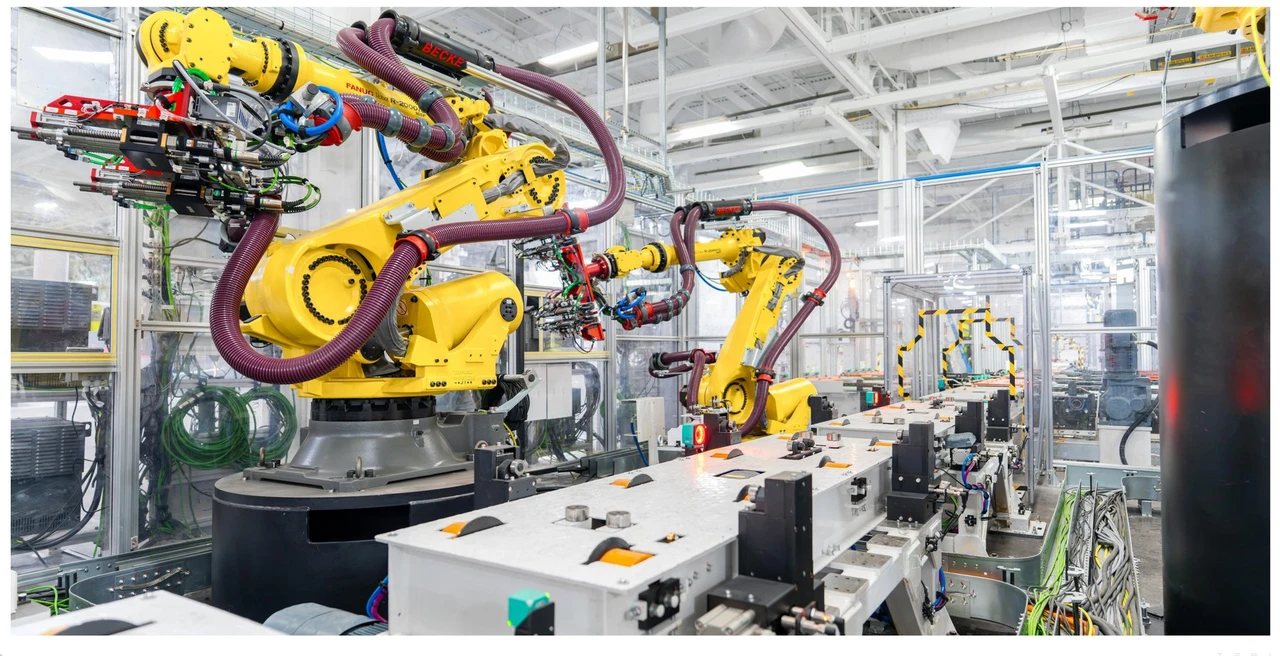
In mid-September, multiple media outlets cited industry sources reporting that Tesla's robotics team visited supply chain companies in the Yangtze River Delta to conduct factory audits, including Tuopu Group, Sanhua Intelligent Controls, and Joyson Electronics.
In October, a response to an inquiry for a ChiNext IPO disclosed by Xinjian Transmission provided another angle: an anonymous top-tier client, referred to as Company A, has already placed mass production orders with the company for humanoid robot screw products. The filing, however, did not publicly confirm Company A's identity.
Over the past two years, the market has been eager to dissect Optimus's bill of materials to identify component suppliers that could emerge as winners. A primary focus has been the planetary roller screw. As the core transmission component in linear actuators, it converts the rotary motion of a motor into linear push-pull motion. By distributing the load across multiple rollers, it achieves high load capacity and rigidity within a compact structural footprint, making it suitable for robot joints that require significant thrust. Following this technical trajectory, domestic companies have begun expanding production capacity, and the market has generated substantial long-term demand forecasts.
But shifting the focus away from Tesla to examine the financial reports of the Chinese robotics supply chain reveals a stark contrast: while some components already show clear signals of shipments and orders, other products in which the market has placed high hopes are still waiting for downstream demand to materialize.
The components popularized by Tesla are not necessarily the first to achieve commercial scale.
Contrasts in the financial reports
Let's start with the motors.
In the first half of 2026, Kinco shipped 113,600 frameless torque motors, a year-on-year increase of 422.90%. During the same period, the company's revenue from the robotics sector reached approximately RMB 243 million, up 62.31% year-on-year, accounting for 54.36% of its total operating revenue.
Leisai Intelligence disclosed that its backlog of frameless torque motor orders exceeds 1 million units, and the company continues to advance the construction of automated production lines. It is important to note that backlog orders do not represent completed deliveries, and Leisai's robotics revenue cannot be directly equated to the company's total revenue.
LiDAR is also showing signs of commercial scaling. In the first half of 2026, Hesai Technology shipped 260,653 robotic LiDAR units, a year-on-year increase of 165.3%. During the same period, RoboSense reported sales of 282,600 LiDAR units for "robotics and other applications," up 510.4% year-on-year.
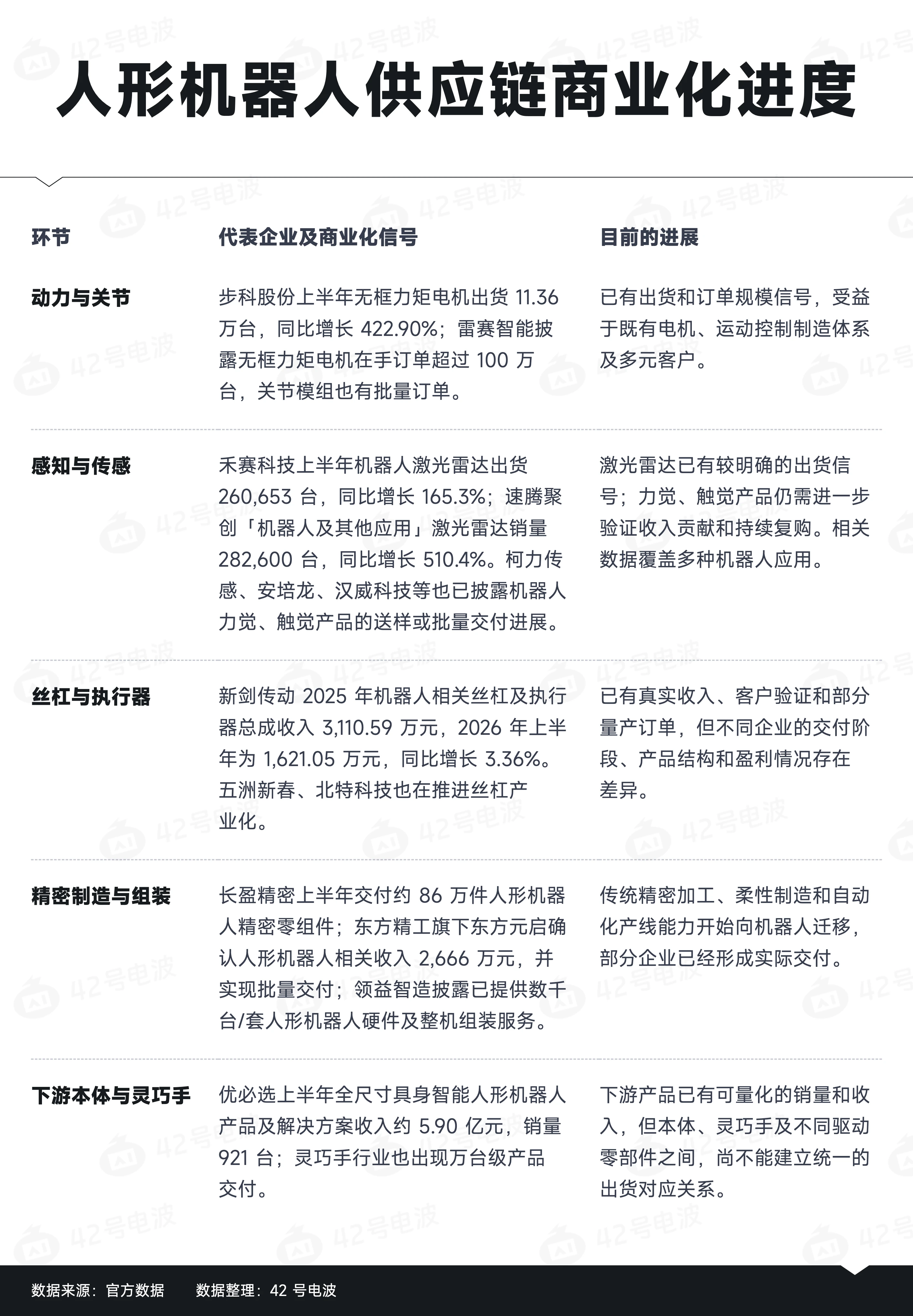
These figures are not entirely driven by humanoid robots. Motors, motion control systems, and LiDAR can serve a variety of products, including mobile robots, quadruped robots, and industrial robots, meaning they do not need to rely entirely on the mass production timeline of any single humanoid robot manufacturer.
The situation with ball screws is different.
In 2025, Xinjian Transmission generated RMB 31.1059 million in revenue from ball screws and related electromechanical actuator assemblies for embodied AI robots, representing a year-on-year increase of 346.36%. In the first half of 2026, this figure stood at RMB 16.2105 million, a year-on-year growth of 3.36%.
Sales revenue from an anonymous client, designated Customer A, also shifted significantly: it totaled RMB 16.5875 million in 2025, dropped to RMB 1.5248 million in the first half of 2026, and fell further to RMB 224,400 in July and August. The company explained that following multiple iterations of technical solutions, the core technical routes and process parameters for its main products have now been finalized. As a result, procurement needs during the earlier R&D and prototyping phases have declined, marking the transition into the initial stages of mass production.
Although Customer A has already issued mass production orders, a time lag remains between order execution, the client's production ramp-up, delivery, and revenue recognition.
Why are some components already showing signs of scaling, while ball screws are still waiting?
One reason is that motors, motion control systems, and lidar already benefit from mature manufacturing ecosystems and a diversified customer base. While robotics alters the physical dimensions, performance requirements, and operating environments of these products, suppliers do not need to build their manufacturing capabilities from scratch.
The second reason brings us back to the robot hardware itself: the specific joint architectures chosen by different manufacturers dictate which components actually secure orders.
Tesla can drive expectations, but not broader demand
To understand this divergence in demand, one must first examine how different manufacturers select their joint architectures for the robot hardware.
Tesla can amplify market expectations for a particular technical approach, but it cannot dictate demand across the entire Chinese robotics market.
In terms of joint motion types, rotary joints currently remain the mainstream. Guanyan Tianxia estimates that in 2025, rotary joints will account for approximately 94% of global demand for humanoid robot joint modules, with linear joints making up about 6%.
The difference between the two approaches goes beyond simply using motor rotation versus converting that rotation into linear motion. Rotary joints benefit from relatively mature mechanical structures, control schemes, and supply chain ecosystems, making them easier to develop and debug within existing architectures. In contrast, linear drives offer advantages in certain high-thrust, high-stiffness scenarios, but their cost, structural layout, and control requirements also heavily influence overall robot design.
The performance advantages of ball screws must be weighed against overall robot design constraints before they can translate into actual market demand.
In real-world applications, the pace of demand for ball screws is similarly slow. Current humanoid robot shipments are still dominated by exhibitions, scientific research, and data collection, while industrial applications requiring high payloads and continuous, long-duration operation remain limited. The Embodied AI Development Report (2026), published by the China Academy of Information and Communications Technology and other institutions, indicates that global humanoid robot shipments exceeded 22,000 units in the first half of 2026. Among these, entertainment and commercial performances combined with scientific education and data collection accounted for more than 60%, tour guiding and retail assistance made up approximately 19%, smart manufacturing accounted for about 13%, and warehousing and logistics comprised roughly 5%.
The humanoid robot market has not yet developed a unified demand structure centered on industrial operations. With use cases yet to converge, technical approaches remain unsettled. Different robot manufacturers have made distinct trade-offs across dimensions such as payload, cost, spatial footprint, and motion performance, based on their respective cost structures and target customers.
In public materials, Unitree states that its joint actuation primarily relies on a high-bandwidth, force-controlled, quasi-direct-drive planetary rotary joint approach characterized by rotary actuation. Meanwhile, the Kepler K2 employs a hybrid architecture combining planetary roller screw linear actuators with rotary actuators.
Zhang Haixing, founder of Matrix Superintelligence and a former Tesla employee, noted in an October interview with Southern Weekly that the company's second-generation robot originally featured almost entirely linear joints but was never publicly released due to prohibitive costs. The third-generation MATRIX-3 instead adopted a hybrid "rotary plus linear" drive. Zhang stated that the third-generation product reduced ball screw usage by approximately 40% compared to the previous design. He added that replacing all rotary joints with linear joints would at least double the overall robot cost.
This reflects the product experience of a single company, but it reveals a broader trend: even when the performance advantages of linear joints are recognized, cost pressures force robot manufacturers to recalculate their hardware costs.
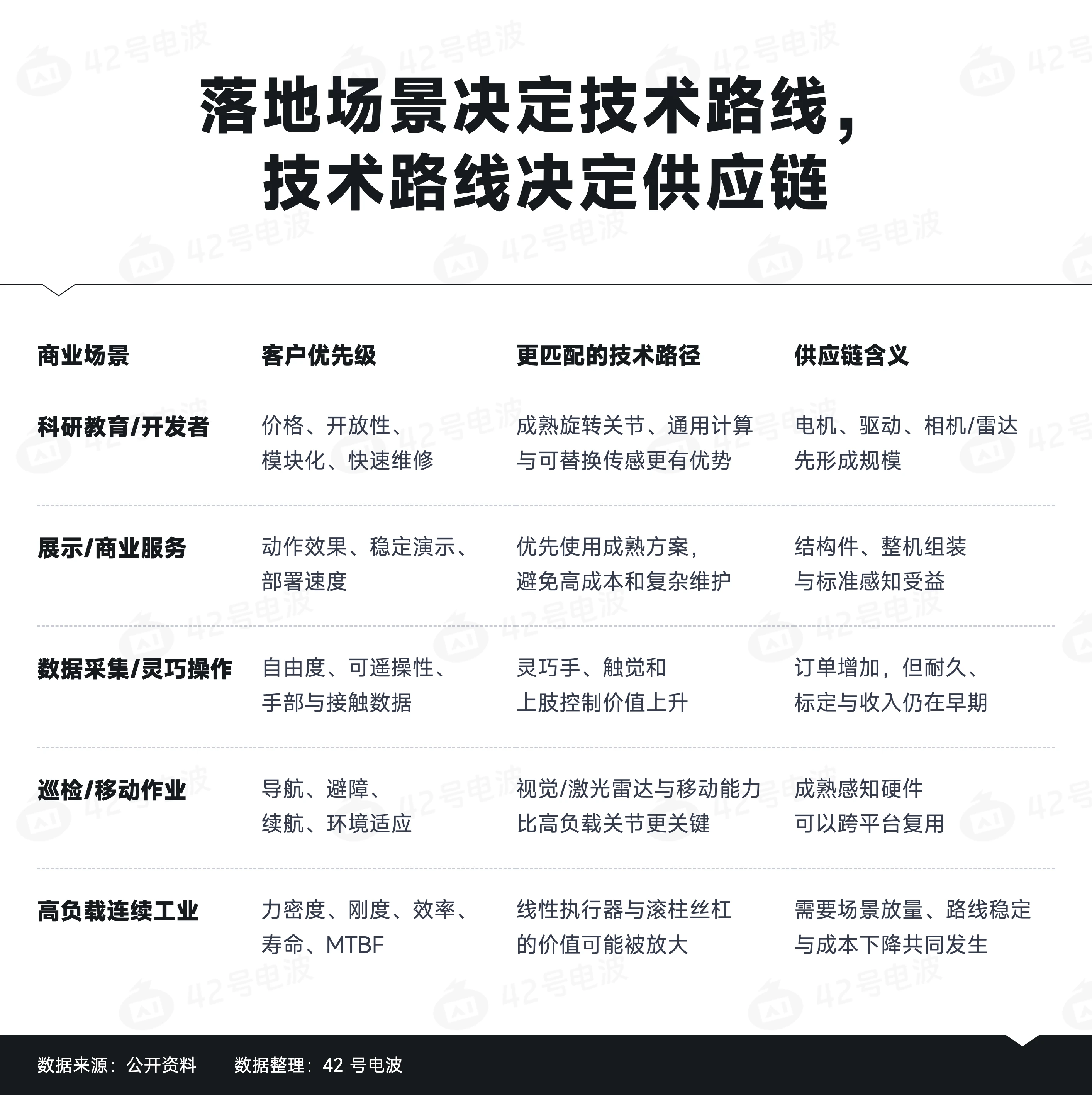
The trade-offs made by a single company may seem minor, but the independent decisions of numerous robot manufacturers introduce the biggest variable into the supply chain. Suppliers can no longer lock in manufacturing processes around a stable design in advance, as they did in the automotive era. This diverges from the logic of the partially scaled supply chains already established in the auto sector.
Tesla’s influence in the new energy vehicle sector stems not only from specific component technology choices, but also from its vehicle sales volume, mature manufacturing systems, and long-term supply chain collaboration. Once a technology is adopted at scale, suppliers can invest in equipment and refine their processes around relatively stable product demand, ultimately driving down costs through mass production.
In the humanoid robot sector, however, robot body design, application scenarios, and the technological roadmaps for core components are all being explored simultaneously.
China’s supply chain advantages have also made daily iteration possible for robot manufacturers. According to a report by Nanfang Daily, the "Robot Valley" in Nanshan District, Shenzhen, has gathered more than 200 companies across the robot supply chain. Spanning precision machining, motor drives, sensors, and complete robot assembly, many of these suppliers are located within a half-hour drive of one another. Zhao Tongyang, founder of ENGINEAI, noted that companies can draft designs in the morning, build prototypes in the afternoon, and iterate the next day, compressing the R&D cycle from a monthly to a daily timeframe.
For precision transmission components like ball screws, this level of iteration efficiency presents both an opportunity and a source of uncertainty.
While robot manufacturers are still experimenting with different joint architectures, suppliers that can respond quickly and accommodate design revisions have the opportunity to participate earlier in the development of a wider range of products.
However, while motors, LiDAR, and certain precision manufacturing services can accumulate shipments across multiple clients and different robot form factors, demand for ball screws remains locked to specific technological roadmaps. Once a design is adjusted, the changes propagate all the way up the supply chain. A supply chain professional, discussing the modification and finalization of the ball screws in the Optimus hand, noted, "The wiring inside the motors has to be redone."
Demand for planetary roller screws remains dependent on humanoid robot body shipments, the proportion of models utilizing linear actuation, and the actual number of screws required per robot.
The market for micro ball screws, however, hinges on dexterous hands. GGII estimates that sales in China's dexterous hand market reached approximately 19,200 units in 2025 and are projected to hit 70,200 units in 2026. Yet, the underlying technical approaches have yet to converge, with linkage, tendon-driven, direct-drive, and hybrid configurations all seeing adoption.
The technical value of these components only translates into supplier revenue through the robot's physical architecture, actual shipment volumes, and per-unit consumption. Consequently, while the long-term market potential for screws is substantial, current revenues remain limited.
The Gap Between Prototyping and Mass Production
Demand-side constraints tell only half the story. The other half lies hidden on the factory floor.
One supply chain professional noted that as robot production scales from one unit to 10, 100, and 1,000 units, the manufacturing system undergoes a series of fundamental shifts.
A single robot can be hand-assembled by a few engineers who simply troubleshoot and readjust as issues arise. At 10 units, manufacturers must formalize production processes and establish standard operating procedures (SOPs) and standard inspection procedures (SIPs). At 100 units, they need to implement core component traceability, incoming material inspection, and end-of-line testing tools. Scaling further to 1,000 units typically requires shifting from work-cell production to an assembly line, with clearly defined station roles and inter-process inspection mechanisms.
He also pointed out that because robot products iterate so rapidly, companies sometimes cut corners on reliability testing to accelerate prototyping. As a result, defects such as faulty incoming materials are only discovered once they reach the production line.
The more frequently a product is revised, the faster suppliers must respond. However, if validation processes are compressed, design defects and quality issues can emerge in clusters during subsequent production. Mass production means more than just building additional prototypes; it requires maintaining consistent and stable product quality across continuous deliveries.
This is especially critical for precision transmission components like screws. Suppliers must prove more than just the ability of a single screw to meet precision specifications. They must also demonstrate consistency across different production batches, stability in mass-production yield rates, and reliability under repeated loading and long-term operation.
The same logic applies to cost.
Data disclosed by Xinjian Transmission shows that the average selling price of its planetary roller screws fell from RMB 1,652.31 in 2024 to RMB 758.83 in 2025, before rebounding to RMB 781.29 in the first half of 2026. The pricing structure for this business remains in flux. The company explicitly noted that as customer validation progresses and order volumes scale up, both product prices and gross margins will undergo further changes.
This means that cost reduction post-mass production involves more than simply scaling up the output of an existing design. It may also require redesigning the product, altering manufacturing processes, and striking a new balance among performance, reliability, and cost.
Industry observers also note that reducing the cost of a robot from RMB 200,000 to RMB 100,000 cannot rely solely on supplier price cuts or competitive negotiations. Instead, it requires value analysis and value engineering to re-evaluate the product architecture, component selection, and overall design.
In other words, if an OEM modifies its joint architecture, the equipment and manufacturing processes originally built around a specific type of screw may not be directly transferable to other products.
Returning to Xinjian Transmission, the company's designed capacity for screws and related electromechanical actuator assemblies in 2025 was 1.5 million units. Production reached approximately 1.09 million units, and sales were around 980,000 units, resulting in an overall capacity utilization rate of 72.7%. Meanwhile, its IPO fundraising project plans to simultaneously build production capacity for both humanoid robot and automotive planetary roller screws. Wuzhou Xinchun and Beite Technology are also advancing similar projects.
Expanding capacity ahead of the curve can help companies secure future customers, but it also requires them to make calculated judgments about future demand.
As robot delivery volumes scale from dozens to hundreds and eventually thousands, supplier requirements will inevitably shift. In the early stages, customers prioritize rapid service and operational flexibility. However, once clients begin stable, high-volume deployments, their focus shifts toward a supplier's quality management systems, equipment capabilities, production processes, process engineering recommendations, and sustained delivery capacity.
For ball screw suppliers, pre-planned capacity is essentially a calculated bet.
Ball screw suppliers have been waiting for Tesla for two years, but the story of this wait is far from over.