

Maxinsights Raises $30 Million Seed Round Led by Peak XV to Scale Robot Training Data
By Jiang Si Qi
On October 22, Santa Clara-based Maxinsights closed a $30 million seed round led by Peak XV, with participation from Tola Capital, South Park Commons, Yince Capital, and Alumni Ventures, to scale its pipeline of real-world human demonstration data for robot training.
On October 22, U.S. Eastern Time, Maxinsights, a robotics training data company headquartered in Santa Clara, California, announced the close of a USD 30 million seed funding round led by Peak XV, with participation from Tola Capital, South Park Commons, Yince Capital, and Alumni Ventures. It targets precisely the most scarce resource in robotics training: massive volumes of real-world human demonstration data.
What Maxinsights does can be summarized in one sentence: it pays everyday people to wear cameras and record their daily routines—such as cooking, cleaning, and commuting—and then processes these egocentric videos into training data that robots can learn from. The company positions itself as the "data layer for physical AI," handling everything from data collection and quality control to annotation and delivery in-house. On the same day, the company also launched two proprietary products: MaxLoop, for quality control of the collected videos, and MaxGlove, a sensor glove that captures hand force.
The company's approach is rooted in the logic of robotic motor learning. According to Maxinsights, for a robot to learn how to fold a shirt or load a dishwasher, it must first watch humans perform the exact same task thousands of times. However, no one has yet recorded this kind of everyday physical labor at the scale required by current models.
Founder and CEO Yuguang Yuan stated: "Robots are going to enter real kitchens, where unexpected things happen every few minutes. The only way to capture these edge cases is to record real labor in real homes."

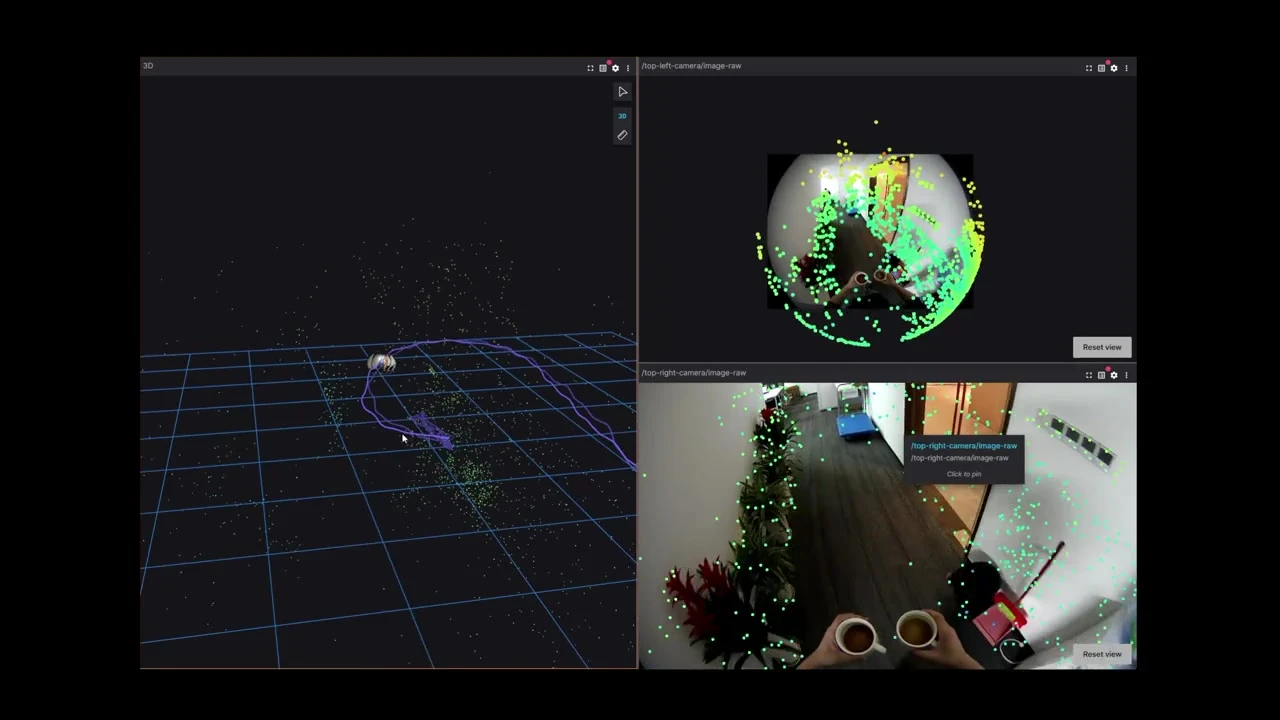
Visualization interface showing multi-camera feeds and 3D trajectories (Source: Maxinsights website)
Image | Egocentric video footage captured by a data collector (Source: Maxinsights LinkedIn)
To acquire this kind of footage, Maxinsights has built its own data collection network. According to the company, there are currently more than 5,000 contractors distributed across six countries, wearing Maxinsights' proprietary camera hardware to load dishwashers, make milkshakes, and wash cars. According to Forbes, this hardware suite includes head-mounted, wrist-mounted, and chest-mounted cameras. The company recruits these collectors through local staffing agencies but manages them directly, without outsourcing the collection process to third-party vendors.
All data collection takes place in real-world settings. According to Maxinsights, industry peers often set up tasks in simulated environments and even ask operators to slow down their hand movements to facilitate post-processing. Maxinsights, however, records real work at a natural pace in actual homes, restaurants, and hotels, constantly exposing the model to new environments and unforeseen situations. The collectors are simply filming tasks they already perform in their daily routines; they just wear the additional cameras to record the process and are compensated for it.
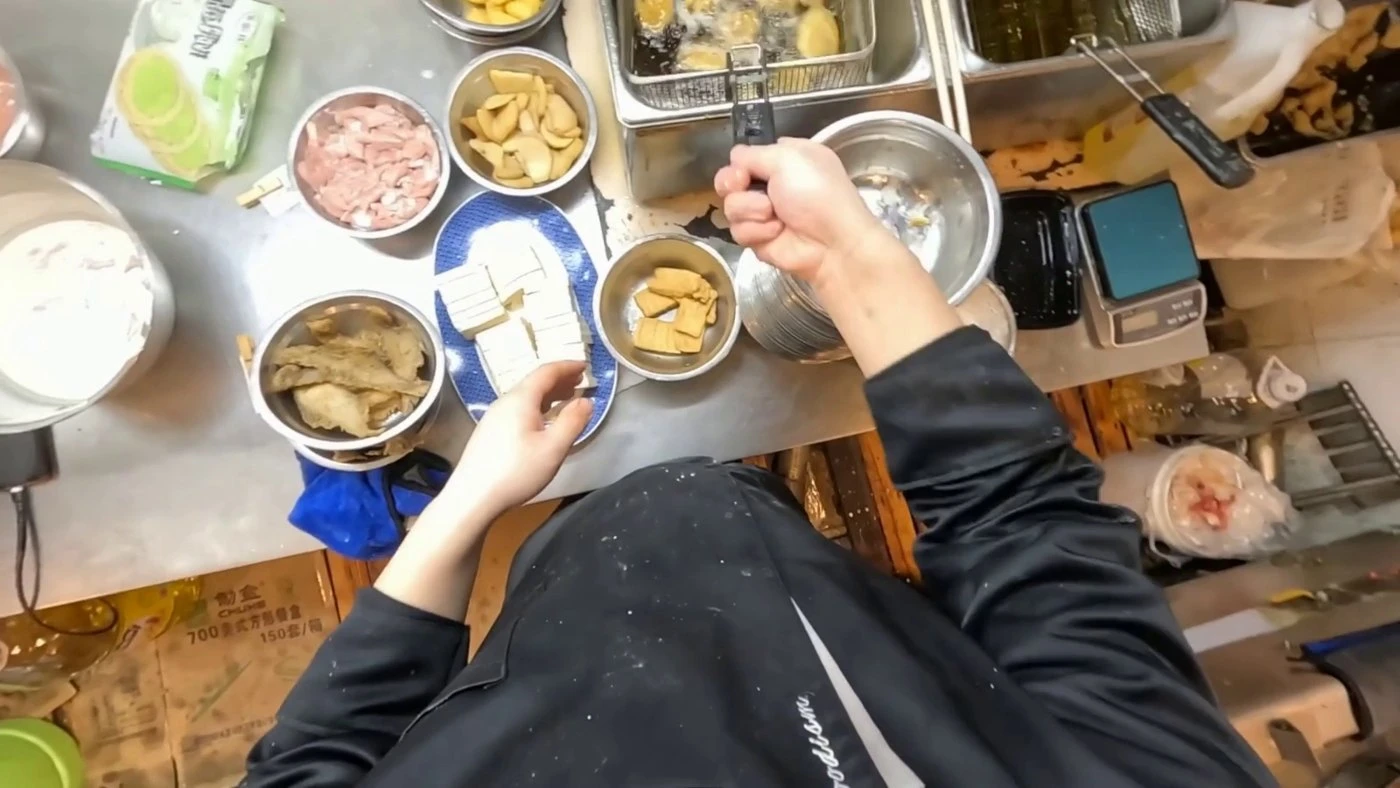
Egocentric video footage captured by a data collector (Source: Maxinsights LinkedIn)
Image | Egocentric view of a collector preparing food in a kitchen (Source: Maxinsights website)
Once the raw data is ingested, it undergoes five processing stages.
The first stage is data collection;
The second stage is inspection, involving both automated and manual review of every video to assess recording quality, task completion, hand visibility, multi-channel signal synchronization, and metadata completeness;
The third stage is annotation, where a proprietary model tags each video across four hierarchical levels—environment, task, subtask, and instruction—while simultaneously labeling hand poses, body movements, and object interactions;
The fourth stage is curation, which involves querying the corpus and adjusting data ratios based on task, scene, region, behavior, complexity, or specific customer requirements;
The final stage is the delivery of raw or processed datasets, after which feedback from customers and models feeds into the next collection cycle.
According to Maxinsights, this pipeline has accumulated more than 2 million hours of video to date, of which 1.5 million hours have been processed and are ready for immediate delivery and direct use in model training. The company currently works with more than 30 customers, spanning frontier AI laboratories and foundation model companies, eight of which have signed long-term, ongoing partnership agreements.
Two of these customers are specifically named. According to Maxinsights, all 200,000 hours of first-person perspective data used to train Genesis AI's robot foundation model GENE-26.5, released on May 6 this year, were exclusively provided by Maxinsights. Additionally, Maxinsights is the largest data provider behind Dyna Robotics' world-action model Dyna-2.
"For Genesis 26.5, we focused heavily on videos of people naturally completing everyday tasks—a large portion of which was provided by Maxinsights—to help the model learn from a broader range of real-world scenarios," said Johnson Wang, co-founder of Genesis AI.
As data volumes continue to grow, the pressure on quality control becomes increasingly acute—a challenge that MaxLoop is designed to solve.
According to Maxinsights, real-world videos break most annotation tools: hands are occluded by objects, multiple hands appear in the frame simultaneously, operators wear gloves and rings, and fast movements create motion blur. To address this, the company trained a hand-tracking model on its own collected videos and built MaxLoop on top of it. MaxLoop is an "agent-in-the-loop" system that scores each video clip upon receipt and corrects issues while data collection is still underway.
Egocentric view of a collector preparing food in a kitchen (Source: Maxinsights website)
Figure | Visualization interface for multi-camera feeds and 3D trajectories (Source: Maxinsights official website)
Maxinsights shared several key metrics detailing the impact of MaxLoop's launch. The time for operators to receive quality feedback dropped from one to two weeks to the same day. The team size for manual review was reduced by 90%, and review costs fell by approximately 80%. The company can now process 450,000 hours of video per month. The same model also extracts pose, object state, contact, and force data from each video clip. According to the company, whereas one hour of video previously taught a model only a single task, it can now teach it several.
While MaxLoop handles quality control and parsing at the software level, MaxGlove supplements the dimensions of information that cameras cannot capture. Co-developed by Maxinsights and Genesis AI, this sensor glove records grip tightness, object weight, and how contact states change throughout a task. According to Maxinsights, vision alone cannot give a robot the physical "feel" of an interaction. Force and torque signals, however, reflect contact, pressure, resistance, and slip, helping the robot determine whether an object is grasped securely, how much force to apply, and when adjustments are needed.
Maxinsights opted to build its own glove because off-the-shelf alternatives require long calibration cycles, yielding only 10 to 20 minutes of usable data per day. According to the company, MaxGlove integrates with existing egocentric collection systems, deploys reliably across various environments, and will be rolled out across the entire collection network, with the goal of collecting 1 million hours of haptic data by 2027.
The team behind this integrated hardware and software stack has deep engineering roots. Founder Yuguang Yuan previously co-founded the industrial robotics company Mega Gear Robotics, which was later acquired. Before that, he was Eaton’s youngest executive leader, managing a product division with roughly USD 150 million in revenue and over 1,500 employees. Co-founder and CTO Kun Wang joined Google in 2014 as an early member of the simulation team for Google's self-driving project, which later spun out as Waymo. In 2019, he co-founded QCraft with several former Waymo colleagues, serving as its COO. QCraft has since grown into a unicorn with over 1,000 employees, and its autonomous driving technology is deployed in more than 1 million vehicles. The rest of the team hails from Google, Microsoft, Meta, Waymo, and Hulu.
This is the primary reason the lead investor is backing the company. Rohit Agarwal, Managing Director at Peak XV, noted, "Almost every company in this space is simply selling data hours. Maxinsights is one of the few teams that treats quality control as an engineering challenge rather than just a labor issue, which enables their ability to collect data at scale in real-world environments." He added that this approach creates significant barriers to entry, which is why many labs that have tested other suppliers ultimately stick with Maxinsights.
Maxinsights is currently headquartered in Santa Clara, with offices in China and Indonesia, and is set to open new locations in Turkey and Mexico.