

AgiBot Launches Genie Studio 2.0 to Validate Robot Deployment in New Scenarios in as Few as 7 Days
By Jiang Si Qi
On October 23, AgiBot released Genie Studio 2.0, an all-in-one embodied AI operations platform and the second installment of its "AI WAVE" series. The platform comprises Flywheel, Agent, and Monitor modules, covering data collection, model training, simulation testing, task orchestration, and multi-robot operations.
On October 23, as the second release in its seven-part "AI WAVE" series, AgiBot launched Genie Studio 2.0, a comprehensive embodied AI task platform. The platform comprises three main modules—Flywheel, Agent, and Monitor—covering data collection, model training, simulation testing, task orchestration, and multi-robot operations and maintenance. According to AgiBot, the platform enables the deployment and validation of a completely new task scenario from the ground up in as little as seven days.
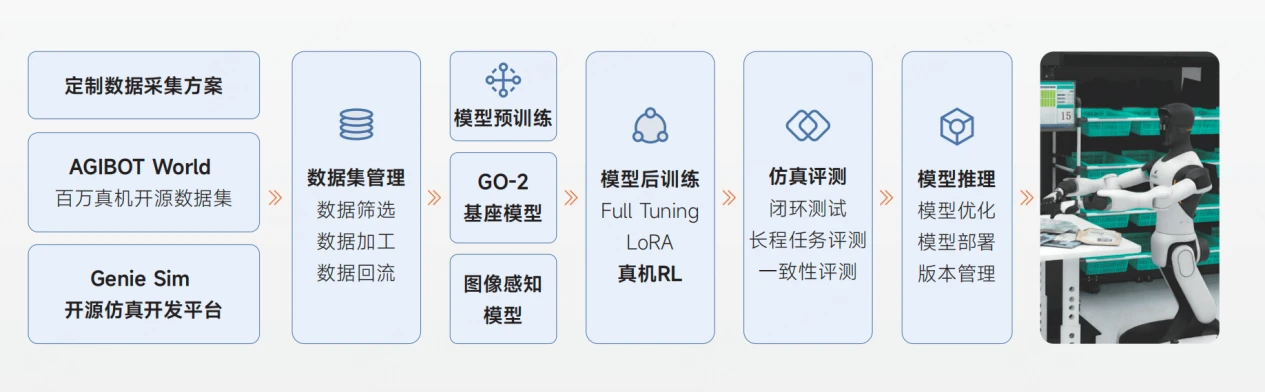
After a robot model is validated in a laboratory setting, it must still adapt to on-site materials, interface with production line equipment, and handle anomalies during operations. Genie Studio 2.0 integrates model development, task workflow setup, and equipment operations and maintenance into a single platform, helping robots transition from individual skills to real-world task execution.
Flywheel handles the iterative development of embodied models. The platform can centrally manage real-robot, simulation, and open-source data, supporting the training of image perception models, visual-language-action (VLA) models, and real-robot reinforcement learning models, while also providing tools for experiment management and computing power scheduling. AgiBot states that its proprietary reinforcement learning training framework achieves hour-level convergence in real-world projects, with task success rates reaching 99%.
Once model training is complete, simulation evaluation can be conducted via the Genie Sim Benchmark. This platform covers four dimensions and 42 task categories, supporting integration within five minutes and evaluation completion within 30 minutes. AgiBot claims that the discrepancy between simulation results and real-robot performance is less than 10%. After the robot is deployed, failure and anomaly data can be fed back into Flywheel for subsequent iterations.
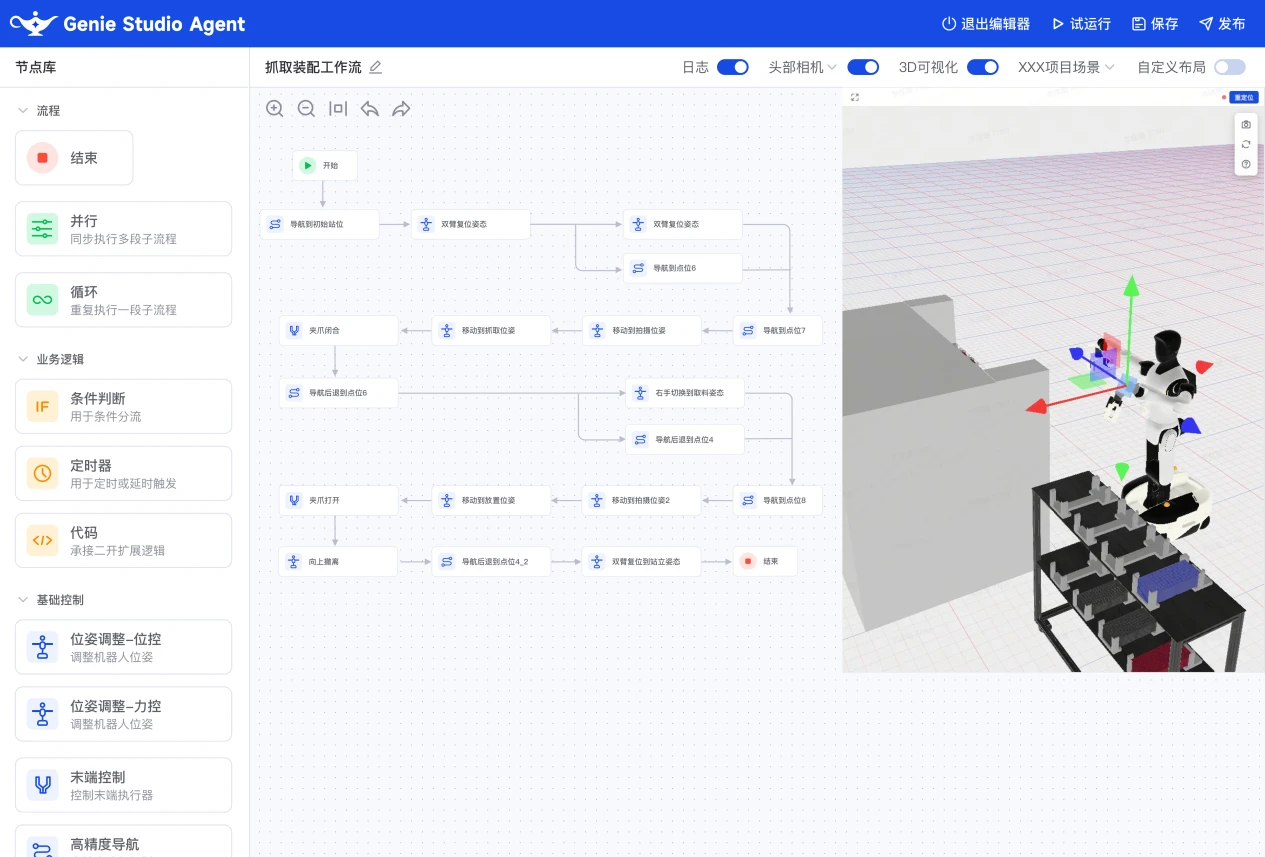
Agent is responsible for orchestrating individual capabilities into complete task workflows. Developers can combine capabilities such as navigation, visual localization, model inference, and logical reasoning through a visual drag-and-drop interface, and can also integrate custom business logic and third-party communication. Workflows can first be validated in a simulation environment to test paths, collisions, and task logic, after which skill nodes, parameter configurations, and other elements are packaged into business templates for reuse in other projects.
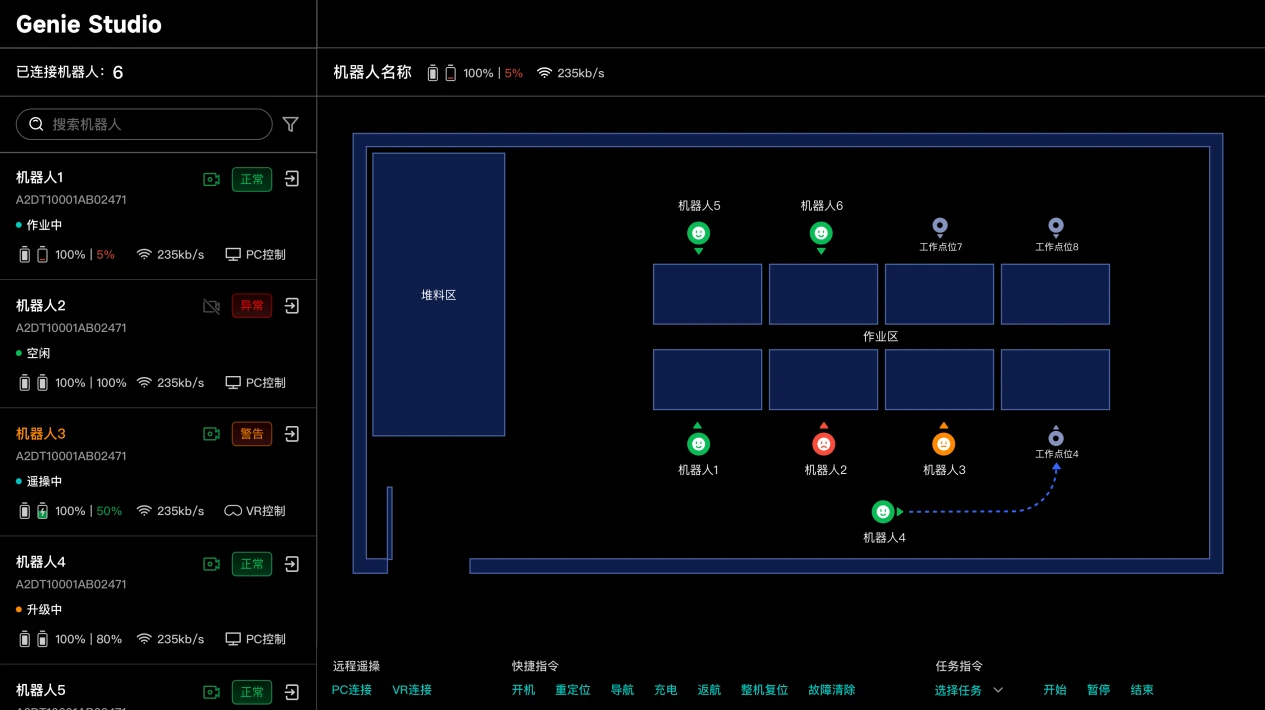
Monitor is designed for the centralized operations and maintenance of multiple robots. It allows users to view device status, task progress, and operational data, and supports group management, task scheduling, fault alerts, remote intervention, and online debugging. Operational and anomaly information recorded by the platform can also be fed back to Agent and Flywheel to adjust task workflows and update models.
According to AgiBot, Genie Studio 2.0 has already been deployed in applications such as manufacturing and rail transit. In a Changzhou CNC machine tool project, robots collaborated with automated guided vehicles to handle the loading and unloading of six machine tools. The team completed the process from requirements gathering to production line validation in 14 days, and organized the task workflows and equipment interface configurations into reusable templates.
On the pilot validation line at GP Intelligent, three AGIBOT G2 robots collaboratively completed component feeding, assembly, finished product boxing, and tote transport for automotive battery management system (BMS) controllers. AgiBot states that the relevant task success rate reached over 99.9%, with a single task cycle time of under 13 seconds, and completed a 7x24-hour continuous production validation.
At Longcheer Technology's tablet loading and unloading production line, the platform centrally manages multiple robots while tracking operation counts, success rates, cycle times, and fault conditions. In the Guangzhou Metro service scenario, Genie Studio 2.0 has been deployed on more than 60 devices, enabling centralized monitoring of equipment status and task metrics across different stations, along with fault alerts and remote connection capabilities.
Genie Studio 2.0 integrates model training, task orchestration, and device operations and maintenance, using on-site operational data to continuously refine workflows and model capabilities. As the system accumulates skills, workflows, and business templates, deploying and reusing robots in new scenarios is expected to reduce the need for ground-up development.