

2026 Apsara Conference: Qwen's Focus on Real-World Deployment

The Apsara Conference, which opened on September 22, featured Qwen showcasing several hardware products designed for different use cases: the N1 and N1 Pro AI glasses, a pair of clip-on earbuds, and the QwenNote A2 and desktop device Eva from Qwen Office. The first three are everyday wearable devices, while the latter two focus more on work-related tasks.
On their own, none of these products offer significant novelty. However, their simultaneous launch reveals Alibaba’s core objective: many user needs occur outside of chat interfaces. For AI to handle tasks effectively, it must first understand what the user is seeing, hearing, and discussing. Hardware captures this context, while the Qwen App and Qwen Office aim to convert that information into actionable services.

What the Glasses Need to See
The Qwen AI Glasses N1 series features a 50-megapixel sensor and supports first-person perspective recording. While taking photos is one function, the camera’s primary value for AI lies in enabling users to ask questions directly about what they are looking at.
For example, standing in front of an exhibit and asking, “What is this?” allows the glasses to capture the current view, eliminating the need to pull out a phone, take a picture, and then send the image to an AI model.
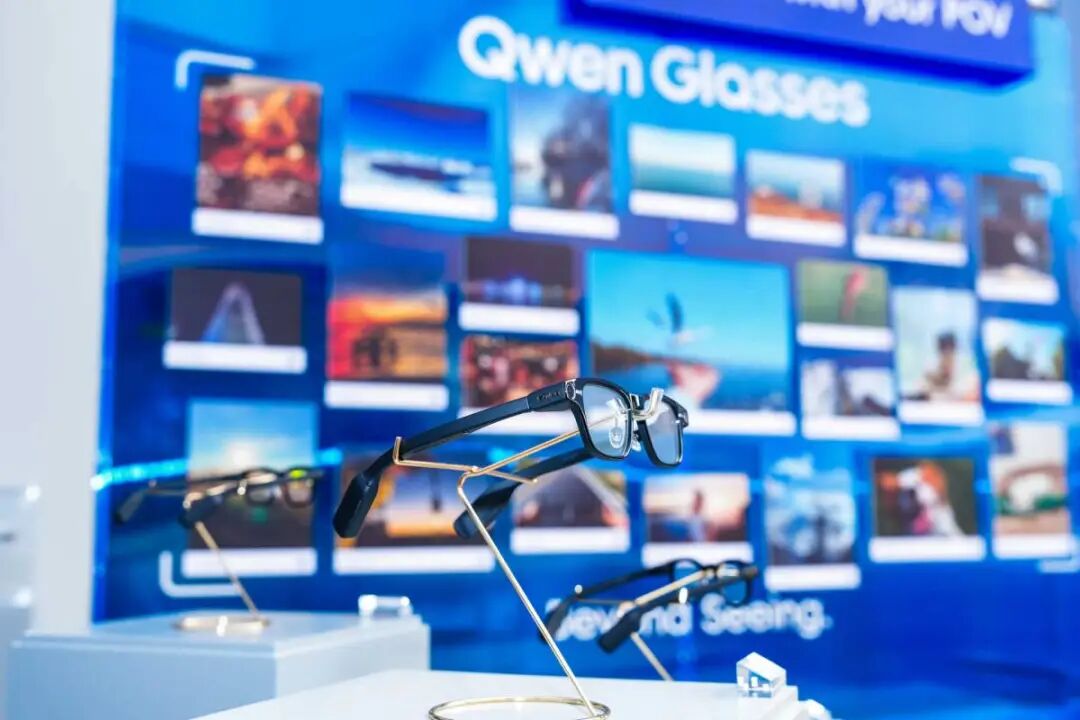
The challenge lies in the fact that a single frame may contain multiple objects. When a user says "this," the model may not know which one they are referring to. To address such ambiguous references, the N1 Pro adds eye-tracking functionality as a supplementary cue. During demonstrations at the exhibition area, when a user looks at an exhibit and asks a question, the glasses can determine the subject of the query by combining gaze data.
In addition, the N1 Pro features iris recognition. While eye tracking helps the glasses identify where the user is looking, iris recognition serves to verify the identity of the person initiating the operation.
From first-person perspective capture to eye tracking and then iris recognition, the N1 Pro aims to reduce the communication cost between humans and AI. In the past, users had to specify details like "the white box on the left." Now, there is an opportunity to simply say "this." This is particularly suitable for scenarios such as visiting exhibitions or identifying items, where users need to ask questions while looking at things.

Letting Sound Into Subsequent Work
Alibaba introduced the Qwen Clip, powered by Qwen technology, at the World Artificial Intelligence Conference earlier this July.

The glasses process visual data, while the clip-on earphones primarily handle audio. Qwen demonstrated features including face-to-face translation, AI note-taking, and voice-initiated tasks. For conversations, users can receive real-time translation assistance while listening, or review organized content afterward. Often, the most tedious part of communication occurs after the conversation ends, when users must recall what needs to be noted and what actions require follow-up.
Qwen Office's newly launched QwenNote A2 is closer to a dedicated work tool. It can be carried around, supports independent internet connectivity and voice transcription, and allows users to assign tasks to Qwen Office via voice commands. After client visits, users can have it organize key discussion points, which can then be used to prepare meeting minutes or follow-up materials. The A2 is priced at RMB 1,199 and went on sale on September 22.

The key here is to move the conversation content into the next stage of work. Requirements casually raised by clients, scheduled times, and documents that need to be resent are easily overlooked after returning to one's desk if not recorded promptly. A2 hopes to preserve these details as text for Qwen Office to continue processing.
The handling method also involves privacy. A2's published design sends voice to the cloud for a single transcription, then deletes the original audio while retaining the text and meeting notes. "No recording retention" refers to how the processed data is stored; during transcription, audio is still collected and transmitted. Whether to enable this feature during meetings or visits must also consider the awareness and consent of those present.
The other product, the QwenNote Eva, is a screenless desktop device priced at RMB 899. Users seated at their desks can initiate schedules and other office tasks via voice. The two products aim to solve the problem of how to integrate AI more smoothly into white-collar workers' daily workflows.

Hardware handles perception; software determines how far the task can go.
The information gathered from glasses, headphones, and QwenNote serves only as prerequisite material for executing tasks. Whether the system can locate corresponding information after capturing an image of a product; whether it can compile accurate to-do items based on internal company documents after listening to a meeting; and in which software it can execute commands upon receiving instructions—these questions ultimately must be answered by software and services.
Qwen has laid the groundwork for this well in advance. In January, Alibaba announced an upgrade to the Qwen App, integrating services such as Taobao, Taobao Flash Sales, Alipay, Fliggy, and Amap into a single interaction entry point, aiming to allow users to complete tasks like shopping and travel planning through conversation. The Qwen Glasses G1 and S1, launched in March, extended capabilities including shooting, recognition, and translation to wearable devices.
Qwen Office's newly released "Enterprise Context" product targets the B2B market, aiming to organize corporate documents, meeting content, and group chat information so that agents can access these resources on demand when executing tasks. A2 retrieves information from offline interactions, while Enterprise Context provides internal business materials. The former informs the system "what was just discussed," while the latter helps it understand "how matters should be handled within this company." If these two products are well-coordinated, their combined effect will certainly be greater than the sum of their parts (1 + 1 > 2).

Mobile phones represent another layer between apps and wearable devices. At the conference, Alibaba also unveiled the Qwen Intelligence solution for smartphone manufacturers. The Magic9 series, to be released by HONOR on September 28, will be among the first models to feature this integration. However, getting agents into the mobile phone system requires both parties to address constraints related to power consumption, memory, and response time, as well as to partition tasks for the model. According to official reports from HONOR, in the collaborative solution, the Pro model handles complex reasoning, the Fast model manages quick responses, and the GUI Agent takes care of interface operations; HONOR's system framework integrates perception, planning, and tool invocation.
This division of labor points to a more difficult step for mobile agents: translating a user request into a sequence of executable actions. For example, if a user wants to arrange a schedule for a performance, the assistant may need to search for information, invoke transportation and calendar services, and return to the user for assistance when information is insufficient or operations are blocked. Therefore, the model's ability to understand requirements is only the beginning of the task; whether applications open up their capabilities, whether the system can maintain task state, and which steps require user confirmation all influence the final outcome.
Thus, so-called hardware-software integration does not simply mean placing the same chat window into glasses, earbuds, and desktop devices. Hardware adds visual, audio, and task-initiation entry points; software must supplement user context, enterprise knowledge, service invocation, and execution permissions. Every link is interdependent, and only by connecting the entire chain can a unique ecosystem barrier for Alibaba AI be formed.

Alibaba wants Qwen to stand at both ends of the task.
Putting these products together, Alibaba's ambition in AI is already becoming apparent. With these products grouped, Alibaba's strategy becomes clearer: the Qwen models and cloud services provide underlying capabilities, while apps, glasses, earphones, and office equipment directly enter users' lives. Alibaba aims not only to provide AI for others' products but also to ensure that when users encounter issues, they first think of its Qwen.
This explains why the hardware forms showcased at the Apsara Conference were so diverse. Glasses give AI a visual perspective, earbuds capture everyday sounds, A2 brings information from work sites back to office systems, and Eva remains on the desktop awaiting instructions.

However, as of now, this remains a vision Alibaba has yet to realize. The more critical next step is how many users these hardware devices can attract. Only by achieving scale will third-party developers have stronger incentives to integrate their applications, and only then can Alibaba refine the connection between devices and services through extensive real-world usage.
Author: Hope
Edited by Yisong


Source: Future Devices