
Three Major Embodied AI Works from China, US, and Korea: Connecting the Present and Future of Robot Agents
Recently, with the release of a report by Anthropic, every major large language model (LLM) giant has taken a seat at the table for Embodied AI.
In July 2026, Anthropic released a unique experimental report titled "Claude plays robotics." They directly connected Claude to four types of robotic bodies: the Unitree humanoid robot G1 and quadruped robot dog Go2 in simulation, the Franka robotic arm, and the real-world Unitree robot dog Go2 walking in an office corridor. One of the core findings of the experiment was that the same model exhibited drastically different performance when switching its interface abstraction layer.
In fact, from Silicon Valley to Beijing, and from large model vendors to robotics companies, everyone is attempting to make the vision of "LLMs and VLMs becoming the brain of robots" a reality, thereby creating true robotic agents.
But how difficult is it to build robotic agents, and what should be done? Three recent works—one from Meta / Nanyang Technological University / University of Washington, one from Korea's Sungkyunkwan University, and another from Tsinghua University / Purdue University and other institutions—just happen to form a complete narrative thread regarding embodied AI agents.
Meta FAIR, in collaboration with Nanyang Technological University, the University of Washington, Brown University, Northwestern University, and other institutions, published the paper "HumanCLAW: Can Vision-Language Models Act Through a Body?" This work constructed a three-layer decoupled framework that allows frozen VLMs to drive humanoid bodies in physical simulations. It also conducted benchmark tests on nine cutting-edge VLMs across 1,218 find-navigation-interact rounds in 41 household scenarios.
Another paper, released by researchers from Sungkyunkwan University in South Korea, titled "RoboBRIDGE: A Modular Framework for Bridging Policies to Robust Real-World Robotic Agents," aims to encapsulate arbitrary action generation policies into robotic agents capable of fault recovery, long-term temporal consistency, and cross-domain robustness through a five-module orchestration framework.
The third paper, published by Tsinghua University in collaboration with Purdue University, the Institute of Automation of the Chinese Academy of Sciences, Wuwen Xinquan, and other institutions, is titled "Harness VLA: Steering Frozen VLAs into Reliable Manipulation Primitives via Memory-Guided Agents." Its core lies in downgrading frozen VLAs into retryable contact-intensive primitives. Combined with six parsed primitives and a dual-memory system, it achieved significant improvements in cross-embodied manipulation without fine-tuning the models.
HumanCLAW clarifies the problem, while RoboBRIDGE and HarnessVLA each provide a solution from the perspectives of "modular adaptation of lower-level VLAs" and "memory optimization of upper-level planners," respectively.
Meanwhile, the three papers collectively suggest that deploying either VLMs or VLAs directly onto robots may not be sufficient.
The model is responsible for action prediction, but to ensure the robot reliably completes tasks, an orchestration layer must be added outside the model to monitor for errors, handle recovery from failures, and determine whether re-planning is needed when scenarios change.
This implies that the next breakthrough in Embodied AI may lie in the abstraction layer between the model and the physical robot body.
VLMs Can Barely Drive the Body
Researchers behind HumanCLAW propose that to test whether a large model—or an embodied agent—can "act through its body," one must first resolve a dilemma.
If motion execution is handed over to a trained controller, it is often unclear whether a failure stems from poor decision-making by the VLM or from the body's unresponsiveness. Conversely, if motion is abstracted into scripted animations like "move forward three steps" or "turn left 90 degrees," the physical consequences disappear.
A code agent can turn left and then immediately turn right without issue, but a real human body requires deceleration, weight shifting, and transitional movements between intentions. These seemingly "imperfect" actions are precisely the core of embodied action.
To address this, HumanCLAW proposes a three-layer decoupling approach.
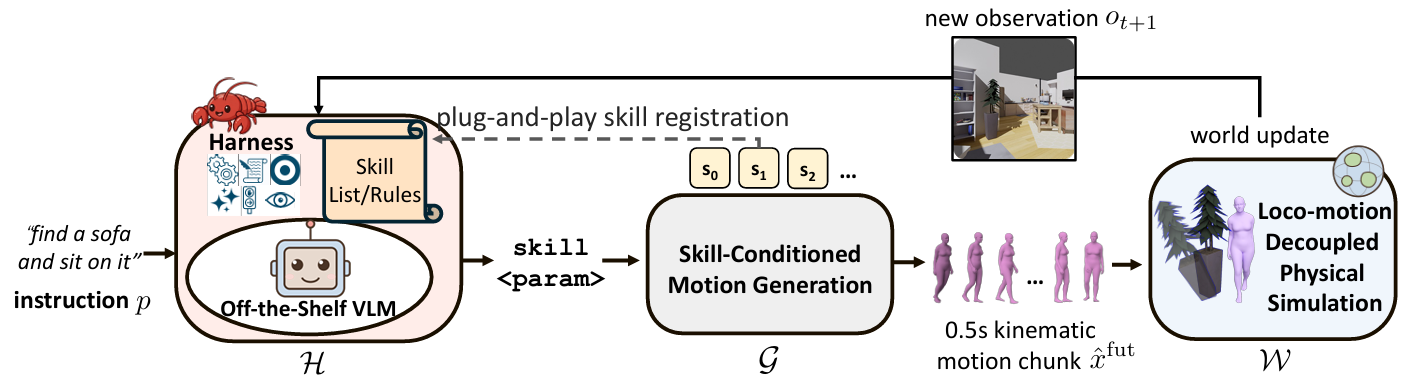
The first layer is the control system. The VLM is guided through a reasoning pipeline: the top level first externalizes 'what it sees and the distance', then derives mid-level objectives 'what to do in the next few seconds', selects one of eight atomic skills with parameters, and finally performs spatial safety verification via skill-specific validators.
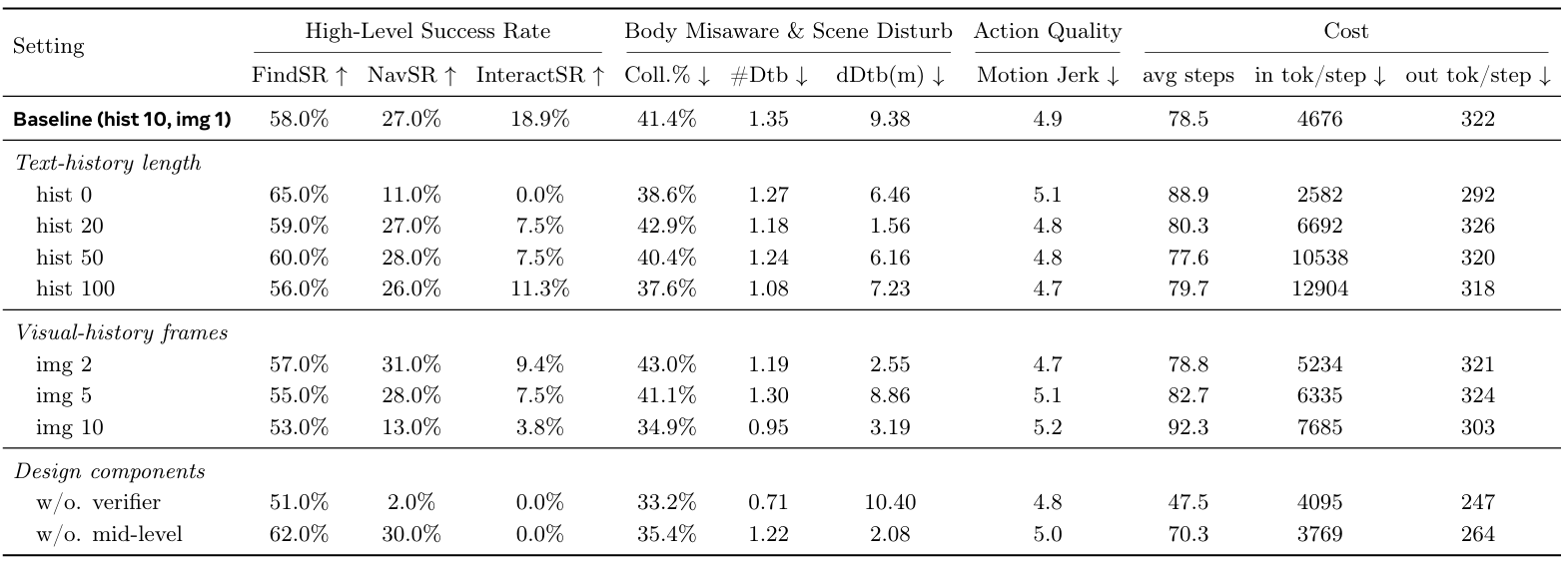
Do not underestimate the validator; it is a critical component. In ablation experiments, removing it caused navigation success rates to plummet from 27% to 2%.
The second layer is the skill-conditioned motion generator. The generator uses a shared base motion DiT (38 million parameters, trained on AMASS human motion data) to provide natural human motion priors, with each atomic skill paired with a plug-and-play ControlNet adapter.

The key lies in its extremely high zero-shot fidelity: command step tracking rate 0.97, turning angle 0.99, sitting height 0.98. This means the execution end does not make errors; failures are purely due to decision-making issues.
The third layer is semi-physical simulation. This layer finds an elegant middle ground between pure kinematics (no physical consequences) and full dynamics (where failures are confounded by balance issues) by retaining collisions, gravity, and object displacement while excluding loss of balance, making every failure readable and attributable.
Notably, the research team also designed the HumanCLAW-Bench evaluation metric to assess VLMs across four dimensions: high-level task success rate, low-level action quality, bodily awareness and physical interference, and computational cost.
Specifically, researchers placed nine of the strongest VLMs, including GPT-5.5, Gemini-3.1, and Claude-4.8, into a blue humanoid body and tasked them with a single command in 41 unfamiliar home scenarios: "Find a sofa, walk over to it, and sit on it." This constitutes HumanCLAW-Bench: 1,218 find-navigation-interaction episodes.
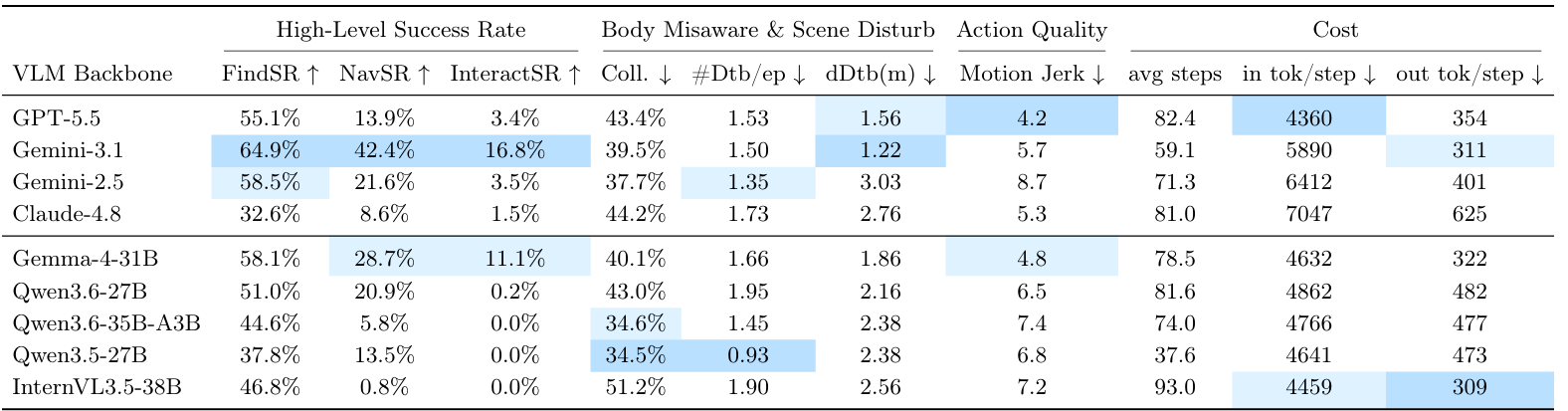
The results showed that more than half of these frontier VLMs failed to reach the sofa's vicinity after finding it, and over two-thirds of those that did could not successfully sit down, resulting in an overall task success rate of only 16.8%. The "landing rate" was particularly discouraging; for instance, only 65% of instances where Gemini-3.1 found the sofa actually resulted in arrival, while InternVL3.5-38000000000 achieved just 2%. Furthermore, the recognition rate differed from the objective visibility rate by only 5 percentage points, indicating that perception is not the bottleneck. Thus, the collapse occurs after recognition.
Automated root cause analysis yielded conclusions: 64% of navigation failures were related to bodily perception errors, including 30% claiming "arrival" from far away (distance hallucination), 20% failing to stop when already within 0.2 meters and continuing to collide, and 14% sending forward commands despite legs being stuck. Interaction failures accounted for 81% bodily placement errors, with 58% sitting into thin air, 14% sitting on the wrong object, and 9% briefly sitting down before walking away on their own.
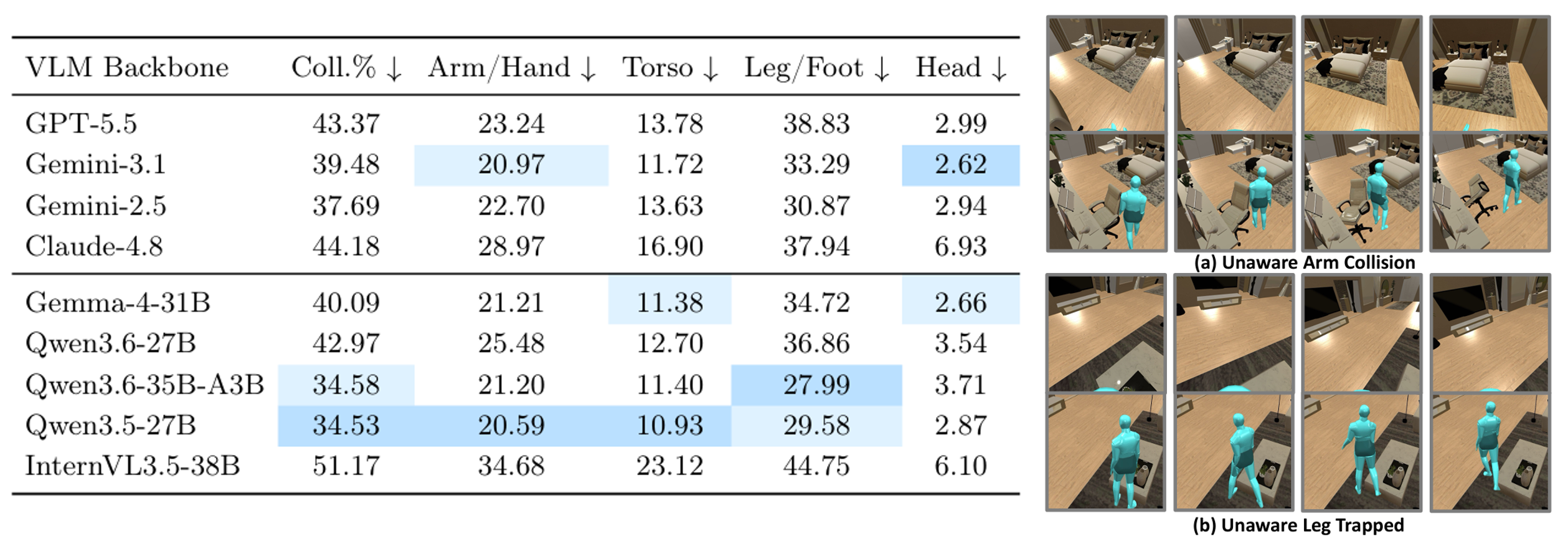
Moreover, collisions concentrated on parts not under the agent's "gaze": legs and feet accounted for 28-45%, arms for 20-35%, and the head for less than 7%. VLMs could describe the chair they saw but did not know it was the very arm that had just knocked it over.
The author team notes in the paper that generalizable action intelligence stems from reasoning rather than fitting action data. Therefore, HumanCLAW serves as a methodological contribution, proving the feasibility of the technical route involving "frozen VLM + fixed motion priors + semi-physical closed-loop."
Attempting to Make the Body More Obedient
The aforementioned HumanCLAW demonstrates that VLMs/VLAs do not lack stronger action prediction capabilities; rather, they need the core abilities of a closed-loop AI agent. These core abilities include knowing when it has failed, recovering from failure, and adjusting plans when the scene changes.
RoboBRIDGE's approach is to solve these capabilities using an intermediate framework instead of retraining the model.
In the field of LLM AI agents, it is well known that while bare LLMs have strong generation capabilities, they cannot verify their own outputs, cannot reliably execute multi-step tasks, and degrade when encountering unknown domains. The community's solution is to build general orchestration frameworks, such as LangChain and AutoGen. This means equipping any LLM with tool calling, planning, and verification modules to transform the base model into an AI agent.
RoboBRIDGE is positioned as the VLA version of LangChain: it equips any action policy with five 'exoskeletons' to attempt to make the body more obedient.
RoboBRIDGE splits the operation of robotic AI agents into five modules with distinct responsibilities, forming a closed loop around the central Controller.
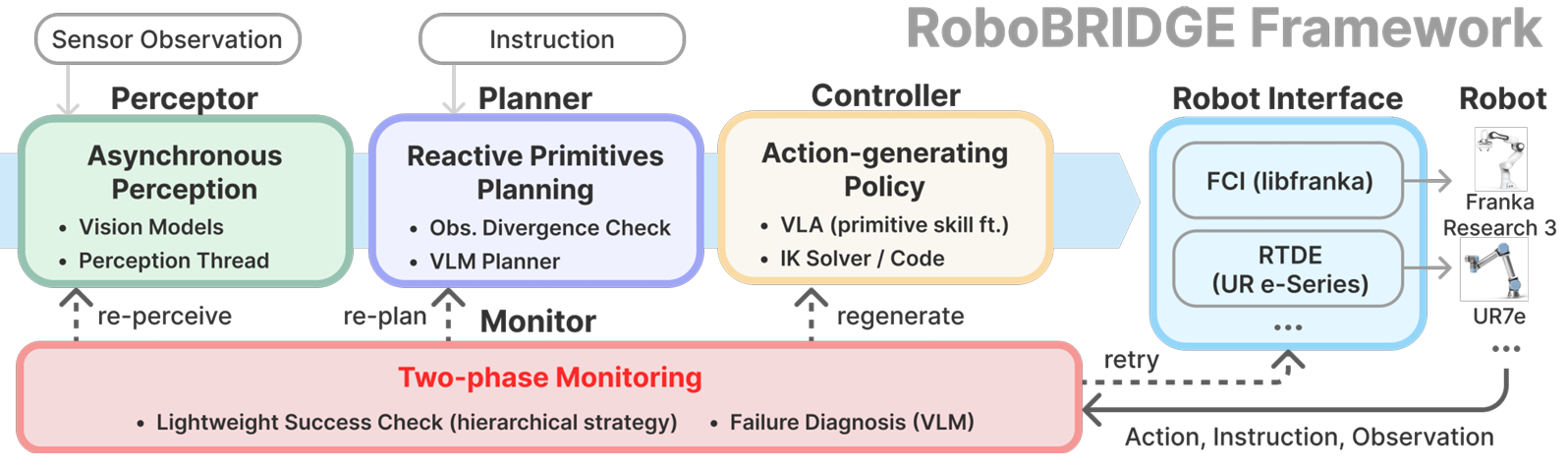
Monitor acts as the quality inspector. It works in two stages: first, a lightweight model continuously monitors at 5Hz to determine whether 'the current action succeeded or failed,' and only wakes up the large model for deep root cause diagnosis upon detecting a high-confidence failure.
Once a failure is confirmed, recovery attempts are made in ascending order of cost: first retry the current action; if that fails, regenerate the trajectory; if still unsuccessful, replan the subtask; and finally, force a full re-perception of the scene. The core philosophy of this four-tier progressive mechanism is 'good enough,' avoiding immediate global replanning.
The Perceptor acts as the eyes. It runs asynchronously independent of the execution thread, continuously refreshing scene understanding and tracking positional changes centered on objects.
The Planner serves as the dispatcher. It decomposes high-level tasks into sequences of skills while listening for scene changes from the Perceptor. When object positions shift or objects appear/disappear beyond a threshold, it triggers replanning, ensuring the robot does not cling to an outdated plan.
The Robot Interface functions as the hands and feet. It translates motion commands output by the Controller into specific robot coordinates, performs inverse kinematics solving and safety checks, and interfaces with real or simulated hardware.
The crucial Controller acts as the torso. It encapsulates arbitrary motion generation strategies (such as VLA, IK controllers, or others), exposes a unified interface to upper-layer modules, and allows for pluggable replacement.
When using VLA as the Controller, RoboBridge additionally introduces basic skill fine-tuning. This involves decomposing manipulation tasks into cross-domain invariant basic action units like MOVE and GRIP. Each unit is trained with a dedicated LoRA adapter, which can be switched on demand during execution, thereby reducing VLA's sensitivity to domain shifts.
RoboBRIDGE has been validated in both simulation and the real world.
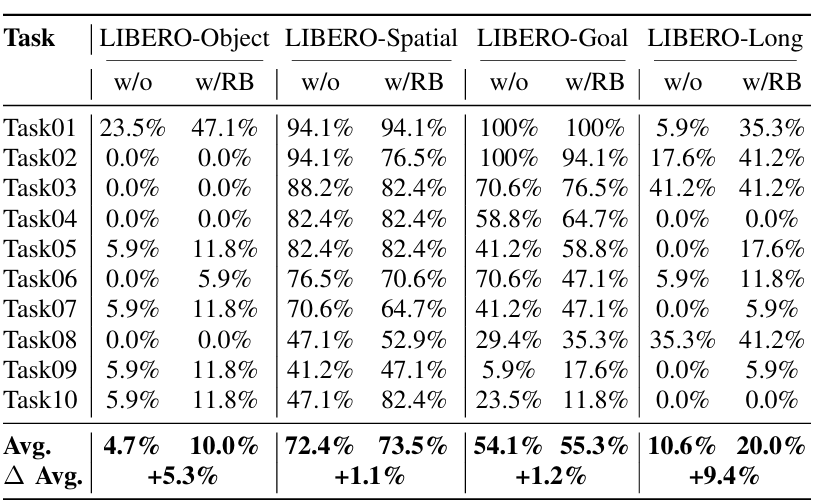
On the simulation front, LIBERO is a language-conditioned tabletop manipulation suite with relatively short tasks and controllable scene variations; independent VLA models already have a certain foundation, with GR00T-N1.5 reaching 35.5%, and RoboBridge boosting it to 39.7% after encapsulation. RoboCasa comprises twenty-four long-horizon kitchen tasks characterized by large scenes, numerous steps, and frequent execution drift; independent VLA models almost completely failed across the board, averaging only 3.7%. After encapsulation, performance doubled to 7.5%, and excluding relatively simple pick-and-place tasks, it jumped from 6.2% to 11.4%.
In terms of real-world transfer, identical monitoring and recovery behaviors were transferred to unknown environments on both the Franka and UR7e robot platforms without additional adaptation, maintaining robustness against visual changes and actuation uncertainties. Additionally, researchers identified that the primary residual faults stemmed from perceptual misidentifications under occlusion and irreversible manipulation failures during dense contact interactions.
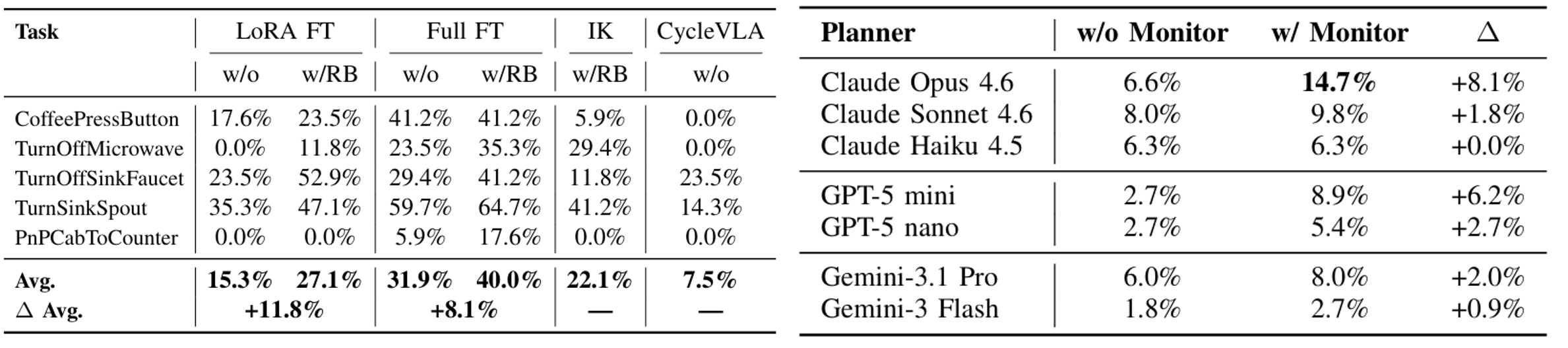
Ablation experiments reveal that RoboBRIDGE provides positive improvements for LoRA fine-tuning, full fine-tuning, classic IK controllers, and even CycleVLA. In addition, using Claude Opus for monitoring yields an 8.1% improvement, whereas switching to smaller models such as Claude Haiku or Gemini Flash is almost ineffective. The upper limit of the orchestration framework depends on the reasoning quality of the "brain," indicating that the monitoring module still requires a strong reasoning LLM.
RoboBRIDGE demonstrates that adding a layer of orchestration logic to VLA, without changing the model, can enable robots to complete tasks more stably in real-world environments.
Trying Again to Make the Brain Smarter with Use
If RoboBRIDGE mainly equips VLA with 5 modules to enable it to more intelligently receive brain commands and optimize actions, then HarnessVLA takes another more radical path: the VLA is completely frozen, the primitive library remains fixed unchanged, no training or modifications are made; instead, only the planner is taught how to "make good use of existing tools," making the brain smarter and better suited for robot movement.
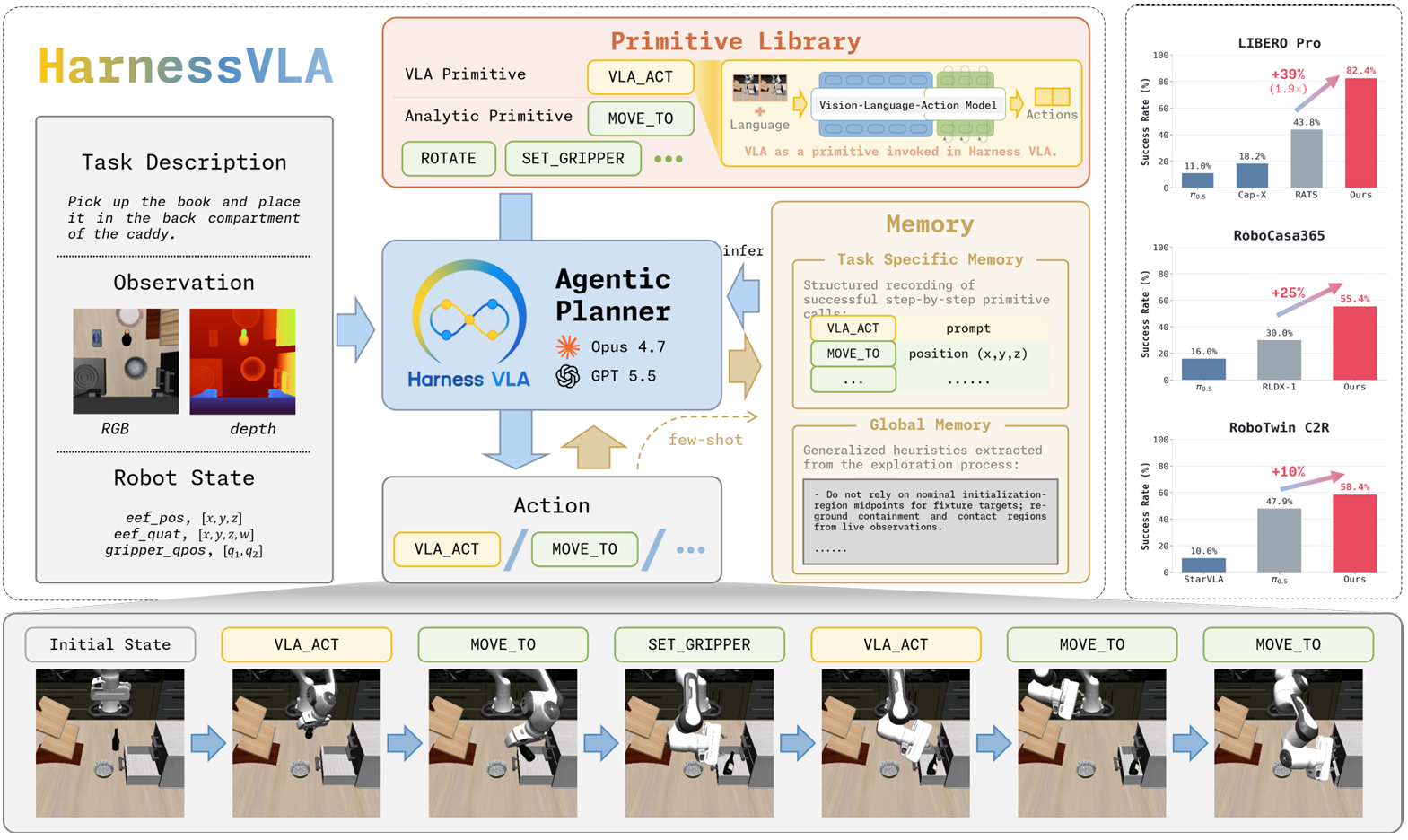
"Existing tools" include six parsing primitives (based on IK kinematics, zero training): MOVE TO (move to spatial target), MOVE POSE (adjust end-effector pose), ROTATE WRIST / ROTATE PITCH (wrist/pitch rotation), SET GRIPPER (open/close gripper), RELEASE (release object); and one VLA primitive: VLA ACT, which is called only within a local window specified by the planner and performs contact-intensive tasks (grasping, placing, button pressing, faucet turning). There is a fixed limit on the number of attempts; if it fails, the planner decides whether to "retry or switch strategy."
A key design element here is similar to HumanCLAW's "atomic skills" approach: VLA ACT does not perform traditional continuous control but instead makes sparse, retryable local attempts. That is, the planner uses parsing primitives to move the robot to a locally compatible region for VLA, calls VLA ACT, observes the result, and then decides the next step. The VLA has changed from "the person driving the whole way" to "a designated driver who only helps with the hardest parking spots."
Notably, what distinguishes HarnessVLA from other VLA orchestration schemes is its most unique design: a dual memory system.
The first is task-specific memory. After a single exploration on a reference scenario, if successful, the entire sequence of primitive calls is stored as a structured trajectory—for example, replacing coordinates [1.23, 0.45] with "the chair closest to the target." When encountering a new scenario, the model retrieves this structural skeleton and re-accepts all spatial parameters using real-time RGB-D perception.
The second is global memory, which accumulates reusable "failure modes" and "success rules" across tasks over time. These are meta-knowledge summarized after the planner repeatedly encounters pitfalls; once entered into the database, they are never repeated. For instance, "don't waste time retrying when grasping empty space" or "if an object doesn't follow the hand, the grasp has failed."
In terms of performance, HarnessVLA shows varying degrees of improvement across three benchmarks.
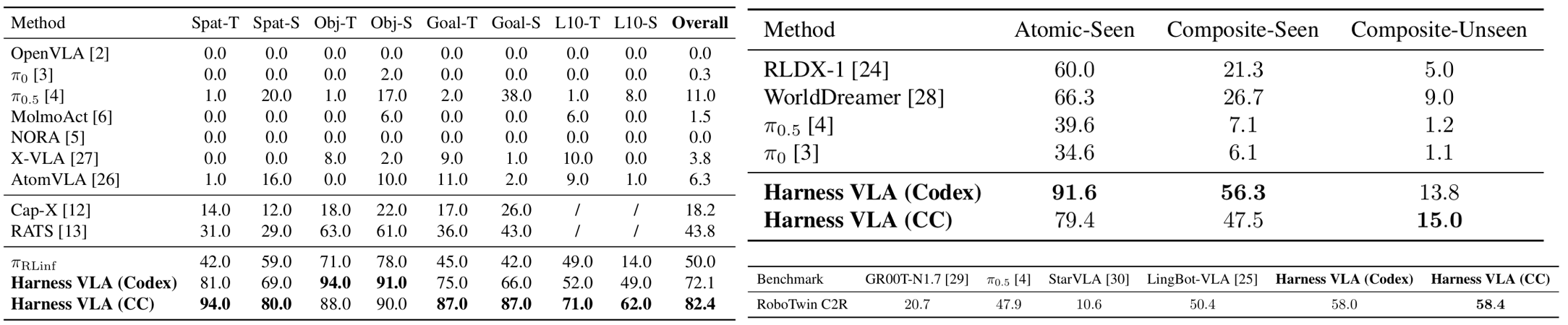
On LIBERO-Pro, which involves both semantic and spatial perturbations, HarnessVLA achieved 82.4%, which is 38.6 percentage points higher than the strongest baseline, RATS. On RoboCasa365, a long-horizon kitchen scenario, the score increased from 30.0% (RLDX-1) to 55.4%, a rise of 25.4 percentage points. On RoboTwin C2R, which tests two-arm transfer capabilities, the score improved from LingBot-VLA's 50.4% to 58.4%, with VLA weights remaining frozen in both cases.
Researchers also identified three phenomena at the mechanism level. First, planner-level semantic re-grounding restores task-conditioned behavior, allowing VLA ACT to execute local operations once brought to the correct position.
Second, sparse but retryable VLA calls. One call to VLA already exceeds the baseline; after 5-8 calls, improvements reach saturation, meaning the key lies in deployment and observation prior to calling.
Third, primitive parsing isolates non-contact execution. The planner only increases its usage ratio of VLA when facing dense contact tasks such as those in RoboCasa365.
In other words, the same VLA can improve from 43.8% to 82.4%, demonstrating that there is no need to add another order of magnitude to the VLA training set. The key is to provide the planner with a notebook, a fixed toolbox, and a "try → record → avoid repeating mistakes next time" loop, enabling the "brain" to become smarter with use.
In Conclusion
Reading these three relatively recent embodied AI papers together easily leads to the narrative: "orchestration is more urgent than scaling; frameworks are the bottleneck."
However, returning to the reference frame of the LLM domain, this judgment warrants a question mark. Some argue that AI has entered its second half, where the key lies in applications, Agents, and other narratives favoring "user experience" championed by major tech companies.
But the fact is that Kimi, GLM, DeepSeek, Anthropic, and OpenAI continue to densely release new models, and the returns from pre-training have not yet peaked. While Agents and orchestration frameworks do enable existing models to accomplish more, the capability leaps brought by each generational upgrade of foundational models often outweigh all framework optimizations combined. It is still too early to talk about AI entering its second half.
Embodied AI is only a matter of time. The VLA model itself has not yet converged, with GR00T, π0.5, and Gemini Robotics all undergoing rapid iterations; the SOTA from a year ago may have already been naturally surpassed by improvements in foundational capabilities today.
HarnessVLA's improvement of frozen VLA from 43.8% to 82.4% is indeed impressive, but if the next version of VLA itself raises the baseline to seventy percent, how much incremental gain will orchestration still have?
This is not to deny the value of orchestration, but rather to say that the benefits of orchestration are highly dependent on the model foundation. As the capabilities of the model foundation improve with architectural changes, the specific problems that orchestration needs to solve are also changing.
Of course, there is one thing that model upgrades are unlikely to overwrite: the 'sense of body' highlighted by HumanCLAW, which is also where the value of RoboBRIDGE and HarnessVLA lies. If a model never knows what its arm just knocked over or what it should do after missing a grasp,
If it is still a matter of whether to try or continue executing the next step, then the act of "acting through the body" remains one link short.
Therefore, how to make the model aware that it has a body is a topic more worth discussing than specific task success rates or other numerical metrics.