

PrimeBot’s Hao Dong: Lowering Post-Training Costs for Home Robots

In September, during the International Conference on Intelligent Robots and Systems (IROS 2026), PrimeBot and Hao Dong’s team at Peking University hosted a dual-arm manipulation challenge designed for real-world home scenarios. Participants trained models using demonstration data, then deployed the top-performing models on physical robots to execute tasks such as opening washing machine doors, loading clothes, and folding laundry. Primotion, Northstar, and XJTU_Talent took first, second, and third place, respectively.
"The results achieved by participants were significantly better than our official baseline," Hao Dong told 42HOW Robotics. The level of participation and performance exceeded his expectations.
Hao Dong is a tenured associate professor in the School of Computer Science at Peking University and Chief Scientist at PrimeBot. In an in-depth interview with 42HOW Robotics regarding the competition and his team’s recent research progress, topics ranged from dual-arm manipulation to home robotics products. A recurring question he emphasized was: How can we enable robots to continue learning across diverse environments and tasks at an affordable cost?
"In embodied AI, large-scale post-training is our focus," Hao Dong said. He explained that after robots acquire foundational capabilities, post-training is necessary to make specific tasks more reliable. For home applications, this improvement must cover a wider variety of objects, environments, and tasks. "Achieving both high success rates and strong generalization is difficult."
To expand post-training coverage to more environments and tasks, the team first needed to address the cost and difficulty of data collection. Post-training via human correction typically relies on physical robots: the model executes a task, a human intervenes when necessary, and the correction process is added to the training data. As the number of robots and deployment locations increases, equipment investment, transportation, and manual operation become significant burdens.
Hao Dong illustrated the challenge with a hypothetical scenario: "Deploying 1,000 or even 10,000 robots in different rooms for post-training would be extremely costly and operationally complex."
To address this issue, the team proposed HIL-UMI, aiming to reduce the data collection costs associated with robot post-training. Zimu Han, Yiming Zeng, and Jiyao Zhang are co-first authors of the paper, with Hao Dong as the corresponding author.
Where Post-Training Begins Once Foundational Capabilities Are Established
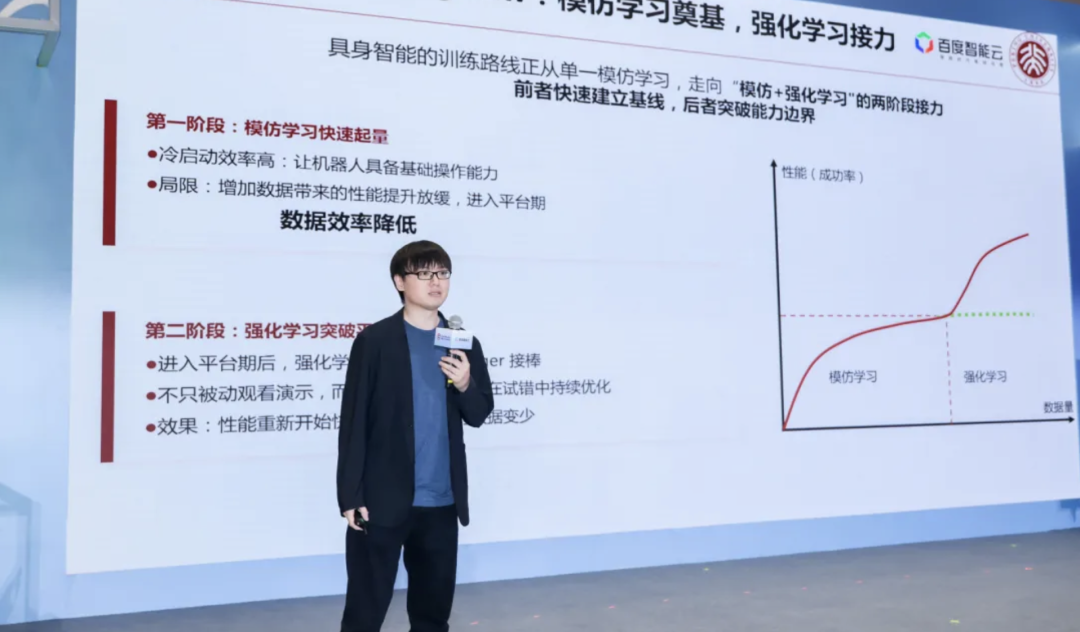
When discussing the performance improvements of robot models and how much each stage—pre-training and post-training—contributes, Hao Dong argues that they are sequential phases that cannot be simply divided by contribution ratios.
He uses the analogy of a car’s startup and acceleration: pre-training lays the foundation, enabling the model to begin performing tasks; further improving its performance on this basis is the role of post-training. "After the startup is complete, I need to accelerate further. That is when post-training comes into play," he says.
This explains his view that pre-training and post-training are inseparable: foundational capabilities are established first, followed by continued learning based on problems encountered during task execution. The two stages must be connected. For him, the key lies in understanding what capability stage the model has reached and what specific tasks it needs to solve.
Different scenarios can start from different points. In industrial settings, some workstations face limited variability, allowing models to undergo post-training for specific tasks earlier once they have acquired certain capabilities, thereby increasing success rates. In contrast, home environments require covering more diverse tasks and handling broader variations, making the accumulation of foundational capabilities equally important.
Therefore, Hao Dong’s emphasis on post-training also reflects the requirements for pre-training scale. In his view, both scales must be substantial for home applications. Existing capabilities determine where post-training begins, while subsequent training ensures these capabilities become reliable in real-world environments.
Before pursuing his PhD, Hao Dong had three years of full-time entrepreneurial experience, during which he lived in factories. He recalls that even when products were developed, competing with large manufacturers on cost was extremely difficult, which motivated his decision to continue his studies.
After returning to China in 2019, Hao Dong began researching robotics at Peking University. He aimed for AI to interact with the real world and alter the physical environment, a concept he termed "proactive AI."
At that time, few researchers in China were working on embodied AI. Hao Dong envisioned it might take a decade before this direction could be practically implemented. However, by 2023, embodied AI had already begun moving toward industrialization, a pace of progress that exceeded his expectations.
When discussing how to select research problems today, he offers a specific metric: the amount of time and resources required to achieve the same success rate. "The less, the better," he says.
In home scenarios, these costs multiply as rooms, objects, and tasks increase. If every round of experience acquisition requires deploying the robot on-site and assigning personnel to monitor its execution and correct errors, post-training becomes difficult to scale cost-effectively. HIL-UMI aims to change exactly this data acquisition step.
Moving Post-Training Data Collection Off Real Robots
HIL-UMI was developed jointly by researchers from Peking University, PrimeBot, Xi’an Jiaotong University, and others. The study builds upon UMI’s data collection approach. UMI, short for Universal Manipulation Interface, is a framework for robot data collection and policy learning. During data collection, a human operates a gripper to complete tasks while the system records video footage, the gripper’s motion trajectories, and its open/close states; these demonstrations are then used to train the robot.
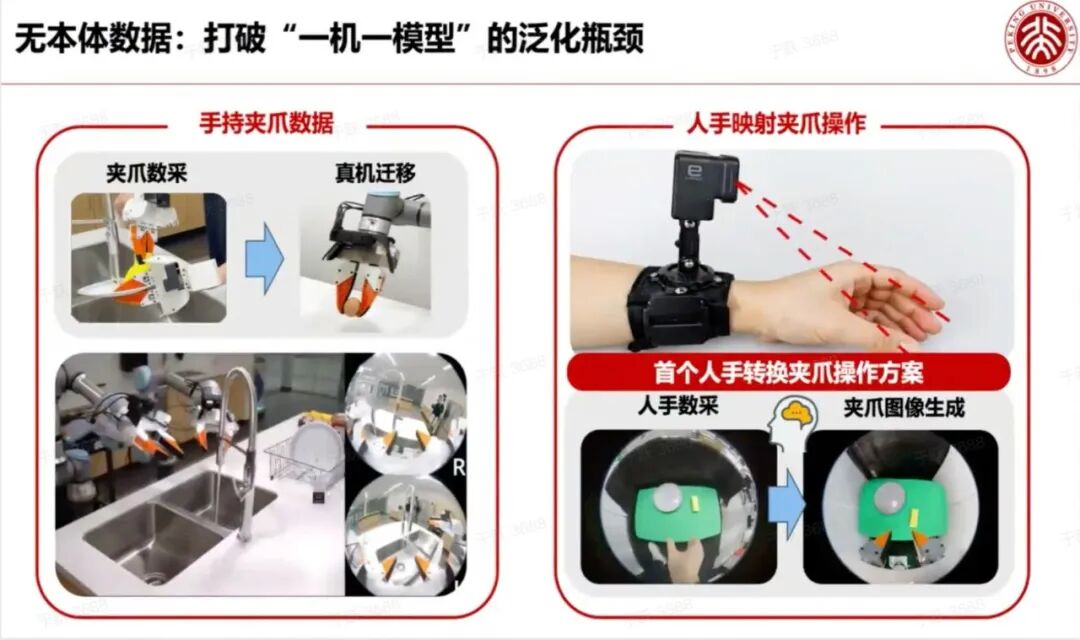
Humans can carry the gripper and accompanying equipment to various locations to perform demonstrations. However, it remains necessary to determine whether the action models have learned sufficiently and where additional training is needed. Hao Dong explains their method in one sentence: "While humans are collecting data, the model behind them is also inferring and analyzing."
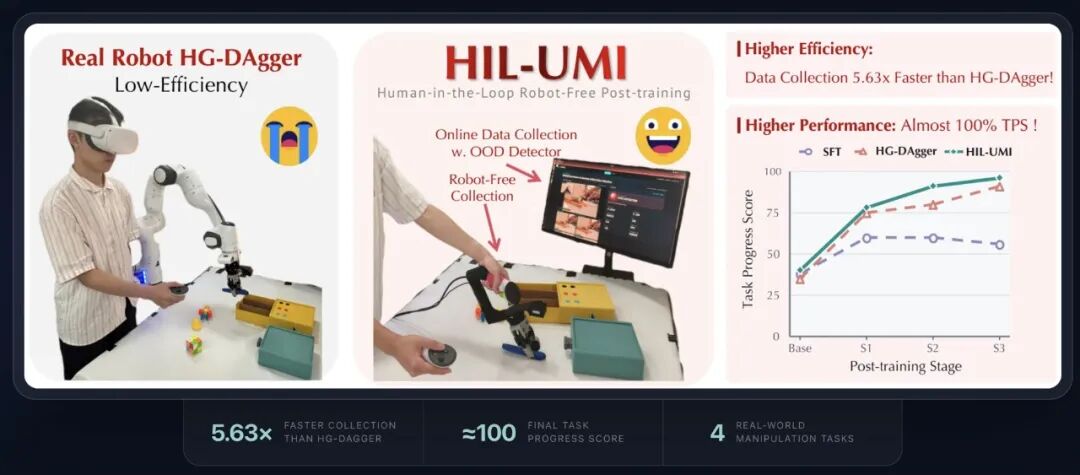
The system compares the model’s predicted actions with the human’s actual movements. When the discrepancy is significant, it records the corresponding demonstration segment for use in the next training round. This step does not require the physical robot to execute the predicted actions. Once the model is updated, the focus of data collection in the subsequent round shifts accordingly.
To make the supplemented data more effective, the team also trained an 'advantage estimator' that assesses how much a given action sequence advances the task, continuously refining this assessment with new demonstrations. During policy training, the system uses progress-based judgments to label baseline demonstrations, incorporating newly collected targeted demonstrations as positive samples for joint training. During execution, positive conditions guide the model to generate actions that better drive task completion. This approach is known as Advantage-Conditioned Behavior Cloning (ACBC).
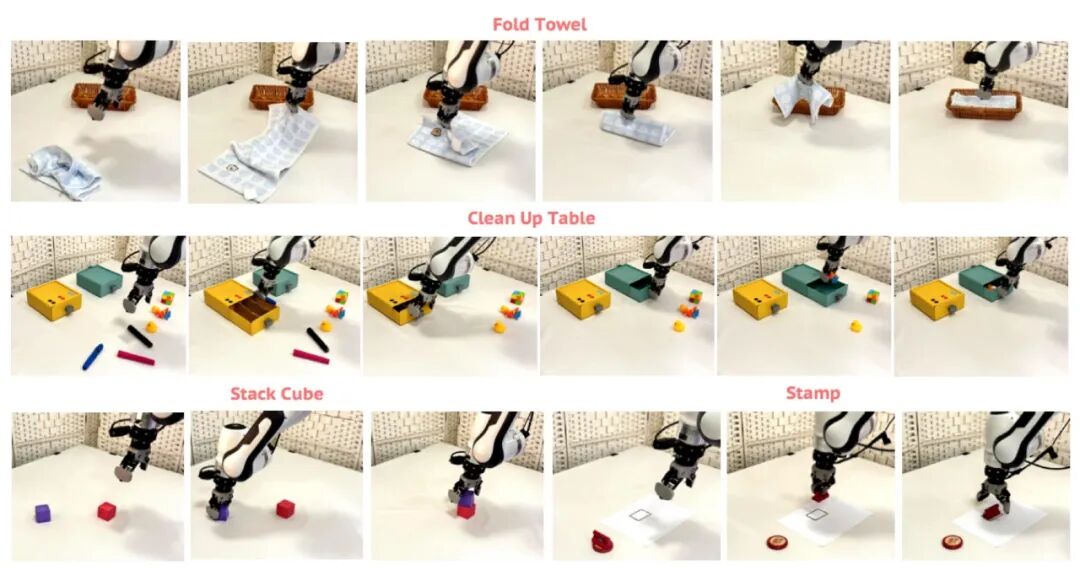
Hao Dong and his team validated the method on a Franka single-arm robot across four tasks: folding towels, clearing tables, stacking blocks, and stamping documents. Under identical per-round data acquisition budgets, the final task progress score achieved by the complete HIL-UMI method exceeded that of the baseline, which continued collecting standard demonstrations and applying supervised fine-tuning. This score tracks specific milestones, such as whether the towel has been flattened, fully folded, or placed into the basket.
In the table-clearing task, measured by time spent per frame of data acquisition, HIL-UMI operated at 5.63 times the speed of HG-DAgger, a real-robot manual takeover method. It also achieved a final task progress score approximately 5 points higher. The direct benefit demonstrated by this research is the reduction in time wasted on repeatedly running the robot and waiting for manual intervention.
'Currently, we are still working with single-machine, single-arm setups. Validating the underlying principle was just the first step; we are now moving toward dual-arm and multi-robot systems,' said Hao Dong. The paper further proposes enabling operators at different locations to collect data in parallel, evolving into a distributed post-training system. Portable grippers have lowered the burden of entering diverse scenarios for data collection; organizing more people and locations to participate sustainably remains the next direction for expansion.
What Homes Need Is Simultaneous Improvement in Reliability and Generalization
When research transitions to consumer home products, Hao Dong prioritizes chores with clear, repetitive daily needs: washing, drying, hanging, and folding laundry. These are tasks he personally encounters. In his view, robots should start with these slightly structured activities.
Task selection must also account for the ease of recovery after failure. With laundry folding, "if it’s not folded correctly the first time, I can just try again," says Hao Dong. He envisions robots with self-correction capabilities—retrying if the initial attempt fails. Even if slower, successfully completing the task delivers practical value.
This gives post-training a concrete objective: models must learn task-execution actions while accumulating experience in continuing after errors. Users require chores to be completed consistently and reliably.
When discussing PrimeBot’s existing consumer robots, Hao Dong identified the next key focus as "operational intelligence"—enabling robots to actually perform household chores. He confirmed that the team is developing an internal design distinct from current products to support this capability.
When discussing close human-robot interaction in homes, Hao Dong emphasizes that both hardware and algorithms must support force control, allowing robots to perceive their own physical state.
As a single model enters more households, variables such as clothing types, furniture, room layouts, and tasks will change. Hao Dong favors a single model covering diverse scenarios and tasks, evaluating whether previously learned abilities help the robot master new tasks faster.
This adds a dimension to what he calls the "horizontal Scaling Law": the number of tasks mastered. Using success rate as a threshold, can a model that has learned more tasks achieve a higher starting point, require less data, and enter post-training faster when encountering new tasks?
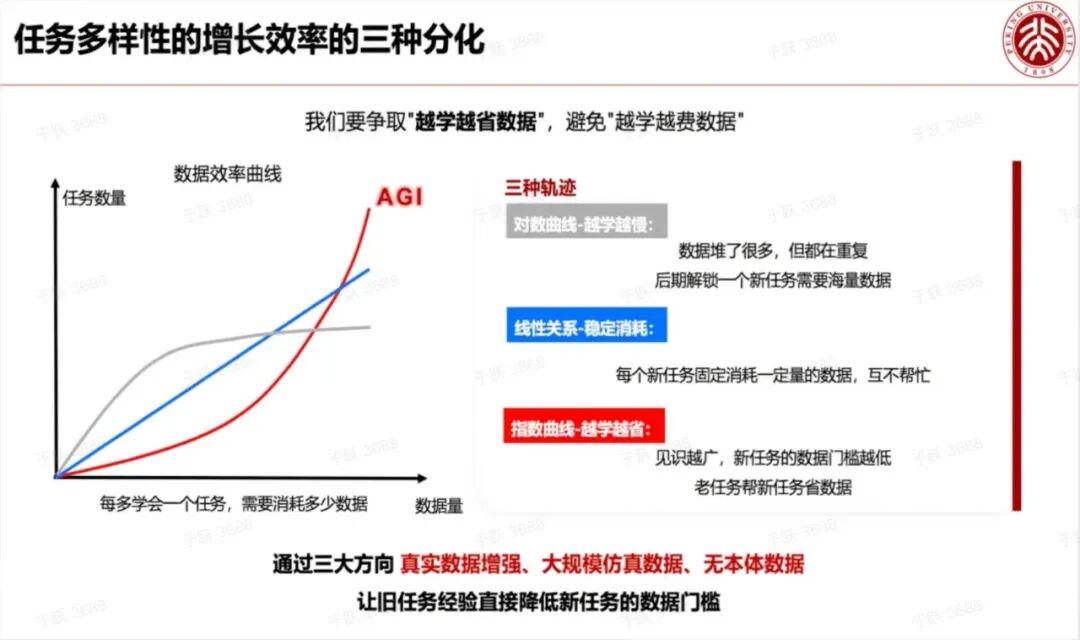
"As I cover more tasks, the amount of data I need for new tasks will decrease," Hao Dong describes the general-purpose capabilities he hopes to achieve. For him, the significance of covering more tasks also lies in whether subsequent learning costs can be reduced.
Whether this continuously accumulated experience enables robots to adapt more easily to the next task or the next home is the question that large-scale post-training ultimately needs to answer.
In this process, human demonstration and correction remain indispensable. When discussing robot self-evolution, Hao Dong emphasized that even if more automated learning is desired in the future, it must first go through human-in-the-loop post-training to establish sufficient capabilities.
'Humans will always be there; it's just that their proportion will constantly decrease,' he said. Currently, HIL-UMI has completed validation on four single-arm tasks, and the team is advancing towards dual-arm and multi-robot expansion. Moving from portable collection to large-scale post-training requires more experiments and deployments for verification. What Hao Dong focuses on next is how to push this step forward.