

Hesai Launches AI Camera Kosmo to Monetize the Real World as Data
"Hesai's spatial intelligence products will ultimately be a bigger deal than LiDAR," Hesai co-founder and CEO David Li said on October 14.
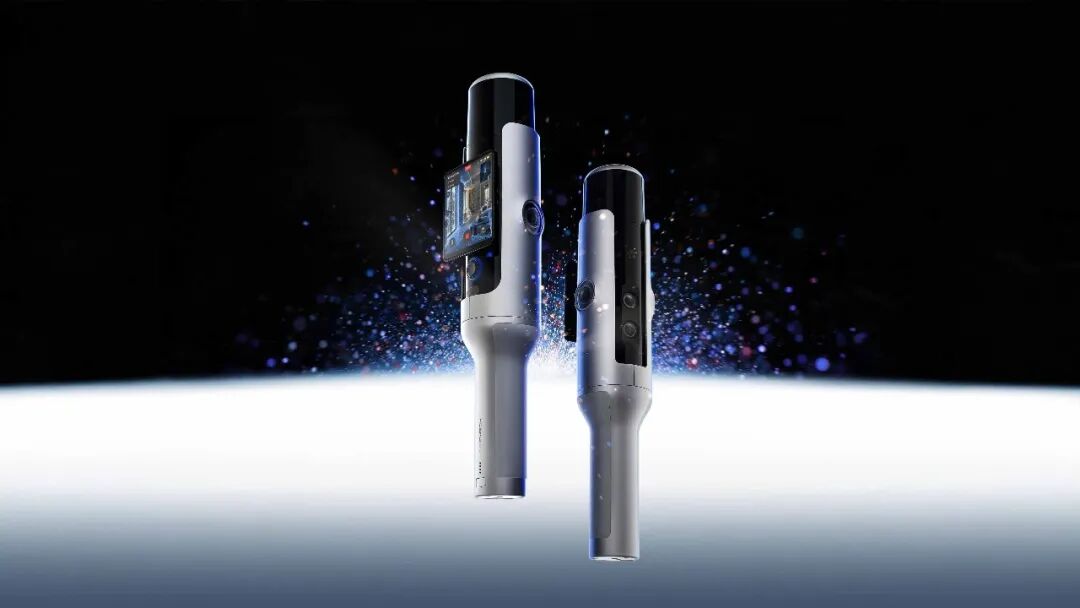
On that day, Hesai launched the Kosmo 3D world data engine, which includes the AI spatial camera Kosmo One and the cloud platform Kosmo World. Kosmo One is a handheld device integrating LiDAR, cameras, and an inertial measurement unit (IMU). Users can scan rooms with it to record spatial structures, object positions, and information such as color and texture. Kosmo World reconstructs this data into 3D scenes, using AI to identify and segment objects within them, turning items like tables and chairs into extractable, movable, and reusable 3D assets.
For robotics companies, this system provides a pathway from real-world scenarios to simulation training environments: after scanning stores, factories, or rooms, users can adjust object positions to generate different layouts for robot training and evaluation. This reduces manual modeling workload, makes the appearance and spatial relationships of training environments closer to actual deployment scenarios, and narrows the gap between simulation and real-world operation.
A company well-known for automotive LiDAR is now extending its products into robot training, world models, and 3D content production. Beyond selling hardware, Hesai aims to generate revenue through cloud processing and digital assets.
David Li stated that there will be more products in spatial intelligence. When asked when these might surpass LiDAR in significance, he replied with just two words: 'Ultimately.' Kosmo is the most concrete manifestation of this judgment at present. What Hesai seeks to verify is whether its technological and manufacturing capabilities accumulated over the past decade can support a new data-driven business.
From LiDAR to 3D Data
At the launch event, David Li recounted the story of Hesai’s first lidar unit.
In October 2016, Hesai brought the newly developed device to the China International Industry Fair. The lidar could only operate continuously for about ten minutes; the team rented a hotel room near the exhibition center, repairing the unit and swapping it back onto the booth as it was fixed.
Ten years later, a product that once cost over three hundred thousand RMB per unit is now priced at around one thousand. Equipment that previously relied on manual assembly can now be produced every five or six seconds. The growth of China’s smart vehicle market has enabled Hesai to integrate dedicated chips, system design, and mass manufacturing.
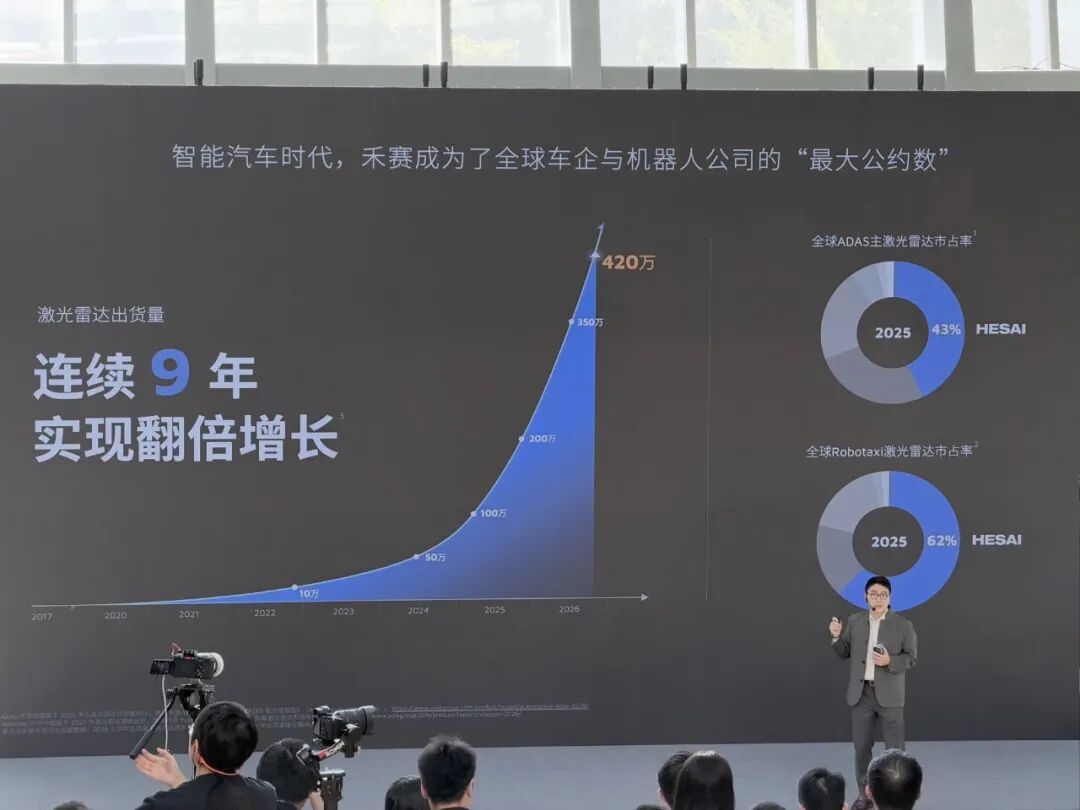
Now, he repeatedly asks himself: What has Hesai actually accumulated? Is it automotive supply chain capability, lidar expertise, or underlying technology that can be transferred to other products?
“Hesai remains a company focused on underlying technologies.” David Li defines Hesai’s core capabilities as complex opto-mechatronic system design, dedicated chip and semiconductor design, and a cost-, quality-, and manufacturing-oriented production system. In his view, new products are extensions and upgrades of these capabilities.
The demand for Kosmo originated from the way existing customers used Hesai’s lidars.
According to David Li, clients in surveying, construction, gaming, and robotics have increasingly demanded higher-precision radars over recent years. However, after acquiring the radar, they still had to integrate cameras, inertial navigation systems, and computing platforms to deploy their applications. Different companies ended up building similar systems from scratch, often with suboptimal integration and user experience.
Hesai has decided to productize these shared infrastructure components into a complete solution. Robot training was one of the early, clearly defined use cases; Sharpa provided application traction and validation scenarios. (Sharpa is a robotics company co-founded by Hesai’s three founders, developing both robot hardware and AI models.) Customers from other sectors, such as film and television, emerged gradually during the product development process.
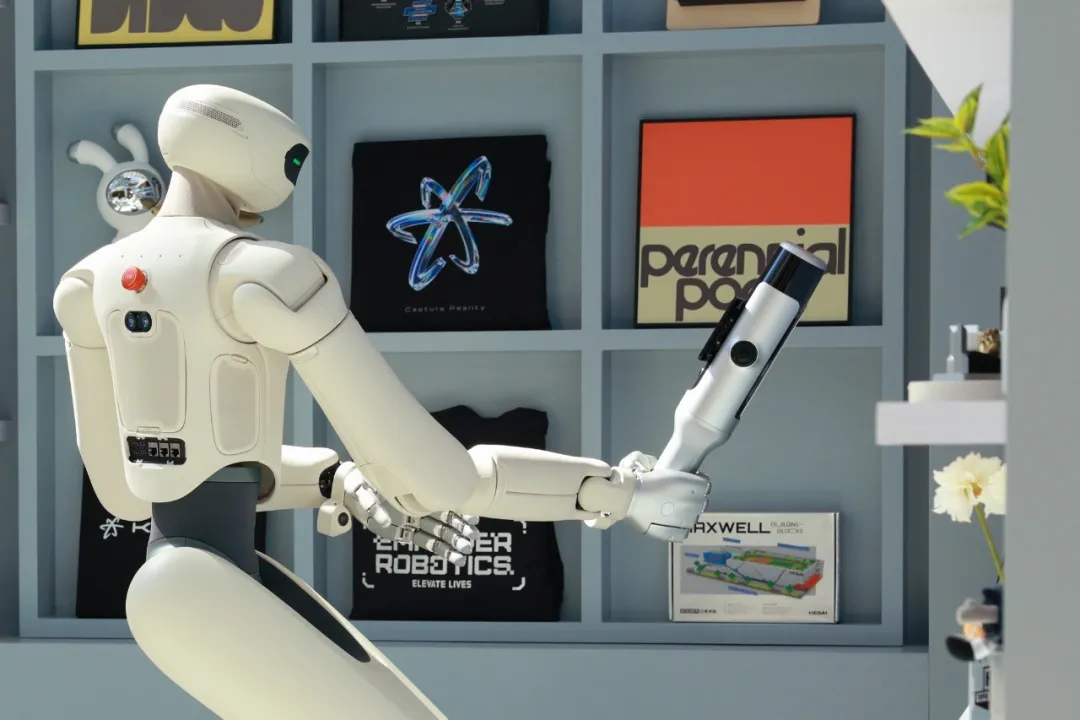
The resulting Kosmo One is a handheld device resembling a wine bottle. It integrates a custom-developed LiDAR, an 8K imaging system, a one-inch CMOS image sensor, and a high-precision IMU. The LiDAR captures spatial geometry, the camera records color and texture, and the IMU tracks device motion; all these data streams contribute to 3D reconstruction.
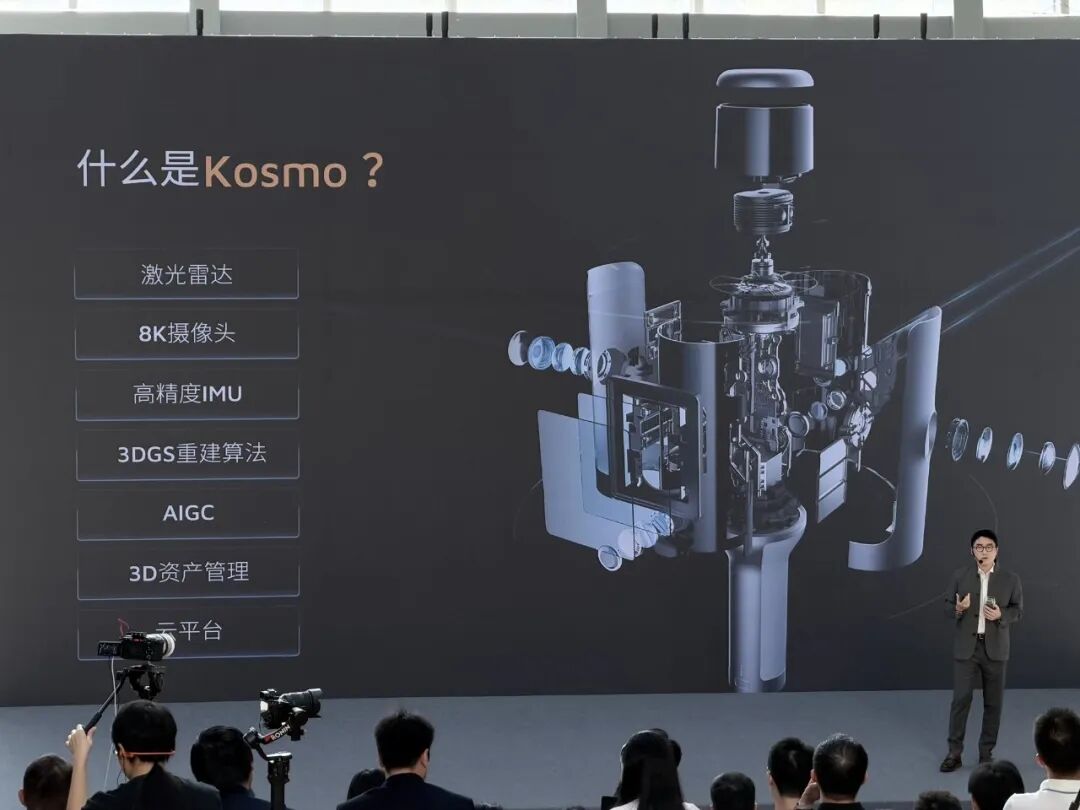
During his presentation, Hesai Co-founder and CTO Shaoqing Xiang demonstrated the LiDAR’s millimeter-level precision using a tennis racket, showing that the point cloud could clearly resolve mesh holes spaced approximately 5 millimeters apart.
The imaging system was also redesigned around the goal of 3D reconstruction. Shaoqing Xiang explained that traditional cameras typically optimize for single-camera, single-frame performance. However, reconstructing a space requires stitching together information captured by different cameras at different times. If white balance, exposure, and color processing are inconsistent, the same floor may appear in different colors across frames, compromising final fidelity.
To address this, Hesai developed a dedicated ISP (Image Signal Processor) that converts raw sensor signals into images optimized for subsequent 3D reconstruction. With Kosmo One, users can power on and begin scanning with a single button press; it takes approximately 15 minutes to scan a standard 100-square-meter indoor space.
This product shifts what Hesai delivers to customers. Previously, clients purchased individual sensors and handled integration themselves; now, Hesai aims to deliver ready-to-use 3D models directly into training or creative workflows.
David Li explained this shift with a straightforward analogy: 'I’ve already cooked the dishes; you’re handed a model.'
Turning Real Rooms into Robot Training Grounds
After Kosmo One captures a space, Kosmo World determines how that data can be used.
Shaoqing Xiang divides the platform’s workflow into three steps: generating 3D scenes, allowing users to edit and process those scenes, and eventually building a platform where users can share and access 3D content as their assets grow.
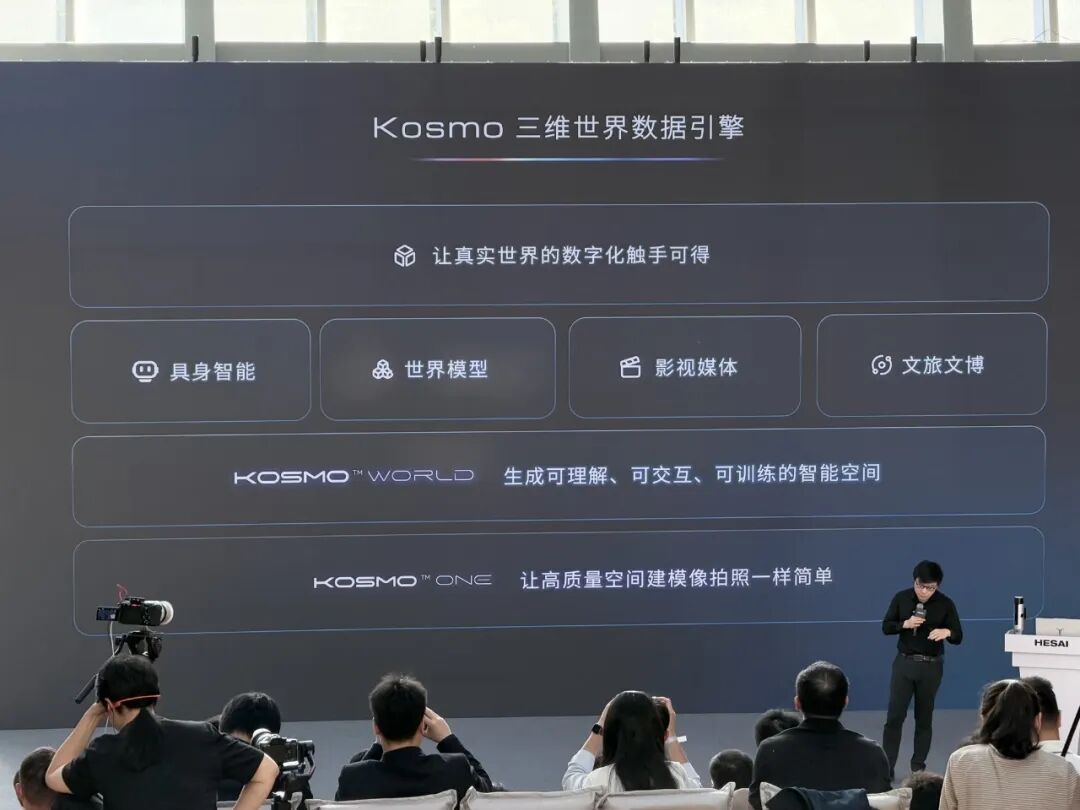
Its underlying system, Kosmo Spatial Core, outputs three types of data simultaneously from a single reconstruction. 3D Gaussian Splatting (3DGS) primarily restores scene appearance; mesh represents the geometric structure of objects and spaces; and depth provides distance relationships. All three data types originate from the same spatial capture and remain aligned.
For robot training, these information streams serve vision, interaction, and spatial perception respectively. A photorealistic room requires clear object boundaries, dimensions, and positions to enable further construction of interactive tasks.
The sofa showcased at the launch event serves as one example. Once AI identifies the sofa, it can extract it individually from the room; previously occluded areas are then filled in by AI. Users can also use language commands to extract other objects, moving, rotating, and recombining them.
This allows a single scanned room to generate multiple layouts. As robots learn to manipulate objects in simulation, they encounter different arrangements and spatial relationships. According to Hesai, the platform can also adapt visuals to match specific robot camera characteristics, generating observation views from the robot’s own perspective for training and evaluation, while supplying data for world models.
The Sharpa robot deployed in DQ ice cream stores utilizes this 3D training environment.
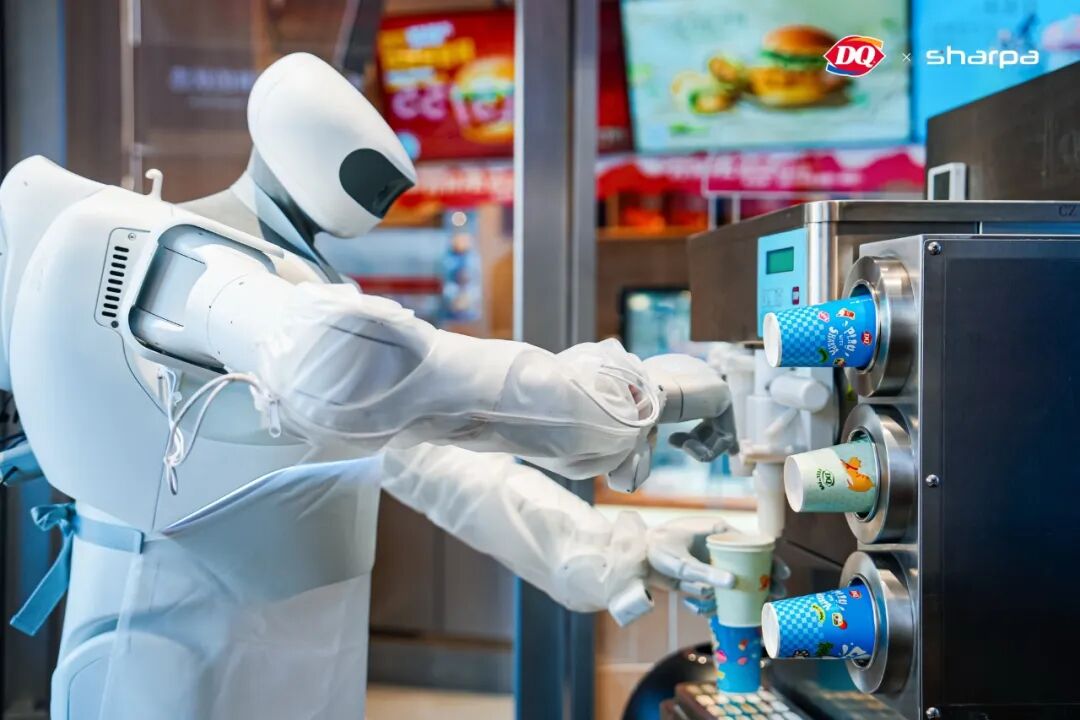
Shaoqing Xiang explained that previously, manually modeling and reconstructing such store environments required a professional team to invest approximately 300 hours. In contrast, Kosmo’s on-site spatial scanning takes about 15 minutes. The former represents the labor input for manual modeling, while the latter is the data collection time; however, post-scan reconstruction, editing, and training preparation remain integral parts of the complete workflow.
According to disclosures from Hesai, after adopting this 3D training environment, Sharpa’s task failure rate dropped to one-tenth of its previous level, achieving a task success rate of 99%.
Kosmo also employs AI during scene reconstruction to fill in areas that were not scanned, such as the underside of sofas or obscured carpets. These generated contents make assets more complete and easier to reuse.
At the press conference, Shaoqing Xiang compared the results of real-world scanning versus generative model reconstruction: when 20 photos of the same room were fed into a generative model (GPT-6 Astra), the reconstructed output exhibited issues such as furniture displacement, structural changes, and the addition of non-existent objects. Although incorporating Kosmo’s 3D data as a reference improved some structural errors, discrepancies in appearance and material texture remained compared to the scan results.
David Li argued that advances in generative AI capabilities actually expand the demand for real-world data: the more tasks models can solve, the broader the range of scenarios they need to cover. Generating additional content based on existing information can extend training environments, while continuous collection of real-world spaces provides the system with new information.
When asked whether the business could scale if a single room scan could be reused repeatedly, his explanation followed this logic. Robot training prioritizes generalization capabilities; the same room can serve as training material for different robots. As robots expand from food service into retail, hospitality, and home sectors, the variety of spaces and tasks they need to cover will continue to increase.
In his view, growth in this business will come primarily from expanding robot capabilities and broader application scopes.
From Selling Hardware to Selling Compute and Digital Assets
Robots were Kosmo’s earliest demand source, but Hesai currently cannot determine who its largest customer base will be.
David Li said in an interview that the film and television industry was an unexpected byproduct of product development. Once real spaces are reconstructed into 3D assets, they can enter virtual production and post-production workflows, allowing creators to adjust camera angles, lighting, and reuse scenes repeatedly.
According to Hesai, the 3DGS data generated by Kosmo has already been integrated into Pixar RenderMan’s rendering workflow. The company is also connecting with creative tools such as Unreal Engine and Houdini, as well as robotics simulation platforms like NVIDIA Isaac Sim and Isaac Lab, to enable different customers to use these assets within their own workflows.
Amap provides an alternative use case. At the launch event, Amap and Hesai announced a strategic partnership. The first batch of fully reconstructed 3D spaces—including Chong Art Museum and Pianfeng Gallery—are now live on Amap’s Street View ranking under “Flying Street View.” Users can preview interior spaces before visiting. For cultural tourism and museum sectors, there is a need to record, preserve, and showcase real-world spaces.
These clients share collection and reconstruction capabilities, but what they purchase may differ. Some require long-term device access, others want a one-time space reconstruction, and still others need pre-made assets.

David Li divides potential revenue into three tiers.
The first layer is hardware. This is currently the most direct and existing form of revenue. According to his description, product prices are relatively high, so early adoption will prioritize high-value scenarios where customers are willing to pay for quality.
The second layer is cloud-based processing services. A customer who wants to fully reconstruct a building or room does not necessarily need to hold the equipment long-term. What they truly need is the final delivered 3D model. Behind data collection lies substantial computation, and Hesai can charge around this process. David Li describes it as "collecting electricity fees": the result is what is delivered, while computing power and processing capability underpin the billing.
The third layer is digital assets. Once sufficient spaces and objects have been captured and processed, subsequent users can directly obtain usage rights, eliminating the need for repeated scanning and creation. Under his vision, the platform will aggregate more assets and provide them to clients through licensing, subscriptions, and other methods.
These layers of business have different construction cycles. David Li expects that in the next three years, hardware and cloud services will remain the dominant models; a digital asset platform may take at least three to five years to build. He said the platform already has assets available for free download, and in the long term hopes to gather more content from various sources.
Hesai's current business plan includes software-and-hardware integrated products, as well as spatial data production services for world model and physical AI companies. In David Li's vision, these businesses will further evolve into an asset platform.
This also means that Hesai needs to learn a new way of defining products.
When serving automotive clients in the past, the team primarily developed products around clear requirements. David Li said that at that time, they would typically identify two or three major clients, consolidate their requirements, define specifications, and then proceed to the R&D and production stages familiar to the company. Now, robotics companies use Kosmo to build simulation training environments, film teams use it to capture scenes and produce shooting materials, and Hesai needs to ensure its single product line adapts to these diverse applications.
David Li says he is more focused on how large this business can become in the future.
Thus, the changes brought by this launch event can be distilled into a specific delivery relationship: Hesai is moving beyond providing sensors to offering usable 3D assets. The scale of this new business will ultimately be determined by how much equipment customers are willing to purchase, how much cloud processing power they consume, and how many assets can be repeatedly licensed.
David Li has already made long-term judgments about spatial intelligence. For it to become a larger business than lidar, Hesai next needs to prove that these spaces collected from the real world can continuously enter customers' workflows and deliver value worth paying for.