

Beyond the Hardware Sale: Can Robot Integrators Turn a Profit?
By Xiong You Di
While robot manufacturers focus on hardware sales, system integrators are tasked with making these machines actually work on the factory floor. However, turning a profit from this secondary development is proving difficult, with a single palletizing project requiring over RMB 1 million in combined hardware and software investment.
Abstract: Robot hardware manufacturers are busy selling robots, while secondary development companies are responsible for making them actually do the work. But this money is not so easy to make.
Purchasing a robot is just the beginning of the expenses. Making it actually perform useful work comes at an entirely different price.
During this year's China International Industry Fair, a service provider specializing in full-chain secondary development for embodied AI ran the numbers for us: a factory depalletizing and palletizing robot project (involving a single robot hardware unit alongside development and delivery) carried a combined software and hardware quote of more than RMB 1 million.
A single order can take on different transaction structures. Some customers purchase a complete software and hardware solution directly from the secondary development company; others specify a particular robot model, leaving procurement and development to the secondary developer; still others sign contracts directly with the hardware manufacturer, which then subcontracts the software development to its partners.
"They don't care about the software or the hardware; they just want a robot that can actually do the job," a salesperson put it bluntly.
As robot companies increasingly rally around the slogan of "entering factories," these secondary development companies—earning that "different price"—have also brought their booths to the China International Industry Fair, hoping to attract more customers.
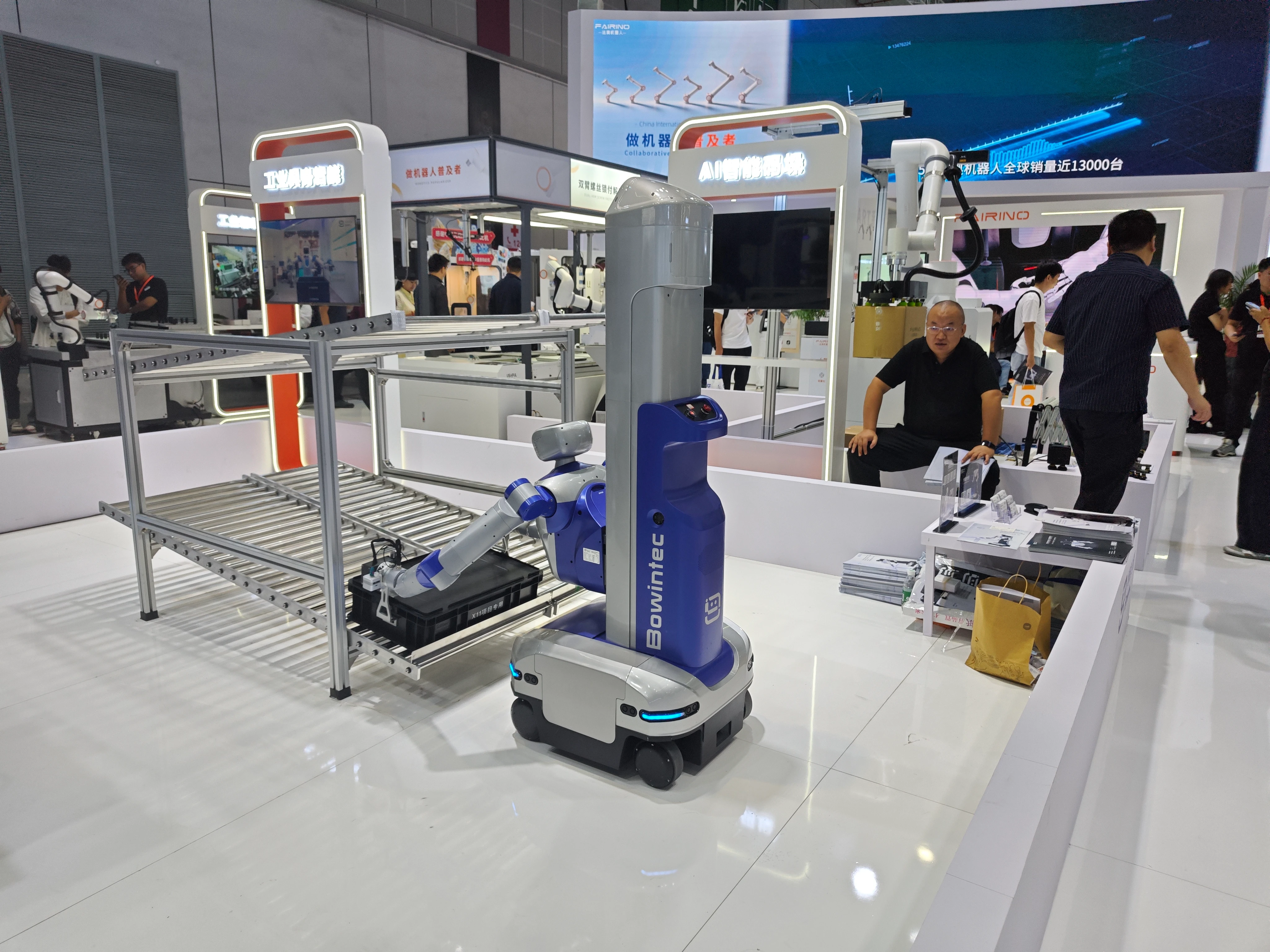
The exhibition scene at the China International Industry Fair (CIIF). The core of the image is a blue and gray mobile robot equipped with a robotic arm cooperating with black objects on a conveyor rack, suitable for logistics handling and other operations. In the background, the "ABB Robot" logo is visible, along with other industrial equipment exhibits. Many visitors are gathered around, and some personnel are communicating at the exhibition tables. The overall scene fits the theme of secondary development displays for industrial robots, echoing the article's content about integrators' booths at CIIF showcasing working robots.
Yet even within secondary development, not everyone is in the same line of business.
Robot Operating System (ROS) "custom development" can cost as little as a few hundred RMB per order and can be taken on by individuals. On social media, numerous posts seek out robot secondary development teams, with demand concentrated on lightweight applications such as guided tours, inspections, and large model interactions. But demand does not guarantee profit. Downstream secondary development for commercial performances and interactions has already become fiercely competitive. According to the China Business Journal, the daily rental rate for humanoid robots has dropped from the RMB 10,000 range at the beginning of last year to around RMB 4,000 today. I also saw someone in a group chat list nine commercial performance packages at once, complete with templates for every scenario.
The secondary developer mentioned at the beginning rarely takes on robot dog projects. In their view, application development for robot dogs is already relatively mature, with many teams in the market having completed similar projects, which limits profit margins amid fierce competition. A staff member revealed that for a robot dog project totaling approximately RMB 200,000, the profit might only range from RMB 10,000 to RMB 40,000. For a company that must develop the relevant software from scratch, the cost of reinvesting in R&D could further erode these margins.
Secondary developers handling actual industrial projects face an entirely different set of requirements.
This team of fewer than 20 people has secured projects worth tens of millions of RMB this year, involving dozens of robots, with a single engineer sometimes managing multiple projects simultaneously. Meanwhile, the robot production line at another industrial robot manufacturer remains in the internal testing phase. They are still actively seeking scenarios to train their robots and pitching their solutions to factories. According to a technician who has long served industrial clients, interactive and tour-guide applications are little more than "toys" and fail to meet the rigorous demands of factory customers.
Behind the orders for robots deployed in factories, beyond the visible robot hardware, lie several distinct billable components, including application development, system integration, channel referrals, and ongoing operations and maintenance.
If customers are willing to pay substantial development fees, why don't the robot OEMs capture that revenue themselves? And for the secondary developers that have taken on these orders, how much actual profit do they ultimately realize?
Why do robot OEMs "hand over" projects?
In 2026, robot sales have indeed surged. According to Counterpoint Research, global humanoid robot shipments exceeded 22,000 units in the first half of the year, representing a year-on-year growth of nearly 300%, with all top five manufacturers by shipment volume being Chinese companies.
However, most of these robots remain in showrooms, theme parks, and laboratories. According to IDC, scientific research and education, performances and exhibitions, and government data collection centers still accounted for 69% of global humanoid robot shipments in the first half of the year. Meanwhile, Frost & Sullivan reports that revenue from humanoid robots in industrial production and operations reached only USD 78 million globally in the first half of 2026, making it the smallest of the four major application scenarios tracked by the firm.
Based on publicly disclosed deployment cases, the small fraction of robots entering factories is primarily concentrated in tasks such as material handling, machine tending, material transport, and quality inspection. However, individual projects remain at different stages, ranging from training and pilot testing to actual production.
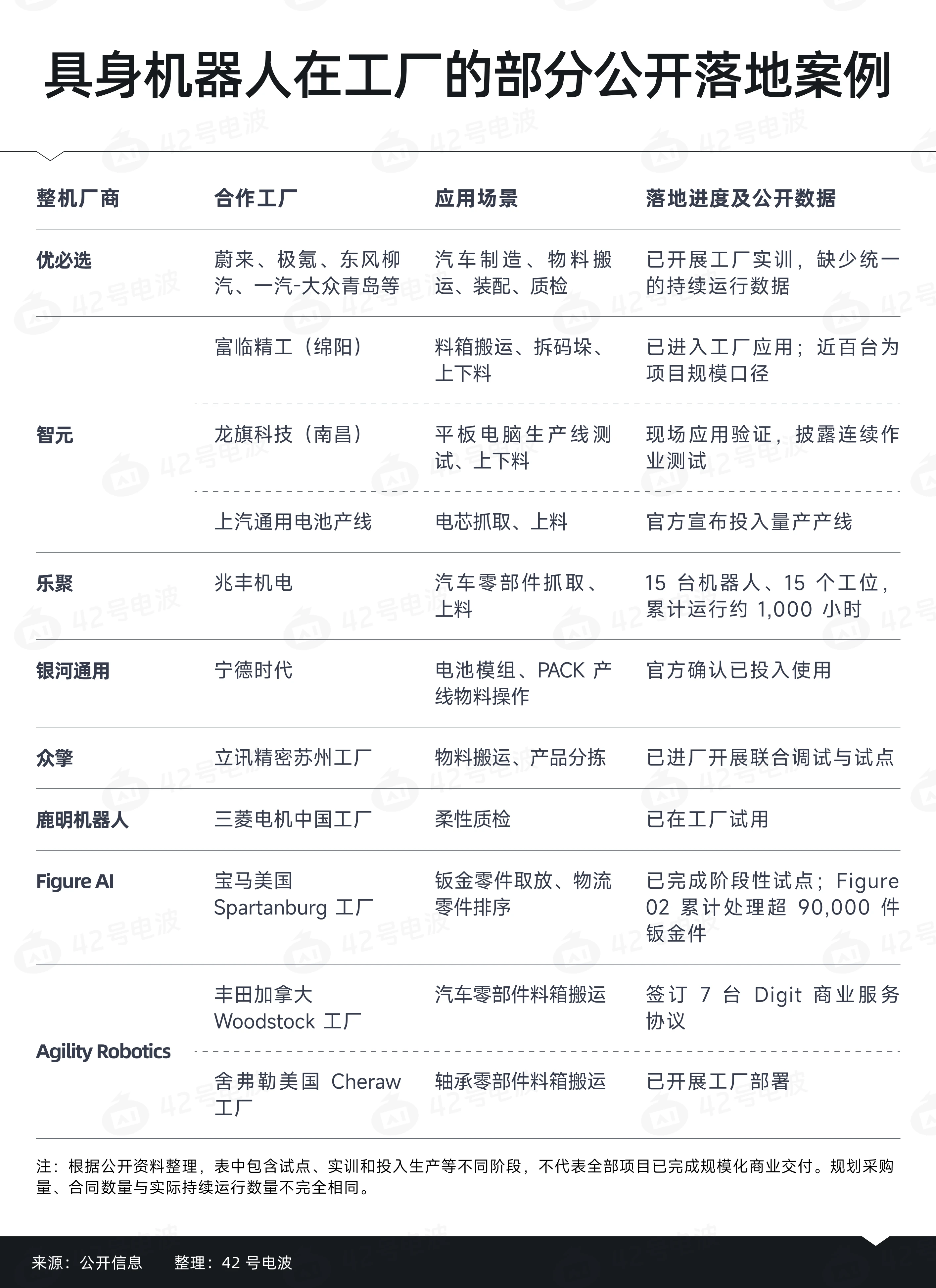
A statistical table of public deployment cases for embodied robots in factories. The table categorizes various robot manufacturers by partner factory, application scenario, deployment progress, and public data. The public data column notes different progress statuses, such as factory training initiated, mass production application entered, and on-site verification put into mass production. It also details specific cases, such as Figure AI and BMW's US factory completing a phased pilot and handling nearly 90,000 sheet metal parts, and Agility Robotics initiating factory deployment at its US Cheraw factory. All data is marked as publicly disclosed, covering various factory operation scenarios including handling, loading and unloading, and material transport.
Moreover, validating an application in a single factory and scaling those same capabilities across multiple facilities are inherently distinct engineering challenges.
Whether to step in and develop an application scenario themselves is, for robot hardware manufacturers, first and foremost an exercise in investment arithmetic.
An executive overseeing supply chain and pilot production at an embodied AI company told us that when robot manufacturers evaluate whether a scenario is worth pursuing, technical feasibility is not the only factor they consider.
"How large is the market? How much manpower is required? How long is the development cycle? Ultimately, it comes down to calculating an ROI."
If a customer purchases only one or two robots but requires extensive custom development, the math simply does not work out for a robot hardware manufacturer to assemble a dedicated R&D team for the project.
According to his experience, robot hardware manufacturers are only likely to be motivated to develop and deliver solutions themselves when procurement volumes for a specific type of demand scale up to dozens or even hundreds of units.
There are also technical limitations. He acknowledged that for robots to achieve true commercial deployment at this stage, "they still need to focus on specific application levels, because the generalization capabilities of brain models have not yet met market expectations."
Even when using the same robot hardware model, switching to a new task may require the development team to adjust software configurations, modify control interfaces, add sensors, or even redevelop manipulation skills. In some scenarios, teams must also recollect data and fine-tune models. This work is typically tied to specific customers and cannot be directly ported to the next project.
For robot hardware manufacturers, dedicating a separate team to every customer would easily drain resources needed for foundational models, hardware iteration, and new product development. "That's why we need partners across the ecosystem. We have so many secondary development companies working together to meet end-user demands."
For secondary development companies, robot hardware manufacturers serve as both equipment suppliers and crucial sales channels.
A salesperson at one secondary development company told us that large clients, particularly Fortune 500 enterprises, typically approach well-known robot hardware manufacturers first.
"When they want to get a project done, they will definitely approach the hardware manufacturer first. They don't know who we are."
Once the hardware manufacturer receives a request, they evaluate the project's scale and development complexity before subcontracting a portion of the work to their partners.
Of course, hardware manufacturers do not provide these referrals for free.
They not only profit from your hardware but also take a 10% cut of your software.
According to the description, in some partnerships, the hardware manufacturer may earn approximately 10% of its revenue from software development services in addition to selling the robot hardware.
For hardware manufacturers, the benefits of this division of labor are clear: it enables them to sell robots into more industries without bearing the full cost of development and delivery alone.
Moreover, relying on downstream partners is not merely a temporary stopgap.
In April of this year, Deng Taihua, founder, chairman, and CEO of AgiBot, stated explicitly at a partner conference that after AgiBot and its top customers jointly complete the "0 to 1" phase of real-world deployment, the company must rely on ecosystem partners to scale from "1 to N" across various scenarios. He revealed that partner-driven sales accounted for 25% of AgiBot's total in 2025, with a target to increase this share to 60% in 2026. Secondary development firms are one such type of partner.
However, just because a hardware manufacturer decides against taking on a project after calculating its return on investment, does that mean it automatically becomes a profitable business for a secondary development company?
Winning contracts does not guarantee profit
A seemingly simple part loading task in a factory may require a robot to practice tens of thousands of times.
In October of this year, Leju and Zhaofeng Electromechanical announced that 15 "Kuafu" robots have been handling part loading tasks on an automotive components production line. The robots have been adapted for 15 workstations and over 10 types of parts, accumulating approximately 1,000 hours of operation and assisting in the production of more than 60,000 components.
However, achieving these results required nearly a year of alignment and integration between the two parties. Kong Aixiang, Chairman of Zhaofeng Co., Ltd., told the media that the robot initially struggled just to grip parts steadily, with the gripping action alone requiring about 15,000 repeated training iterations. This reflects the current reality of deploying embodied AI in industrial settings: while robots can enter production lines, adapting them to specific manufacturing tasks still demands extensive development, debugging, and validation.
An employee at a robotics integration service provider told us that the development cycle for certain robot application projects at their company is about three months. In contrast, some of the robot hardware manufacturers he has worked with might take six months or even longer to develop specific applications in-house. Meanwhile, an industrial robot manufacturer noted that a single robot project typically requires three to five engineers, with a development and debugging cycle lasting around six months.
Robot hardware manufacturers must balance building general-purpose platforms with pursuing multiple product lines, whereas integration companies can focus entirely on a specific customer's tasks and concentrate on solving their problems. The resources invested vary depending on the project's budget. According to these integrators, a contract worth several million RMB naturally provides the motivation to allocate more personnel, making it possible to run multiple projects in parallel.
Another advantage is their familiarity with different robot brands. A software stack that runs perfectly on one robot might require extensive re-tuning when deployed on another. The degree of software openness, control interfaces, and hardware configurations across different manufacturers all directly impact the difficulty of secondary development.
They have their own standards for evaluating a robot's usability.
A technical sales representative told us that some large customers are strictly brand-conscious, willing to prioritize a product even if it costs a bit more. He cited UBTECH and AgiBot as examples: UBTECH enjoys strong brand recognition among industrial clients, while AgiBot’s high degree of software openness and developer-friendly design in certain products are much more to his liking.
"Sometimes you write the code and it works perfectly on an AgiBot robot, but if you switch to a different brand, you might have to tweak a lot of things before it runs again."
He also noted that some lower-priced robot hardware might perform just as well in actual task completion, yet they are not necessarily the first choice for large customers.
For secondary development companies, platform selection is indeed a task that demands significant experience. Beyond selection, the real-world deployment of embodied AI also faces challenges in adapting to on-site production lines, managing development cycles, ensuring stability in scaled applications, integrating with information systems, and handling post-launch maintenance and optimization.
An end-to-end application project encompasses several stages, including scenario analysis, solution design, proof-of-concept (POC) validation, phased delivery, on-site deployment, and ongoing operations with iterative optimization.
Before formal development begins, the team must first determine whether the customer's requirements are feasible, select the appropriate robot, and identify necessary hardware and software adjustments. Only then does actual development and on-site commissioning commence, continuing until the operational metrics stipulated in the contract are met.
Customers typically negotiate requirements with the service provider, such as action success rates and cycle times. If the proposed metrics significantly exceed current technological capabilities, both parties may abandon the partnership before signing the contract.
From solution design to final delivery, every step demands the allocation of engineering personnel and R&D resources.
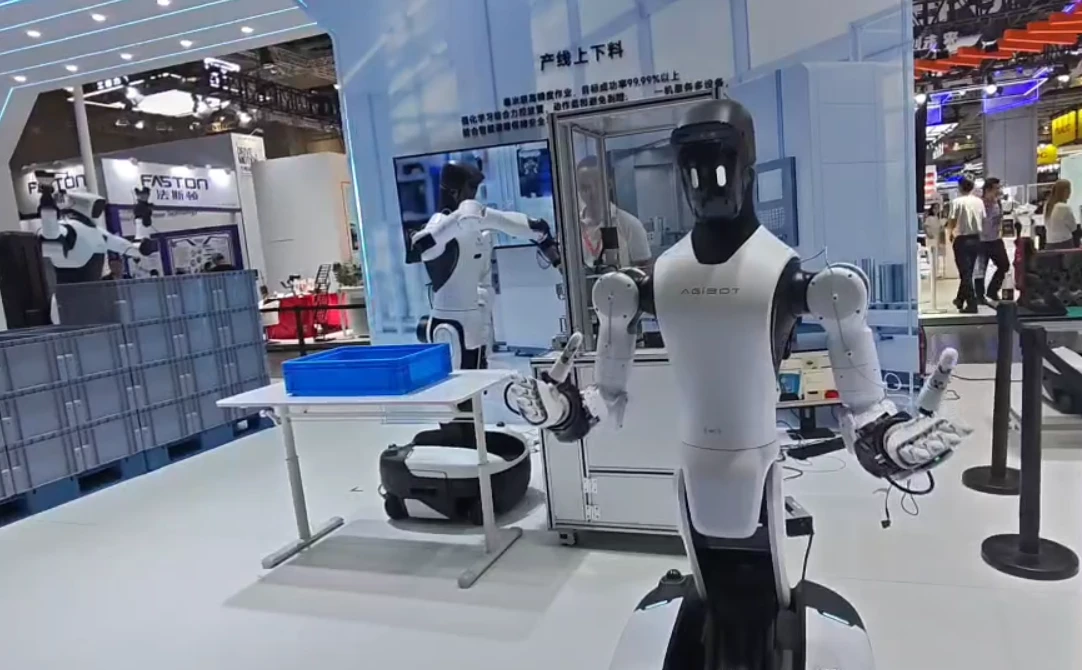
A humanoid robot in an exhibition setting, along with supporting production line loading and unloading equipment. In the foreground is a humanoid robot named "ANIBOT" with flexible robotic arms. In the background, another robot is operating at a workstation equipped with blue bins, and the adjacent equipment is labeled "Production Line Loading and Unloading." This scene echoes the article's discussion on embodied AI applications and robot-related projects, reflecting the application forms of robots in industrial operation scenarios and visually demonstrating the robot applications that need to be evaluated during the solution design phase.
With such substantial investments, what are the actual profit margins? The mature industrial robot market offers a useful benchmark. JAKA Robotics disclosed in its draft STAR Market prospectus that in 2024, the gross margin for its robot hardware business was 54.58%, while the gross margin for its system integration business was 28.85%. Traditional collaborative robot system integration is not entirely identical to today's embodied AI secondary development, but it illustrates that even within a single robotics company, the profitability structures of hardware and system integration can differ significantly. While the quoted price for a turnkey solution can be high, the actual profit retained ultimately depends on project costs, development efficiency, and delivery risks.
Running projects in parallel can help amortize labor costs, but a more viable path for secondary development companies to boost efficiency is reusing past deployment experience.
Staff members candidly note that even if two factories perform similar tasks, specific on-site deployments may still require custom readaptation.
However, projects are not entirely without commonalities. Operations such as material handling, machine loading and unloading, and grasping share at least some basic motions and development experience that can be reused. Some clients initiate a second phase upon completing the first, deploying similar capabilities across additional robots. Yet, if the software has already been developed, clients adding new robot bodies later may not need to pay the same development fees.
Software reuse can truly improve a company's operational efficiency only if subsequent orders are sufficiently large while engineering investments do not need to increase proportionally.
Currently, a single project requires three to five engineers and takes several months. Even with a continuous stream of projects throughout the year, the number of initiatives a small team can advance simultaneously remains extremely limited.
Moreover, in today's embodied robot market, not all customers are ready for large-scale deployment.
We have learned that some projects are initially launched simply to show management that robots have entered the factory, without any urgent need for labor replacement.
Actually, many of our projects are purely for demonstration—just to show the leadership.
For secondary development firms, such projects can still generate revenue; however, demonstration-driven procurement and deployments that continuously create economic value on the production line remain two entirely different matters.
For robots actually deployed in long-term production, customers must also calculate ongoing operational costs. Fulin Precision has previously stated publicly that it aims to keep the payback period for related robot applications under three years, though the exact timeline depends on cycle times, scenario optimization, and procurement scale.
Once a robot passes acceptance testing, its long-term operation involves ongoing maintenance, software upgrades, fault resolution, and technical support.
For secondary development companies, these follow-up services can generate new revenue streams, but they also incur corresponding personnel and maintenance costs. To scale their project-based business, these companies must not only apply their previously developed capabilities to new projects but also ensure that clients can find them directly when future needs arise.
In reality, however, the original robot manufacturers are usually the ones that initially bring clients to them.
Secondary development or working for the robot manufacturers?
"Most of our clients still come through referrals from the robot manufacturers," a sales representative at a secondary development company explained, describing their customer acquisition process.
This dependency extends beyond daily customer acquisition; robot manufacturers are also locking in these relationships through investment, keeping the profits in-house.
In 2025, AgiBot co-invested with industrial partners such as Fulin Precision and Juxing New Materials to establish Annu Intelligence.
According to the agreement disclosed by Fulin Precision, AgiBot provides technical support for the robot hardware and application development. In return, Annu can perform secondary design based on the original hardware to manufacture specialized robots for specific industries, and it receives authorization for complete robot sales and white-labeling within an agreed scope.
In May this year, ENGINEAI made a strategic investment in Feikuo Technology, a company already engaged in scenario-based application development. Prior to this, Feikuo had developed applications for ENGINEAI's products in cultural tourism guidance, commercial reception, and education and research. In August this year, Songyan Dynamics, Jiasu Jinhua, and Luming Robotics jointly participated in a funding round for the robotics software company Oakay.
Partnering with established robot hardware manufacturers provides a crucial customer channel. However, secondary developers may also become dependent on these manufacturers for customer acquisition, technical interfaces, and even hardware procurement.
This inevitably leads to "quite awkward" situations. For instance, a customer might initially approach a specific hardware manufacturer, but if that robot's payload capacity is insufficient for the requested material handling task, the secondary developer may have to recommend a different brand.
Yet the primary goal of a hardware manufacturer is to sell its own robots. "The hardware manufacturer is there to sell its machines, whereas we are here to solve your pain points."
For hardware manufacturers, expanding sales volume is a key objective; for secondary developers, the ability to select the right equipment and execute smooth deliveries is directly tied to their own operations. The commercial interests of the two parties do not always align perfectly.
Therefore, the first hurdle for secondary developers to scale up is transitioning from being a downstream partner of hardware manufacturers to becoming a true solution provider that owns the customer relationship.
The second hurdle is enabling already developed capabilities to serve a broader range of robots.
Oakay aims to use its software platform and unified interfaces to enable certain applications to migrate across robots from different brands. If the software can be deployed across different hardware bodies, the company can offer its services to a wider range of manufacturers and developers without having to repeatedly rebuild solutions for a single model. However, cross-brand compatibility inherently increases integration costs. Control interfaces, underlying capabilities, and the degree of software openness vary among manufacturers, meaning the actual reusability of an application must be validated on a project-by-project basis.
Moreover, robot hardware manufacturers are also lowering the barriers to application development.
In May this year, Unitree launched UniStore, a shared application platform that allows developers to create, publish, and access robot motion applications. AgiBot, Leju, and other companies are also advancing tools for robot skill orchestration, task configuration, and system integration. Leju disclosed that its skill development toolchain has broken down the material loading skill into more than 30 basic modules, enabling developers to combine these modules and reduce the need for repetitive low-level coding.
While these platforms make third-party development easier, they also risk standardizing some simple custom features. Secondary development companies must leverage the open platforms provided by robot hardware manufacturers, even as they face the risk of having some of their services replaced by the manufacturers' standard offerings.
As secondary development companies begin seeking revenue beyond one-time project deliveries, robot hardware manufacturers are not standing still either.
In December 2025, AgiBot and companies including Feikuo Technology co-founded the robot rental platform Qingtianzu, with Feikuo Technology founder Li Yiyan serving as CEO. The launch of Qingtianzu marks a shift for both parties from traditional equipment sales and project outsourcing to jointly operating a rental and service platform. Previously focused on commercial performances, cultural tourism, and exhibitions, Qingtianzu has proposed expanding into industrial manufacturing, warehousing, and logistics following its latest funding round.
In other words, robot hardware manufacturers are equally interested in capturing the long-term service revenue that secondary development companies hope to secure.
Similar recurring revenue models are also being explored in various ways overseas.
U.S. warehouse robotics company Ultra Robotics develops dedicated equipment for tasks such as packaging and sorting, operating under a robot-as-a-service (RaaS) model. Its customer, Highline Commerce, initially paid based on the volume of orders completed by the robots. As the system's operations gradually stabilized, the two parties transitioned to a monthly billing structure.
Ultra is not a traditional secondary development firm, but it provides a useful model: customers do not necessarily have to buy equipment outright; they can also purchase automation services on an ongoing basis.
However, recurring revenue does not inherently guarantee higher margins. Service providers must absorb costs such as equipment depreciation, maintenance, and manual intervention.
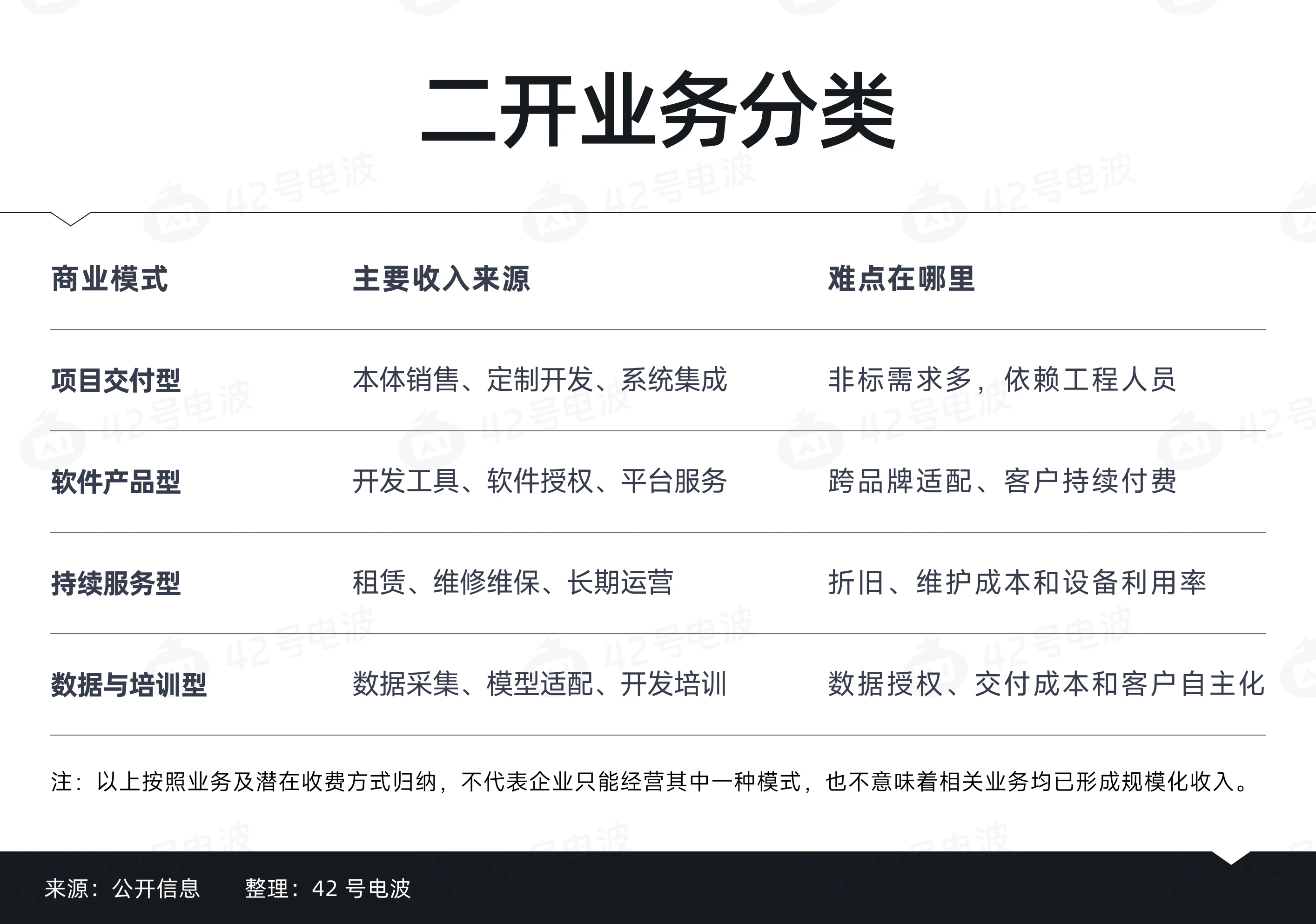
From project delivery to long-term operations, secondary development firms are exploring diverse revenue models. Based on publicly disclosed operations, these approaches can be broadly categorized as follows:
A robot exhibition at the China International Industry Fair (CIIF). A blue and gray robot is picking items from a shelf, with the "BOWINTEC" logo below it. The background features multiple robots and booths, along with visiting attendees. On the right, two men are present, one sitting and the other standing. A large screen above displays text such as "Industrial Robots" and "Collaborative Robots." This image aligns with the article's mention of robot companies pushing into factories and integrators bringing their booths to CIIF to attract more clients, visually presenting the robot exhibition at the fair.
Beyond custom development and equipment leasing, some secondary development firms have also begun offering development courses, corporate training, and data collection solutions.
A staff member told us that the company typically uses its proprietary models to complete client projects. However, if a client prefers to use open-source models, participate in data collection, and continue independent development post-delivery, alternative collaboration models can be arranged.
For additional data collection requirements, small-scale tasks can be handled in-house, while larger projects may be outsourced to external teams and billed separately.
From software tools and long-term operations to training and data services, secondary development firms aim to build enduring service relationships centered around their clients.
However, at present, regardless of the chosen business model, it remains difficult to bypass the robot hardware manufacturers.
Today, for non-standard projects involving just one or two robots, robot manufacturers might find the margins too thin and prefer to hand the work over to partners. However, once a specific application scales or the robots' native software capabilities mature sufficiently, these manufacturers may re-enter the development and delivery process. Conversely, the complexity of customer requirements and the distinct process demands across different industries could ensure that specialized service providers retain a long-term market presence.
Therefore, for secondary development companies, providing ancillary services is not a guaranteed path to easy profits.
For robot manufacturers, deciding whether a scenario is worth developing in-house requires calculating the return on investment (ROI); for secondary development companies, taking on projects that robot manufacturers are unwilling to tackle requires them to evaluate the economics just as rigorously.