

China's MIIT Issues Five Humanoid Robot Standards, Establishing L0 to L5 Intelligence Classification
On November 16, the Ministry of Industry and Information Technology (MIIT) issued Announcement No. 30 of 2026, approving 274 industry standards, including 92 for the electronics sector. The announcement includes five humanoid robot standards managed by the MIIT Humanoid Robot and Embodied Intelligence Standardization Technical Committee (MIIT/TC8), which took effect immediately upon release.
On November 16, the Ministry of Industry and Information Technology (MIIT) issued Announcement No. 30 of 2026, approving 274 industry standards, including Technical Requirements for Embodied Intelligence Data Generation Systems—Key Fundamental Technologies of Artificial Intelligence, with 92 standards falling under the electronics industry. Five humanoid robot standards managed by the MIIT Technical Committee 8 for Humanoid Robot and Embodied Intelligence Standardization (MIIT/TC8) are included in this announcement and take effect on the date of issuance.
These five standards are numbered 118 to 122 in Annex 1 of the announcement, with standard codes ranging from SJ/T 12353—2026 to SJ/T 12357—2026, all classified under the electronics industry. According to the technical committee, this batch of standards covers three main areas: intelligent capability evaluation, key components, and humanoid robot training, detailed as follows:
- Humanoid Robots—Technical Specifications for Training Site Construction (SJ/T 12353—2026)
- Humanoid Robots—Requirements for Training Data Management (SJ/T 12354—2026)
- Humanoid Robots—Classification of Intelligent Capabilities (SJ/T 12355—2026)
- Humanoid Robots—Technical Specifications for Electrically Driven Integrated Joints (SJ/T 12356—2026)
- Humanoid Robots and Embodied Intelligence—Technical Specifications for Dexterous Hands (SJ/T 12357—2026)
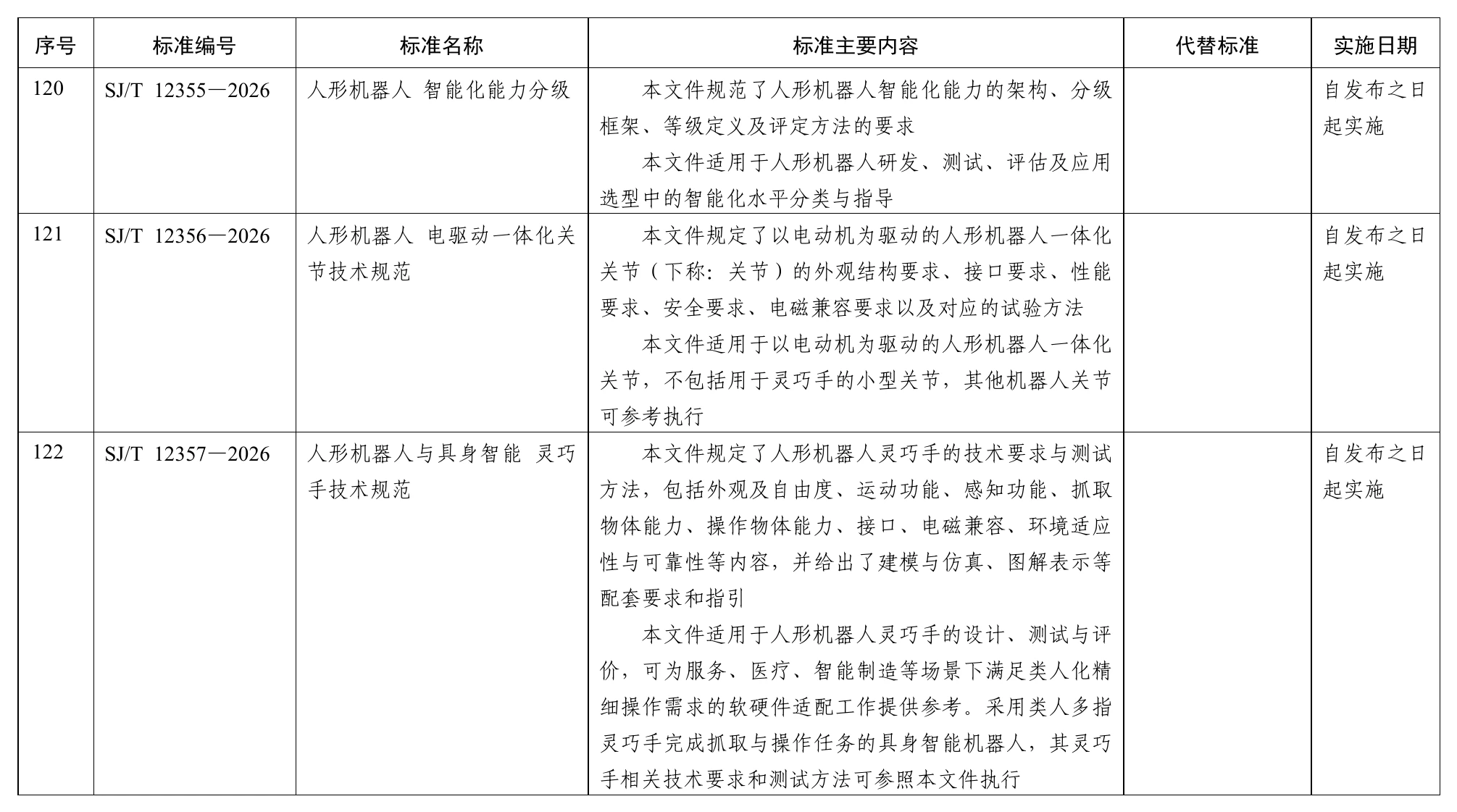
Image | MIIT Announcement No. 30 of 2026 (Source: Ministry of Industry and Information Technology)
The announcement's annex describes Humanoid Robots—Classification of Intelligent Capabilities (SJ/T 12355—2026): This document standardizes the requirements for the architecture, classification framework, level definitions, and evaluation methods of humanoid robots' intelligent capabilities. It applies to the classification and guidance of intelligence levels in the research and development, testing, evaluation, and application selection of humanoid robots.
According to information obtained by The Paper from the secretariat of the technical committee on November 17, this standard establishes an intelligent capability classification framework from L0 to L5 across four dimensions: perception and cognition, decision-making and learning, execution and performance, and collaboration and interaction, providing an evaluation basis for product R&D, testing and evaluation, application selection, and scenario adaptation. The annex to the announcement publishes a summary of the standard's main content and does not list the specific definitions and evaluation indicators for each level from L0 to L5.
Regarding Humanoid Robots—Technical Specifications for Electrically Driven Integrated Joints (SJ/T 12356—2026), the announcement's annex states: This document specifies the appearance and structural requirements, interface requirements, performance requirements, safety requirements, electromagnetic compatibility requirements, and corresponding test methods for electrically driven integrated joints of humanoid robots.
This document applies to electrically driven integrated joints for humanoid robots, excluding small joints used for dexterous hands, though other robot joints may refer to it for implementation. A report by The Paper on the same day notes that this standard focuses on core joints such as the torso and legs of humanoid robots, unifying interfaces, performance metrics, and test methods.
Regarding the Technical Specification for Dexterous Hands in Humanoid Robots and Embodied Intelligence (SJ/T 12357—2026), the appendix to the announcement states: This document specifies the technical requirements and testing methods for dexterous hands on humanoid robots, covering appearance and degrees of freedom, motion functions, perception functions, object grasping capabilities, object manipulation capabilities, interfaces, electromagnetic compatibility, environmental adaptability, and reliability. It also provides supporting requirements and guidelines for modeling, simulation, and graphical representation.
This document applies to the design, testing, and evaluation of humanoid robot dexterous hands, providing a reference for hardware and software adaptation to meet human-like fine manipulation requirements in scenarios such as services, healthcare, and intelligent manufacturing. For embodied AI robots that use human-like multi-finger dexterous hands to perform grasping and manipulation tasks, the relevant technical requirements and testing methods for their dexterous hands can be implemented with reference to this document. According to The Paper, this standard targets the design, testing, evaluation, and delivery of dexterous hands, focusing on improving issues such as inconsistent interfaces and low overall system integration efficiency.
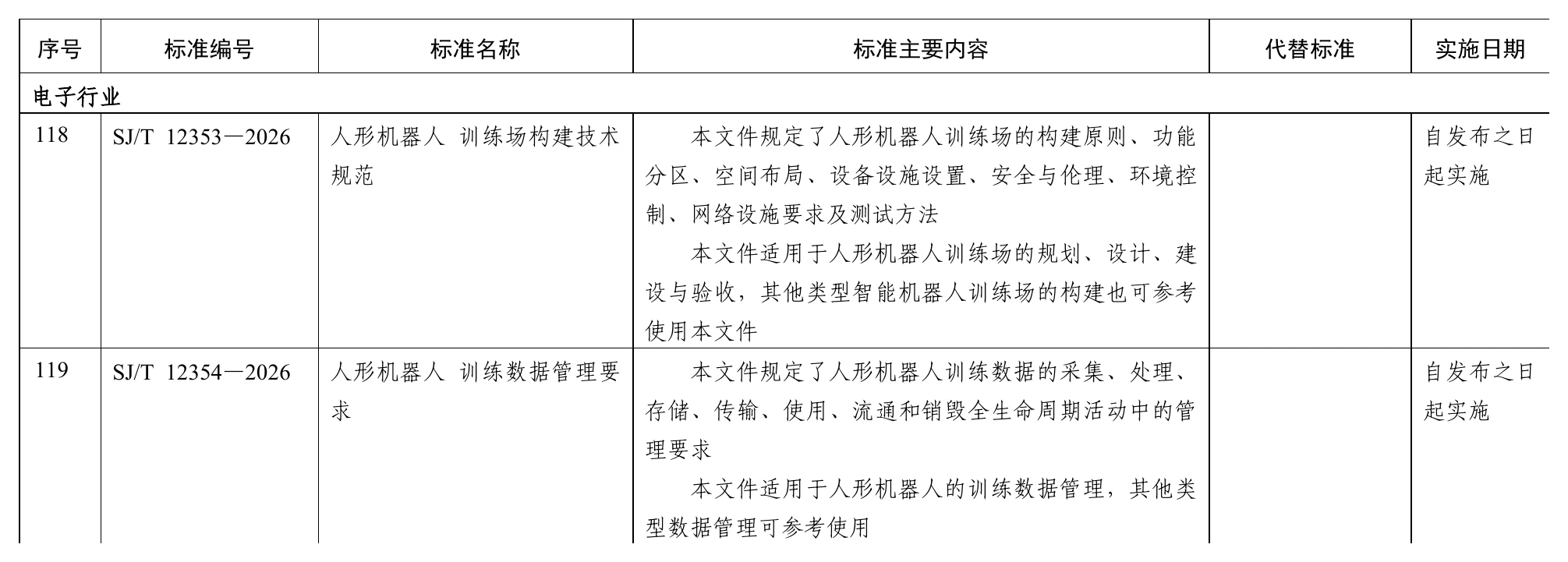
Image | MIIT Announcement No. 30 of 2026 (Source: Ministry of Industry and Information Technology)
Regarding the Technical Specification for Training Ground Construction of Humanoid Robots (SJ/T 12353—2026), the appendix to the announcement states: This document specifies the construction principles, functional zoning, spatial layout, equipment and facility setup, safety and ethics, environmental control, network facility requirements, and testing methods for humanoid robot training grounds. It applies to the planning, design, construction, and acceptance of humanoid robot training grounds, and can also be referenced for the construction of training grounds for other types of intelligent robots.
The supporting standard, Requirements for Training Data Management of Humanoid Robots (SJ/T 12354—2026), states: This document specifies the management requirements for the entire lifecycle activities of humanoid robot training data, including collection, processing, storage, transmission, use, circulation, and destruction. It applies to the training data management of humanoid robots, and can be referenced for other types of data management.
The same announcement also approved the Artificial Intelligence: Key Basic Technologies: Technical Requirements for Embodied Intelligence Data Generation Systems (SJ/T 12398—2026), listed as item 126 in Appendix 1, which also takes effect on the date of its release. The appendix to the announcement states: This document establishes a reference framework for embodied intelligence data generation systems and specifies the system's technical requirements. It applies to the design, research and development, and testing of embodied intelligence data generation systems.

Image | MIIT Announcement No. 30 of 2026 (Source: Ministry of Industry and Information Technology)
Found an error? Tell us