

Walden Refines Factory Robots Through Real-World Deployment, Shares Lessons at CoRL 2026
By Jiang Si Qi
Spun out from Toyota Research Institute, Walden presented at CoRL 2026 on deploying general-purpose robots in manufacturing, using shared autonomy and continuous model iteration to improve performance through 33,000 real-world camshaft loading operations.
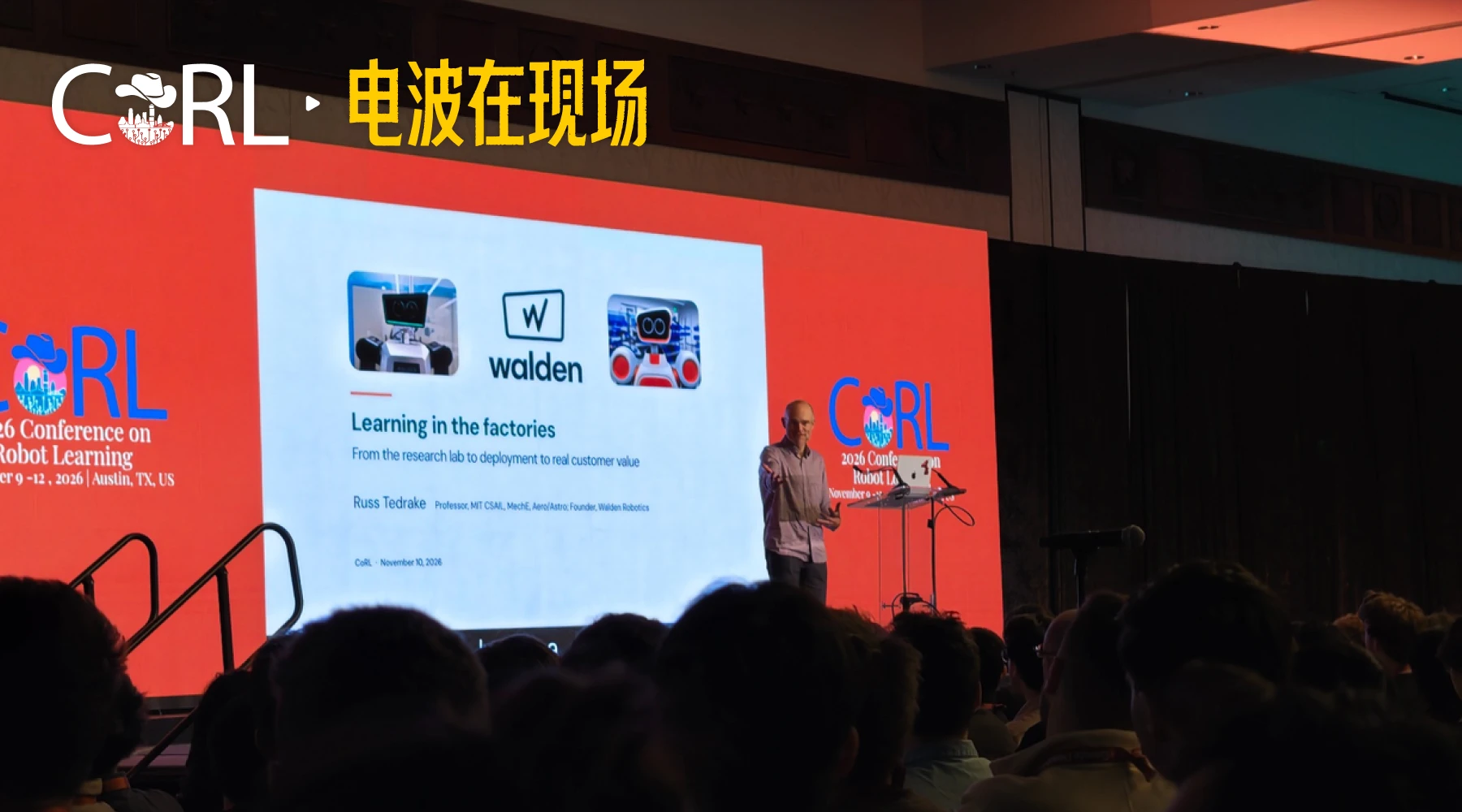
On November 10, local time, the premier robotics learning conference CoRL 2026 opened in Austin, Texas.
As part of the conference program, Russ Tedrake, co-founder and CEO of Walden and a professor at the Massachusetts Institute of Technology, delivered a talk titled "Learning in the factories." He opened with a key insight: "The real lessons are learned on the shop floor." This statement captures the team's original motivation for stepping out of the lab to found the company.
This talk clarified the direction Russ has charted for Walden: moving from academic research labs to real-world deployment to create tangible value for customers.
In January of this year, Russ and his team spun out from the Toyota Research Institute to found Walden, setting out to translate years of robotics research into real-world manufacturing. By February, their robots were already operating inside a Toyota factory in North America.
In July, the company made its official public debut, announcing the close of a USD 300 million seed round co-led by Toyota and Deviation Capital, which brought its post-money valuation to USD 1.1 billion.
Months of on-site deployment also shaped the more specific questions Russ addressed in his talk: how to keep robots running reliably through an entire shift on the production line, how to seamlessly transition to manual intervention when anomalies occur, and how to feed the operational experience gathered on the floor back into the next round of model training.
As a practical validation of this philosophy, Walden's earliest and longest-running production line deployment has now completed the loading of 33,000 camshafts.
Russ shared a highly representative anecdote from the field. During the initial factory deployment, the team originally expected to finish the setup in just 15 minutes. However, seeing curious workers gathering around to watch, they adjusted their plans on the fly, spending an extra hour personally assembling and tuning the equipment.
This approach allows frontline workers to see and touch the robots up close, gradually getting to know their future working partners.
In Russ's view, while rapid technological progress is essential, true real-world deployment requires first building trust with the people on the factory floor.
From research to production
For Walden, which recently spun out of the Toyota Research Institute and immediately secured USD 300 million in funding led by Toyota and Deviation Capital, with participation from NVIDIA, Boeing, and Samsung, this launch has already drawn significant industry attention.
The team's technical foundation, however, extends much further back than the company itself. Russ previously led the robotics and machine learning team at the Toyota Research Institute for nearly a decade.
Discussing the foundation of Walden, he cited a series of achievements led or contributed to by the original team: Diffusion Policy, the Universal Manipulation Interface (UMI), Large Behavior Models, OpenVLA, and the open-source simulation tool Drake. This research spans the entire pipeline of robot action learning, demonstration data collection, and the transfer of algorithms to physical hardware.
This deep academic foundation laid the groundwork for the project, but upon transitioning to a corporate structure, the team's core mission became integrating these disparate research outputs into reliably deliverable products.
Walden positions itself as a full-stack physical AI company aiming to develop and deploy general-purpose robots capable of continuous autonomous learning in real-world work environments. The team's capabilities span models, software, hardware, product solutions, industry applications, and scaled manufacturing.
Even the name Walden reflects the team's philosophy. When introducing the company's ethos, Russ referenced Walden Pond in the suburbs of Boston and Thoreau's reflections on a meaningful life in his book Walden.
He hopes robots will take over physically demanding tasks, freeing humans to focus on judgment, problem-solving, and the application of creative skills.
For Russ, "full-stack" has a highly practical definition. If the team identifies the root cause of a task failure on the factory floor as a hardware issue, they must be capable of modifying the hardware; if the problem stems from software, they must iterate on the software.
Often, individual components perform well in isolated testing but still fail to meet production line standards when integrated. In such cases, someone must take full responsibility for the final delivered product.
When outlining the company's roadmap, Russ places equal emphasis on full-stack capabilities, prioritizing on-site data, and prioritizing manufacturing. These strategic choices ultimately point to a single goal: refining general-purpose robots into products that customers will want to use long-term.
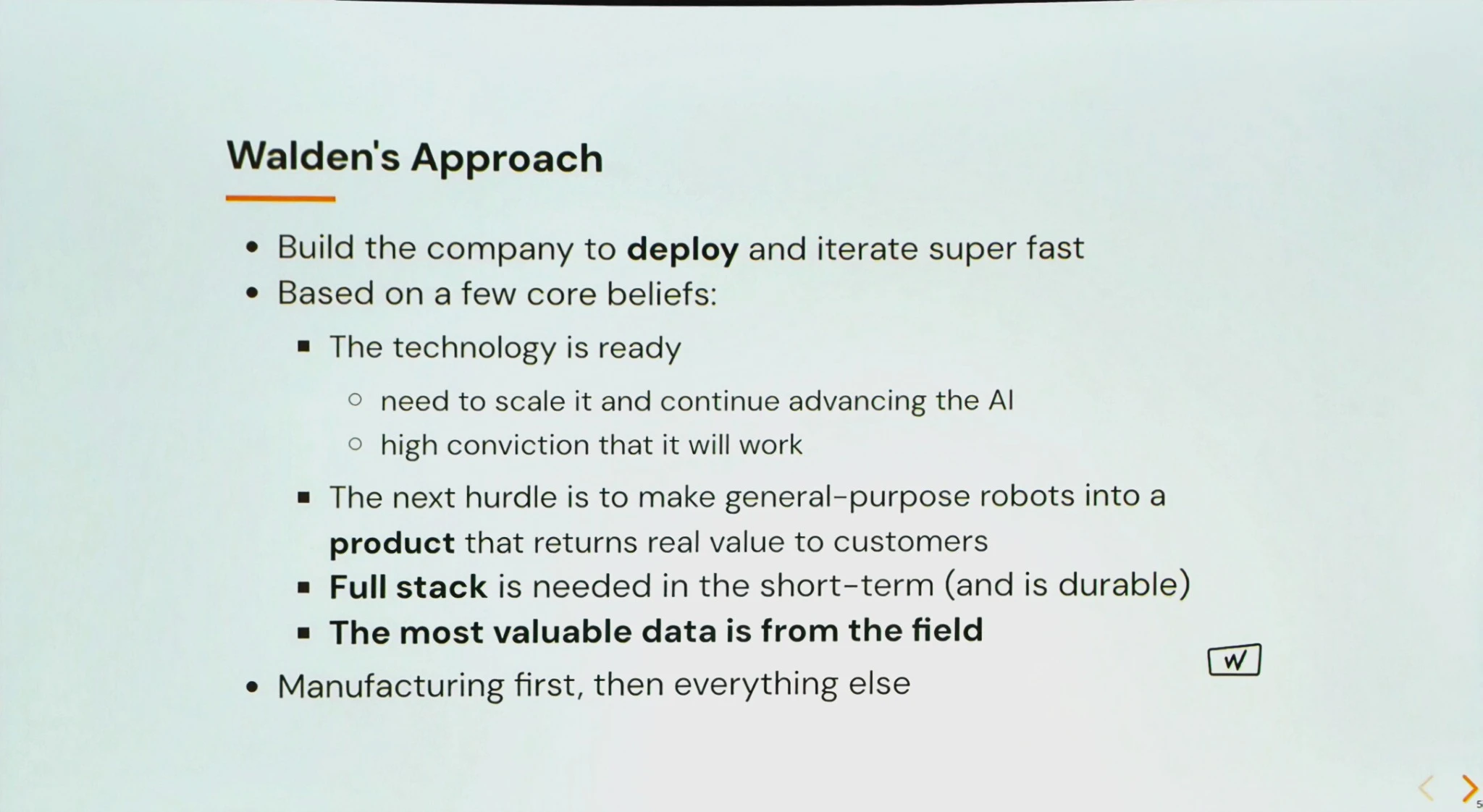
Walden's initial deployment focus is on manufacturing. The team first deeply refines its solutions with a small group of core customers before gradually expanding its business boundaries.
Toyota plays multiple roles in this effort: it is Walden's technological origin, an investor, and a key deployment partner. According to public information released by the company in July, its robots have been in production at a Toyota factory in North America since February this year.
Focusing deeply on manufacturing also allows the team to learn from established industrial systems. Factories have long accumulated a comprehensive methodology covering how to train and onboard new employees, standardize quality inspection processes, handle abnormal failures, and maintain the long-term stable operation of an entire production line.
During his presentation, Russ candidly shared that engaging with veteran manufacturing experts completely reshaped his way of thinking.
The team is also developing its own robot hardware. Russ explained that the equipment showcased in this presentation is merely a cost-effective transitional solution chosen for rapid deployment, while development of their proprietary models remains underway.
This sequence of trade-offs highlights Walden's current core priority: prioritizing deployment in real-world conditions and relying on long-term, continuous operation to identify which aspects of the entire system still require iterative optimization.
The first lesson on the production line
As part of this long-term deployment project, Walden's robots have loaded a cumulative total of 33,000 camshafts, and operations remain ongoing.
Camshaft loading is an excellent entry point for understanding Walden's deployment strategy.
On a machining production line, parts require a continuous supply. Workers retrieve camshafts from bins and place them at workstations. Even for experienced operators, this repetitive task drains the energy needed for more complex work, requiring a return to replenish materials approximately every seven minutes.
The team selected this task directly in response to feedback from frontline workers. Russ noted that if you were to compile a list of requests collected over a week, camshaft loading is consistently the task workers most want automated.
The parts are heavy, and repeated manual handling can cause hand strain, making the production line eager to offload this physical burden.
From the robot's perspective, however, the task is far from simple. A single camshaft weighs approximately 3.5 kilograms, requiring the robot to reach into a bin to grasp it. The operating space is constrained, and the robot must also execute precise material handovers.
Continuous heavy lifting over the long term also places severe demands on the robotic arm itself. While the operation allows some tolerance in speed, it sets an exceptionally high bar for reliability.
Dropping a part triggers a cascade of additional procedures. Staff must inspect the component on-site, determine whether it is scrapped, and then restart the production line.
Over days and weeks of continuous operation, sporadic errors accumulate and ultimately translate into operational and maintenance costs that the customer must bear. Furthermore, the robot must complete a full shift while reliably ensuring a steady supply of materials.
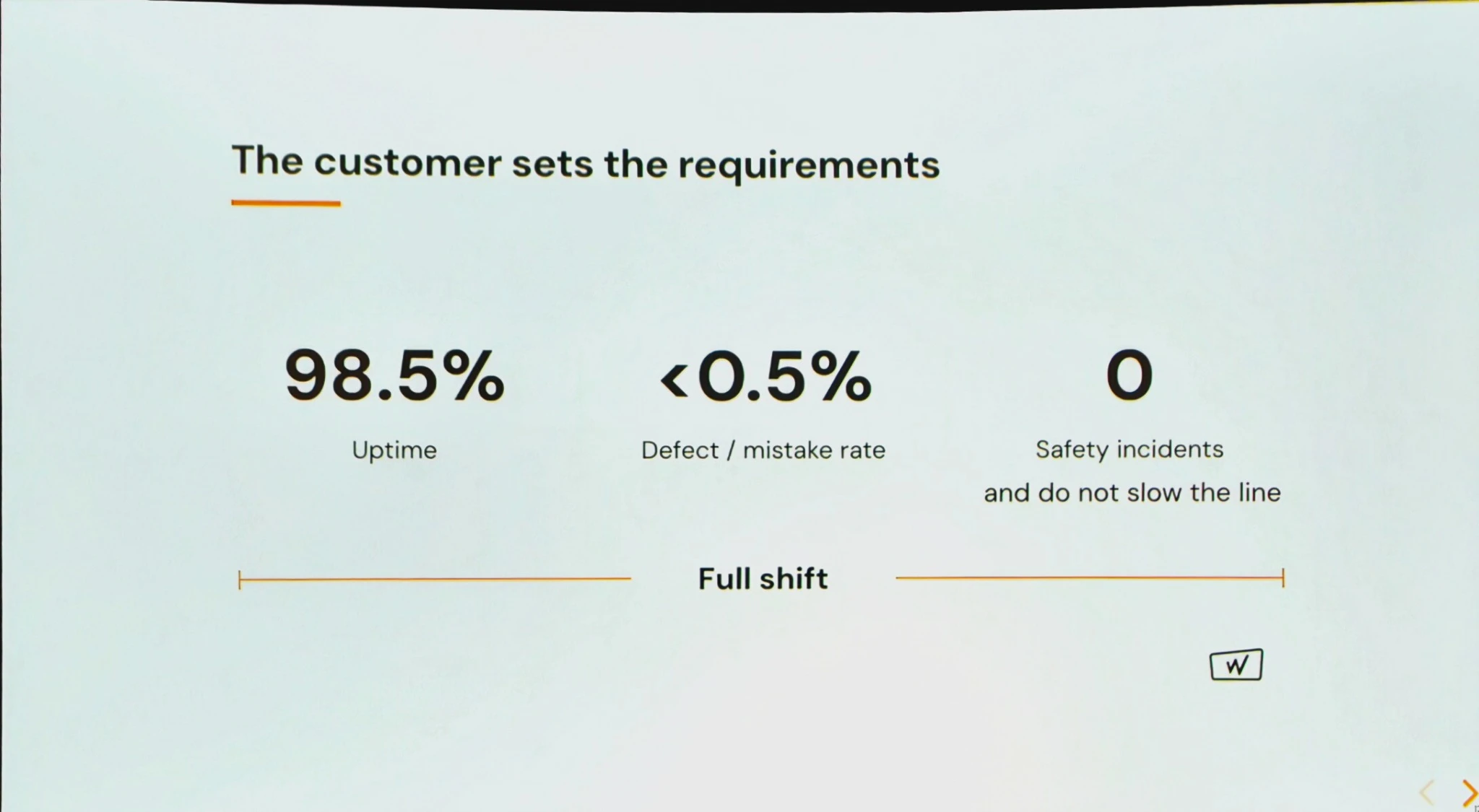
At the outset of the partnership, both parties established a clear set of delivery metrics: 98.5% operational availability, a defect and error rate below 0.5%, zero safety incidents, and no disruption to the overall pace of the production line.
These figures serve not only as the performance standards for deploying the robot but also signify that the evaluation system no longer focuses solely on model performance; maintenance, fault recovery, and human-robot collaboration capabilities are now equally factored into the assessment.
In a production line environment, autonomous capability must be delivered alongside the ability to operate continuously for extended periods. If the system encounters anomalies that the model cannot handle independently, a reliable fallback plan must be in place.
To this end, Walden employs a shared autonomy framework: the robot executes routine tasks autonomously, while a remote teleoperator intervenes to assist when necessary, returning control to the robot once the situation is resolved.
Russ relates this early approach to the human-guided DAgger method. Under this paradigm, a human observes the policy in action, takes over promptly at critical risk nodes, and simultaneously collects the corrected demonstration data.
In the camshaft loading scenario, the remote teleoperator relies on the robot's first-person view to assess site conditions, assisting with grasping or fault recovery when necessary to keep the production line running.
This collaborative model hinges on the teleoperation system being sufficiently reliable. The operator must have a clear view of the site conditions and be able to connect quickly, while the accompanying control interface must support a complete closed-loop action sequence.
Russ specifically noted that the team developed proprietary tools tailored for first-person teleoperation, ensuring that even fallback recovery actions—such as picking up a dropped camshaft from the floor—are incorporated into the design from the outset.
Therefore, the 'task completion' discussed in this presentation must be understood within the framework of human-robot collaboration.
During the Q&A session, Russ clearly delineated two boundaries: ultimately, humans and robots work together to ensure task execution, while the proportion of tasks completed purely autonomously by the robot still has room for improvement.
This distinction directly impacts the evaluation of project effectiveness and determines post-deployment labor costs.
As iterations progress, the team continuously tracks the average intervention interval, which measures how long the robot operates independently before requiring human intervention.
The performance gap between different model versions in the field is clearly visible: the average intervention intervals for the first-generation Large Behavior Model, the previous model, and LBM 2.0 are 22.6 seconds, 78.5 seconds, and 340.3 seconds, respectively, with LBM 2.0 achieving an autonomous operation rate of 98.2%.
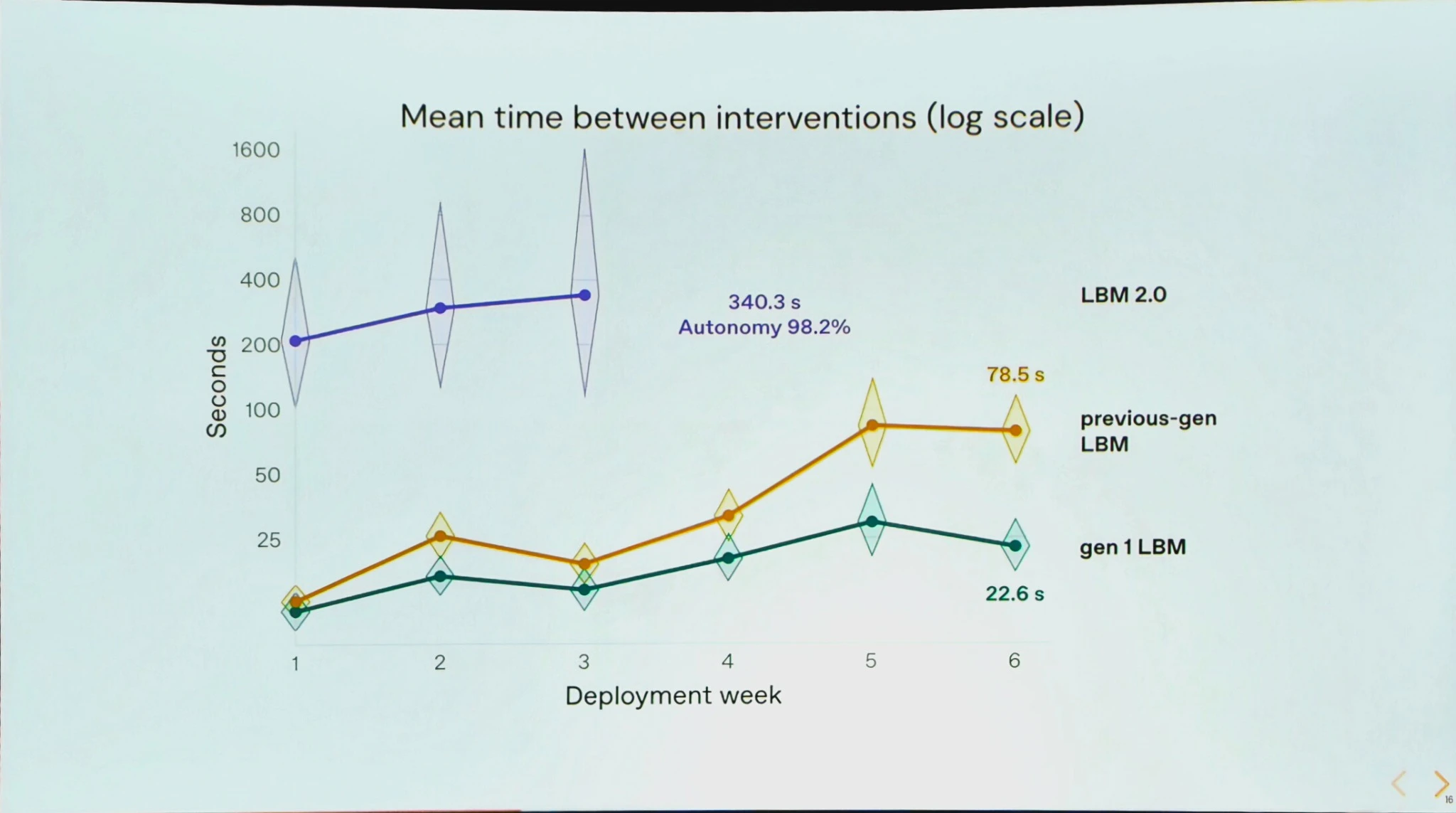
Monitoring the intervention interval alone is not enough; the duration of each intervention is equally critical.
Weaker-performing models often require operators to take over for extended periods to execute multiple consecutive steps. In contrast, more mature models typically need only brief corrections to resume autonomous operation.
Even when the intervention frequency is similar, brief fine-tuning and full manual control place vastly different demands on the operator.
Therefore, Walden relies on a combined set of observational metrics: the autonomous operation rate, the duration of each individual intervention, and the temporal distribution of help requests.
The changes driven by these iterations are clearly perceptible on the factory floor.
Russ shared that the on-site workers gradually figured out the pattern: knowing the team pushes model updates every Thursday, they began proactively coming over to observe the new version's performance.
About an hour after a major version update, he received a message: "What did you do?"
The robot's movements became smoother and faster, and it even developed grasping postures never seen before.
This model iteration was achieved without interrupting ongoing production.
The team could evaluate the performance of the old and new versions against the same production standards for direct comparison, allowing the customer to determine whether the optimization would disrupt normal production.
According to Russ, this breakthrough boosted the confidence of both partners and prompted discussions about deploying the system in additional scenarios.
From initially spending time helping workers approach and get comfortable with the robot, to later waiting together for weekly version updates, human involvement has been integral throughout the entire deployment process.
Robotics companies need customers to open their facilities, provide feedback, and allow room for trial and error; in return, customers need assurance that the team can continuously troubleshoot issues and iterate on optimizations.
This mutual trust is the foundation for keeping robots on the production line over the long term.
Continuous Improvement Through Deployment
After deploying robots in factories, Walden had to answer a core question: exactly how much benefit can field experience accumulated through continuous deployment bring to the next round of model training?
"The data you get from a factory is fundamentally earned through trust," Russ said.
Dispatching equipment and operations personnel to the site, building partnerships, and finalizing formal contracts—each step is highly time-consuming. The data gathered from deployment closely reflects real-world operating conditions, but the acquisition costs are high. Production runs on a fixed cadence, and customers prioritize keeping existing processes stable. They are reluctant to frequently alter operational tasks just to collect diverse data.
There has long been skepticism in the industry regarding the value of deployment data.
To meet production standards, teams often narrow task boundaries initially. Repeating the same operations over a long period causes the collected data to become highly homogeneous, making it difficult to transfer directly to other tasks. A further contradiction arises from reliability: the more reliable the robot, the fewer bottlenecks it encounters and the less human intervention it requires, which in turn reduces the number of error-correction samples available for optimization.
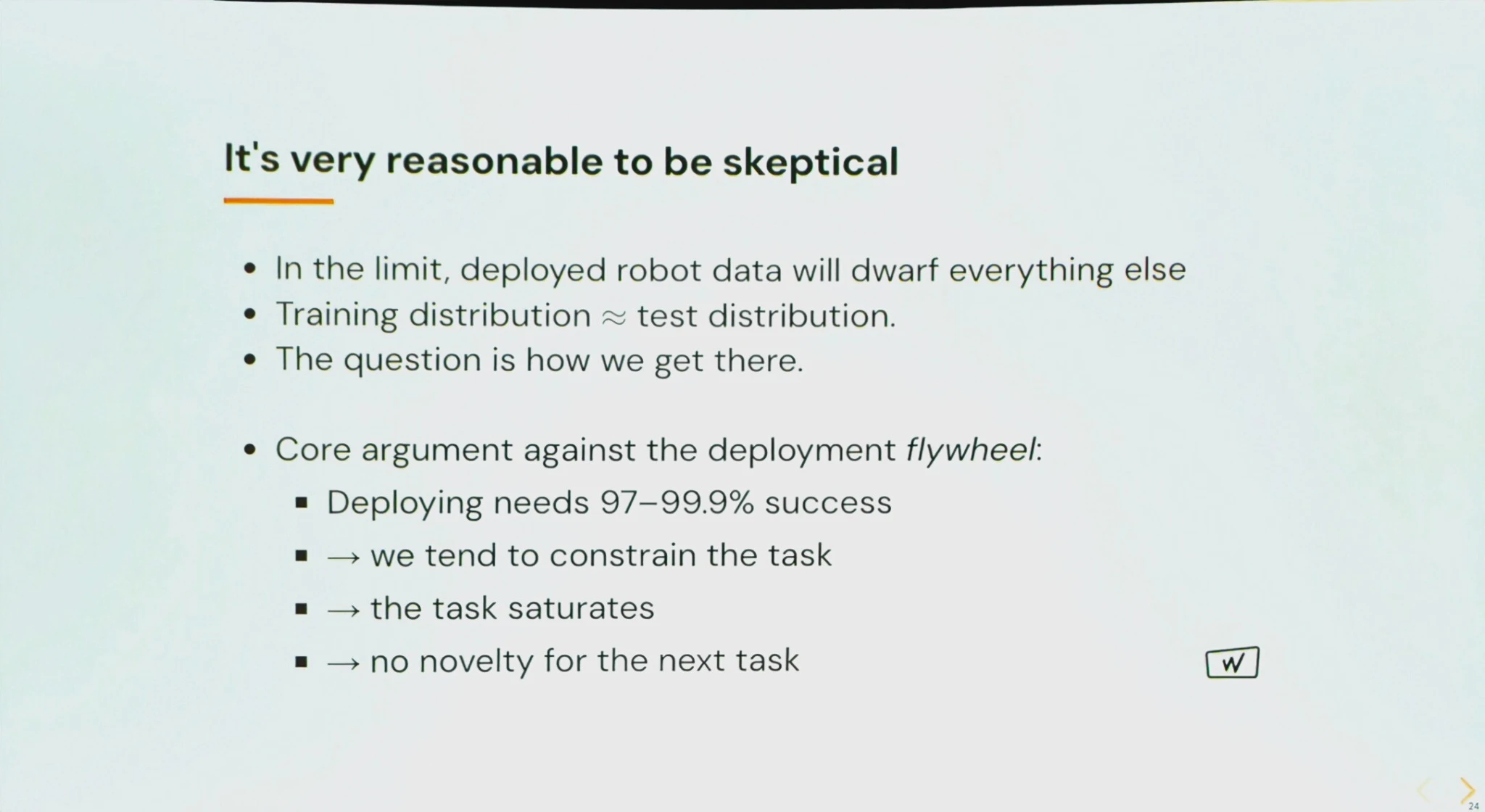
Russ acknowledges some of the premises behind this skepticism: industrial environments inherently demand high success rates, and it is indeed necessary to limit task scopes during the initial stages of a project. However, whether this means field data loses its value for iterative improvement still needs to be verified through controlled experiments.
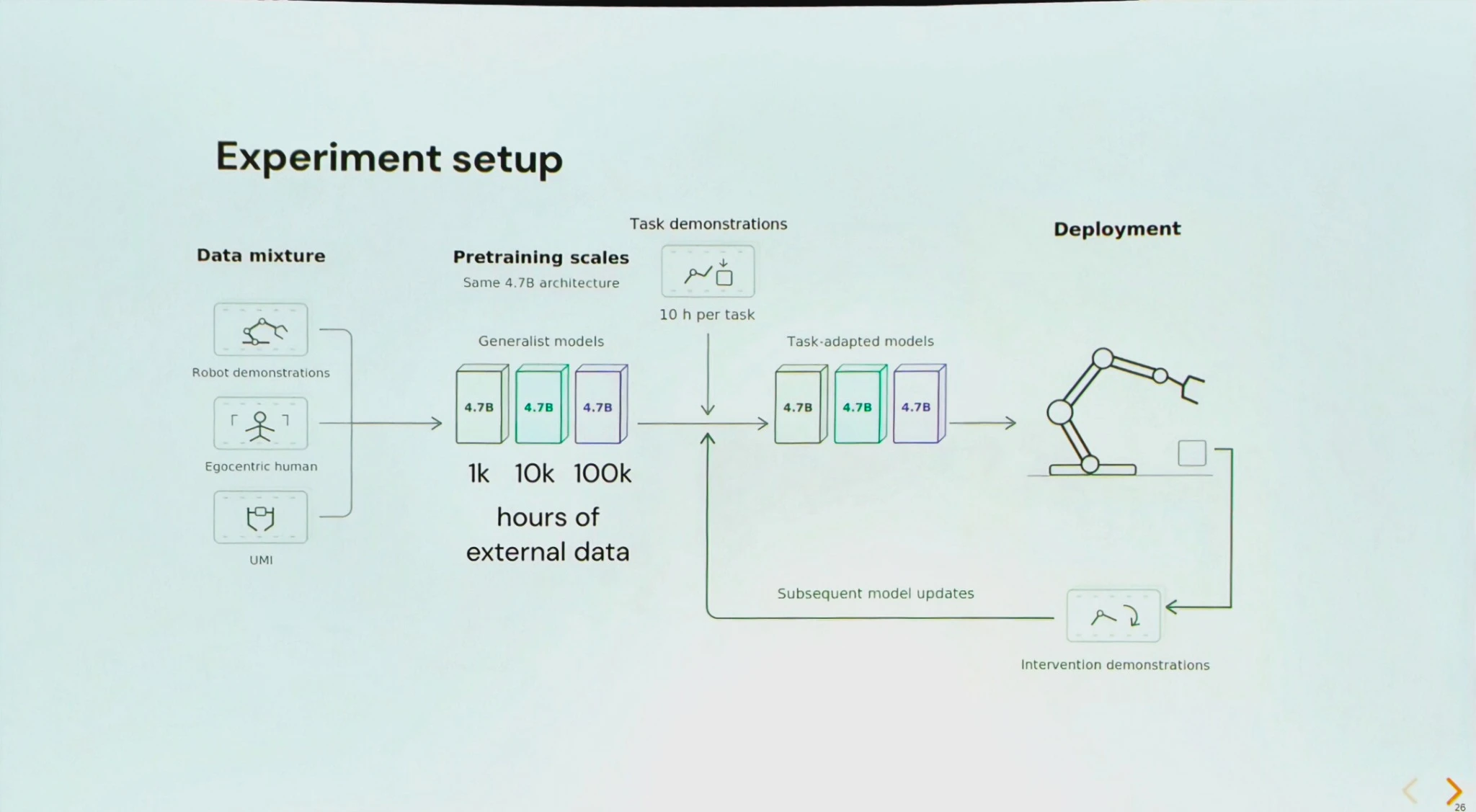
The team kept the 4.7B-parameter model architecture unchanged, pre-training it with 1,000, 10,000, and 100,000 hours of external data, respectively. The datasets encompass autonomous robot demonstrations, first-person human operation recordings, and data collected by UMI.
For each task, the robot is first provided with ten hours of demonstration samples to complete task adaptation before transitioning to a shared autonomy deployment mode. During this process, corrective demonstrations from human interventions are collected to iterate on subsequent versions. The test tasks cover machine tending, material dispensing, and assembly, involving numerous operations that require precise alignment and dynamic adjustments.
During the subsequent 24-hour on-the-job learning period, the models with different pre-training scales diverge in performance. The model pre-trained on 100,000 hours of external data sees its average interval between human interventions increase from approximately 40 seconds at the beginning of adaptation to about 80 seconds, accumulating a total of 1.36 hours of remote intervention samples throughout the process. In contrast, the model pre-trained with only 1,000 hours of external data maintains an intervention interval steady at around 27 seconds, collecting 2.22 hours of intervention data.
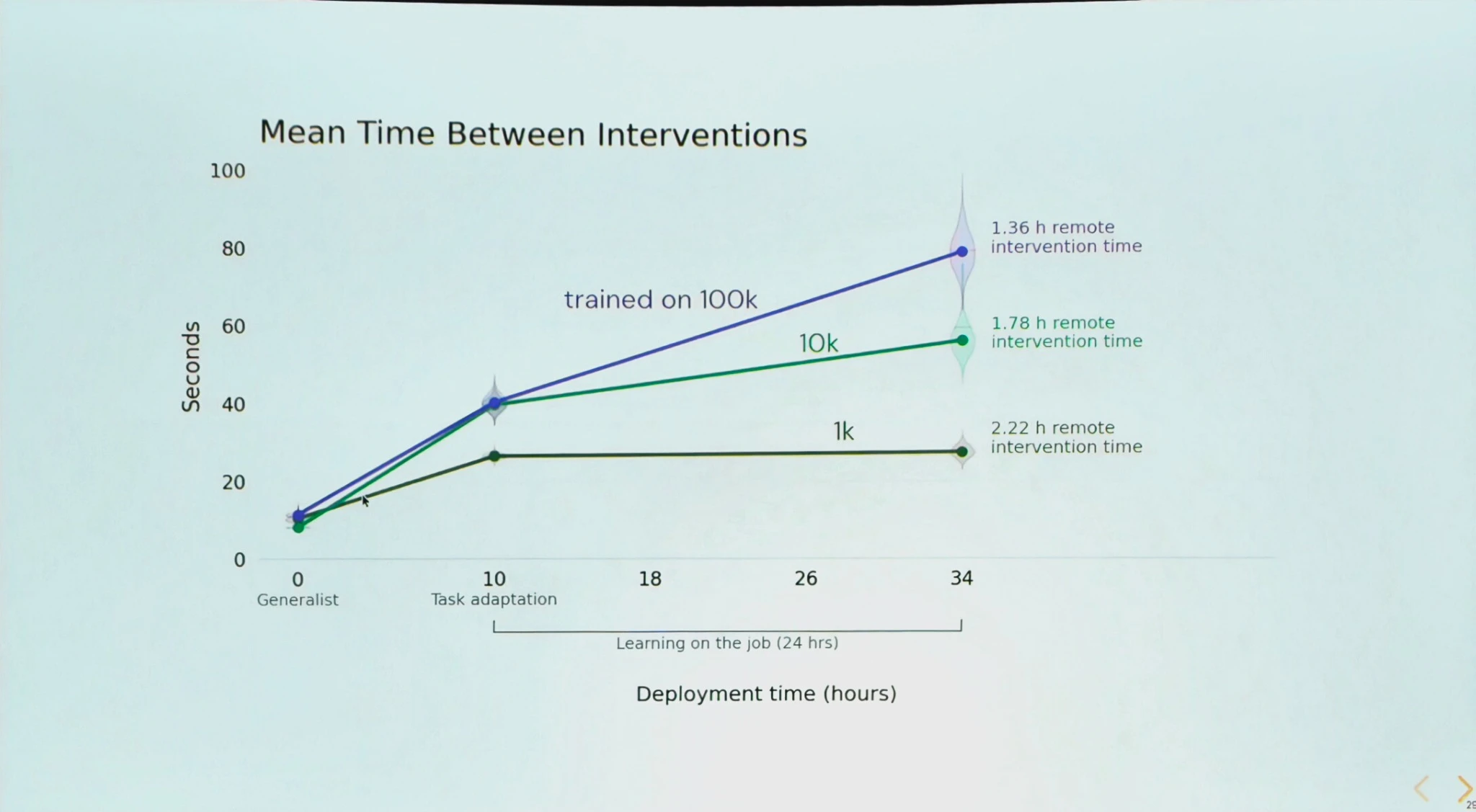
"The stronger models receive less intervention data, yet show even greater improvement." This is the conclusion the team drew from their controlled experiments.
This result confirms their hypothesis: the general capabilities established through extensive pre-training enable the robot to quickly adapt to entirely new, specific processes using only a small number of on-site corrective samples.
This also shapes Walden's approach to iterating on its foundation model. According to Russ, even if a model already possesses strong manipulation capabilities, its initial deployment in a factory still requires an onboarding and adaptation phase to fully grasp the specific constraints of on-site tasks and gradually meet the strict requirements of high production cadence and high yield rates on the assembly line. Moreover, the stronger the model's inherent capabilities, the more this adaptation and growth trajectory will evolve.
A bearing assembly task serves as a prime example. The mating clearance for the bearing is extremely small, making it difficult to assemble properly with a simple vertical downward press. The robot autonomously attempts micro-adjustments in multiple directions, iteratively probing until the parts are finally aligned and seated. Such subtle dynamic adjustments are exactly the kind of experience the team hopes to continuously accumulate from remote assistance and actual operations. Being able to pick up a part is only the first step; mastering a stable and reliable assembly method requires continuous on-site learning.
To achieve scale, the robots also need to learn to autonomously determine when to request assistance. In the early stages of the project, dedicated personnel can be assigned to continuously monitor a single device and handle anomalies promptly. However, once the deployment scale expands, this labor-intensive model becomes unsustainable. The robots must take on the capabilities of anomaly identification and proactive help-seeking, allowing a single operator to support the operation of multiple devices simultaneously.
In October, Walden publicly disclosed its corresponding solution: embedding an assistance request module within the action generation policy, which autonomously determines whether to seek help by combining task status, environmental information, and its own execution results. Action planning and assistance requests share the same set of multimodal representations, and all on-site intervention records are simultaneously used to bidirectionally optimize both capabilities.
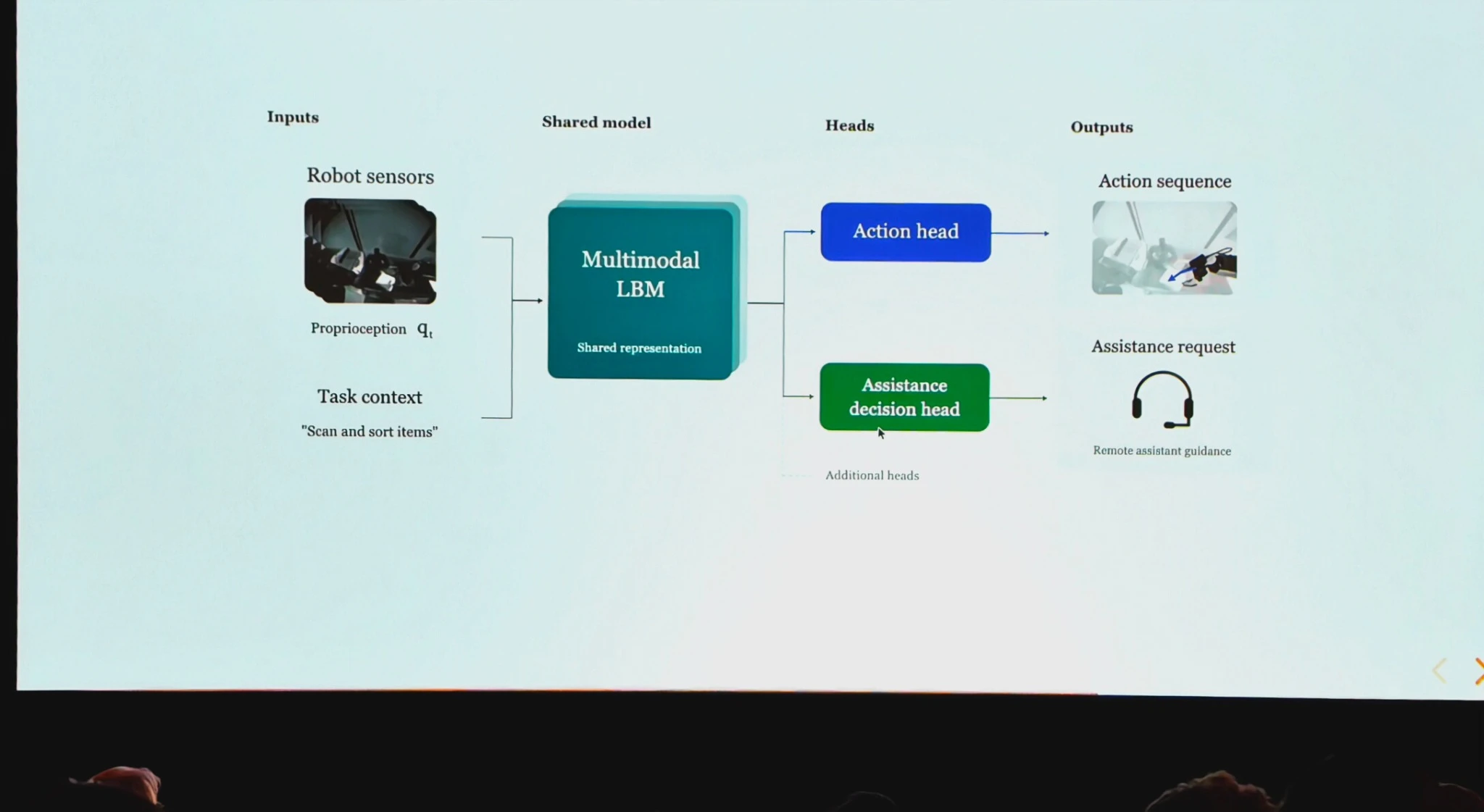
Initiating a help request is only the beginning of the entire operational pipeline. The ultimate success of real-world deployment depends on who handles the alerts, how quickly the on-site situation is assessed, and how personnel are allocated when multiple robots request assistance simultaneously. If help requests are too frequent, they will continuously burden the human workforce; if anomalies are not reported promptly, they could lead to production line failures. Therefore, model capabilities and the remote assistance system must be refined in tandem and advance together.
Russ connects this approach to Toyota's classic Jidoka (autonomation) philosophy. Under this principle, machines proactively stop the line and trigger alerts when anomalies occur, preventing defects from moving further down the process, and then rely on the Andon system for rapid resolution. For robots, proactively requesting help essentially makes hidden anomalies explicit, allowing human operators to intervene at the right moment.
A critical next step is the post-incident review following fault resolution. Russ specifically warns that simply feeding the actions taken during manual takeovers directly into training often fails to identify the root cause of the failure. By applying the 'Five Whys' method to trace the issue layer by layer, the team can determine whether to supplement specific training data, replace a particular hardware component, or adjust the on-site operational workflow.
The value accumulated from deployment goes far beyond the action policies learned by the robots; it also encompasses the team's comprehensive engineering experience in troubleshooting. A single task failure could stem from blind spots in the perception module, hardware defects, or flawed operational procedures. The value of a full-stack team is precisely demonstrated through these kinds of targeted adjustments.
Walden also uses its own manufacturing operations as a testing ground. According to Russ, the team has already deployed its own robots to handle material preparation, equipment monitoring, and partial assembly tasks, while simultaneously iterating on its proprietary hardware. Figuring out how robots can simplify manufacturing processes, lower maintenance barriers, and help build a stable supply chain are all critical challenges the team must tackle.
In the second half of his talk, Russ made a clear assessment: the manufacturing capability of the robots themselves has become the core bottleneck for scaling up deployment. The team is currently designing robot models better suited for mass production and is working with Toyota to advance industrialized manufacturing.
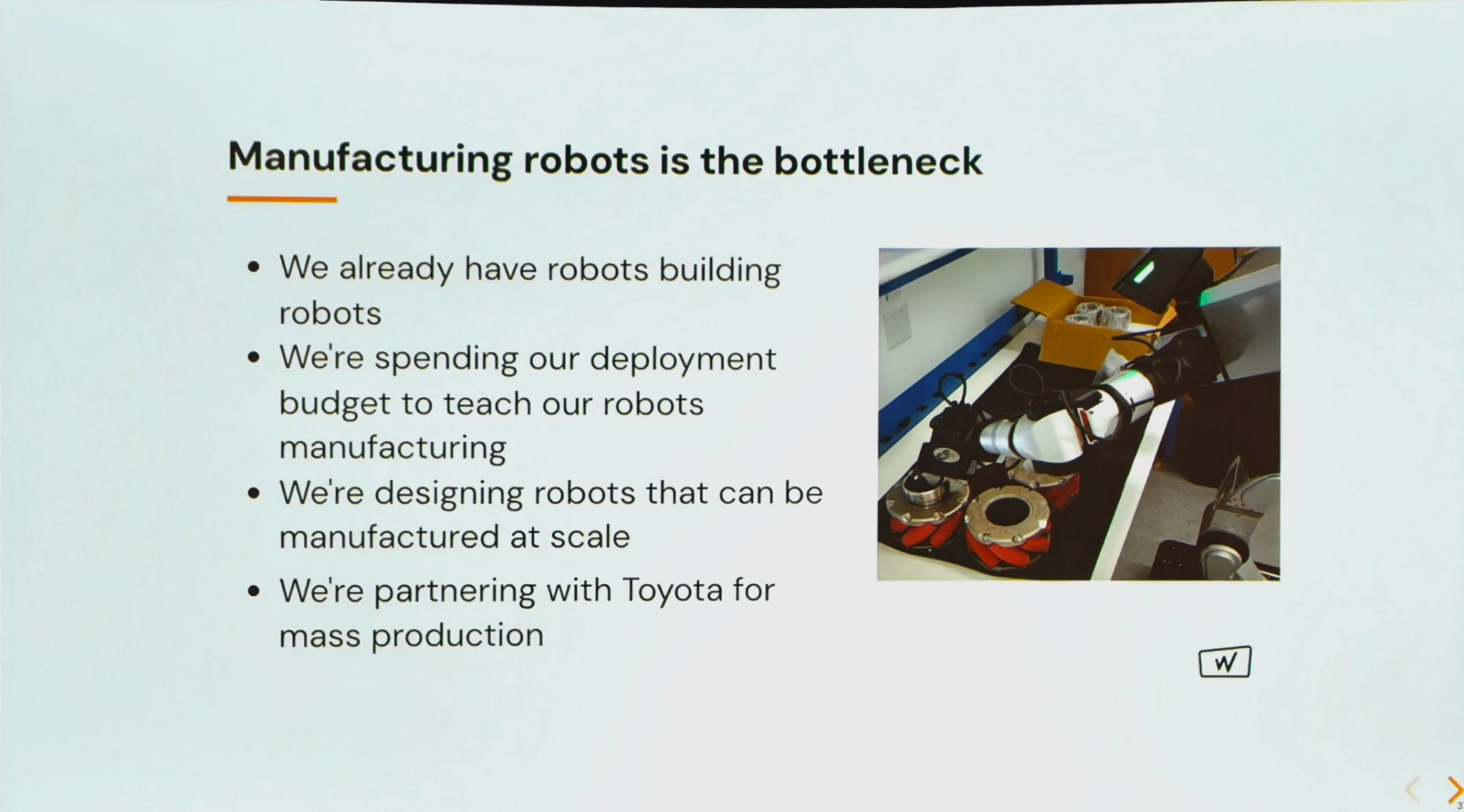
This approach remains in its early stages. Whether the capabilities acquired in the factory can transfer across different tasks still requires continuous validation through long-term on-site operation. Furthermore, once a small number of units are running stably, expanding the fleet will introduce entirely new manufacturing and operational challenges.
Russ candidly admitted that figuring out how to reliably mass-produce functional robots is currently the issue occupying the team's attention the most.
After spinning out from the Toyota Research Institute, Walden integrated years of academic research into the actual production cycles of its real-world customers. The loading record of 33,000 camshafts is just one visible milestone; behind it lies a continuous loop of model iteration, remote collaboration, fault analysis, and hardware optimization.
As these workflows are progressively streamlined, the team expects the robots to take on an increasing number of tasks, ensuring that every on-site deployment better prepares the system for its next operational shift.