
What It Means for Figure to Add System 0 in Helix
Recently, debates have erupted online over whether Figure 03’s household chores were truly autonomous.
Given the prevalence of teleoperated robots falsely claiming autonomy, many viewers are now skeptical, making it difficult to determine the actual operational mode of Figure robots. Nevertheless, this article aims to analyze from a technical perspective what the Helix 02 model brings to the Figure 03 robot.
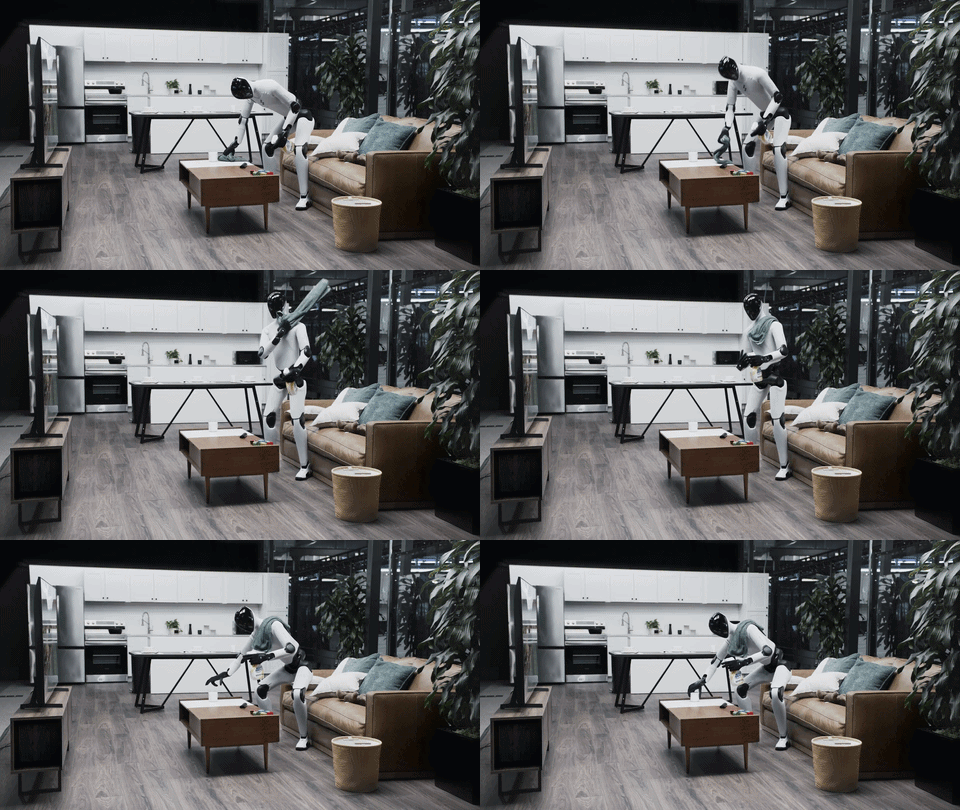
In videos released by Figure, the robot is shown completing a series of tasks in a living room, such as wiping tables, picking up toys, cleaning sofas, and turning off the TV. It can even perform human-like movements, such as draping a towel over its shoulder or tucking a storage box under its arm.
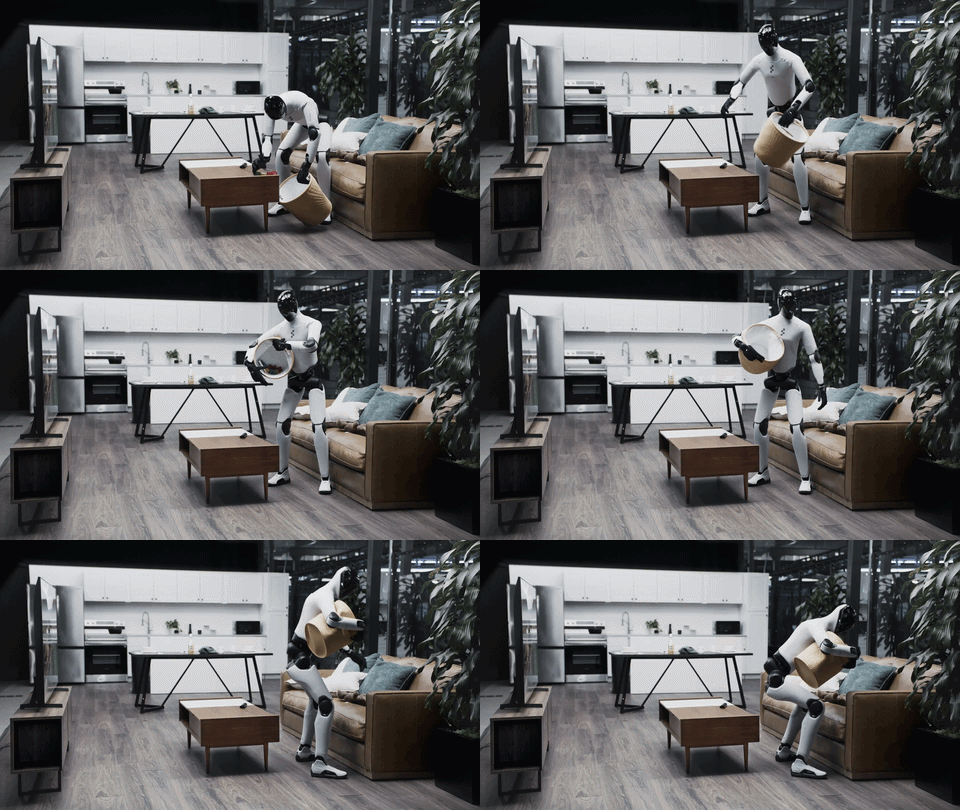
Regarding these full-body control and end-to-end autonomous operations, the official explanation states that these new behaviors were acquired simply by adding new training data, without designing separate controls for each individual action.
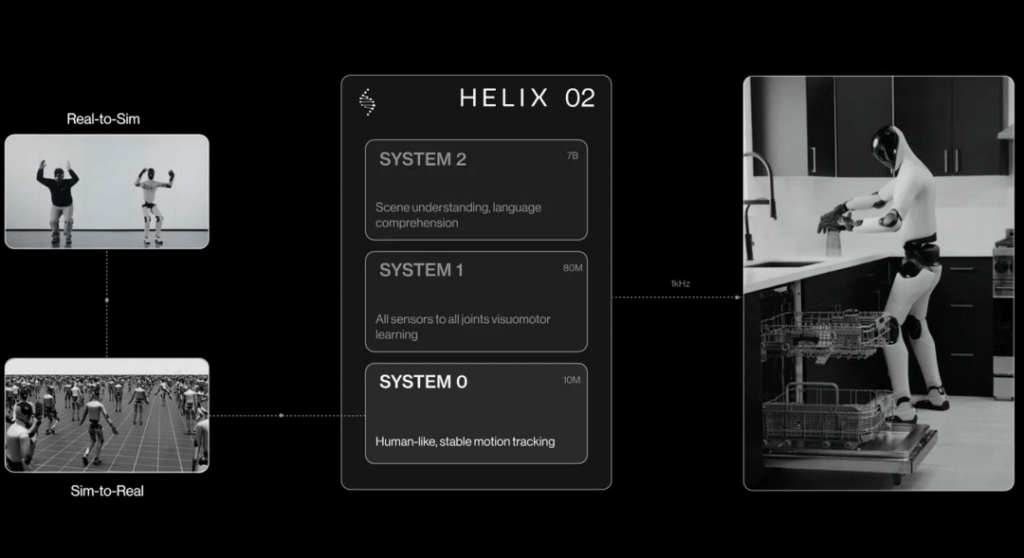
The core of this capability lies in the Helix 02 model, released earlier this year. Compared to the first-generation version, the key improvement in the new version is the formal introduction of a new system layer: System 0.

Why Add an Extra System 0
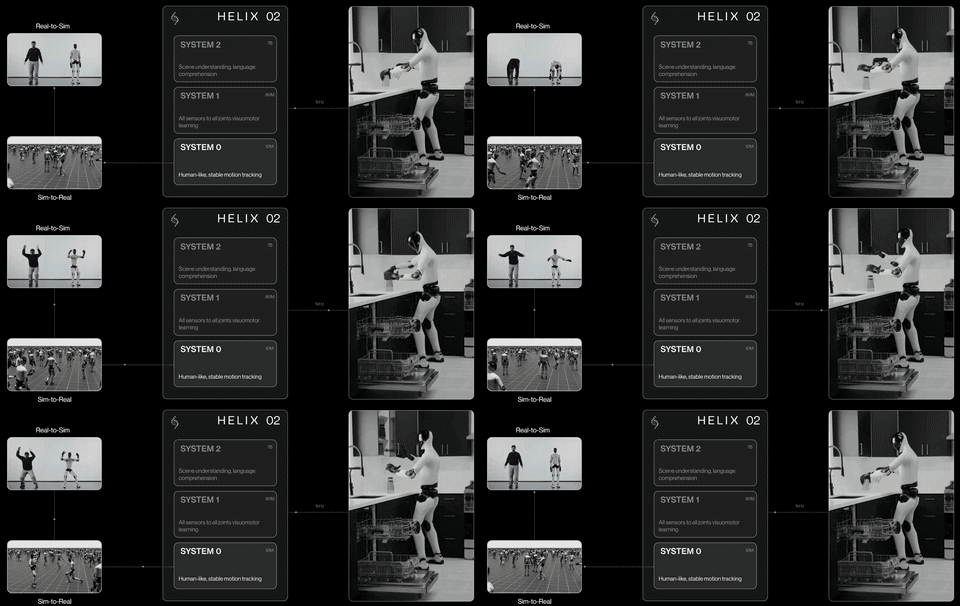
Beneath Helix’s existing System 2 and System 1, System 0 inserts a whole-body controller running at 1 kHz, responsible for balance, contact handling, and full-body coordination.
Official information indicates that this layer was developed through over 1,000 hours of joint-level human motion data and large-scale sim-to-real reinforcement learning training. It consists of a neural network with approximately 10 million parameters, replacing more than 100,000 lines of hand-written C++ control code.
Many readers might see this merely as adding another low-level controller, but the introduction of System 0 primarily redefines the boundaries of robotic systems.
Last year, Figure’s initial Helix model focused heavily on upper-body manipulation for humanoid robots. This year, the Helix 02 model enables Figure 03 to perform precise manipulation while moving, with System 0 being the key enabler.
In the past, industry discussions around VLA (Vision-Language-Action) models centered mainly on whether robots could understand the world and execute actions based on language instructions. Few had integrated stable mobile manipulation into these frameworks. Indeed, robots have performed well in two distinct directions:
- locomotion: walking, running, obstacle negotiation
- manipulation: grasping, placing, and operating objects
But the main problem is that these two things rarely hold true simultaneously. Most models are actually designed with the assumption that they can be decoupled: move first, stop, stabilize, then operate, and then move again.
This is why many robot demonstrations look clean and the movements are correct, but the process is segmented.
The real world doesn't work this way. In daily life, people rarely come to a complete stop before performing an action. These behaviors share a common characteristic: movement and manipulation are coupled together rather than performed serially.
In the introduction of Helix 02, Figure also mentioned that the difficulty of loco-manipulation (integrated locomotion and manipulation) does not lie in walking being hard or manipulating being hard, but in the fact that the two cannot be cleanly decomposed.
Therefore, the emergence of System 0 means that 'how the robot body stabilizes during movement and manipulation' has been incorporated into the learning system. This implies that Helix 02 is not just trying to become an Agent capable of invoking Skills, but is attempting to rewrite both the method of Skill generation and body control itself.

What exactly is System 0, using Agents and Skills as analogies
Using the recently popular concept of Agents as an analogy can make it more intuitive to understand the structure of Helix 02.
- The top layer is the Agent, responsible for decision-making: it observes the environment and determines the next action.
- The middle layer is Skill, functioning like modular 'task packages' such as walking, reaching, grasping, and placing.
- The bottom layer is the controller, which executes these actions physically, driving motors and moving the body.
In this architecture, the boundaries between layers are relatively clear. The Agent does not handle specific execution details; Skills do not manage physical stability; and the controller does not understand high-level tasks.
The problem arises when this layered structure enters real-world environments: each layer may be correct individually, but they fail to integrate smoothly. Although every step has a corresponding Skill and a controller to execute it, the entire process is forcibly fragmented.
When the environment changes slightly—for example, if an object's position shifts or the ground is uneven—this segmented structure becomes prone to failure. The evolution in Helix 02 can be understood through the same analogy.
System 2 remains the Agent, responsible for understanding tasks and scenes. However, System 1 is no longer a discrete library of Skills; instead, it acts more like a continuous Skill generator. It does not call upon specific functions like 'walking' or 'grasping,' but rather continuously generates whole-body movements.
System 0 can be understood as a layer of bodily reflexes, or 'muscle memory.' The key difference in the relationship among these three layers compared to traditional structures is that Skills are no longer the central hub of the system. Instead, they reside at the lowest level, serving to make execution stable, natural, and continuous.
These elements, which were typically scattered across various control logic and compensation modules in traditional systems, are now unified into learned priors.
From this perspective, System 0 serves as the physical foundation that enables all actions to function. Because of this layer, System 1 can confidently generate continuous movements without needing to evaluate every step for risks like falling or losing contact.
This is why Helix 02 can combine many previously separate actions into a single continuous behavior, making Figure 03 robots appear more fluid in their work.

Breaking it down, what has actually changed?
If we merely view it as "adding a 1 kHz control layer," we easily underestimate the changes brought by System 0. When broken down, the key trade-offs lie in several critical technical aspects.
The most significant factor is the form of training data. System 0 utilizes over 1,000 hours of joint-level human motion data, which has been remapped to the robot's own joint space.
Therefore, it learns more fundamental coordination relationships between joints during human movement, rather than just simple walking postures.
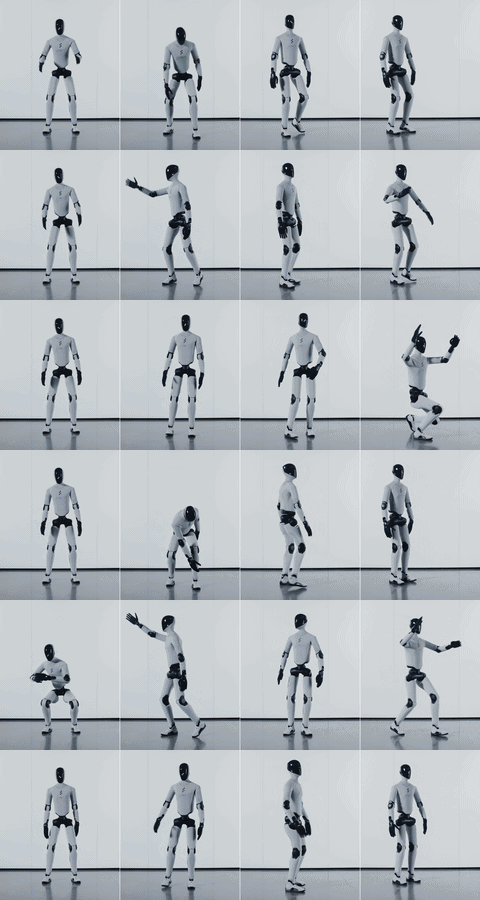
The second change lies in the role and scale of the model. Figure introduced System 0 as a network with approximately 10 million parameters, taking full-body joint states and base motion information as input and outputting joint-level actuator commands at 1 kHz.
This scale brings it closer to a high-frequency, low-latency, strongly constrained motion prior network. It is not responsible for understanding the environment or generating task-level actions; instead, it specializes in stabilizing upper-level action goals into physically executable behaviors within high-frequency closed-loop control.
A key change is also the training methodology. System 0 was trained entirely in simulation, utilizing over 200,000 parallel environments and large-scale domain randomization to learn how the body maintains stability under various disturbances and contact conditions.
Such a training approach essentially uses simulation to exhaustively explore possible physical scenarios for the body, allowing the policy to converge across these distributions.
Another aspect is the interface design with System 1. System 1 remains a transformer responsible for converting perception and semantic goals into full-body actions, but it outputs joint target positions rather than directly controlling force.
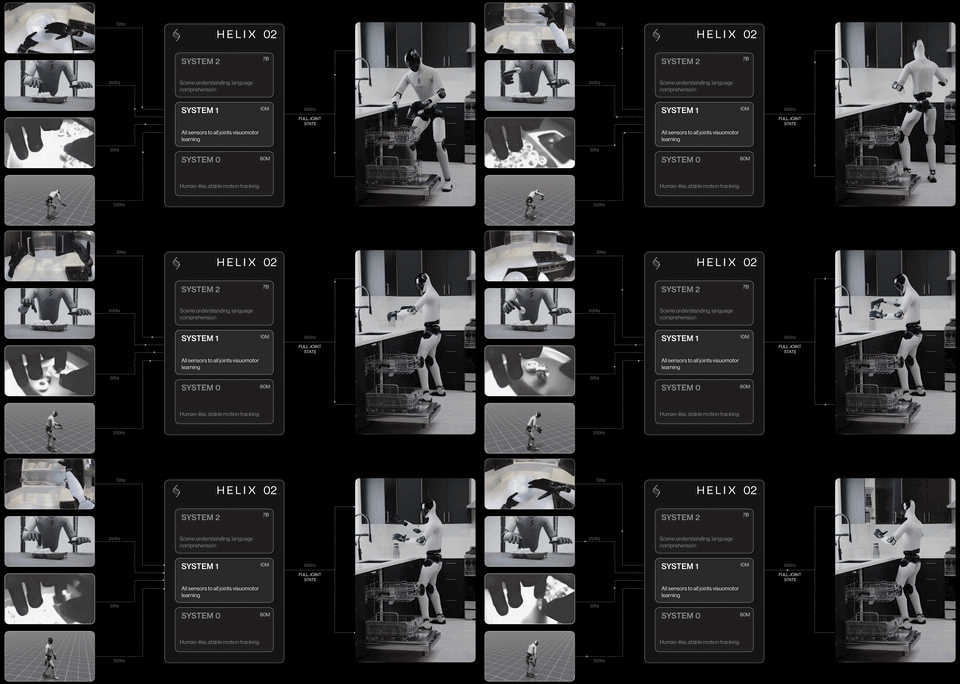
Therefore, System 0 takes over the "last mile," converting these targets into specific actuator commands at 1 kHz frequency while continuously correcting errors, handling contacts, and maintaining balance during the process.
This interface design is quite restrained. Figure did not merge everything into a single end-to-end black box but instead implemented a layered approach across time scales: the slow layer handles understanding, the medium layer generates actions, and the fast layer ensures stability.
From this perspective, System 0 rewrites the expression of the link from action to physical execution. It serves as a learned prior that handles these issues uniformly within high-frequency closed loops.
Thus, Figure’s emphasis on "100,000 lines of C++ being replaced" points directly to this shift in expression: moving from explicit rules to data-driven motion priors.

The technical approach is already shifting
With the addition of System 0, the Helix 02 model has also developed strong locomotion and manipulation capabilities. This reflects a key focus of the robotics industry this year: the integration of locomotion and manipulation.
As robots move toward large-scale deployment in real-world environments, focusing solely on upper-body manipulation—like the early versions of the Helix model did last year—is no longer sufficient to meet application demands.
This process resembles the path autonomous driving has taken: in the early stages of the industry, competition focused on the quality of individual modules; over time, more and more capabilities have been absorbed into unified models.
In comparison, Google DeepMind’s RT-2 excels at semantic understanding and action selection, while Nvidia’s GR00T emphasizes its model and data architecture.
The focus of Helix 02 leans more towards whether the robot's actions can be continuously executed in the real world, i.e., loco-manipulation (integrated locomotion and manipulation).
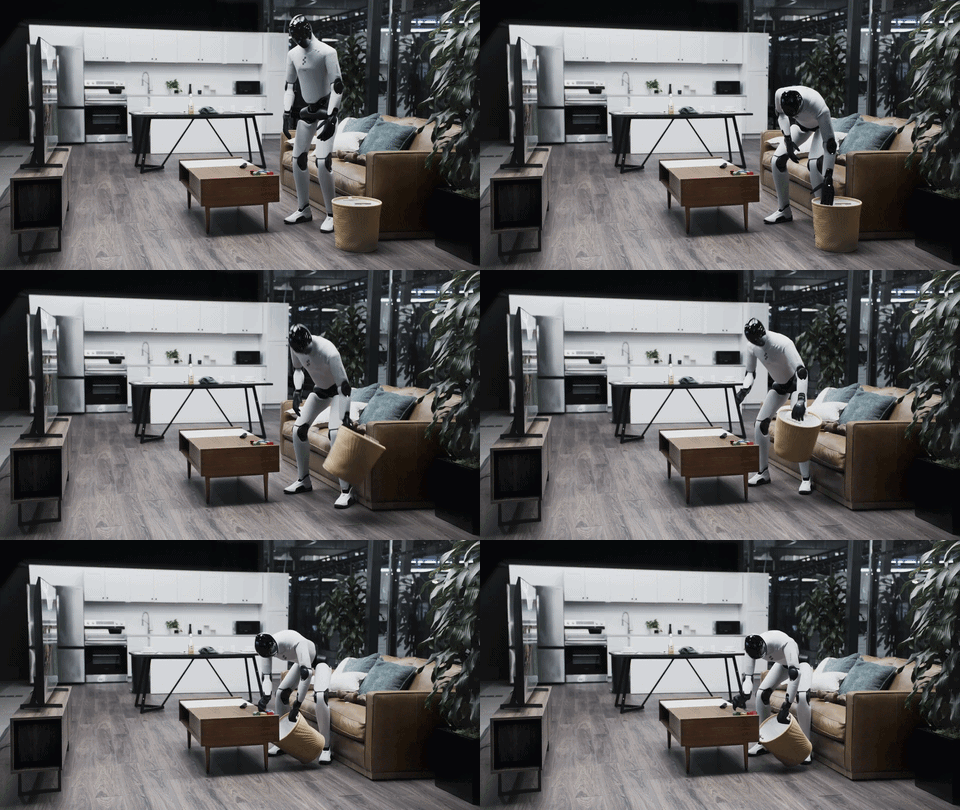
However, although Figure has achieved good completion rates for kitchen and living room organization tasks, they have not yet demonstrated the true robustness of their S0 + S1 + S2 systems across dimensions such as unfamiliar environments, strong disturbances, long-horizon failure recovery, and cross-home generalization. This is also an area that requires further verification in their subsequent work.
For now, Helix 02's approach of fusing various tool capabilities into a single continuous policy and adding a layer of high-frequency body priors begins to extend the robot's system pipeline from "pixels to actions" further to "pixels to torques."
Therefore, the synergistic integration of models and physical bodies will also be a major theme in the future development of robots.