
After Unitree's IPO Acceptance, the Logic Behind Galbot's Valuation Exceeding 20 Billion Yuan Emerges
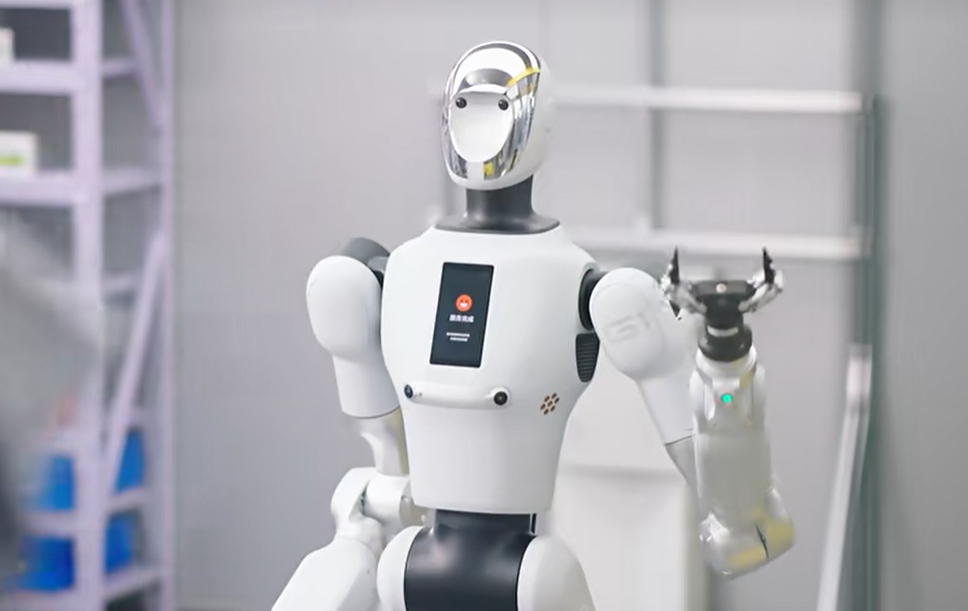
Recently, Unitree Robotics' IPO application on the STAR Market was accepted, a move that has almost ignited the entire robotics industry.
However, one detail in its prospectus has been overlooked by many.
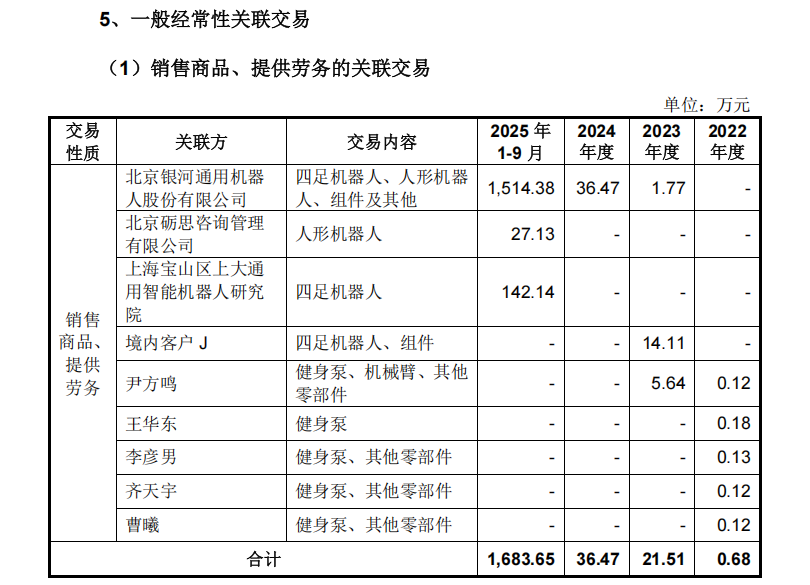
The prospectus shows that from January to September 2025, Unitree Robotics sold goods worth 15.1438 million yuan to Beijing Galaxy General Robotics Co., Ltd.
The main products sold include quadruped robots, humanoid robots, and robot components. Galaxy General procures these robotic products primarily for 'its own technology research and development' and 'secondary development for external sales'.
If viewed merely as routine B2B sales, this matter does not appear particularly special.
But when placed within the current landscape of the robotics industry, this amount of over 15 million yuan actually reflects certain industrial division-of-labor relationships.

What Exactly Are You Buying When You Purchase a Robot?
The key issue is not how many are purchased, but what they are used for.
From a logical standpoint, it is unusual for a humanoid robot company to procure another company’s humanoid robots. Unless what it truly needs is a different capability underlying the robots.
After several performances on the Spring Festival Gala, the stability of Unitree's hardware has become well-known. This is also a key reason why its robots are procured by many research institutions and even competitors for training movement and work capabilities.
Following intense exposure over the past one or two years, it is now widely understood that the primary source of a robot's capabilities lies in its models. For robots to truly enter people's homes and daily lives, they must possess strong model capabilities. In this process, the hardware body serves as a platform, while the upper limits depend on model algorithms.
Therefore, for those unfamiliar with the robotics industry, when they see Unitree robots moving or performing tasks, the related model algorithms may not necessarily originate from Unitree itself.
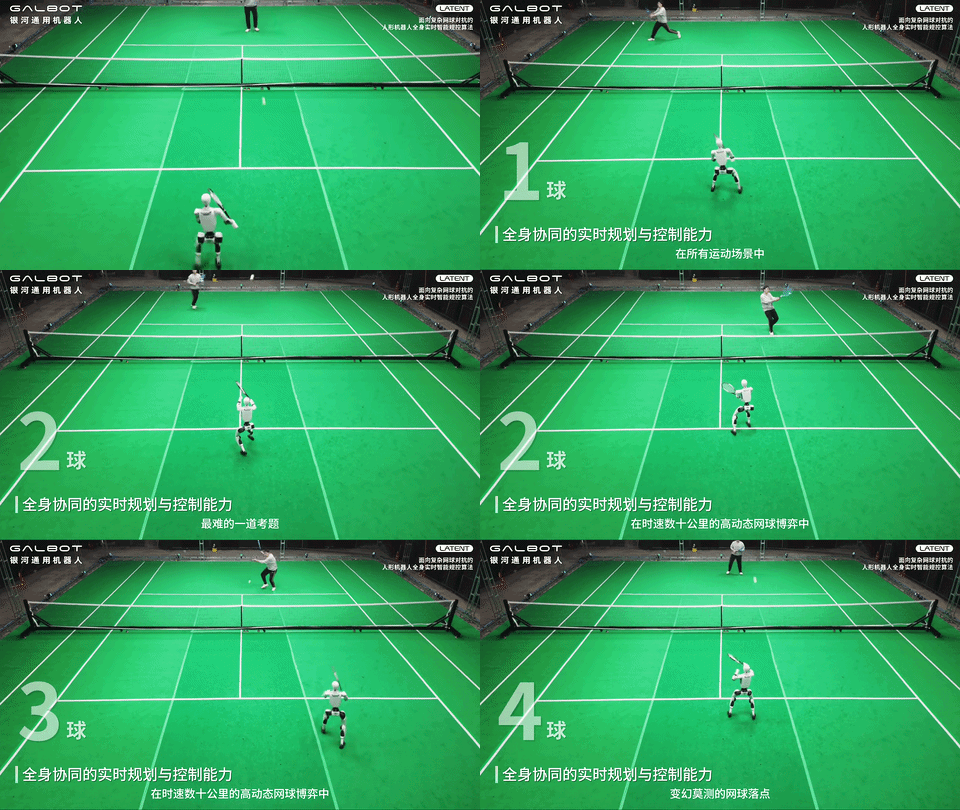
Judging from General Robotics' recent activities, its released video of a robot playing tennis features hardware from Unitree's G1 and algorithms developed by General Robotics called "LATENT," enabling humanoid robots to master long-range dynamic tennis skills.
This algorithm allows robots to autonomously learn motor skills by collecting fragmented movements such as forward-backward motion, forehand and backhand swings, and lateral footwork.
In other words, LATENT's approach focuses on leveraging available data to learn complex, non-reducible movement capabilities rather than relying on hard-to-obtain data like match-play running patterns.
Following this thread reveals that General Robotics' development path is remarkably clear, helping explain why the company's valuation has exceeded 20 billion yuan.

Behind General Robotics' Valuation Exceeding 20 Billion Yuan
In early March this year, General Robotics announced the completion of a new round of financing totaling 2.5 billion yuan, marking the largest single funding amount disclosed in China's robotics industry to date. Consequently, General Robotics' valuation surpassed 20 billion yuan.
If you look deeper, what actually supports General's valuation of over 20 billion yuan is a complete capability structure.
The reason robots have become so popular in the past year or two lies in the development of AI, which has rapidly enhanced their capabilities while also carrying the hope of bringing AI to practical application.
So the key here is scenario implementation. Many companies choose to start from capabilities, first making the robot stronger, and then seeking applications.

Galbot's focus lies in scenarios; its practical applications are a key differentiator from other robotics companies, since robots that remain at the demo stage struggle to create real value.
Looking at its layout in isolation, it roughly breaks down into four directions:
- Industrial manufacturing: Collaborating with enterprises such as automotive factories, robots are deployed in factories for work, with cumulative order volumes reaching several thousand units. The company has also launched the industrial heavy-duty robot Galbot S1, which features a maximum arm payload of 50 kilograms.
- Cultural tourism and new consumption: Deployed over 100 "Galaxy Space Capsules" across China to facilitate robot retail operations and other tasks.
- Instant retail and smart pharmacies: Deployed in 24 cities, with each store managing over five thousand SKU types; robots can autonomously pick and pack items.
- Healthcare and elderly care: Partnering with hospitals to promote the deployment of robots in scenarios such as wards, pharmacies, and triage services.
Why is the deployment of robots in real-world scenarios so important right now? Because once they enter these environments, a more critical event occurs: the continuous generation of data. This data can, in turn, drive improvements in robotic capabilities.
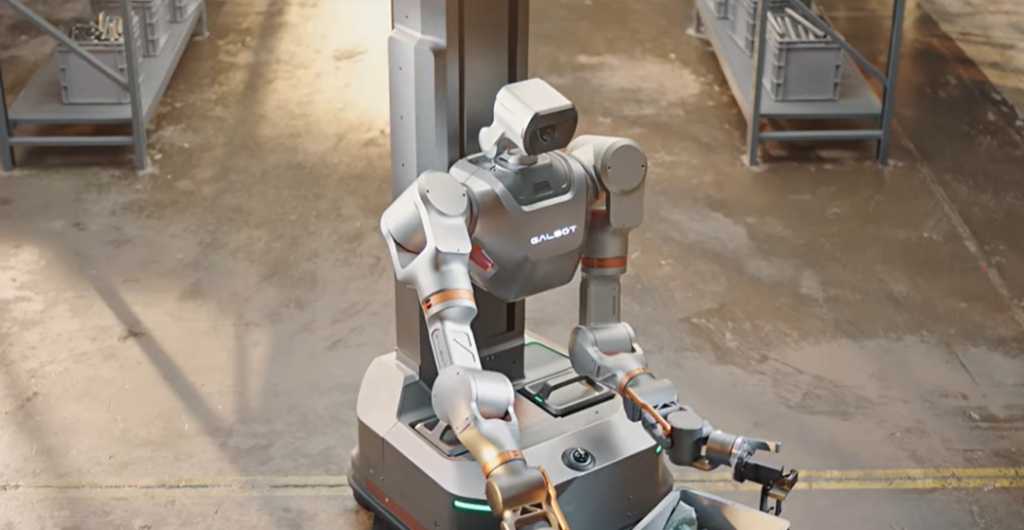
In the field of Embodied AI, improvements in model capabilities are inseparable from data. Galbot's approach has, to a certain extent, constructed a closed loop: scenarios, data, models, enhanced task capabilities, and more scenarios. Within this cycle:
- Each task execution generates new data
- Each round of model updates improves success rates and efficiency
- Enhanced capabilities enable entry into more complex scenarios
This forms a "the faster it runs, the faster it gets" system. Therefore, the key to robot deployment is not solely economic value; the data flywheel is equally crucial. In the long run, scenarios, data, and models are all critical competitive barriers, and none can be omitted.
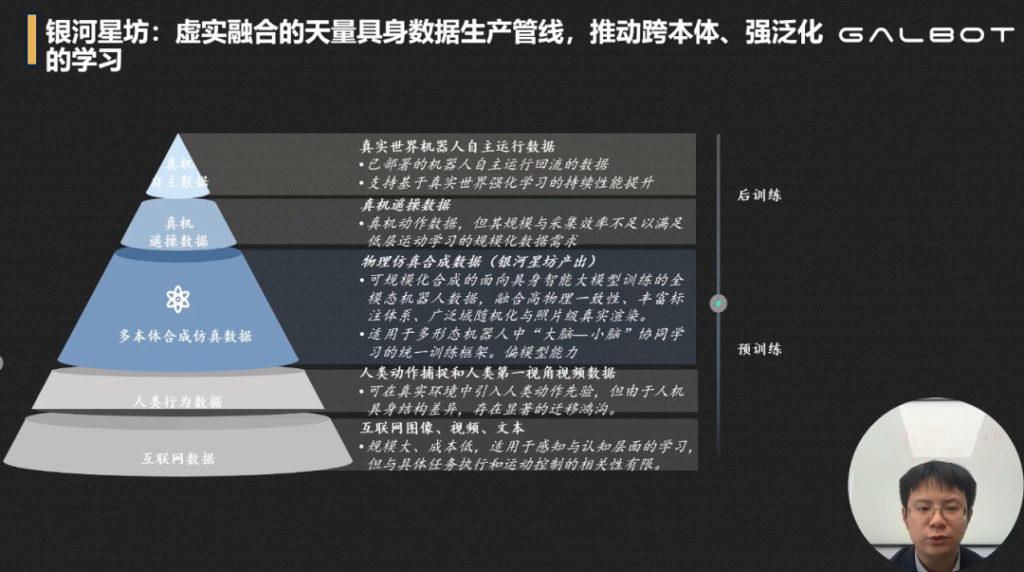
At GTC 2026, Wang He, founder and CTO of Galbot, stated that deploying models to perform autonomous tasks in the real world would generate feedback data that further enhances model effectiveness.
Regarding data sources, Wang He emphasized multi-agent synthetic simulation data. After pre-training with multi-agent synthetic simulation data, human behavior data, and internet data, followed by post-training using a small amount of real-machine teleoperation data, an efficient embodied AI model for robots can be obtained.
Additionally, in the area of model algorithms that the entire industry is currently concerned about, Galbot's route differs somewhat.
Generally speaking, a robot's motion capabilities rely on its cerebellum, while task planning capabilities rely on its brain. The industry typically handles these two aspects separately.
In contrast, Galbot has integrated its "brain," "cerebellum," and "neural control" into a single end-to-end model called AstraBrain, avoiding information loss between modules that can arise from fragmented development.
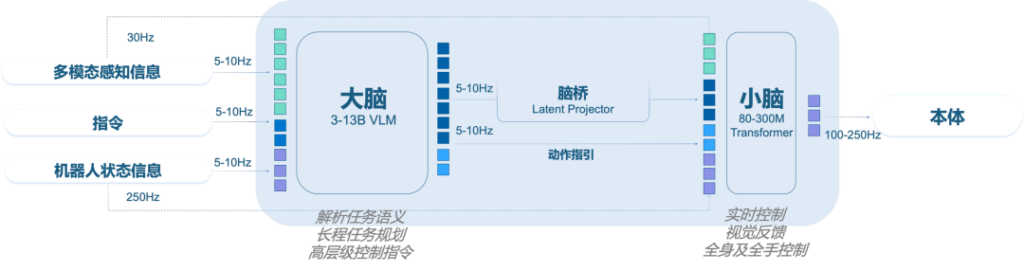
Furthermore, through a reinforcement learning framework, AstraBrain enables robots to undergo billions of rounds of trial-and-error in virtual environments, acquiring the general capability of "how to interact with the physical world." This allows robots to "see, think, and act" simultaneously, much like humans.
Therefore, broadly speaking, Galbot is not merely a hardware company nor a pure model algorithm firm; it resembles more of a "system integrator." The sum of these capabilities is also the key reason for its valuation exceeding 20 billion yuan.

Industry Differentiation: Four Distinct Paths
When viewed within the broader industry context, Galbot's distinctiveness becomes apparent because the robotics sector itself is beginning to diverge.
Not everyone is pursuing the same objective; four different paths have already emerged.
One approach, exemplified by Unitree, prioritizes the hardware itself. This strategy has been quite successful so far; according to its prospectus, in 2025, Unitree Technology achieved operating revenue of 1.708 billion yuan, a year-on-year increase of 335.36%, and realized non-GAAP net profit exceeding 600 million yuan, a year-on-year surge of 674.29%, primarily driven by rapid growth in product sales.
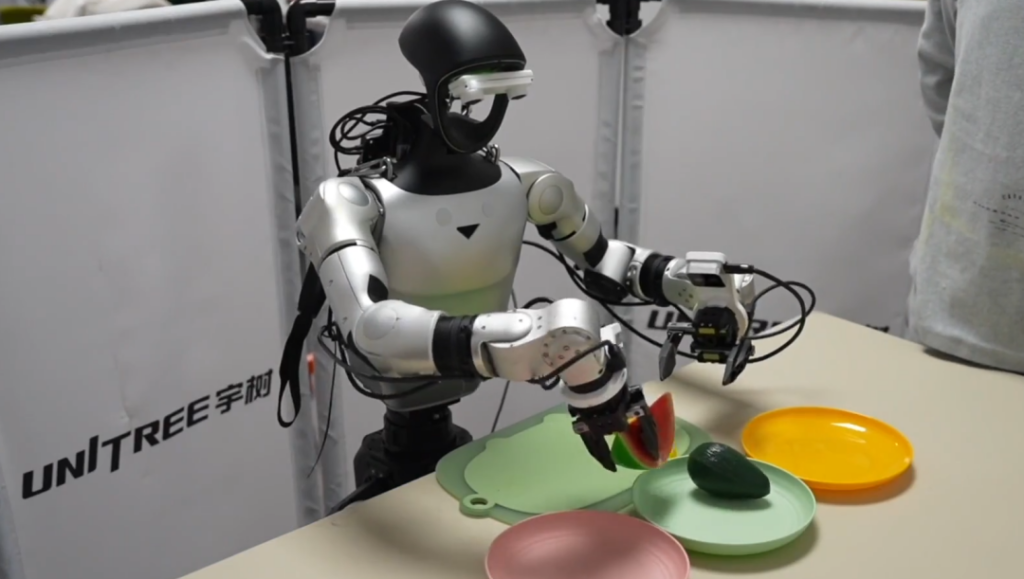
In the past couple of years, as the robotics industry has developed rapidly, numerous developers and embodied AI companies have purchased Unitree's robots to train their model algorithms, which significantly contributed to Unitree's performance boom last year.
Notably, however, Unitree has not stopped here. The prospectus discloses that Unitree plans to allocate 2.022 billion yuan from the raised funds to an intelligent robot model R&D project, representing a substantial investment. Consequently, Unitree's 'role' within the industry is bound to differ from its current position in the future.
The second approach focuses on scenario-based implementation, similar to Galbot (Yinhe Tongyong), which gradually deploys robots in industrial, cultural tourism, and other scenarios. This enables data and models to be driven by real-world applications, with the core lying in the continuous enhancement of robot capabilities. Once this path establishes a data closed loop, it becomes difficult to replicate and yields a first-mover advantage in specific scenarios.
A third category includes companies like Tesla and Figure, whose ultimate goal is to achieve trillion-level scaled production akin to the automotive industry.

On this trajectory, we frequently hear Elon Musk discussing Optimus's capacity for millions or even tens of millions of units, while Figure's founder aims to produce one robot every thirty minutes. However, this route requires full-stack self-research of both software and hardware and ultra-large-scale mass production, necessitating significant capital investment due to its long development cycle.
So, behind Optimus is the world's richest man, Elon Musk, while Figure boasts the highest valuation in the global robotics industry, at approximately 270 billion yuan.
The final route lies upstream of robotics: rather than building robot bodies directly, it focuses on providing infrastructure around simulation environments, data generation capabilities, and AI training compute power. This can be understood as the "operating system + power grid" of the robotics era.
This layer determines the industry's overall training efficiency, data scale, and capability ceiling. For instance, Nvidia provides a simulation platform for robots; Isaac Sim allows for the design, simulation, testing, AI training, and validation of robots in high-fidelity, physically accurate virtual environments, thereby reducing the costs of physical testing.
The four paths each have their own focus and barriers. However, a more obvious trend is emerging: a clear collaborative relationship is forming between hardware bodies and model algorithms. It is not necessary for every company to self-develop all stages, nor must all capabilities remain closed internally.
They may appear to be taking different routes, but they ultimately point toward the same destination: enabling robots to truly step out of demos and create value in the real world.