

Hesai Delivers Over 23,000 Robot Power Modules in Q3 as Kosmo Data Engine Begins Generating Revenue
By Jiang Si Qi
Hesai Technology reported RMB 90.51 million in revenue from its Strategic Growth Business for robotics and physical AI in the third quarter of 2026, more than doubling sequentially. The company delivered 23,405 robot power modules and began recognizing revenue from its Kosmo 3D world data engine.
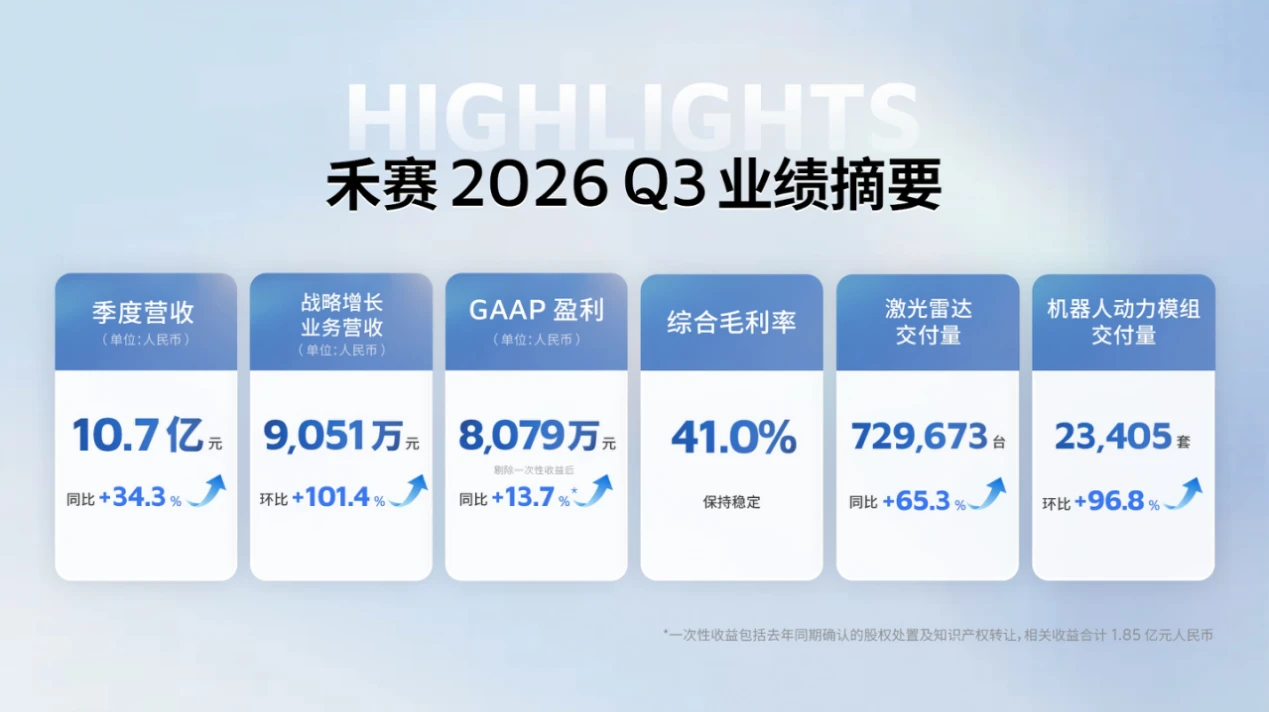
On November 10, Hesai Technology released its unaudited financial results for the third quarter of 2026. Revenue from its strategic growth business (SGI) for robotics and physical AI reached RMB 90.51 million, a 101.4% quarter-over-quarter increase. Within this segment, the company delivered 23,405 robot power modules, up 96.8% quarter-over-quarter, while its 3D world data engine, Kosmo, began contributing revenue.
Robot power modules enter volume production
As of the end of September 2026, Hesai had cumulatively shipped 35,295 robot power modules. Monthly production capacity has increased to 10,000 units, and full-body joint modules have entered mass production. The company expects annual shipments of power modules to reach six figures in 2027.
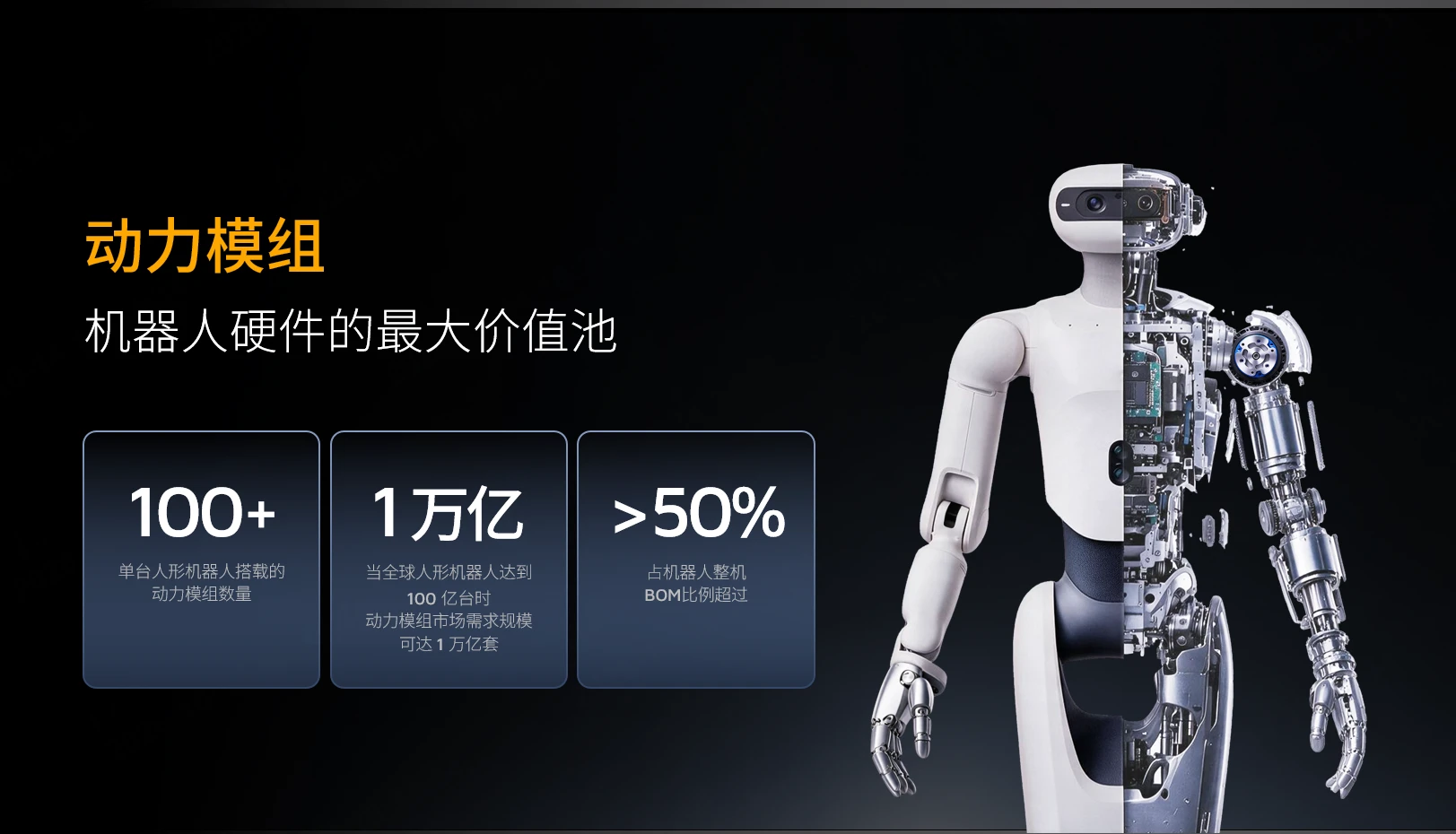
Illustration of Hesai's robot power modules and their application in robot joints
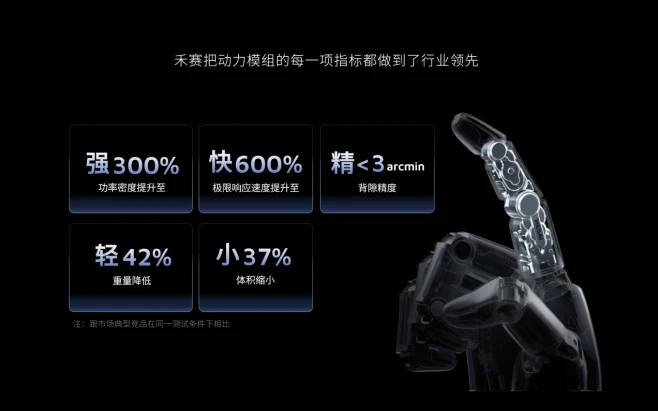
Hesai states that through the co-design of its motors, control algorithms, and transmission systems, its power modules achieve a 37% reduction in volume compared to similar products and a threefold increase in power density. They also feature back-drivability, making them suitable for high-speed movement and precise manipulation in robots.
These power modules are already deployed in the dexterous hands and robotic products of robotics company Sharpa. Sharpa's first flagship tactile dexterous hand, the Wave (W01), utilizes Hesai's power modules and features 22 active degrees of freedom. The D01, an integrated tactile-sensing dexterous manipulation robot, and the next-generation W02 dexterous hand, released by Sharpa at IROS 2026, are also equipped with Hesai modules. Key components, including motors and reducers, are developed in-house by Hesai.
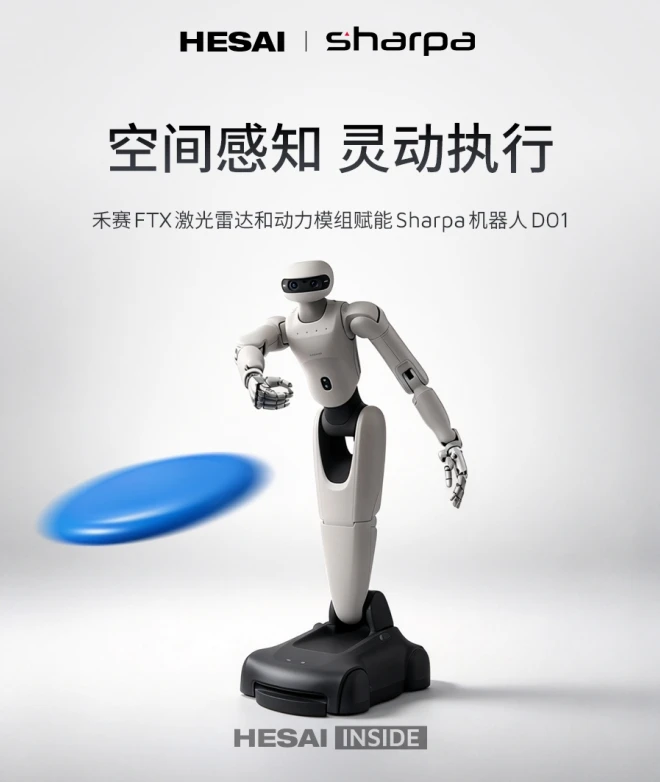
The Sharpa D01 robot equipped with Hesai's power modules
Kosmo converts real-world spaces into robot training data
Hesai unveiled its 3D world data engine, Kosmo, in October, alongside the spatial capture device Kosmo One and the cloud platform Kosmo World. Kosmo One integrates a LiDAR, an 8K imaging system, and a high-precision IMU to simultaneously capture spatial geometry, color, texture, and device pose information. Hesai stated that Kosmo has already begun contributing to revenue.
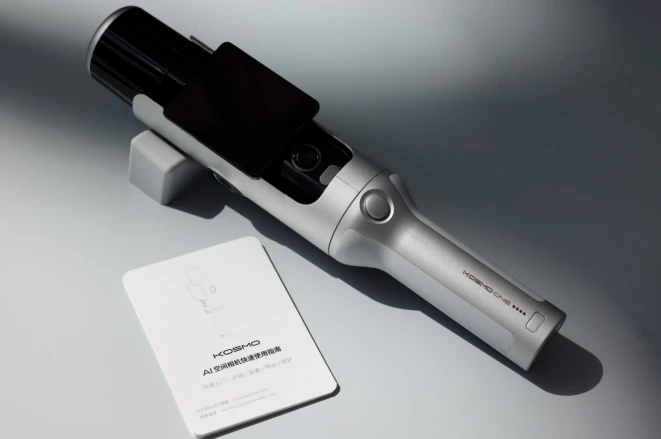
Hesai's Kosmo One spatial capture device
The underlying system of Kosmo World, Kosmo Spatial Core (KSC), can generate 3D Gaussian Splatting (3DGS), mesh, and depth data from a single scene. These are used to reconstruct scene appearance, build interactive objects, and represent spatial distances, respectively. The platform also supports semantic segmentation and the completion of unscanned areas, transforming the captured environment into a 3D scene with semantic information ready for robot training.
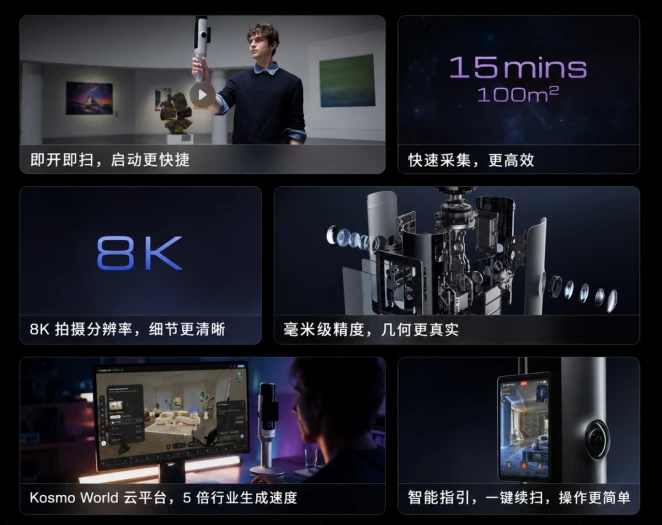
The capture and reconstruction workflow of Kosmo One and Kosmo World
Hesai states that data generated by Kosmo can be visually adapted to the camera characteristics of target robots, spanning pre-training, post-training, and evaluation deployment. The goal is to train robots in virtual environments that match their own sensors. Hesai has partnered with Galbot and Yuanli Lingji to explore the application of Kosmo in embodied AI.
David Li, Hesai's co-founder and CEO, stated that Kosmo and the robot power modules target 3D spatial data and robot mobility, respectively, representing two strategic initiatives to expand the company's physical AI business. CFO Fan Peng noted that SGI revenue in the first three quarters has already exceeded the original full-year target of RMB 100 million, and the company reiterated its 2026 SGI revenue guidance of RMB 200 million to RMB 300 million.