

Coowam Debuts at CIIE With Edge-Deployed World Models for Multi-Form Robots
By Jiang Si Qi
At the 9th China International Import Expo on November 6, Coowam made its debut by showcasing the D0 heavy-duty quadruped and X1 urban service robots. Both machines run on the company's proprietary COOWAM dual-layer agent world model, demonstrating its approach to driving diverse robot form factors with edge-deployed world models.
On November 6, the 9th China International Import Expo opened in Shanghai. Making its debut at the event, Coowa Robotics showcased the D0 heavy-duty quadruped robot and the X1 urban operations service robot at booth A2-03 in Hall 7.2H of the National Exhibition and Convention Center (Shanghai). The company also introduced its technical roadmap for driving diverse robot form factors with edge-deployed world models.
Both robots are equipped with Coowa's proprietary COOWAM two-tier agent world model. The upper layer, Urban VLM, is responsible for interpreting industry operation standards, decomposing tasks, and executing long-horizon planning. The lower layer, CooWAIM, achieves high-speed action inference and execution within the latent space. The entire model is deployed onboard the robots, forming a closed loop for perception, planning, and motion control locally. This reduces reliance on stable networks, allowing the robots to operate independently even in low-bandwidth or completely offline scenarios.
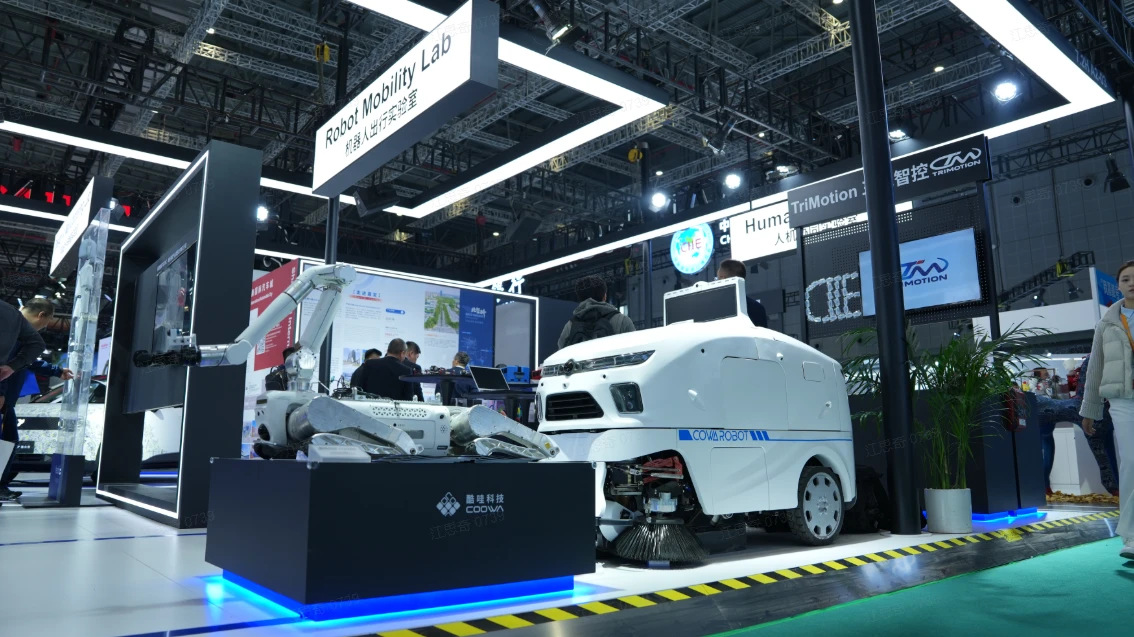
Based on the Aether heavy-duty quadruped platform, the D0 can navigate uneven terrain such as stairs, slopes, and gravel roads. Equipped with swappable top modules, it can handle diverse tasks including municipal sanitation, last-mile delivery, and security patrols. The X1 features the Glide one-ton, three-wheel drive-by-wire chassis, focusing on dynamic urban spaces like sidewalks and auxiliary roads to perform curb sweeping, obstacle avoidance, and narrow-passage recovery. Despite their different mobility form factors and application scenarios, both share the same underlying model foundation, visually demonstrating Coowa's "one brain, multiple form factors" technical philosophy.
Urban operations require much more from robots than just reproducing isolated, single-point motions. Curbs, steps, and temporary obstacles constantly change traversability conditions, and continuous tasks like sweeping require the robot to follow workflows reliably. Coowa's core approach relies on a unified model foundation, allowing different robot hardware to reuse task understanding and environmental planning capabilities, and then adapting to distinct operational requirements based on their own physical structures.
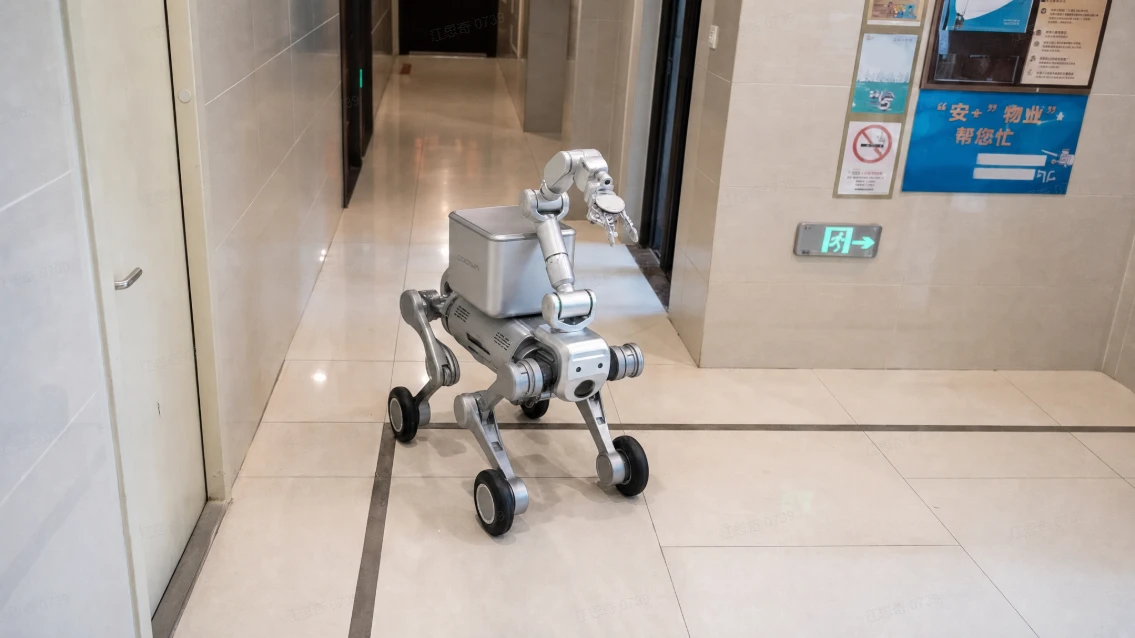
The event also saw the reveal of the D2 quadruped robot dog for community delivery. Targeting last-mile delivery within residential communities, this product can navigate, travel, grasp, and place items from delivery stations directly to residents' doorsteps, catering to the delivery needs of small parcels, fresh produce, and food delivery. Expected to be officially released in 2027, it will expand Coowa's deployment scenarios from municipal operations and security patrols to everyday community services.
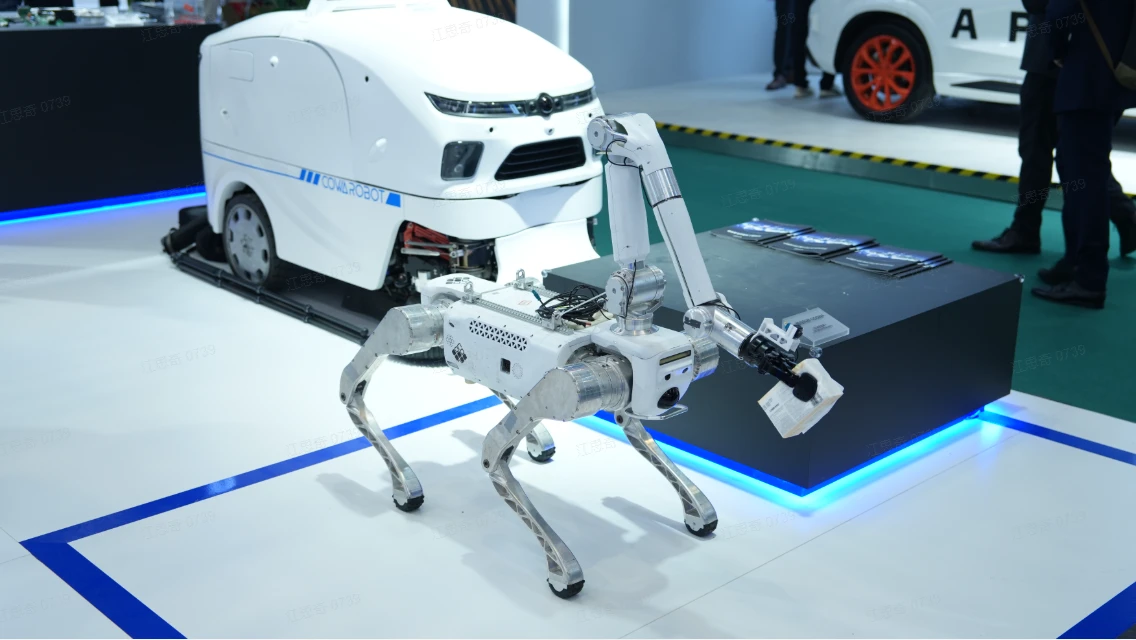
Coowa has named this vision of multiple robots sharing an intelligent foundation "RoboCity." Under this concept, wheeled robots, autonomous shuttles, quadrupeds, and humanoid robots act as independent physical agents, collaborating on various urban tasks. Liao Wenlong, Coowa Robotics' founder and CTO, noted that world models must simultaneously comprehend both physical rules and human social logic for robots to truly deploy in real-world environments and reliably perform tasks.