

Xiaomi Unveils 21-DOF Bionic Hand Designed From 1,827 Factory SOPs
By Jiang Si Qi
On October 27, Xiaomi Technology revealed a 21-degree-of-freedom bionic dexterous hand driven by 26 hybrid motors and equipped with 1,500 high-density tactile points across the palm. Its configuration is derived from 1,827 real-world Standard Operating Procedures at the pilot center of Xiaomi Automobile's Intelligent Manufacturing Department, which the company used to determine the optimal number of degrees of freedom.
On October 27, Xiaomi Technology unveiled a 21-degree-of-freedom (DOF) bionic dexterous hand. The hand is hybrid-driven by 26 motors and equipped with 1,500 high-density tactile sensing points across the entire palm. Its configuration is derived from 1,827 real-world Standard Operating Procedures (SOPs) at the pilot center of Xiaomi Auto's Intelligent Manufacturing Department. Xiaomi used this data to determine the optimal number of DOFs for the hand.
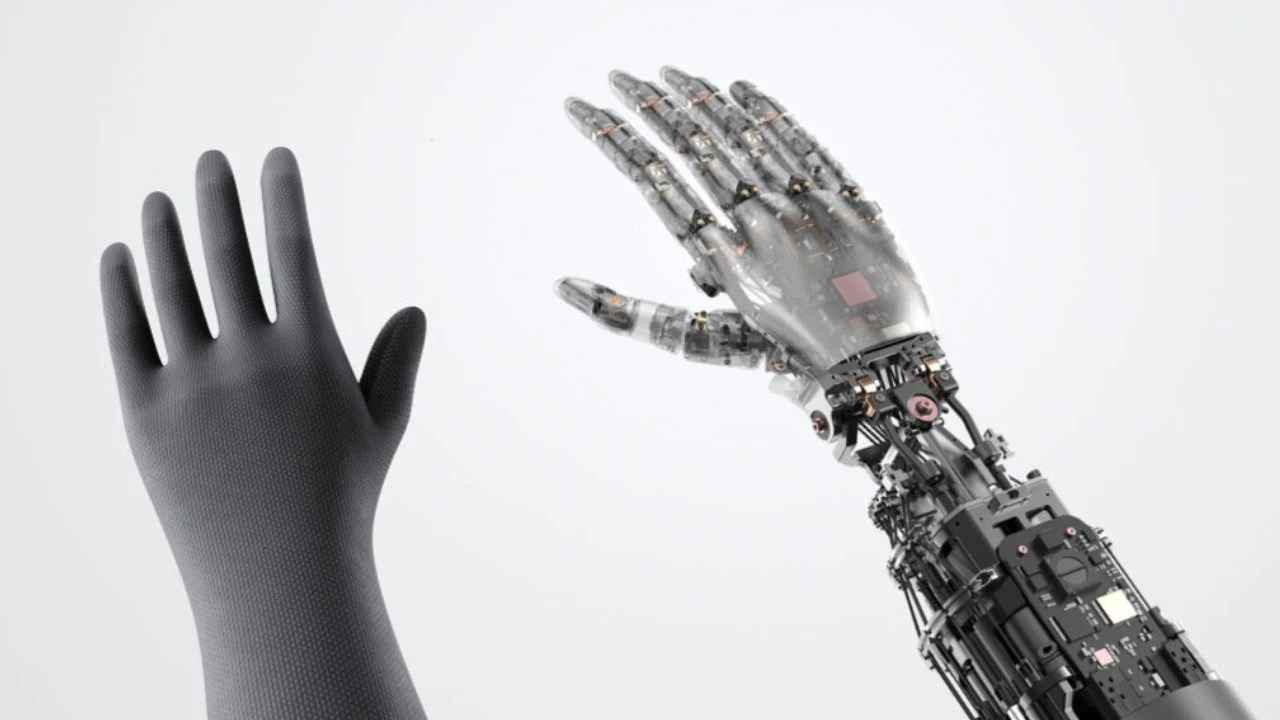
Image | Xiaomi's 21-DOF bionic hand and tactile glove (Source: Xiaomi Technology)
This bionic hand builds on Xiaomi's prior technological foundation. In March of this year, Xiaomi Technology introduced the CyberOne full-palm tactile bionic hand, which features a replaceable tactile glove covering the fingertips, finger pads, and palms. By July, Xiaomi's robots had completed a four-month "internship" at the Xiaomi Auto factory, achieving a 98% success rate in dual-sided operations at the self-tapping nut loading station. At the time, Lei Jun noted that the company is continuously exploring new applications, including bionic dexterous hands.
According to Xiaomi, flexible manufacturing involves a massive scale of production tasks and highly diverse dexterous operations, making it the ideal starting point for the hand's design. The pilot center comprises 16 typical work sections with a total of 2,579 SOPs. The team selected 1,827 of these SOPs and collected multi-angle video and motion capture data, covering more than 70.8% of the manual operation processes across the typical work sections. This data was classified, segmented, cleaned, and retargeted for multidimensional human-hand-based data analysis and simulation. Additionally, the team converted actual factory tools, parts, and manipulated objects into digital simulation assets to verify the bionic hand's multi-angle grasping capabilities.
The team began its analysis by evaluating DOF utilization. The study compared the range of motion for each joint during actual operations against the full average stroke of the corresponding human hand DOF. The results indicated that the utilization rates for the tested DOFs were consistently above 50%. The team also calculated the coupling correlations between joints. For instance, in a single finger, the flexion angle of the distal interphalangeal (DIP) joint is typically about one-third that of the proximal interphalangeal (PIP) joint. Joint combinations with a correlation above 0.8 were identified as candidates for an underactuated coupling scheme, allowing them to share a single actuation source.
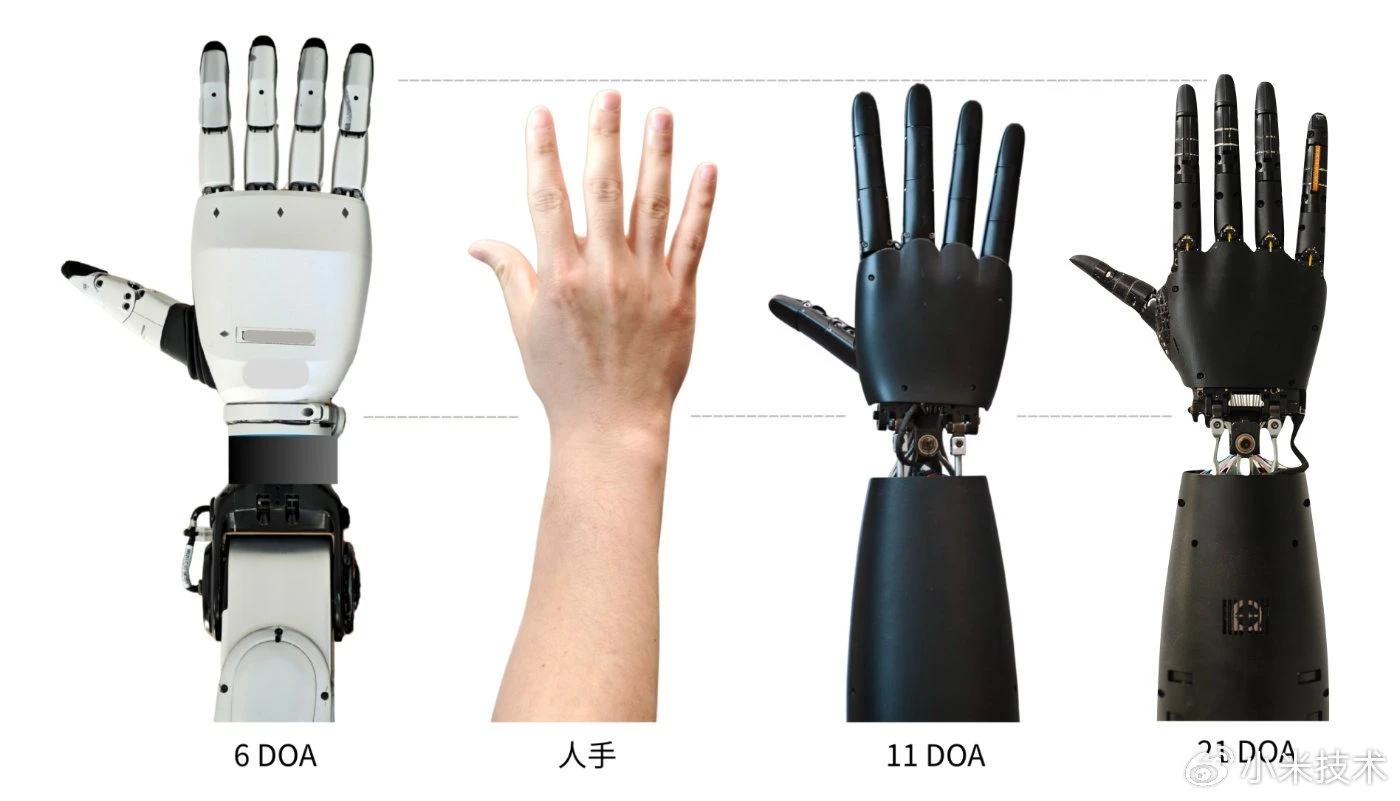
Image | Comparison between Xiaomi's bionic hand and a human hand (Source: Xiaomi Technology)
Through multiple simulation ablation studies, the team finalized the design at 21 DOFs. According to Xiaomi, the average stable grasping success rate in the 17–21 DOF range is 15% to 38% higher than in the 6–15 DOF range. The 21-DOF configuration yielded the highest benefits in both factory task coverage and grasping success rate. Increasing the DOFs to 23 or more resulted in diminishing returns for grasping performance. In multi-pose real-robot grasping tests using actual factory parts and tools, the new bionic hand demonstrated improved anthropomorphic grasping and higher success rates compared to its lower-DOF predecessors.
For actuation, the hand relies primarily on tendon-driven mechanisms. It incorporates five direct-drive DOFs at joints with lower load requirements to mitigate the structural stacking issues associated with high DOFs. The tendon-driven motors are primarily housed in the forearm, keeping the palm weight at 324 grams and consequently reducing the distal rotational inertia. To address the nonlinear control challenges caused by tendon creep, the team developed a tendon tension sensor to enable precise force control at the fingertips and throughout the grasping process.
Thermal management is governed by a thermal prediction model. According to Xiaomi, the bionic hand experiences numerous aperiodic high-current holding conditions during grasping, with single-hand power consumption exceeding 100 watts in extreme cases. The model predicts the temperature distribution online after sustaining the current operation for 5 to 10 minutes, estimating the remaining time until overheating. This enables the system to proactively schedule tasks, reduce joint torque, or adjust fan speeds, achieving a prediction accuracy of better than 3 °C. The model combines reduced-order physical models for electromagnetics and heat with machine learning corrections based on online recursive least squares. Because Xiaomi's robot features a fabric-covered full-body design, the team is also researching thermal management fabrics that incorporate high-thermal-conductivity fillers, surface radiation modification, and natural moisture absorption and evaporation.
The tactile design builds on the approach of the previous tactile glove. The new bionic hand achieves a tactile spatial resolution of 1 mm at the fingertips, finger pads, and finger bases, and 2 mm at the palm. The tactile glove is designed for easy disassembly and maintenance, and can also be used to collect tactile datasets structurally aligned with the human hand.