

NVIDIA Posts Record Quarterly Revenue as Board Chair Rules Out Jensen Huang's Return
Following Jensen Huang's departure, NVIDIA posted its first earnings report with fiscal Q3 2027 revenue surpassing $100 billion for the first time, reaching $115.8 billion amid a 103% year-over-year increase.
Following Jensen Huang's departure, NVIDIA has released its first earnings report.
Early on November 18, Beijing time, NVIDIA reported its third-quarter fiscal 2027 results for the three months ended October 25, 2026. Quarterly revenue surpassed USD 100 billion for the first time, with key metrics as follows:
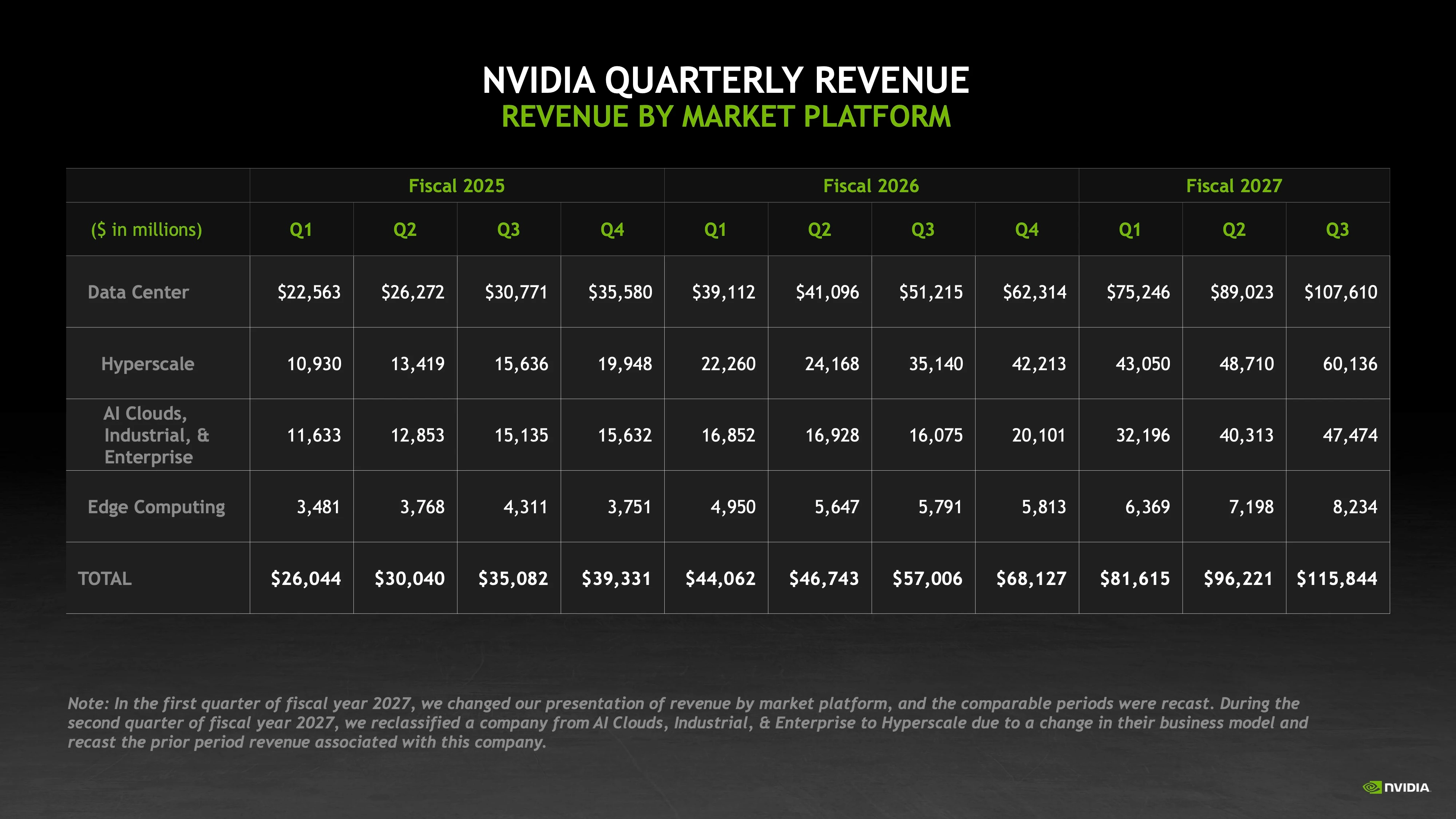
- Quarterly revenue reached USD 115.8 billion, up 103% year-over-year and 20% quarter-over-quarter. Data center revenue totaled USD 107.6 billion, up 110% year-over-year and 21% quarter-over-quarter.
- Gross profit was USD 86.7 billion, up 107% year-over-year and 20% quarter-over-quarter. The gross margin remained steady at 74.8%.
- Operating income reached USD 77.5 billion, up 115% year-over-year and 22% quarter-over-quarter; net income was USD 65.3 billion, up 105% year-over-year and 9% quarter-over-quarter.
- Free cash flow was USD 43.8 billion, up 98% year-over-year and 105% quarter-over-quarter.
- For the next quarter, the fourth quarter of fiscal 2027, NVIDIA projects revenue of USD 130 billion, plus or minus 3%. Both GAAP and non-GAAP gross margins are expected to be between 71% and 72%, representing the lowest gross margin of the year.
Meanwhile, interim CEO and CFO Colette Kress represented the company on the earnings call. This follows NVIDIA's announcement on November 12 that Jensen Huang had stepped down as president, CEO, and director, prompting the launch of a search for his successor.

NVIDIA Board Chair Harvey Jones stated on the call, "Jensen Huang voluntarily resigned from his positions as president, chief executive officer, and director. The NVIDIA board of directors unanimously accepted his resignation and has no intention of reinstating him as CEO."
Discussing the search for a successor, he said, "We want to appoint a permanent CEO as soon as possible, but we will not rush the process before finding the right person."
Colette Kress also noted, "From a business perspective, it is business as usual. We have been in touch with our customers, suppliers, and partners, and they are 100% supportive."
At the end of the earnings call, Colette Kress added, "We've got this."
Five days after his resignation, Jensen Huang also issued a public statement early this morning: "If the board believes my return is in the best interests of shareholders, employees, the company, and the United States, I would be deeply honored to respond to these requests and resume my role as CEO."

In recent days, calls for Jensen Huang to return to his post have been constant, but the NVIDIA board has not relented.
As of press time, NVIDIA's stock price was up 3.92% in after-hours trading.
Quarterly revenue surpasses USD 100 billion for the first time
In the third quarter of fiscal 2027, NVIDIA's revenue reached USD 115.8 billion, a 103% year-over-year increase and a 20% sequential increase. Compared to the previous quarter's USD 96.2 billion, this represents an increase of approximately USD 19.6 billion.
Maintaining double-digit sequential growth on such a massive revenue base is primarily driven by the data center segment.

This quarter, NVIDIA's data center business revenue reached USD 107.6 billion, up 110% year-over-year and 21% sequentially, accounting for approximately 93% of total revenue. The edge computing business—which includes PCs, gaming, workstations, robotics, and automotive—generated USD 8.2 billion in revenue, a 42% year-over-year increase and a 14% sequential increase.
In other words, for every USD 100 in revenue NVIDIA generates, approximately USD 93 comes from the data center segment.
This revenue structure also means that tracking NVIDIA's growth fundamentally comes down to monitoring the procurement and deployment of AI infrastructure: whether cloud providers and AI companies continue to scale their compute capacity, and whether NVIDIA can deliver its next-generation products to customers on schedule.
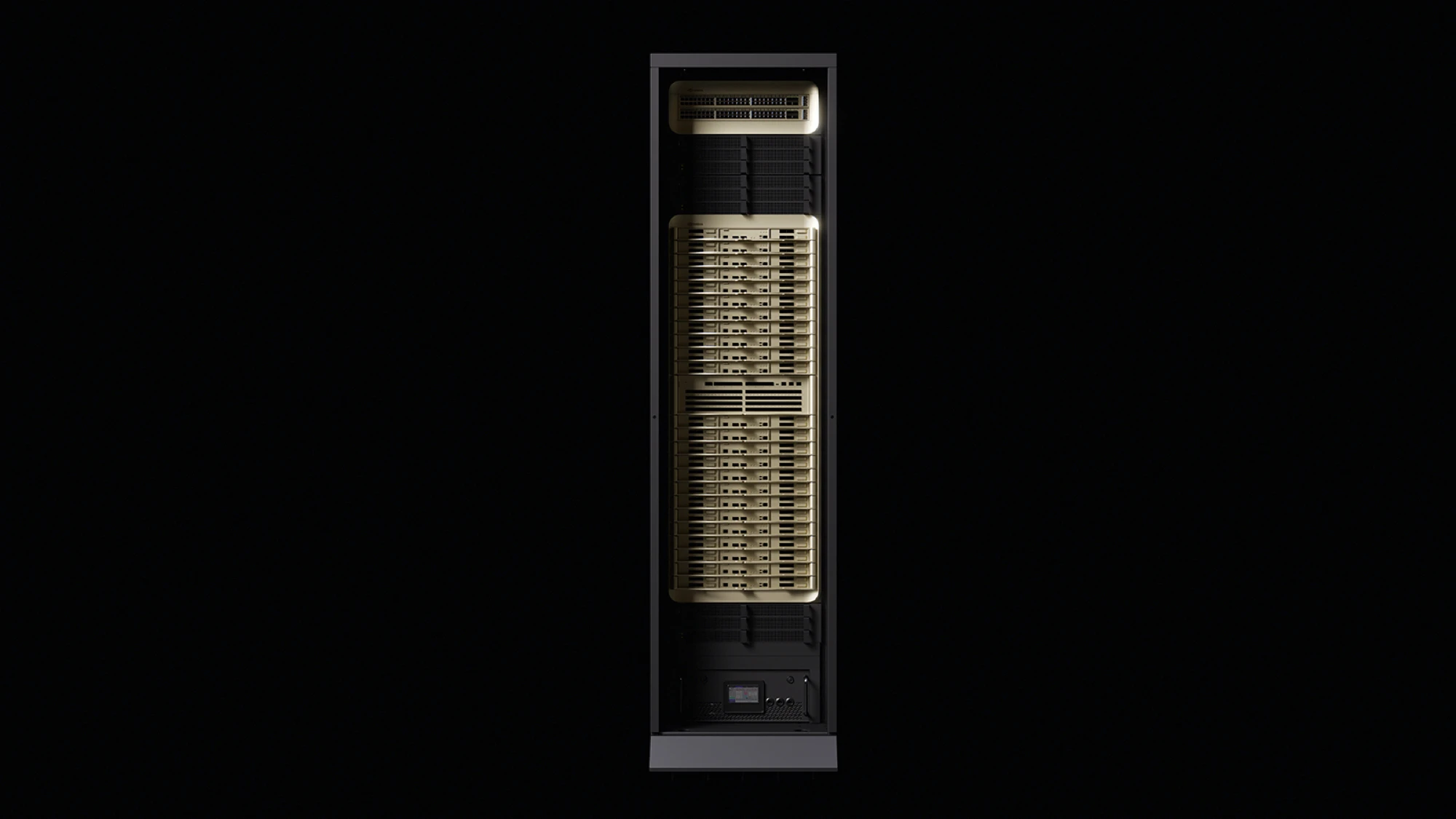
This quarter brought new developments for this product line. NVIDIA disclosed that the Vera Rubin NVL72 has begun shipping, with the corresponding racks already running at partners including CoreWeave, Google Cloud, Microsoft Azure, Oracle Cloud, and Nebius.

The quarter also brought new developments in autonomous driving and embodied AI:
- Robotics platforms: Isaac introduced new development tools, datasets, and runtime software; Agile Robots unveiled a reference humanoid robot powered by Jetson Thor and built on Isaac GR00T.
- World models: Cosmos expanded its training, evaluation, and deployment tools for world models, targeting robotics, autonomous driving, and industrial applications.
- Autonomous driving development: NVIDIA launched new Alpamayo development tools and the Halos SAFE framework to help developers build and evaluate autonomous driving systems.
- Automaker partnerships: Expanded collaboration with Mercedes-Benz and Volvo Cars to advance safe autonomous driving.
- Mobility applications: Bolt, alongside Lucid, Mercedes-Benz, Volkswagen Commercial Vehicles, and Einride, demonstrated use cases for the DRIVE Hyperion platform in autonomous vehicles and future robotaxi fleets.
Revenue growth also continues to translate into profit and cash.
Under U.S. Generally Accepted Accounting Principles (GAAP), NVIDIA reported net income of USD 65.3 billion for the quarter, a 105% year-over-year increase. Gross margin stood at 74.8%, up 1.4 percentage points year-over-year and down 0.2 percentage points sequentially. Free cash flow for the quarter reached approximately USD 43.8 billion, nearly doubling year-over-year.
Together, these figures demonstrate that as of the end of the quarter, NVIDIA has maintained strong profitability and cash generation capabilities even while scaling up its deliveries.
In the earnings report, NVIDIA also provided guidance for the next quarter.

NVIDIA projects fourth-quarter fiscal 2027 revenue of $130 billion, plus or minus 3%. Based on the midpoint of this guidance, revenue will grow approximately 12% sequentially, excluding data center computing revenue from China.
Despite continued revenue growth, gross margins are expected to decline in the upcoming quarter. NVIDIA projects both GAAP and non-GAAP gross margins of 71% to 72% for the next quarter. Compared to the GAAP gross margin of 74.8% in the current quarter, this represents a decrease of 2.8 to 3.8 percentage points, marking the lowest gross margin for fiscal 2027.
"Our ambition will not change"
Addressing the leadership transition, Interim CEO and CFO Colette Kress emphasized in her opening statement on the earnings call: "Our ambition will not change, our passion for innovation will not change, and our commitment to our customers, partners, and shareholders will not change."
This confidence is also reflected in the company's growth guidance. NVIDIA raised its year-over-year revenue growth forecast for fiscal 2028 (calendar 2027) to approximately 75%, up from about 70%.
She explained that the upward revision accounts for both sustained growth in customer demand and increased supply capacity from the supply chain. The new management team will also need to deliver on its promise to ship more products to customers on time.
Notably, NVIDIA's latest Rubin architecture chips have begun shipping. Kress disclosed: "In its first quarter of mass production shipments, the Rubin platform generated nearly $20 billion in revenue, making it the fastest-ramping product in NVIDIA's history."
Meanwhile, the new architecture chips have also accelerated customer deployment speeds. Kress added: "Our hyperscale cloud partners deployed Vera Rubin into production in about a month, taking roughly half the time required for Grace Blackwell."
Regarding compute demand, Kress highlighted a striking contrast in the data: 'Since May, token prices have dropped by nearly 60%, driving up token usage and compute demand. As a result, leasing prices across all GPU generations are rising.'
She further noted that Hopper GPU leases in some multi-year renewals have reached up to twice their original price, while B300 lease rates have increased by more than 60% since launch. In NVIDIA's view, the declining cost of token usage is expanding applications and compute consumption; Kress used these lease price changes to illustrate that GPU demand remains robust.
On physical AI, Kress stated that physical AI revenue in the third quarter of fiscal 2027 was nearly three times that of the same period last year, and full-year revenue is currently expected to exceed USD 25 billion. Meanwhile, Kress expects agentic AI and CPU demand to grow in tandem, projecting that total CPU revenue in fiscal 2028 will be more than double the previous fiscal year.
However, revenue expansion does not mean profitability levels can be maintained indefinitely at their current highs. Addressing analysts' questions about long-term pricing power and gross margins, Kress explained that the company has absorbed some of the increased supply costs and continues to fulfill existing customer purchase orders, with a shift to new pricing taking effect in the new fiscal year.
'We expect the fourth quarter to be the low point for gross margin, after which it will rebound to 72% to 73% in fiscal 2028,' Kress said.
Beyond business operations, the board's requirements for the successor also involve the national security and regulatory landscape. NVIDIA Board Chair Harvey Jones stated, 'Changes in advanced chip technology and the national security environment are bringing significant shifts to our market. The new CEO must navigate these changes carefully.' The company has established a National Security and Export Control Oversight Committee to strengthen relevant oversight and communication with the U.S. government.
NVIDIA's financial results for the third quarter of fiscal 2027 cover the period ending October 25, which predates Jensen Huang's departure. The impact of this major personnel change on subsequent orders, talent, and customer relationships remains difficult to determine at this stage, though more changes may become apparent in the coming quarters.
At the close of the earnings call, Kress reiterated her confidence: 'Our growth momentum is real. Demand is accelerating, and supply is increasing. Customers and partners are standing with us, and our employees are fully committed. We've got this.'
Jensen Huang has expressed his desire to return, and support for his reinstatement continues, but the board insists it has no intention of restoring him as CEO. The tug-of-war among the involved parties has made this scandal highly dramatic. Yet NVIDIA now faces a more practical challenge: without its longtime linchpin, how will the current management team stabilize relations with employees and partners, maintain the pace of innovation and delivery, and keep the company running smoothly?
Found an error? Tell us