

Genesis AI Raises USD 500 Million in Series A at USD 3.5 Billion Valuation
General-purpose robotics company Genesis AI announced a USD 500 million Series A round at a post-money valuation of USD 3.5 billion, co-led by Premji Invest, Khosla Ventures, and Eclipse.
On November 17, general-purpose robotics company Genesis AI announced via PR Newswire the closing of a USD 500 million Series A funding round, bringing its post-money valuation to USD 3.5 billion. The round was co-led by Premji Invest, Khosla Ventures, and Eclipse.
Institutional participants also included Durable Capital Partners, advisory accounts under T. Rowe Price Associates, French public investment bank Bpifrance, HSG, NVIDIA, AMD Ventures, Zoom, Samsung Next, and Ericsson.
The individual investor roster is equally notable, featuring former Google CEO Eric Schmidt, Zoom founder and CEO Eric Yuan, former Yahoo CEO Jerry Yang, prominent French tech entrepreneur Xavier Niel, and former Tesla CFO Zach Kirkhorn.
Proceeds from this round will be used to expand data collection and scale up large model training, thereby increasing the breadth and complexity of tasks the robots can perform. The funds will also go toward refining the robots' physical manipulation capabilities across various scenarios, advancing the commercial deployment of the flagship general-purpose robot Eno, and expanding recruitment for AI research, robotics, and engineering talent.
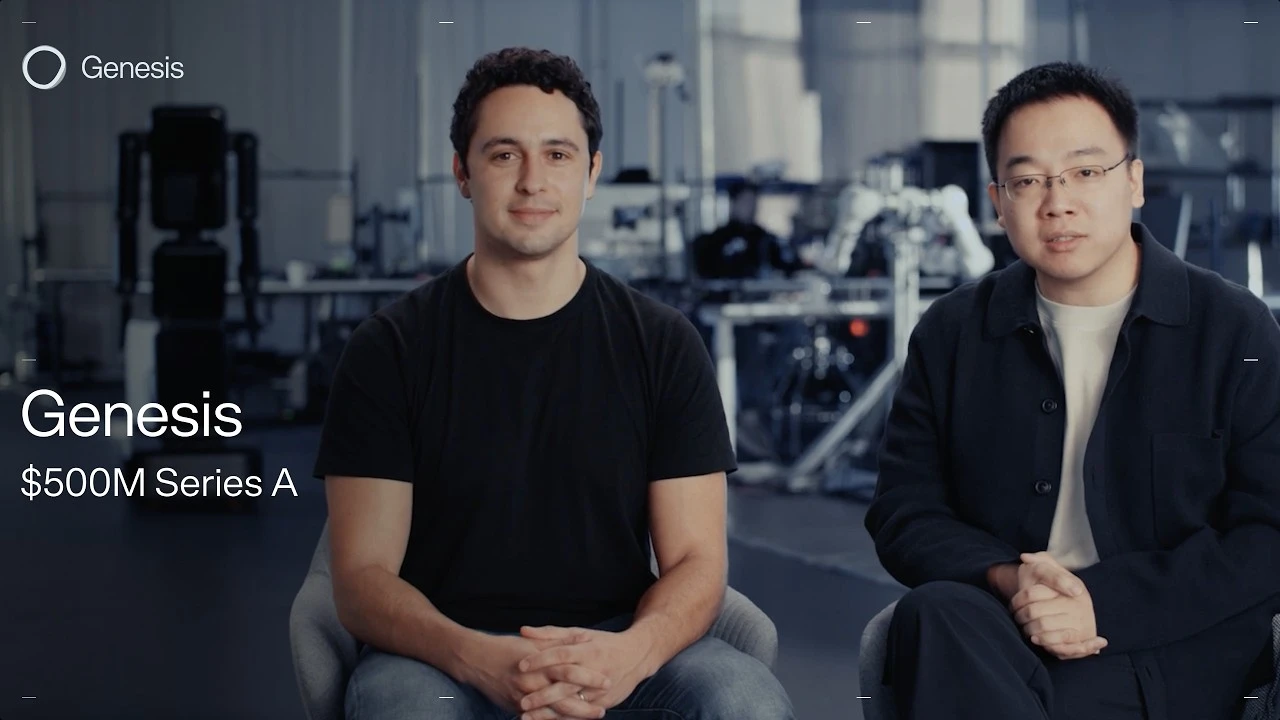
Image | Genesis AI Co-founder and President Théophile Gervet (left) and Co-founder and CEO Xian Zhou (right) (Source: Genesis AI official funding announcement video)
Genesis AI Co-founder and CEO Xian Zhou stated, "Our goal is to break the physical boundaries that constrain human action. To achieve this, we are building a top-performing general-purpose robot, a machine capable of long-term, stable operation in real-world environments. This requires integrating intelligent algorithms, hardware, and robot training and testing pipelines into a complete, closed-loop system. Developing the entire pipeline in-house allows us to meticulously refine every component and accelerate full-system iteration. This funding will enable us to bring general-purpose robots to real-world deployment even faster."
Genesis AI President and Co-founder Théophile Gervet met Xian Zhou at a Carnegie Mellon University lab, and the two co-founded the company in 2024. Earlier, on July 1, 2025, Genesis AI announced the closing of a USD 105 million seed round, which was also co-led by Eclipse and Khosla Ventures.
The company is committed to the integrated, in-house development and iteration of AI, data, and hardware. It has successively launched the foundation model GENE, a dexterous hand paired with data collection gloves, the simulation platform Genesis World, and the general-purpose robot Eno. The dexterous hand achieves a one-to-one mapping of human hand movements with the data gloves: frontline workers wearing the sensor gloves can continuously collect training data for the model during their daily operations, while Genesis World handles robot skill training and validation in virtual environments. Eno's design philosophy benchmarks against human operational capabilities, but it does not pursue a strict replication of the human form.

Image | Genesis AI dexterous hand (Source: Genesis AI website)
A November 17 TechCrunch report notes that hundreds of frontline workers are currently wearing sensor gloves and matching head-mounted cameras to continuously feed real-world data into the model. The dexterous hands mounted on the robots are also scaled to human proportions.
Eno is currently prioritizing deployment in industrial settings such as manufacturing, logistics, and laboratories. The company plans to gradually expand into hospitality and healthcare, and eventually into consumer and outdoor applications, with targeted customer deployments scheduled to begin by the end of 2026.
At a demonstration in Silicon Valley, Zhou Xian showed TechCrunch the model controlling a commercial robotic arm to independently complete a full workflow of boxing, sealing, and labeling. However, the demonstration was not flawless: the robotic arm stumbled while handling cardboard boxes and struggled to peel small labels. No live demonstration of the physical Eno robot was conducted on site.

Image | Genesis AI general-purpose robot Eno (Source: Genesis AI official video)
Genesis AI disclosed that it has built 30 to 40 Eno prototypes so far and has not yet announced its production capacity targets for next year. The company has finalized its mass production partners and plans to begin manufacturing in the United States in 2027. The design for the mass-production model is locked, and pilot testing is underway with select undisclosed customers.
Zhou Xian acknowledged that the project's biggest bottleneck at this stage is hardware-related, encompassing mechanical structural design and the supply chain for mass-producing industrial-grade robots. Currently, the dexterous hands have a stable operational lifespan of only a few weeks before they need to be replaced.
Vedant Agrawal, a partner at lead investor Premji Invest, commented: "What impressed us most about the Genesis robot is its ability to autonomously execute extended, multi-step workflows at near-human speed, with smooth and fluid motions. Being able to independently complete an entire operational process, rather than just performing fragmented, short actions, is what makes a robot that enterprises can truly trust."
Found an error? Tell us