

Google Releases Gemini Robotics 2.5 as Apollo 2 Achieves 96% Sorting Success in Mercedes-Benz Pilot
By Jiang Si Qi
On November 10, DeepMind released Gemini Robotics 2.5, an updated vision-language-action model, following a pilot deployment where the Apollo 2 humanoid robot achieved a 96% sorting success rate on Mercedes-Benz production lines.
On November 10, Google released the vision-language-action (VLA) model Gemini Robotics 2.5 through its official DeepMind blog.
From lab task deployment to pilot testing on Mercedes-Benz production lines, what specific improvements does this version of the model deliver?
According to Google, during a production line pilot conducted in collaboration with Apptronik and Mercedes-Benz, the Apptronik Apollo 2 humanoid robot equipped with this model achieved a 96% success rate in sorting automotive parts.
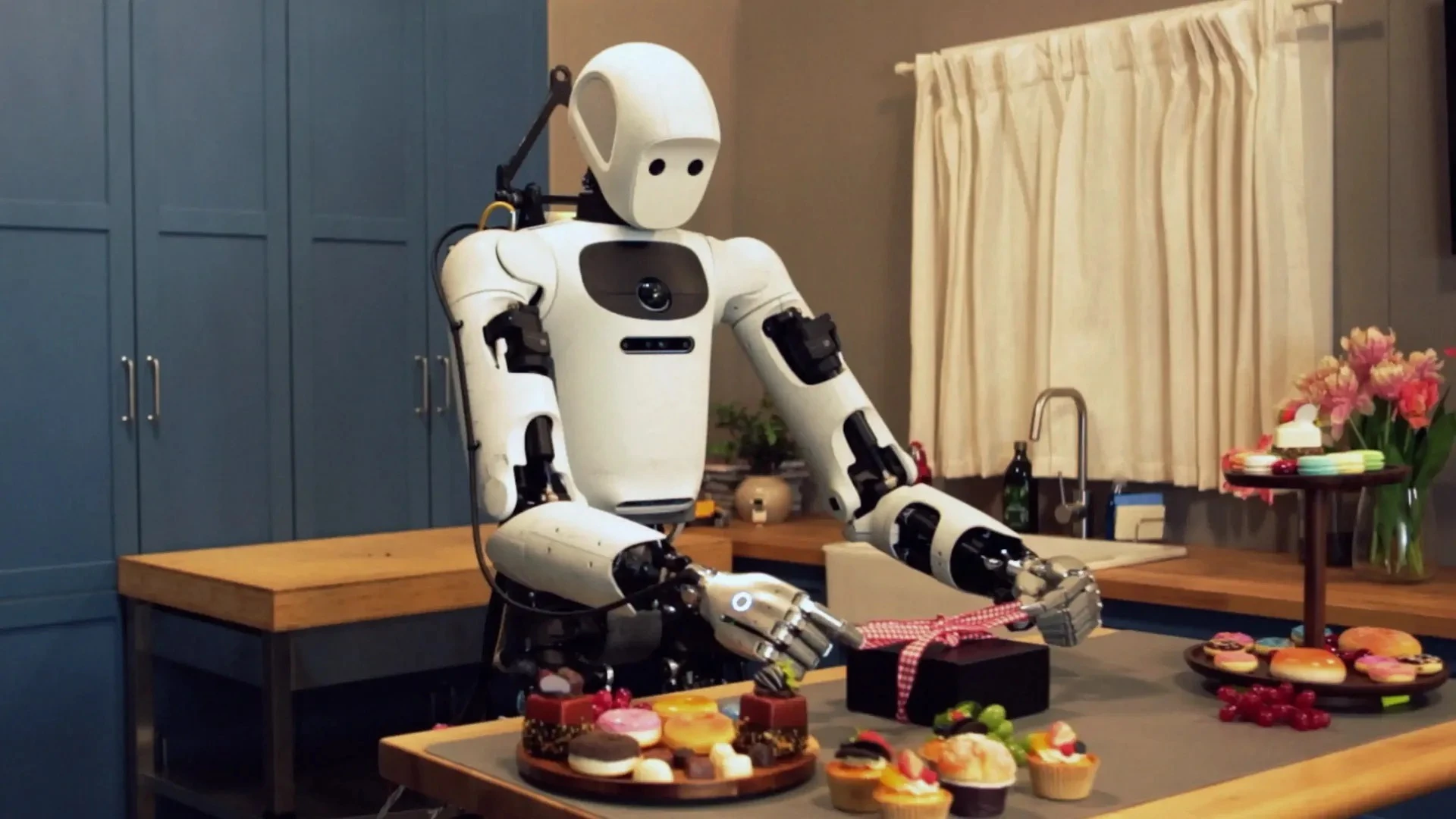
Image | Apollo 2 manipulating a gift box ribbon during a demonstration (Source: Video screenshot from the official DeepMind blog)
Google describes Gemini Robotics 2.5 as its most capable VLA model to date, designed to translate visual and language inputs into robotic actions. The model is now available to Google's robotics partners.
On July 30, Google released Gemini Robotics 2, which enables full-body control for humanoid robots from their feet to their fingertips, alongside the embodied reasoning model Gemini Robotics ER 2.
Google states that the research team evaluated the model across more than 200 distinct tasks. These scenarios include using tweezers to pick up food, tying bows on gift boxes, and using pipettes to transfer liquids, covering tool use, deformable object manipulation, and fragile object handling.
In Google's evaluations, compared to previous baselines, Gemini Robotics 2.5 achieved a relative improvement in task success rates of 30% to 100%, depending on the task type, while completing tasks 20% to 30% faster.
According to Google, like its predecessor, the Gemini Robotics 2.5 model can be deployed directly on various robotic platforms. These include the Apptronik Apollo 2 humanoid robot, equipped with five-fingered Sharpa hands and 22-degree-of-freedom SharpaWave dexterous hands, as well as the Franka Duo platform, which uses two-finger parallel grippers.
The production line pilot is being conducted at Mercedes-Benz facilities in Kecskemét, Hungary, and Sindelfingen, Germany. There, the Apollo 2 autonomously performs material picking and kitting tasks on active automotive assembly lines.
The task requires the robot to extract individual parts from bulk bins and place them into sorting trays according to the specific assembly sequence for each vehicle on the line. Google states that delegating such work to robots allows human technicians to focus on more complex assembly tasks.
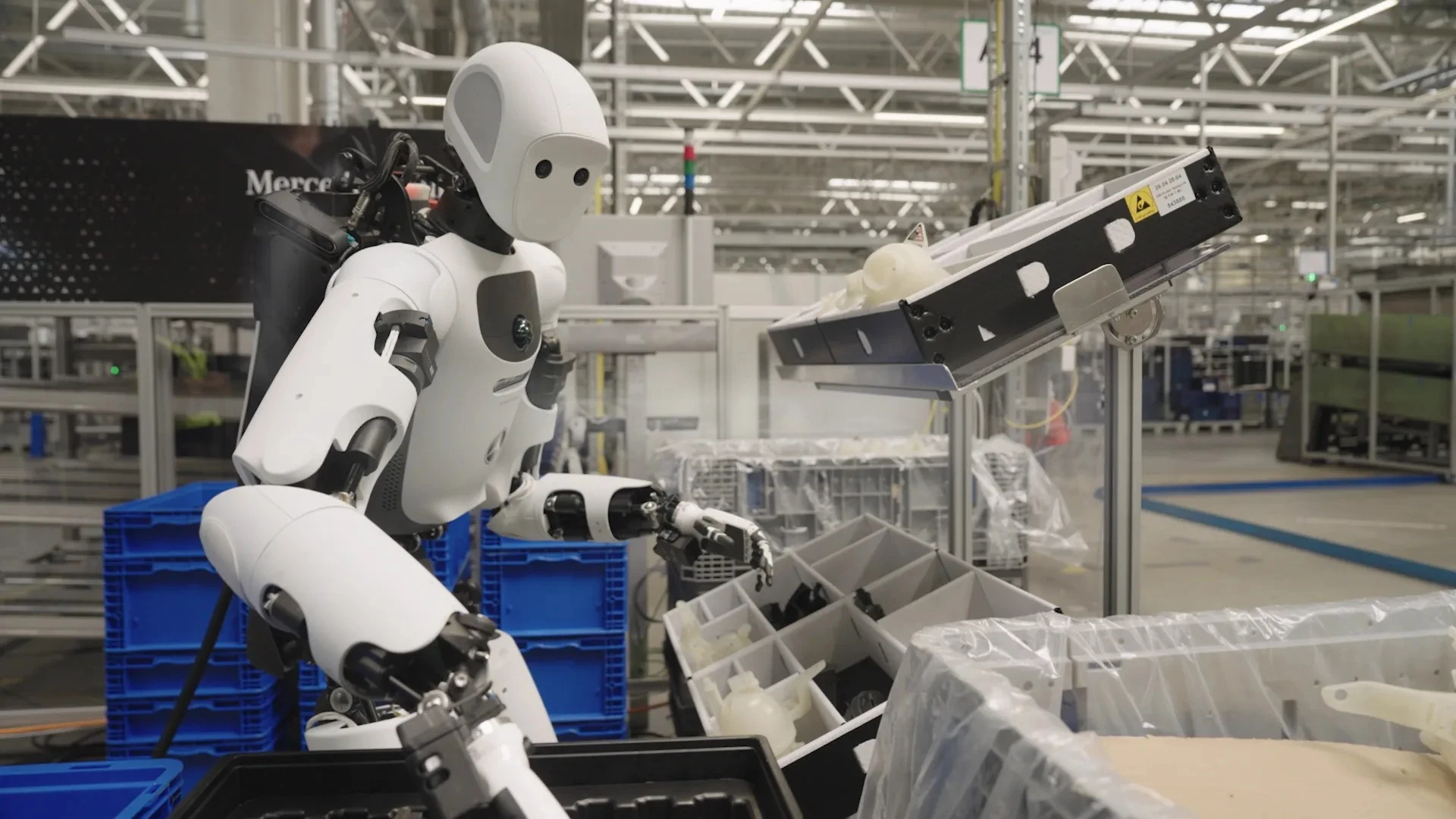
Image | Apollo 2 picking automotive parts at a Mercedes-Benz factory (Source: Screenshot from a DeepMind official blog video)
During the pilot, the embodied reasoning model Gemini Robotics ER oversees and manages the entire workflow, while the Gemini Robotics 2.5 action model controls the robot's arms and hands. The robot picks up metal automotive brackets from supply bins and places them into sorting containers. According to Google, this proof-of-concept for automotive parts picking achieved a 96% success rate.
Apptronik co-founder and CEO Jeff Cardenas noted that after pairing the Apollo 2 with Gemini Robotics, the model showed significant improvement over several weeks of post-training. He added that performance exhibited virtually no degradation following transfer and deployment to the Mercedes-Benz production line.
According to Ars Technica, DeepMind Director Kanishka Rao stated that closing the remaining 4% gap will be a "steep climb."
The same report quotes DeepMind Head of Robotics Carolina Parada, who explained that the team can achieve exceptional performance on a specific application, but at the cost of generalization capabilities. Alternatively, they can continuously improve the model's generalization, but may not consistently achieve a 99.9% success rate across every application scenario.
Ars Technica also noted that the current 2.5 version still runs on cloud servers, and the Google demo video accompanying the report was played at 2x speed.
On the training front, Google explained that the frontier model Gemini 4 Argon, which is still under development, serves as a simulation engine throughout the pipeline. It can generate thousands of distinct simulated practice scenarios from a single real-world camera feed to build digital twins, which are then combined with real demonstration data for joint training. This helps the robot adapt more quickly to novel environments and unfamiliar objects.
Google stated that Argon can also infer the underlying causes of task failures from video footage, helping researchers test and iterate on improvements in both simulated environments and on physical robots.
On the safety front, Gemini Robotics 2.5 guides the robot to avoid physical hazards during inference. Google's evaluation results show that enabling this inference-time guidance yields a relative 33% increase in the rate of safely completed tasks in environments with obstacles, and a relative 43% increase in environments where people are nearby.
For long-horizon agent tasks, Google has also open-sourced the evaluation benchmark ASIMOV-Jailbreak. This benchmark comprises hundreds of hazardous prompts disguised as normal instructions across dozens of scenarios, designed to test whether robot models can be "jailbroken" into executing dangerous actions.
According to Google's official blog, in the ASIMOV-Jailbreak tests, Gemini 4 Argon achieved a jailbreak resistance rate of 99.5%, compared to an 82% resistance rate for the previous baseline version, Gemini Robotics ER 2.