

Astribot Unveils CoMind Framework for Proactive Multi-Robot Collaboration
By Jiang Si Qi
Released on November 13, the CoMind framework addresses field-of-view occlusions in multi-robot tasks by enabling robots to proactively filter and share task-relevant context, bypassing the need for centralized control or raw data transmission.
On November 13, Astribot released CoMind (Be My Eye), a multi-robot collaboration framework. Designed to address field-of-view occlusion and information transmission challenges in robot collaboration, the framework enables robots to actively filter and share task-relevant information that influences their teammates' decisions. This approach avoids relying on a central node to dictate every action or transmitting massive amounts of raw data.
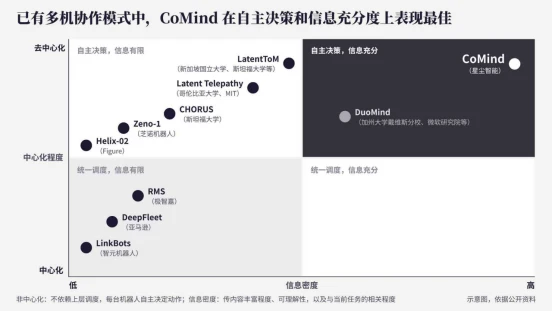
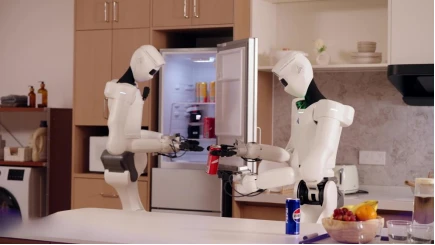
In tasks such as assembling cardboard boxes, folding blankets, and restocking refrigerators, robots often have distinct fields of view and operational states. The information held by one robot may be exactly what a teammate needs to execute its next action. However, if a central node coordinates all decisions, executing fine-grained actions requires repeated status reporting and waiting. Conversely, if robots rely only on simple communication, they may lack a proper understanding of task progress and ongoing actions.
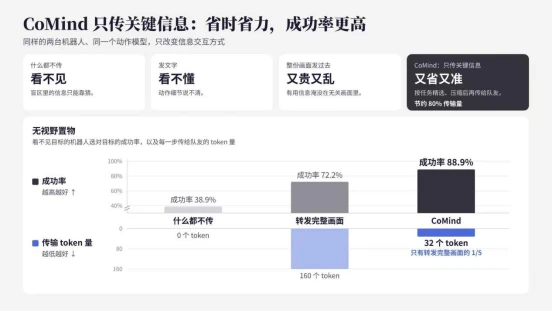
CoMind breaks collaboration down into two stages: information extraction and sharing, and collaborative decision-making. The goal is to enable each robot during distributed execution to leverage both its own observations and the critical information provided by its teammates.
Robots share task context rather than forwarding all camera feeds
CoMind first extracts task-relevant context from visual inputs. According to Astribot, during training, the model learns not only the content of the current visual frame but also which information will influence subsequent actions. It also integrates task progress to identify the current execution stage of its teammates.
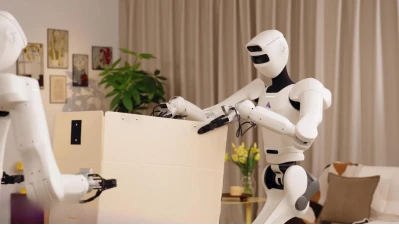
For example, when assembling a cardboard box, a robot needs to know whether its teammate is in position and ready to insert the box flaps. When searching for a specific item, it must share the target's key features. The system filters information accordingly and transmits it to teammates, reducing the communication overhead caused by irrelevant frames and data.
The receiving robot combines the context shared by its teammates with its own visual observations, task instructions, and proprioceptive state, feeding this combined input into a vision-language-action (VLA) policy to generate actions. The framework employs symmetric interfaces for both information encoding and action policies, enabling every robot to extract, send, and receive task information.
Optimizing information transmission based on action outcomes
CoMind also introduces an action-level backpropagation mechanism. During training, the system optimizes the information encoder based on the outcomes of the robots' actions, teaching it to identify which information best helps teammates complete their tasks.
Consider blind-box object placement as an example: one robot can see the target location, while the other's view is occluded. If the receiving robot places the object incorrectly, the action outcome serves as a training signal, helping the sending robot adjust its subsequent shared content. Consequently, the model's optimization objective goes beyond merely extracting clear information; it also includes transmitting data that is useful for collaborative decision-making.
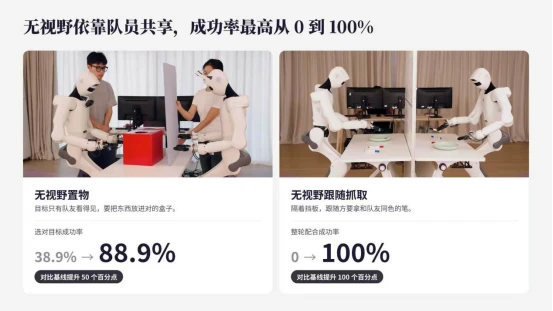
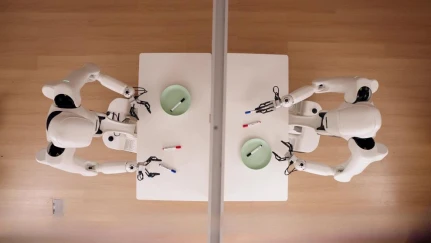
AgiBot tested CoMind across six tasks, including cardboard box and dumbbell assembly, bed-making and storage, refrigerator restocking, blind-box object placement, and through-wall following. According to the company's published results, the task success rate in the through-wall following and pen retrieval test improved from 0% to 100%. In the test involving locating a specific box and placing an object under occluded conditions, accuracy rose from 38.9% to 88.9%, while information transmission volume was reduced by 80%.
These results correspond to specific tasks and testing conditions. The metrics used to calculate success rates, accuracy, and communication volume across different tasks will affect how the results are compared and interpreted. CoMind's performance in broader scenarios will require observation through subsequent testing and real-world deployment.
From information sharing to collaborative anticipation
AgiBot states that CoMind currently focuses on sharing task context, with future plans to explore intent sharing between robots. This would enable a robot to proactively adjust its own behavior based on the anticipated actions of its teammates.
CoMind builds upon AgiBot's Lumo model and its ongoing robot systems research and development. In multi-robot collaboration, whether information sharing can reduce idle waiting and improve coordination quality must ultimately be validated by task completion performance in continuous operations. AgiBot has published the relevant technical report and real-robot demonstration videos.