

Unitree's First Post-IPO Earnings: Q3 Revenue Surges Nearly 70% as Net Profit Declines
By Xiong You Di
Unitree's first post-IPO financial report shows third-quarter revenue jumping nearly 70% year-on-year while net profit fell and R&D spending surged 2.5-fold, reflecting the company's pivot of hardware earnings and IPO funds into embodied AI.
On October 28, Unitree Technology released its first financial report since going public: Q3 revenue grew by nearly 70%, while net profit declined year-over-year, and R&D spending surged by nearly 2.5 times—all three developments occurring simultaneously.
This is not a simple story of "high growth." Unitree is channeling the revenue accumulated from its hardware business and the capital raised from its IPO into a direction that is still in the R&D and validation phase: embodied AI.
Key takeaways
- Revenue continues to accelerate. For the first three quarters, operating revenue reached 1.817 billion yuan, a year-over-year increase of 55.71%, already surpassing the full-year 2025 revenue of approximately 1.699 billion yuan; Q3 revenue alone was 665 million yuan, up 69.93% year-over-year.
- Profit diverges from revenue. For the first three quarters, net profit attributable to parent company shareholders was 387 million yuan, up 270.54% year-over-year; net profit attributable to parent company shareholders excluding non-recurring items was 349 million yuan, down 18.78% year-over-year. In Q3 alone, net profit attributable to parent company shareholders was 113 million yuan, down 17.37% year-over-year; net profit attributable to parent company shareholders excluding non-recurring items was 105 million yuan, down 17.42% year-over-year.
- Gross margin declines as cost growth outpaces revenue. For the first three quarters, gross profit was approximately 982 million yuan, with a gross margin of about 54.02%, down 5.73 percentage points from approximately 59.75% in the same period last year; operating costs for the same period were approximately 836 million yuan, up about 77.9% year-over-year.
- R&D spending increases significantly. For the first three quarters, R&D investment was 263 million yuan, up 191.48% year-over-year, accounting for 14.47% of revenue; net cash flow from operating activities fell 54.69% year-over-year.
The capital markets have already priced in this direction. On October 25, JPMorgan upgraded Unitree's rating by two notches from "Underweight" to "Overweight," raising its December 2027 target price from 300 yuan to 995 yuan. More notably, the bank maintained its 2026 humanoid robot sales forecast at approximately 14,163 units, while raising its 2028 forecast from 41,552 units to 111,554 units.
The market has not changed its assessment of Unitree's current sales volume, but it has significantly raised its expectations for long-term growth.
The backdrop to this shift is the assessment made by Xingxing Wang ten days ago at the World Physical AI Conference: physical AI is showing early signs of a key breakthrough, "in as quickly as one to two years, or as slowly as two to three years." JPMorgan subsequently adjusted its outlook on the industry's commercialization timeline based on this.
Clearly, Unitree is leveraging its scaled hardware business and IPO proceeds to fund the next phase of embodied AI development. However, whether this investment will become a new growth engine remains to be validated by future financial reports and actual orders.
Net profit attributable to parent up 271%, but recurring net profit declines
Let's start with revenue.
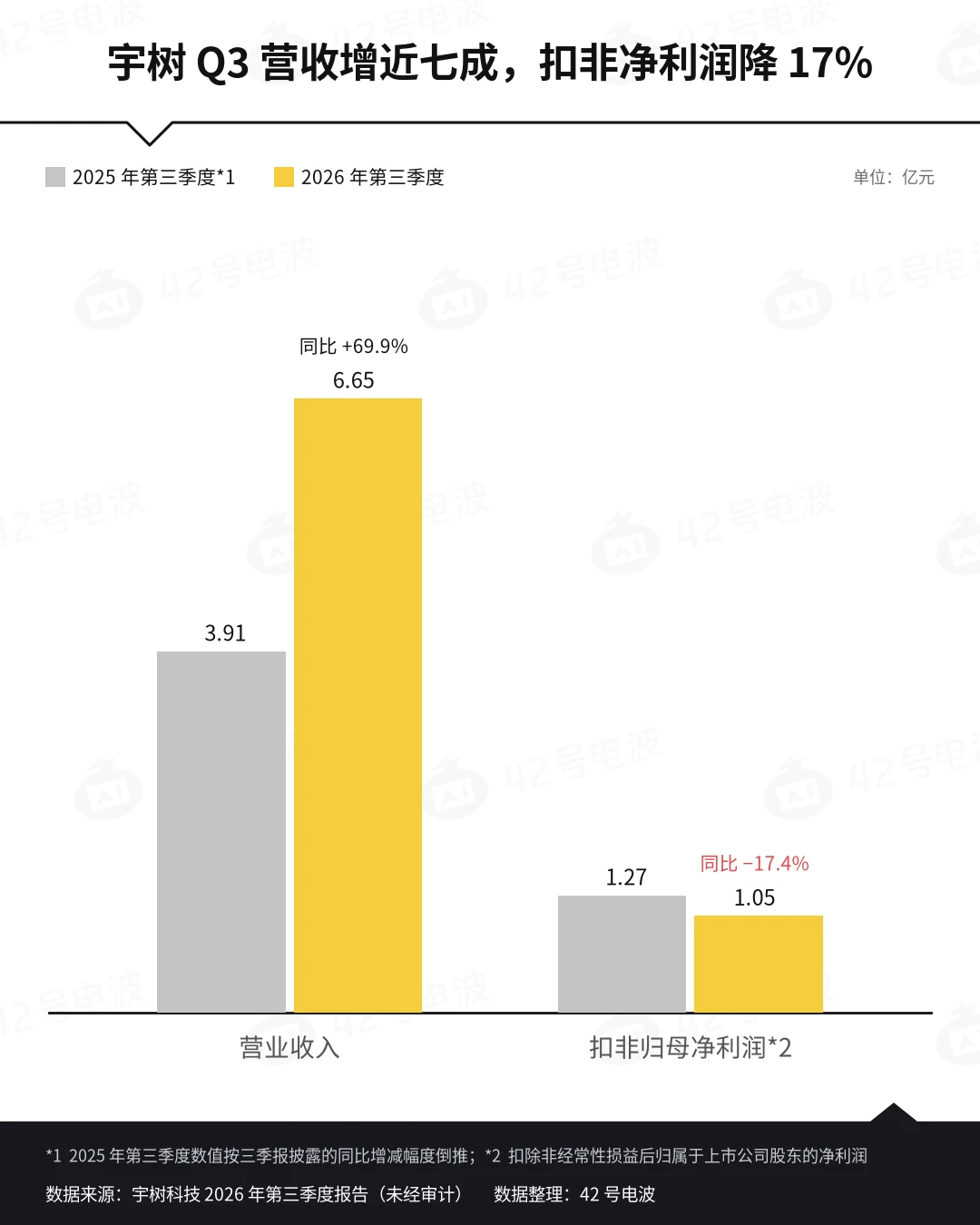
In the first nine months, Unitree generated RMB 1.817 billion in revenue, up 55.71% year on year, surpassing its full-year revenue of approximately RMB 1.699 billion in 2025. Revenue for the third quarter alone reached RMB 665 million, a year-on-year increase of 69.93%, indicating sustained strong growth on the top line.
The profit side, however, tells a completely different story.
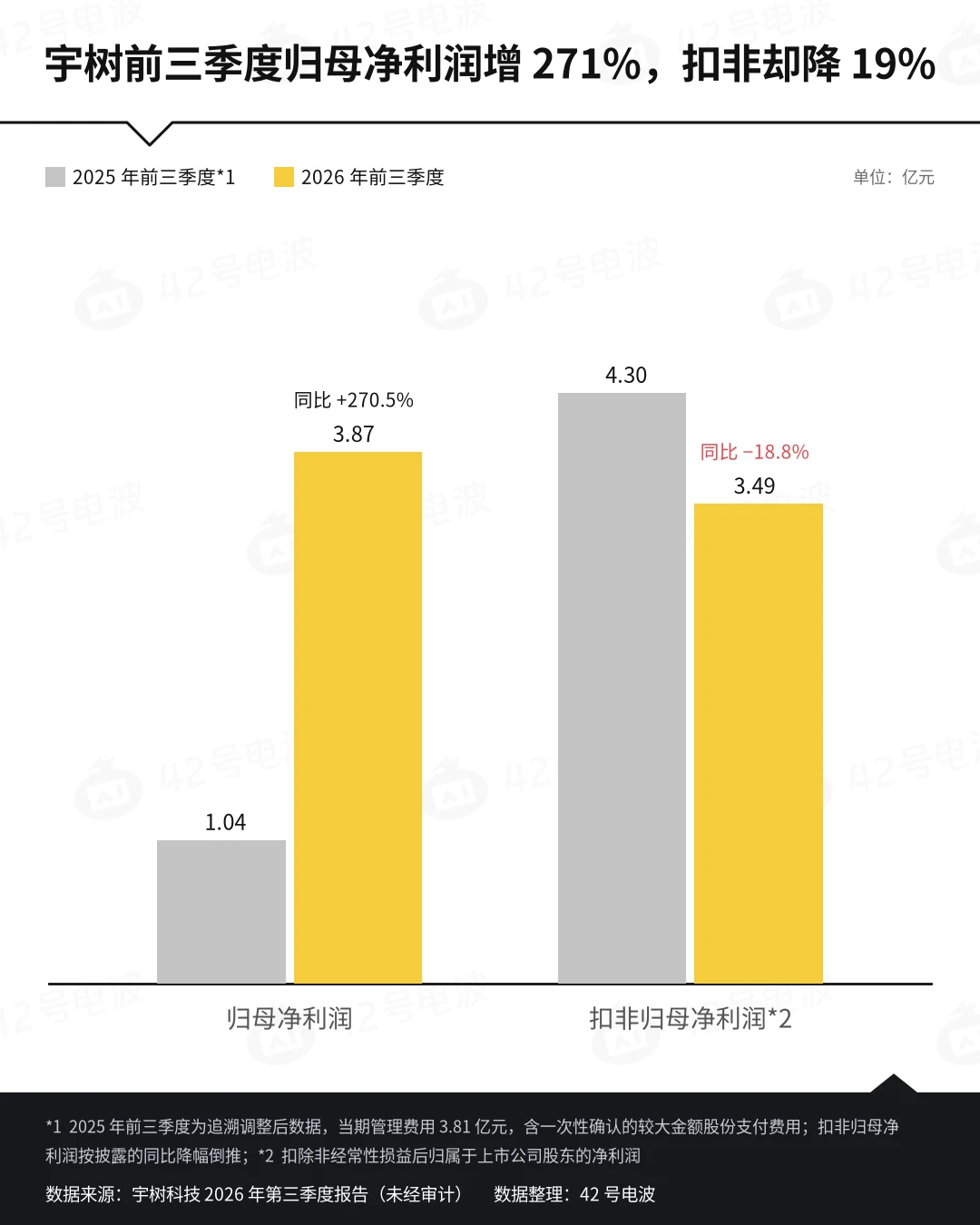
For the first nine months, net profit attributable to parent company shareholders reached RMB 387 million, up 270.54% year on year; however, recurring net profit attributable to parent company shareholders fell to RMB 349 million, down 18.78% year on year. In the third quarter alone, total profit declined 27.78% year on year, while net profit attributable to parent and recurring net profit attributable to parent dropped 17.37% and 17.42%, respectively.
This stark contrast is primarily tied to the profit base from the same period last year.
Based on retrospectively adjusted comparable data in the third-quarter report, net profit attributable to parent for the first nine months of 2025 was approximately RMB 104 million, compared to recurring net profit attributable to parent of about RMB 430 million. The roughly RMB 325 million gap indicates significant non-recurring losses in the year-ago period.
Meanwhile, administrative expenses dropped from approximately RMB 381 million in the year-ago period to RMB 74 million, a decrease of about RMB 308 million. Unitree explicitly noted in its third-quarter report that the year-on-year change in total profit for the first nine months was affected by the one-time recognition of substantial share-based payment expenses in the same period last year.
The similar magnitude of change in these two sets of figures offers clues for understanding the profit base, but they cannot be directly equated. The calculation scope for the year-on-year change in administrative expenses differs from that of non-recurring gains and losses; not all fluctuations in administrative expenses stem from share-based payments.
Net profit excluding non-recurring items offers another perspective: after stripping out these non-recurring gains and losses, Unitree's profitability has not grown in tandem with its revenue.
Turning to costs.
For the first three quarters, operating costs rose by approximately 77.9% year-on-year, outpacing revenue growth, while the gross margin fell by about 5.73 percentage points. Meanwhile, selling expenses surged by roughly 202% year-on-year, and R&D investment increased by 191.48%.
Unitree explicitly stated in its financial report that the increase in R&D spending is primarily driven by investments in embodied foundation model research and computing power. It also includes the expansion of the R&D team and the development of new products.
However, the decline in profit cannot be dismissed with a simple "AI burns cash" explanation. Operating costs, selling expenses, R&D investment, and product mix all influence the bottom line. The available data confirms that while revenue scale has expanded and R&D investment has increased significantly, neither the gross margin nor net profit excluding non-recurring items has improved in tandem.
Cash flow also highlights the cost of this growth.
In the first three quarters, net cash flow from operating activities at Unitree was RMB 194 million, a year-on-year decline of 54.69%. The company attributed this primarily to increased spending on procuring goods and services, employee compensation, and higher sales and R&D expenditures to support business growth.
Selling more robots and increasing R&D spending do not necessarily translate into simultaneous growth in current-period profits and cash returns. Revenue, profit, and cash flow are three distinct metrics.
Notably, rough calculations based on disclosed data indicate that Unitree's full-year 2025 non-GAAP net profit attributable to the parent company was approximately RMB 591 million, with the first three quarters of 2025 accounting for roughly RMB 430 million, leaving an estimated RMB 161 million for the fourth quarter. Given that the non-GAAP net profit attributable to the parent company for the first three quarters of 2026 stood at RMB 349 million, the fourth quarter must generate at least RMB 242 million just to surpass the 2025 full-year total—implying a year-over-year growth of approximately 50%.
Looking ahead to the fourth quarter, can Unitree stabilize its non-GAAP profitability while scaling up its business operations, even as it accelerates R&D investment?
RMB 7.35 billion in cash, with model R&D budget nearly double that of robot hardware
Unitree has ample capital to continue investing in AI, but the more compelling question is how it plans to allocate those funds.
According to the prospectus, the four planned fundraising projects will utilize a total of approximately RMB 4.202 billion in proceeds. Specifically, the intelligent robot model R&D project is slated to receive about RMB 2.022 billion, the robot hardware R&D project about RMB 1.110 billion, the new intelligent robot product development project about RMB 445 million, and the intelligent robot manufacturing base construction project about RMB 624 million.
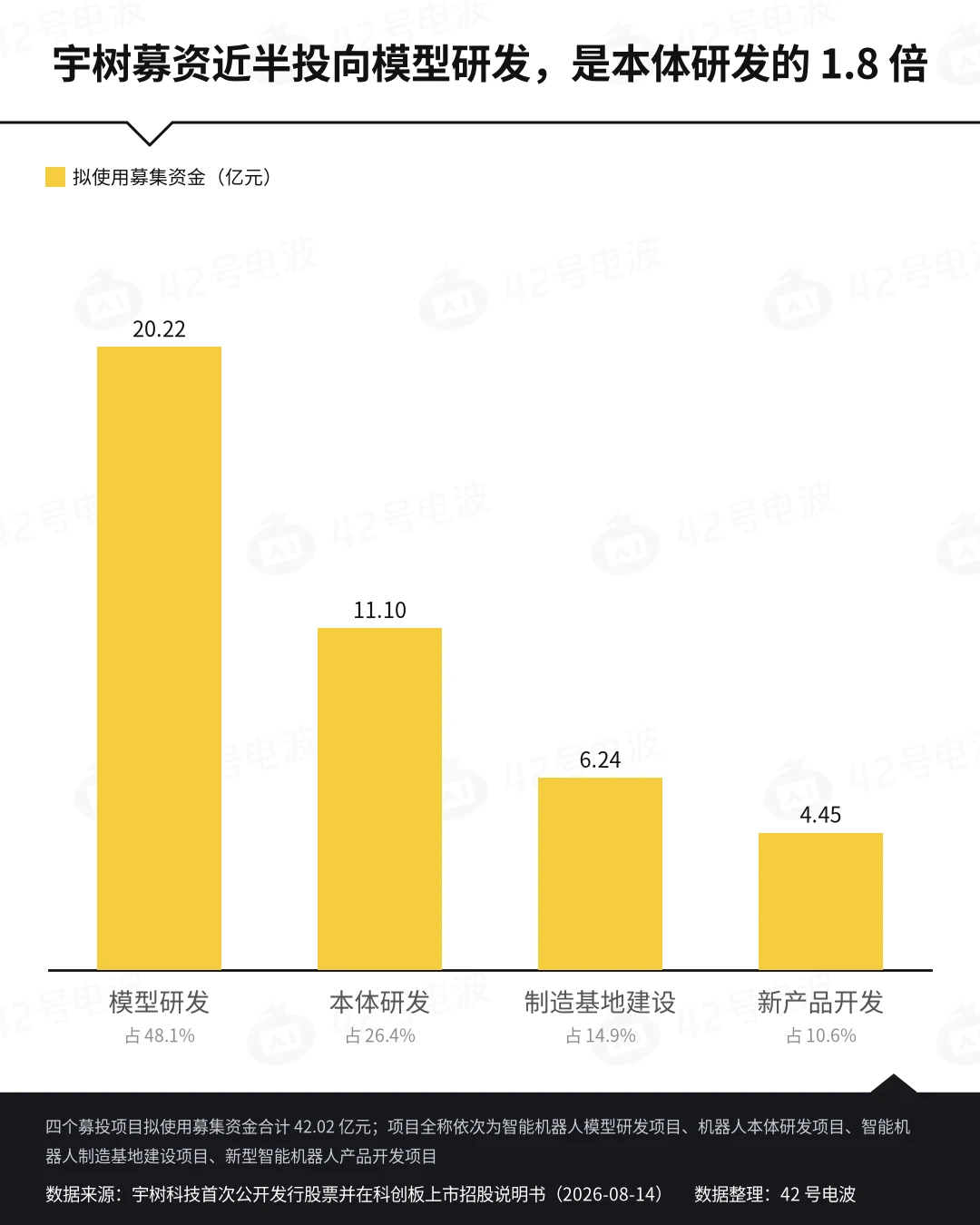
The allocation of resources heavily favors the "brain." The planned investment in model R&D is roughly 1.82 times that of robot hardware R&D, accounting for approximately 48% of the total fundraising budget and making it the single largest area of investment.
The execution of this plan is already accelerating.
In the first three quarters, Unitree's R&D investment reached RMB 263 million, a year-on-year increase of 191.48%, accounting for 14.47% of operating revenue. In the third quarter alone, R&D spending was approximately RMB 127 million, up 249.58% year-on-year and representing 19.10% of the quarter's revenue.
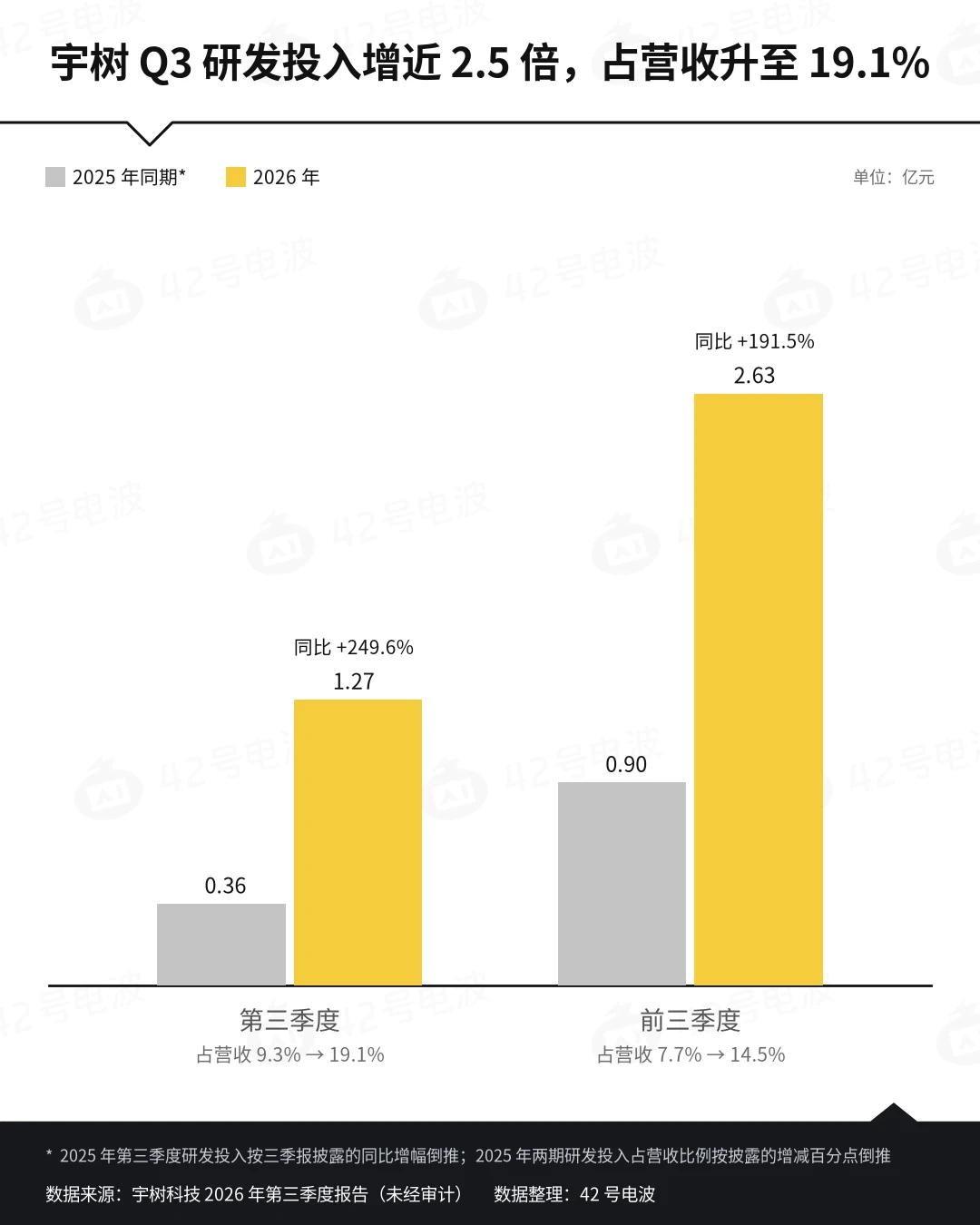
Put simply, third-quarter R&D spending alone accounts for nearly half of the cumulative investment across the first three quarters. R&D expenditure is not only growing, but its rate of growth is accelerating.
Unitree also has the financial foundation to support its ongoing R&D.
As of the end of September 2026, Unitree's cash and cash equivalents reached RMB 7.354 billion, a significant increase from RMB 1.419 billion at the end of 2025. The company has zero short-term and long-term borrowings, though it still carries other liabilities such as lease liabilities.
This increase in funds is directly tied to the receipt of IPO proceeds. The total funds raised in the IPO were approximately RMB 6.099 billion, with net proceeds of approximately RMB 5.917 billion.
There are two other noteworthy figures on the balance sheet.
As of the end of September, Unitree's inventory reached RMB 1.019 billion, an increase of approximately 177% from the end of 2025; contract liabilities reached RMB 233 million, up about 70% from the beginning of the year.
The rise in contract liabilities can serve as an indicator for tracking advance receipts and subsequent contract fulfillment, while the growth in inventory may be linked to business expansion, stockpiling, and production cycles.
Unitree now has the financial foundation to continue investing heavily in AI, and its R&D spending is accelerating. The key question now is what kinds of models this capital will fund, and whether they can meaningfully enhance robotic capabilities.
The one- to three-year window: How to build the robot's 'brain'?
Historically, Unitree was primarily known for its robots' locomotion performance.
Across both quadruped and humanoid robots, Unitree’s long-standing advantages have included its mechanical structure, joint actuation, motion control, and full-system engineering capabilities. However, completing more complex tasks requires robots to understand their environment, identify targets, plan movements, and adjust their strategies based on execution outcomes.
Over the past year, Unitree’s public technology roadmap has expanded from hardware and motion control to embodied models.
In September 2025, the company open-sourced UnifoLM-WMA-0. In early 2026, it introduced UnifoLM-VLA-0, followed by the release of WVLA 2.0, and then released UnifoLM-WLA-1.0 in September. These models explore distinct capabilities—including world modeling, language understanding, and action generation—rather than representing simple linear version upgrades.
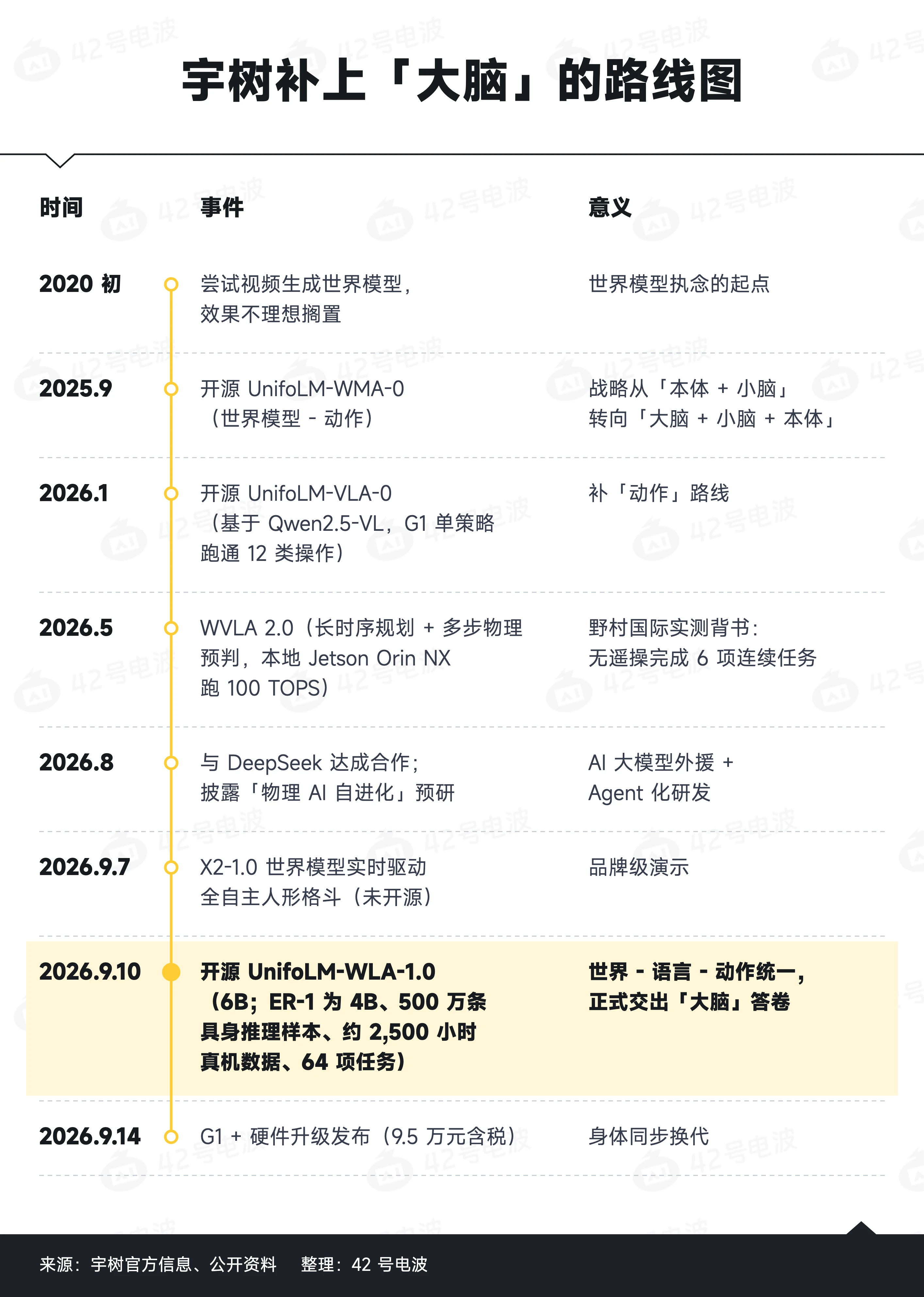
Taking WLA-1.0 as an example, Unitree's official information states that the model features 6 billion parameters and was trained on approximately 2,500 hours of high-quality real-robot data. It covers 64 tasks, including desktop manipulation and whole-body mobile manipulation.
Real-world testing has also begun. Unitree previously disclosed that its industrial-grade embodied model, UnifoLM-X1-0, has completed pilot deployment tests for tasks such as joint motor assembly at its own factory. However, the company's proprietary embodied foundation models have not yet been deployed at scale in its robot products, and the related technology remains in the R&D testing and pilot validation phase.
Unitree has taken its first step from model release to real-robot piloting, but transitioning from a pilot to repeatable, scaled commercial deployment is an entirely different hurdle.
On October 12, Xingxing Wang reflected that over the past decade, he "had not believed in AI enough." Ten days later, at the World Physical AI Conference, he further predicted that key breakthroughs in physical AI could arrive in as little as one to two years, or take up to two to three years.
The "GPT moment" for embodied AI that he described is a state where robots can complete approximately 80% of primary tasks in roughly 80% of unfamiliar environments using natural language or text instructions. Wang also noted that aligning the inputs and outputs of these models with real-world robots remains the most critical challenge today.
In its conference notes, Morgan Stanley summarized Unitree's future strategy as scaling up manufacturing capacity, advancing physical AI models through both in-house development and external partnerships, building compute infrastructure, and expanding data resources. Unitree is also exploring a self-evolving R&D process where AI participates in code generation, simulation training, and real-robot testing, and disclosed in August that it signed a strategic cooperation memorandum with DeepSeek.
All these initiatives point to a single goal: shortening the iteration cycle between model development and actual robot performance. However, these efforts are still a work in progress. While Unitree is allocating more resources to model research and compute infrastructure, whether this investment will yield better products, lower deployment costs, and a growing base of paying customers will only be validated by future real-robot performance and operational data.
From RMB 350 to RMB 995, the capital market is pricing in the future
Unitree's AI strategy has become a critical variable in its capital market valuation.
Public reports indicate that Bank of America Securities set a target price of RMB 350, while Nomura Securities set one at RMB 370. When Morgan Stanley initiated coverage in September, it established a base target price of RMB 500, alongside a bear case of RMB 200 and a bull case of RMB 1,200. On October 25, JPMorgan Chase raised its target price from RMB 300 to RMB 995.
While the publication dates, forecast periods, and valuation assumptions of these reports vary, the spread between the highest and lowest target prices—from RMB 350 to RMB 995—means the highest is roughly 2.84 times the lowest, clearly illustrating the significant divergence among institutions regarding Unitree's future growth potential.
JPMorgan's latest adjustment is particularly noteworthy. Previously, following its research at the China International Industry Fair, the bank remained cautious about the commercialization progress of Chinese robotics firms, arguing that hardware leadership had not yet translated into repeatable commercial demand. Instead, orders remained heavily concentrated in R&D, developer platforms, and small-batch pilots.
However, following the World Physical AI Conference, the bank revised its assessment of the industry's commercialization pace. This aligns with Xingxing Wang's assessment of the breakthrough window for physical AI: if model capabilities achieve critical advancements over the next two to three years, the growth curve for the robotics market could materialize earlier than expected.
From this perspective, the valuation divergence among institutions reflects not only differing judgments about a single company, but also varying assessments of the commercialization timeline for embodied AI.
Unitree has already built a strong foundation in robot hardware, motion control, and scaled deployment, and its IPO fundraising has provided the capital needed for continued investment. The company is now directing more resources toward robotic intelligence capabilities, but this bet is far from over.