

AgiBot Upgrades Genie Sim to Unify Robot Training and Evaluation via Flexible-Body Simulation
By Jiang Si Qi
Folding a towel or tightening a drawstring bag is simple for humans but challenging for robots, as fabrics and ropes continuously deform and contact friction alters subsequent manipulation conditions. If simulation fails to replicate these dynamics, robots may perform well virtually but fail in real-world deployment.
Folding a towel or tightening a drawstring bag is a simple task for humans but remains challenging for robots. Fabrics and ropes continuously deform during grasping and squeezing, and the resulting contact and friction alter the conditions for subsequent manipulations. If a simulation cannot accurately replicate these physical dynamics, a robot might perform well in a virtual environment only to fail during real-world execution.
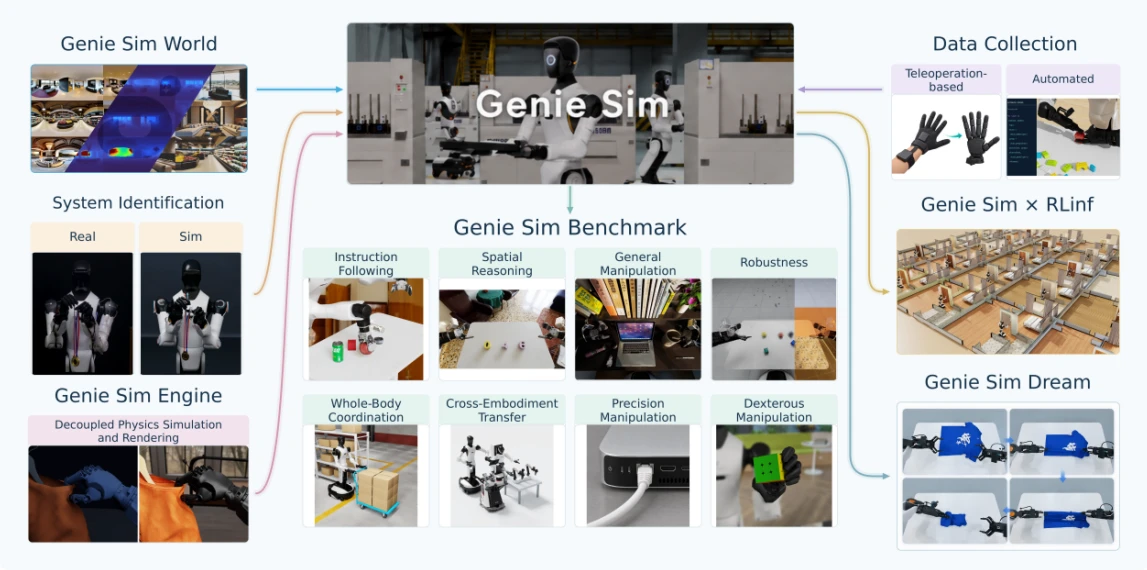
On October 28, during the AI WAVE full-stack technology launch, AgiBot upgraded its Genie Sim simulation platform. Centered on flexible interaction simulation, the upgrade integrates real-space reconstruction, data collection, capability evaluation, model post-training, and open-scenario exploration. By combining Real2Sim system identification with world model inference, the platform enhances the simulation of flexible deformation and complex contact interactions, providing a unified toolchain for robot training and validation.
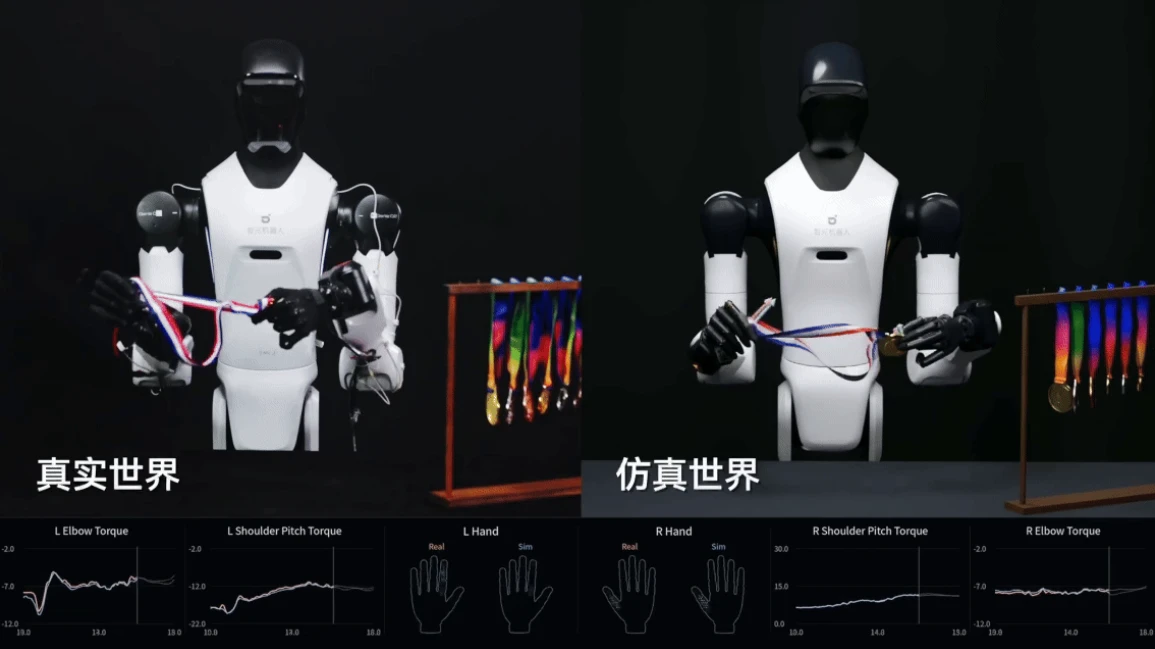
This upgrade introduces the Genie Sim Engine, a flexible physics engine. The engine employs a collaborative multi-physics solver architecture to partition and solve contact dynamics between rigid and flexible bodies, enhancing interaction simulation through dynamic feedback and state management. AgiBot states that the engine achieves a 20x speedup. Additionally, the platform can use real-robot manipulation data to calibrate simulated object properties such as mass, density, friction coefficients, and damping. This helps developers generate flexible manipulation training samples in virtual environments, reducing the consumption of physical materials.

The Genie Sim Dream world model can infer scene changes following robot actions based on real-world imagery, simulating the grasping, squeezing, and folding of soft objects. Robots can execute multi-step continuous operations in the virtual space and adjust their actions based on visual feedback. The platform also supports vision-language models in automatically evaluating task completion and identifying points of failure, enabling developers to validate policies without tying up physical robots.
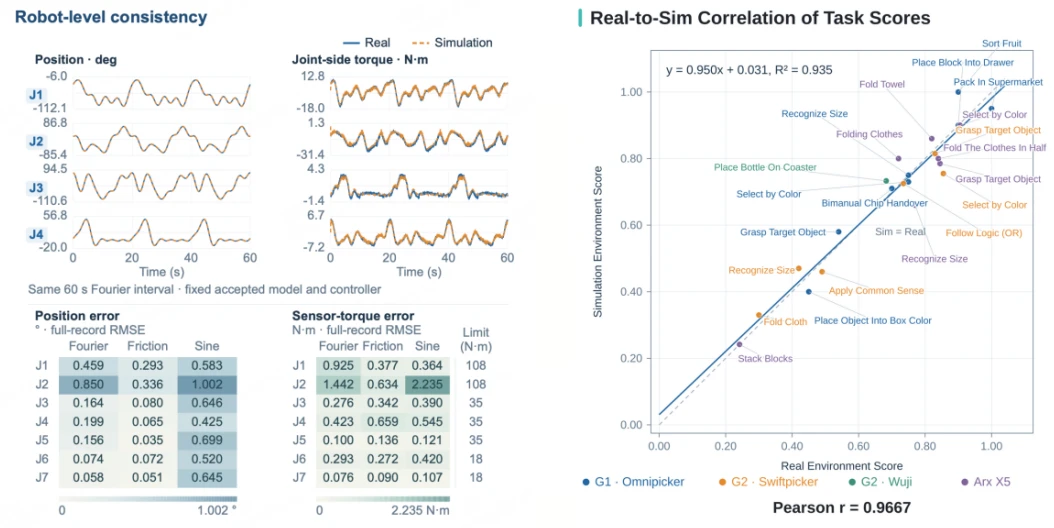
AgiBot conducted comparative evaluations between simulation and physical robots across four robot bodies and 22 complex tasks. Using a zero-shot real-to-sim approach, models trained in the real world were directly applied to the simulation evaluation. According to data published by AgiBot, the correlation between simulation and physical robot task scores reached 96.7%. At the joint level, Real2Sim system identification aligns the inertia, friction, and torque responses between the simulation and the physical robot. When given identical commands, the joint position and torque curves in the simulation closely match the physical robot's performance.
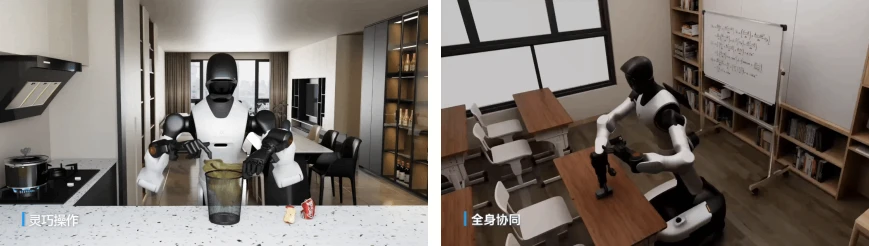
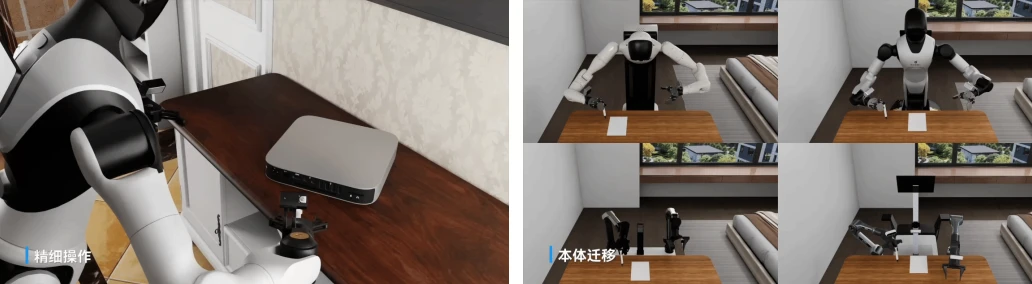
Genie Sim Benchmark introduces four new evaluation dimensions: dexterous manipulation, whole-body coordination, fine manipulation, and cross-body transfer. These help developers assess task completion, manipulation accuracy, whole-body coordination, and the ability to transfer skills across different robot bodies. The platform also simultaneously launched a parallel post-training framework for Genie Sim and RLinf. Developers can filter tasks based on evaluation results, run reinforcement learning in parallel across multiple virtual environments, and then use evaluations to verify policy updates.
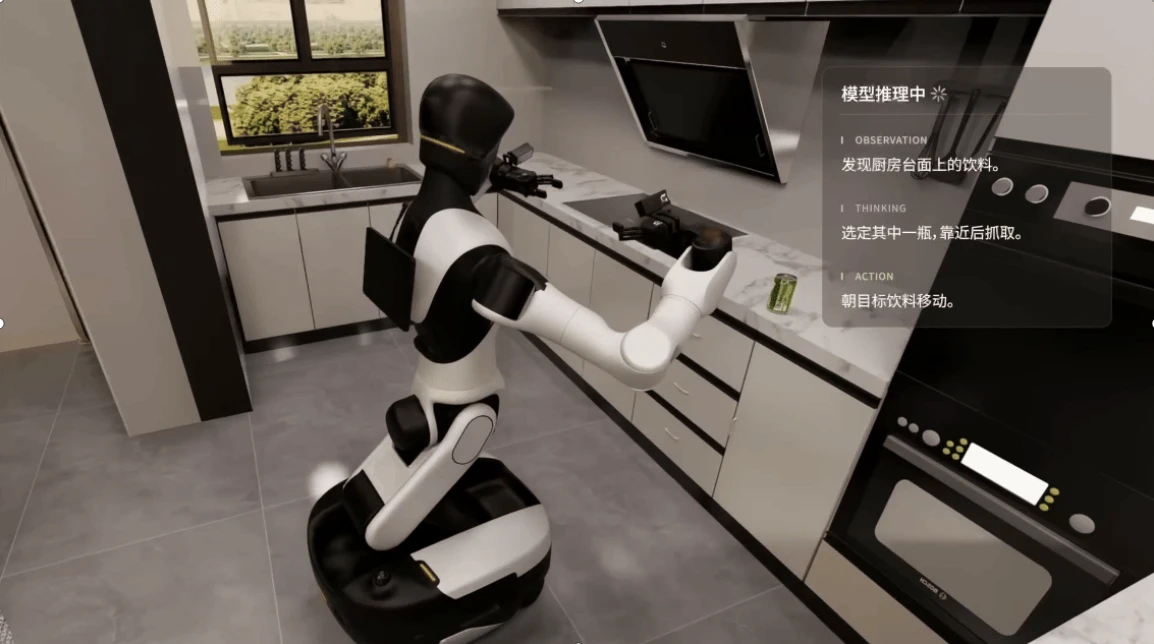
Genie Sim Sandbox covers scenarios including homes, factories, supermarkets, restaurants, and offices, and supports integration with agent systems. Developers can use preset tasks or issue custom instructions, enabling robots to plan paths, manipulate objects, and respond to environmental changes within the virtual environment. This allows developers to observe and identify issues during task execution.
Serving as the training and validation infrastructure within the AI WAVE full-stack pipeline, Genie Sim leverages the real-world physical experience from the AGIBOT WORLD dataset and supports the training iterations of the GO series embodied models. AgiBot states that the Genie Sim code will be updated on GitHub, while simulation assets and accompanying datasets will be made available on Hugging Face and ModelScope, opening them up to developers worldwide.