
Genesis AI Releases Eno: Robot Commercialization May Not Require a Humanoid Form
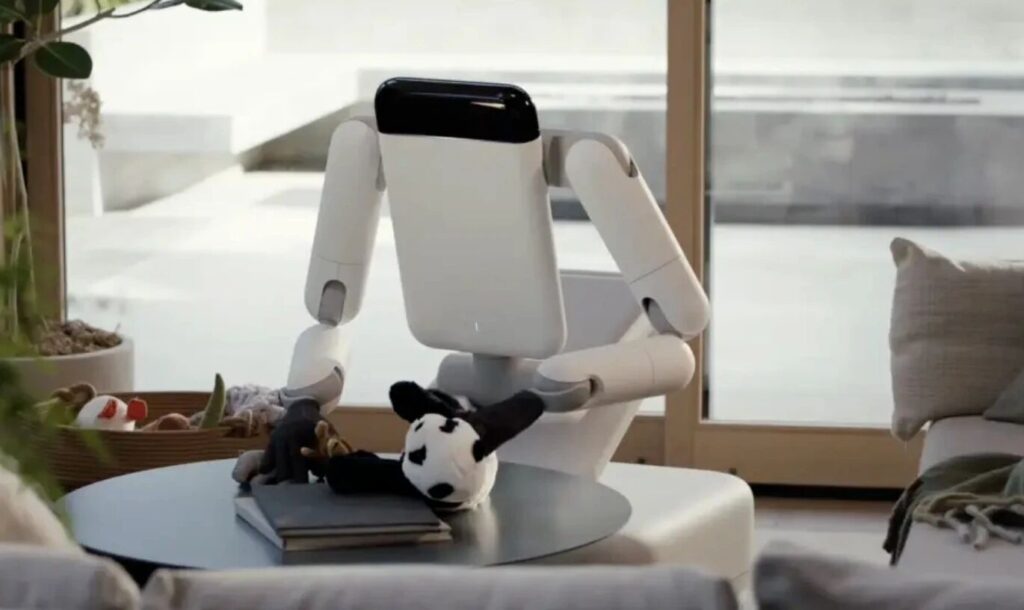
Genesis AI has released its first general-purpose robot, Eno.
This is not a humanoid robot in the traditional sense. It lacks a head and two legs; instead, it features a wheeled chassis, dual arms, and a three-segment collapsible torso.
At first glance, what makes Eno most memorable is its form: its body can be unfolded or folded up, resembling a 'trifold' robot.
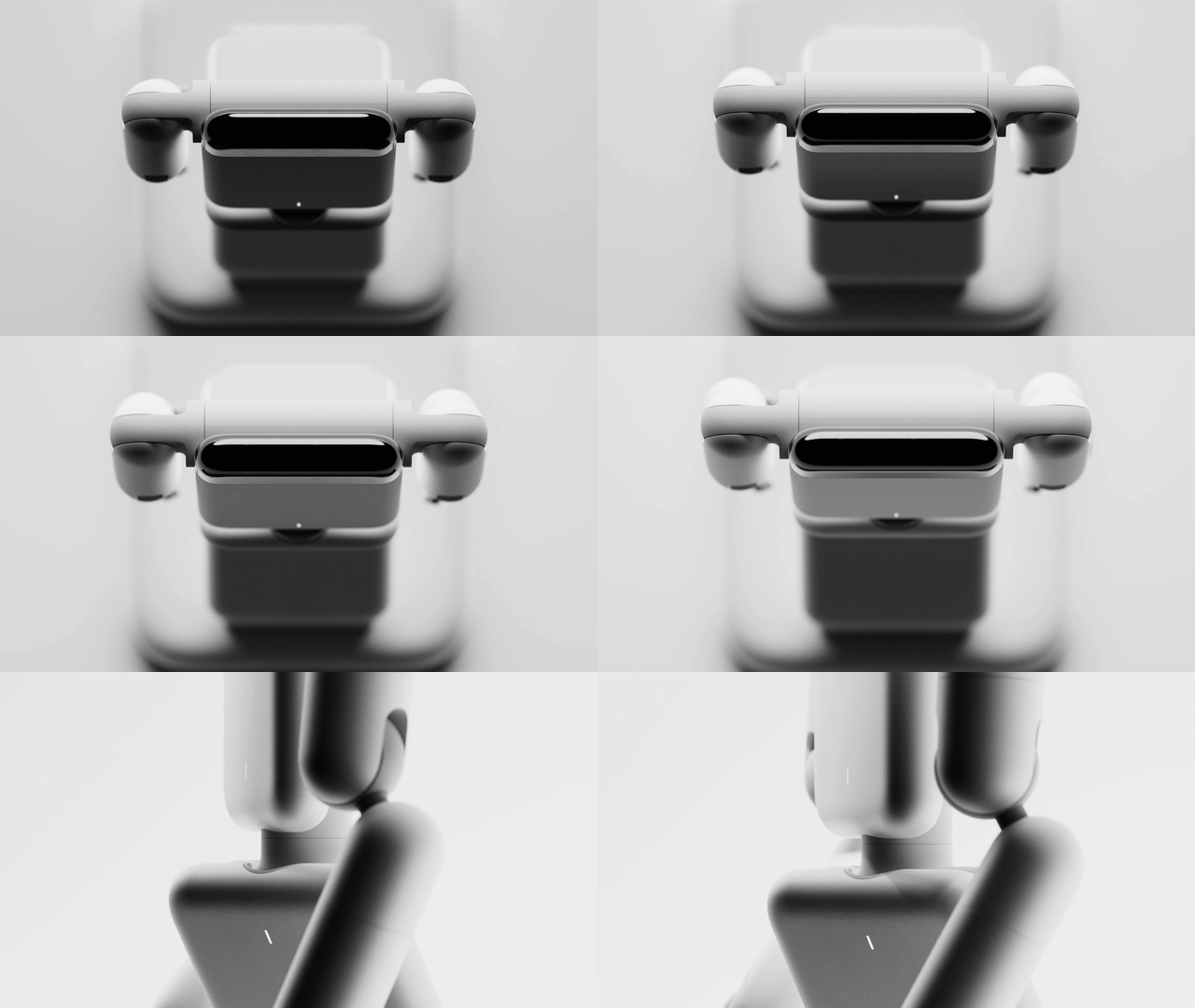
But this structure is not for aesthetic purposes.
Genesis AI aims to solve a more specific problem: if robots are to enter factories, logistics centers, laboratories, and even homes in the future, do they need to fully resemble humans, or is it sufficient to possess key human capabilities?
Eno's answer is that human capabilities are more important than human appearance.

Tri-fold body solves the problem of operational space
The bottom of Eno is a wheeled platform responsible for movement in flat environments. Above it sits a foldable torso that connects to the arms and hands.
The core value of this structure lies in changing the working position of the robot's arms.
Common wheeled dual-arm robots typically mount two robotic arms on a mobile chassis. While they can perform mobility and grasping tasks, their body height, arm base position, and reach range remain relatively fixed.
Eo's foldable torso serves as an 'intermediate layer'.
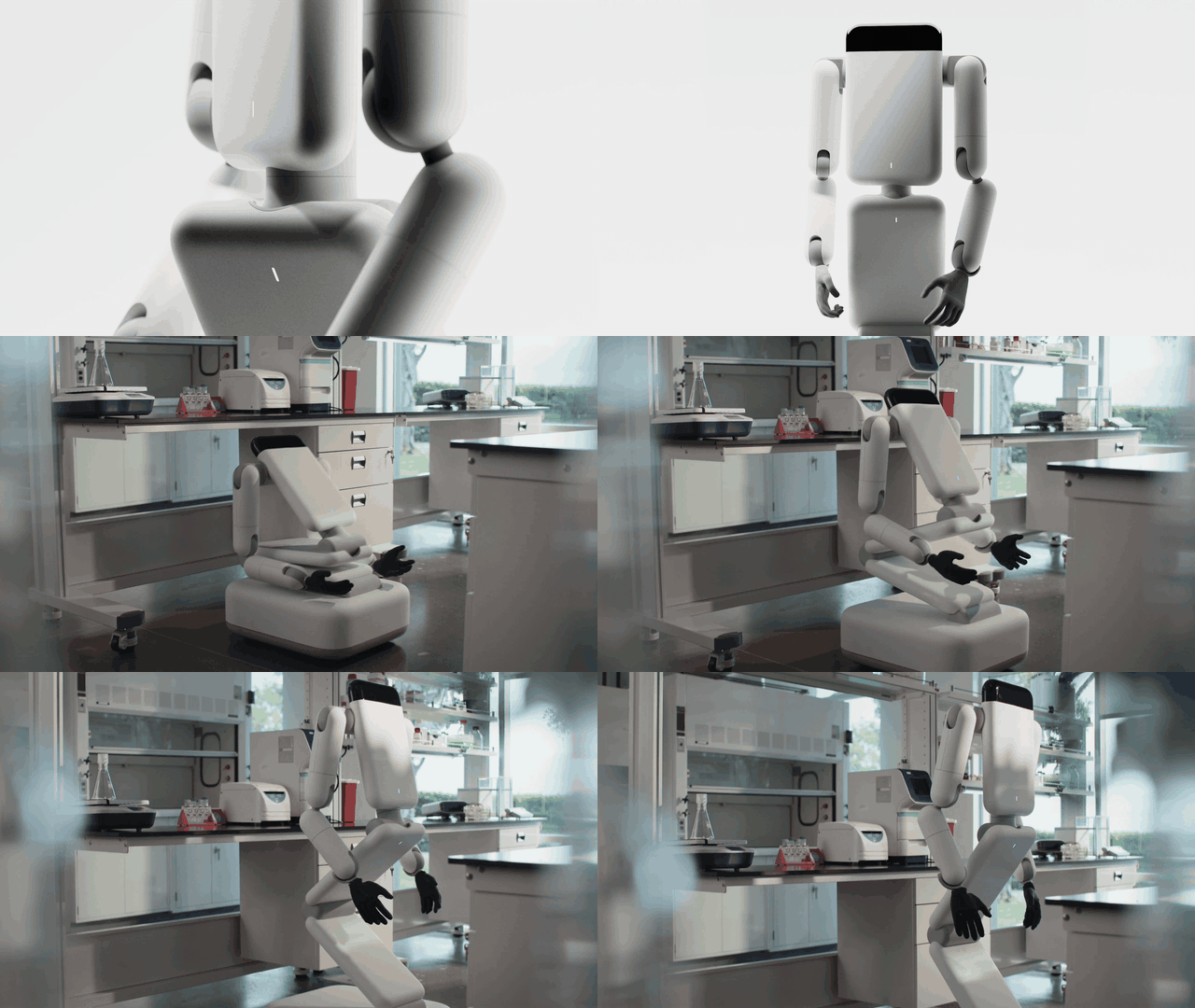
When working, it can unfold, elevate, lean forward, or tilt backward, allowing the arms to approach task points at varying heights and angles; when not in use, it folds down to reduce its volume and presence.
This means Eno doesn't necessarily need two legs to achieve 'up-and-down movement.' It uses wheels for horizontal mobility, a folding torso for vertical reach and height adjustment, and dual arms for manipulation tasks.
For relatively flat but highly complex environments like manufacturing, logistics, and laboratories, this design is more pragmatic than forcing bipedal locomotion.
It doesn't need to climb stairs or mimic human gait. What it needs is to move to the workstation, extend its arms to the correct position, and complete the task.

The Most Human-Like Feature: The Hands
Eno has removed its head and legs, but hasn't abandoned what is most human-like: the hands.
This is Genesis AI's core product focus.
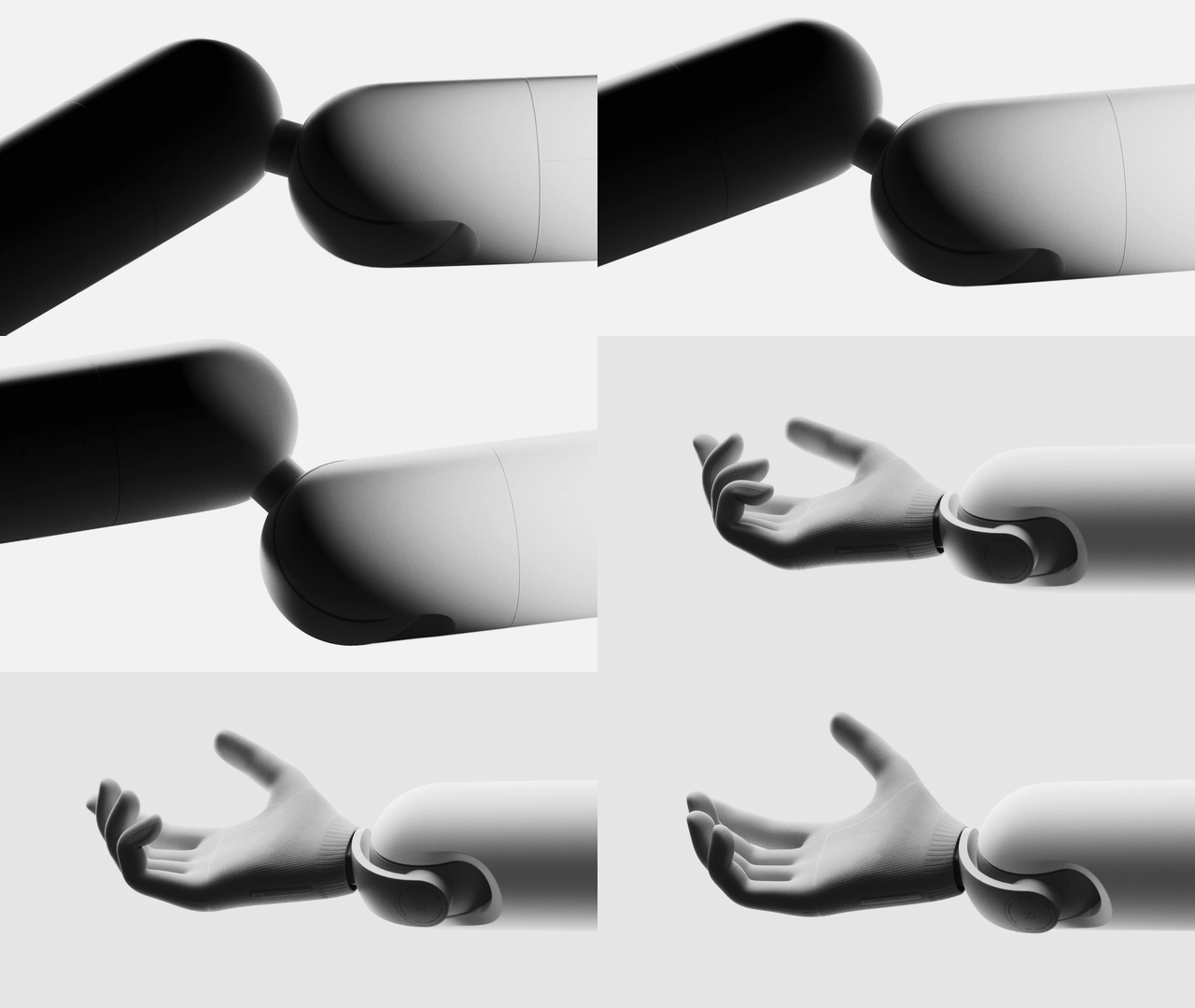
For robots to manipulate tools and objects in the human world, hands are ultimately indispensable. Whether it's holding a cup, organizing wiring harnesses, cracking eggs, pipetting, opening cabinet doors, or placing utensils, what truly determines the upper limit of tasks is rarely how humanoid the robot looks, but rather whether its hands can perform fine manipulation.
Publicly available information shows that Genesis AI has been independently developing dexterous hands. An earlier Business Insider report stated that its robotic hand features 20 degrees of freedom and 20 motors; related reports also mention that Eno's latest version of the hand specifications are still being optimized, already possessing more than 20 active degrees of freedom and integrating tactile and visual sensing capabilities.
The purpose of this design is not to create a 'more complex gripper.'
It aims to closely mimic the operational capabilities of human hands, enabling robots to directly use tools designed for humans, rather than requiring customers to completely rework their workbenches, tools, and processes.
Genesis AI previously demonstrated a series of manipulation tasks, including playing the piano, cracking eggs with one hand, slicing tomatoes, making milkshakes, laboratory pipetting, and organizing wiring harnesses.
These tasks share a common characteristic: they are not simple grasping operations. They involve flexible objects, contact forces, two-handed coordination, and action recovery.
For instance, with wiring harness organization and tape wrapping, the difficulty lies not just in 'grabbing.' Wiring harnesses bend, tape adheres, and the state of objects varies each time. For robots to truly go on duty, they must handle these unstable factors.

GENE is the Brain, Gloves are the Data Entry Point
Eno is not a robot where hardware is built first and then connected to a model.
According to Genesis AI, Eno was designed in tandem with GENE. GENE serves as its robotics-native AI brain.
It is responsible for understanding goals, breaking down steps, and adjusting execution actions when the environment changes. Eno can also be equipped with a chest-mounted screen to display the robot's current task, status, and intent.
This screen is not a "face."
It functions more like a cognitive interface. The purpose is not to make the robot look more human, but to let humans understand what the robot is doing and why.
This aligns with Genesis AI's design philosophy for Eno: do not disguise the robot as a human, but ensure it is understandable to people.
What truly supports GENE is data.
The biggest difference between robots and large language models lies in training data. Language models can access massive amounts of text and images from the internet, but robots lack a ready-made 'internet of the physical world.'
Actions such as how a person cracks an egg, unscrews a bottle cap, uses a pipette, or wraps wire harnesses with tape are difficult to learn solely from videos. They require finger angles, contact force, movement trajectories, and failure correction processes.
Therefore, Genesis AI is developing training gloves.
These gloves are used to collect hand motion and tactile data from skilled workers. Compared to traditional teleoperation, the gloves' approach is closer to 'collecting data within real workflows': allowing workers to wear the gloves during normal work so that robot models can learn how experts complete tasks.
According to Business Insider, Genesis AI plans to deploy thousands of training gloves with industrial partners later in 2026. The report also mentions that teleoperation systems cost approximately 6,000 USD, while training gloves cost about 300 USD. If this cost metric holds true, training gloves are indeed more suitable for large-scale data collection.

Demo Is Already Visible, But Not Yet Mass-Production Ready
The capabilities demonstrated by Genesis AI now are already more complex than typical robotic arm demos.
It is no longer limited to simply moving a rigid object from point A to point B; it is beginning to handle long-horizon tasks, fine manipulation, and tool usage.
In previous demonstrations of the GENE-26.5, the robot was able to perform tasks such as playing the piano, cracking eggs, cooking, handling wire harnesses, and conducting laboratory operations. According to Business Insider, these demonstrations were not teleoperated but completed autonomously by the robot, and were presented at 1 speed.
However, it must be clarified here: this is not yet zero-shot capability.
These tasks are still trained. The fact that the robot can perform them in demonstrations does not mean it can work continuously for a full day at a client site.
Public reports also mention that in the cooking task, the success rate for some steps reaches between 90% and 95%; however, for more delicate actions, such as cracking an egg with one hand or transferring chopped tomatoes, the success rate is approximately between 50% and 60%.
This indicates that Genesis AI's capabilities have entered an observable stage, but there is still a gap before stable deployment.
For Eno, what truly matters is not a single demo, but answering three questions:
- Can it run continuously at real client sites?
- Will the success rate drop significantly when the task environment changes?
- After faults, misgrasps, or objects slipping, can it recover and continue completing the task?
These three questions are far more important than "whether it looks like a human".

Start with industrial settings, then talk about entering homes
Eno's first stop is not the home.
According to Genesis AI's plan, Eno will first enter manufacturing, logistics, and laboratories before expanding into service industries; the home scenario comes much later.
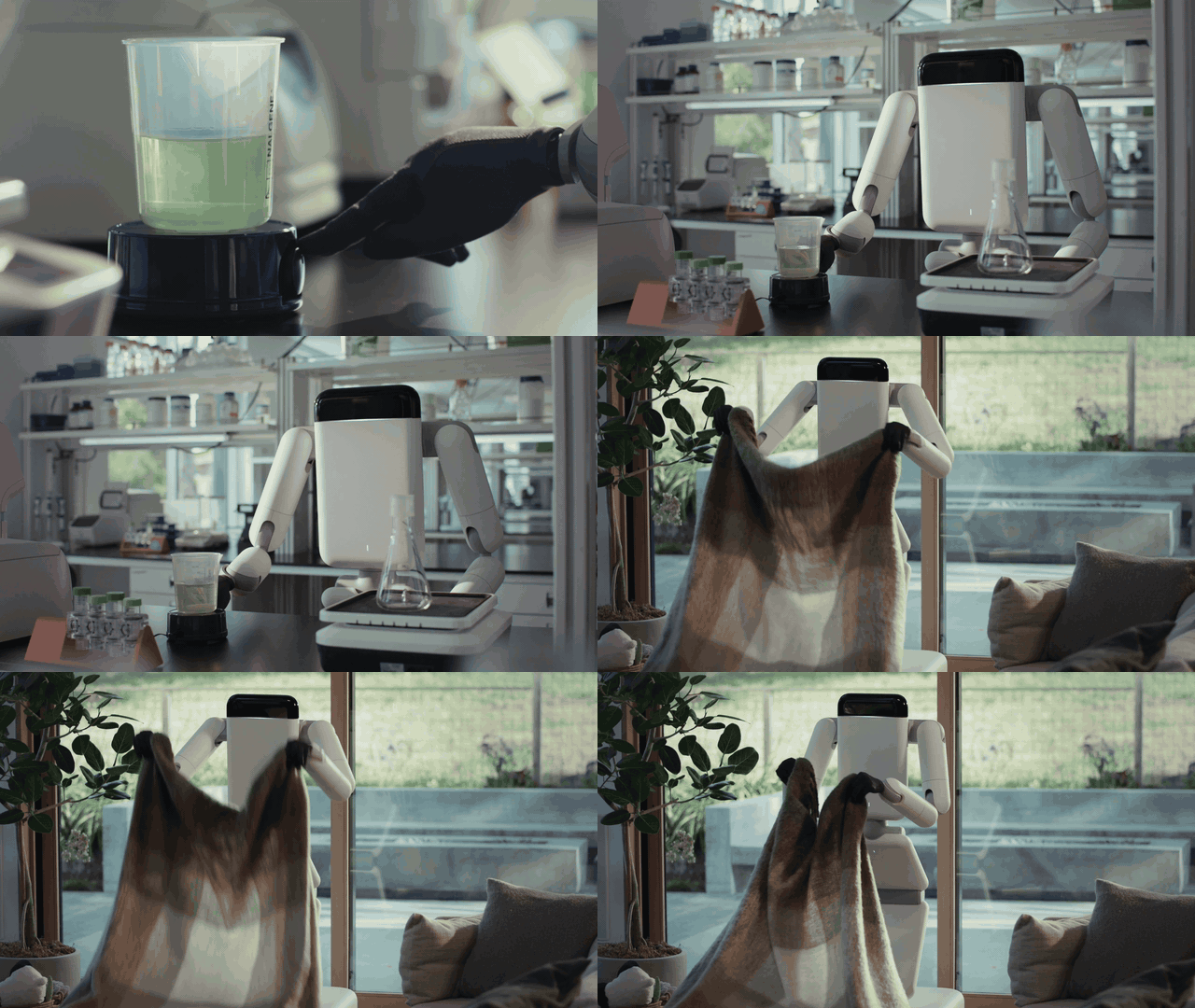
This sequence makes perfect sense.
Home robots sound like they have a larger scope, but the practical difficulty is also higher. Home environments are non-standard, filled with children, pets, furniture, clutter, and numerous unexpected situations. Robots must not only perform tasks but also understand human intent while meeting stricter safety requirements.
In contrast, factories, warehouses, and laboratories are more suitable for the early deployment of general-purpose robots.
These scenarios are more controllable, tasks are more fixed, and customers can more easily calculate the return on investment. As long as a robot can stably complete a certain type of repetitive process, it has the opportunity to first establish a commercial closed loop.
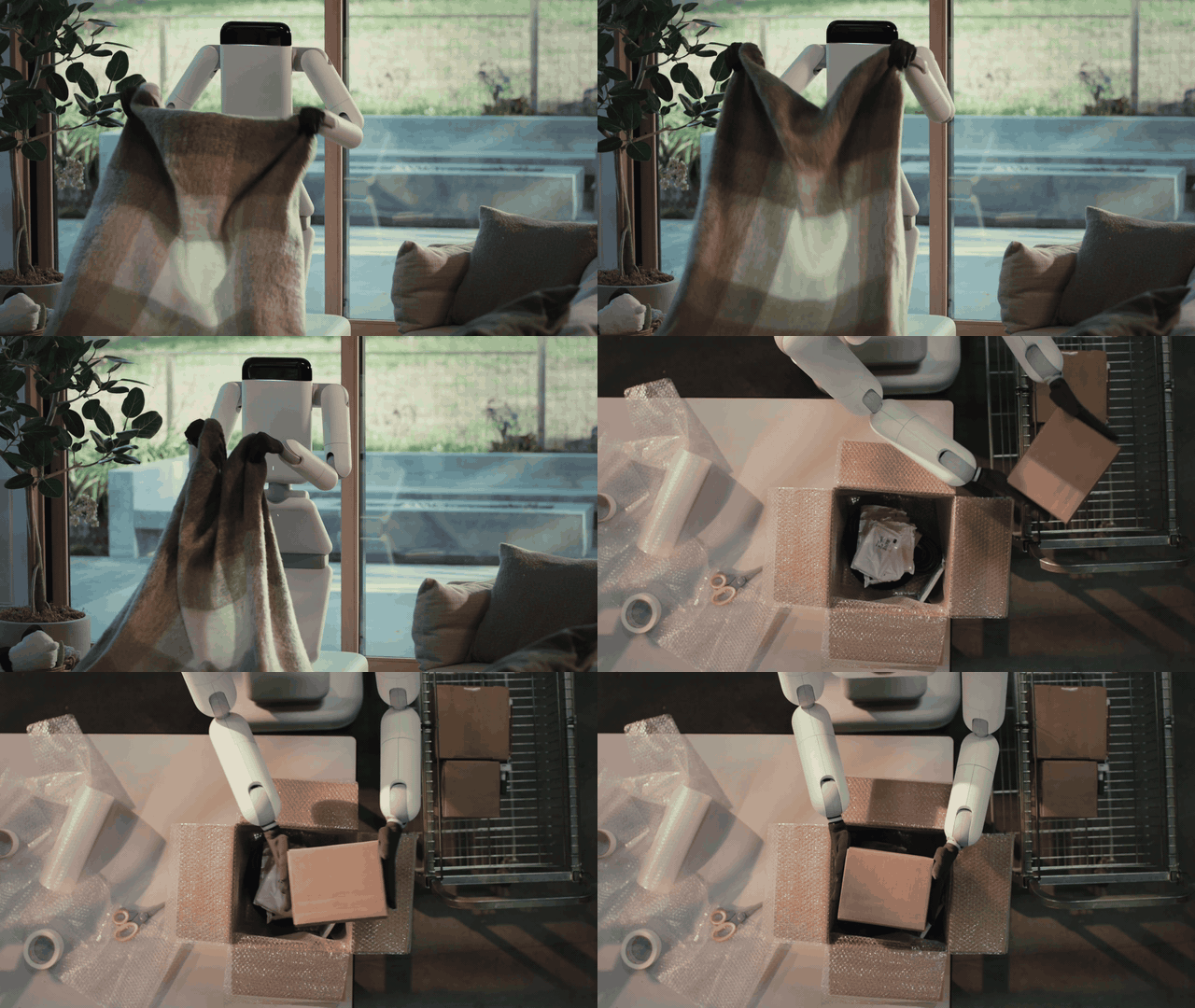
This is also where Eno's product roadmap is more pragmatic than directly entering homes.
It does not start with companionship, emotional value, or domestic fantasies, but rather with mobility, reach, dual-arm manipulation, and real-world tasks.

From a Model Company to an Embodiment Company
What makes Eno more noteworthy is not just that it lacks a head and legs, but that Genesis AI has finally completed its "body".
Prior to this, the identity of Genesis AI that drew the most attention from the outside world was that of a robot model company.
What truly brought it into the spotlight was not a specific robot, but GENE-26.5: a foundational model system designed for robotic manipulation. Centered around GENE, Genesis AI has demonstrated a series of complex operations such as beating eggs, slicing tomatoes, making milkshakes, pipetting in laboratories, and organizing wire harnesses, repeatedly emphasizing its goal to solve how robots understand tasks, learn movements, and adapt to real-world environments.
This is precisely why Genesis AI has consistently been discussed within the context of 'robotic foundational model companies' like Physical Intelligence and Skild AI.
However, the release of Eno marks a step forward for the company.
It no longer merely showcases model capabilities or claims to possess training gloves, simulation systems, and robotic hands; instead, it integrates these capabilities into a complete physical embodiment.
The significance of this lies in the fact that robotic models cannot stand alone without a body.
The model determines how a robot understands tasks, but the body determines what tasks it can perform.
Data dictates how a model learns, but the hands, sensors, and actuators determine whether data can be effectively transferred.
Simulation can accelerate training, but the real embodiment determines whether capabilities can ultimately be deployed at customer sites.
Therefore, for Genesis AI, creating Eno is not simply entering the hardware track, but rather completing the closed loop for general-purpose robots.
GENE serves as the brain, the training gloves act as the data entry point, the Genesis AI Hand functions as the manipulation interface, and the simulation system provides the environment for training and validation; the newly released Eno is the implementation carrier for this entire suite of capabilities.
This is also what distinguishes it from companies that only create single-point demos. Genesis AI aims to build not a robot capable of performing a few tricks, but a system that can continuously collect data, train models, validate capabilities, and deploy them into real-world scenarios.
Of course, this path is more challenging.
Once developing an embodiment, Genesis AI must address issues beyond model performance, including load capacity, battery life, cost, reliability, safety, after-sales support, and customer ROI. While model companies can demonstrate capabilities in the lab, embodiment companies must prove value at customer sites.
Yet precisely because of this, Eno is worth watching.
It signifies that Genesis AI is transitioning from one of the most prominent robot model companies to a truly full-stack robotics company.
If Eno can succeed in manufacturing, logistics, and laboratory scenarios, what Genesis AI proves is not just that 'robots don't have to look like humans,' but another more critical point:
General-purpose robot companies may ultimately need to complete the closed loop from models to hardware.