
General Robotics Unveils AstraBrain-WBC 0.5: The GPT Moment for Humanoid Robot 'Cerebellum'

Just as the cerebellum controls the human body, AstraBrain-WBC 0.5 serves as the core of robotic full-body motion control.
On 6 [Month] 19 [Day], Galbot officially launched the world's first general-purpose cerebellum foundation model for humanoid robots: AstraBrain-WBC 0.5. This model is defined as a groundbreaking large-scale model in the field of real-time full-body motion control for humanoid robots. With a model size scaled to 80400000 parameters, it becomes the first model in this field to reach a GPT-1 magnitude level.
In prior work, humanoid motion tracking faced a long-standing contradiction: agility and generalization constrained each other. That is, trackers skilled in high-dynamic motion tasks often failed when encountering unseen styles or scenarios, while those with better generalization capabilities frequently struggled to fit tasks requiring high agility, especially when these tasks involved complex dynamic laws.
The research team identified the root causes of this contradiction as “insufficient data scale” and “mismatched training process design,” leading to the launch of AstraBrain-WBC 0.5 — a general-purpose online humanoid motion tracker built around the “Scaling Law.” Next, we will break down this model step-by-step and demonstrate its true deployment effects on actual machines.

Architectural Innovations Allow the Model to Process 2000000000 Frames of Data”
First, Galbot researchers constructed a new-level motion corpus: incorporating all mainstream mo-cap sources such as Lafan1, AMASS, Motion-X++, PHUMA, MotionMillion, and adding large-scale real-world data collected by the team. After rigorous filtering, segmentation, and augmentation, they obtained 2000000000 frames of Unitree G1 redirected motion data.
Next, we consider what happens if 2000000000 frames are fed directly into a PPO policy. The report indicates that a single MLP saturates in performance near the 100000000 frame, with sharply diminishing marginal returns on data. The root cause is that 2000000000 frames contain heterogeneous actions such as walking, running, tumbling, dancing, and martial arts; a single policy attempting to learn all these modes simultaneously leads to issues of 'dominance by common movement styles' and 'deficiency in rare capabilities'. Humanoid-GPT manages this scale through an innovative three-layer architecture relay: data layer distribution, multi-expert temporal layer reception, and efficient training layer digestion.
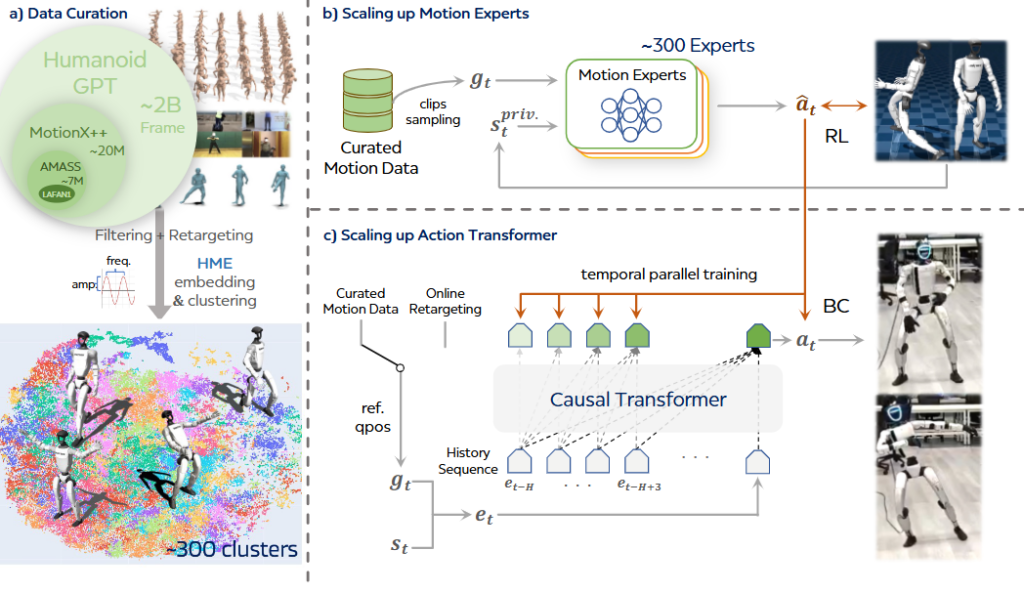
- Data Layer Distribution
Researchers mapped each human motion sequence to the joint space of Unitree-G1 humanoid robot's 29 degrees of freedom, filtering out sequences involving explicit object interactions (such as climbing stairs or swimming) to first ensure driving capability in flat scenarios. Further time warping augmentation (uniform acceleration or deceleration) was applied to the sequences, significantly expanding the training set size for subsequent expert reinforcement learning training.
- Multi-Expert Temporal Layer Reception
Researchers performed Harmonic Motion Embedding (HME) within different data partitions: first extracting per-joint periodic amplitude and frequency from each motion sequence; then organizing these joint-level harmonic features to calculate their mean and standard deviation as HME vectors; finally performing K-Means clustering to obtain approximately 300 motion clusters, each containing about 1,000 – 2,000 sequences. A reinforcement learning-based motion expert was trained on each cluster. The hyperparameter configuration for motion experts is shown below.
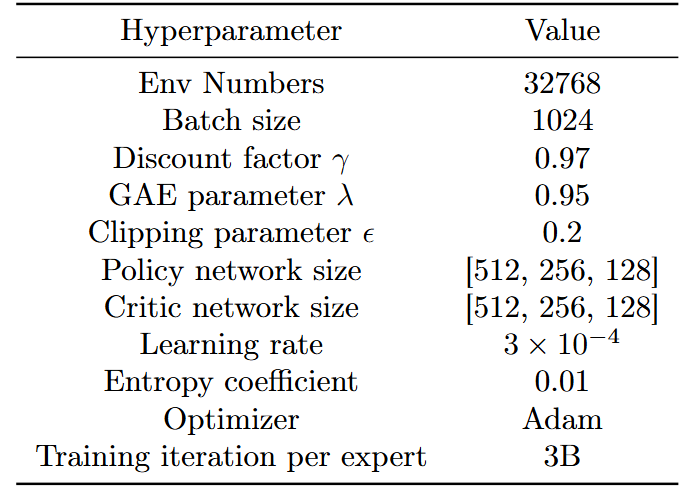
- Training Layer Efficient Digestion
It is not difficult to imagine that while each motion expert can accurately replicate robotic physical movements within its own cluster, performance will drop sharply when encountering out-of-distribution motion targets.
To address this, Galbot researchers' solution was to first reformulate distillation as a temporal modeling problem. By inputting "proprioceptive information" and "target reference pose information" into a Transformer with temporal causal masking, the model gains an ability similar to Transformers' capacity to attend to historical contexts of varying lengths. This overcomes the limitation of MLPs, which "can only focus on a state slice at one moment at a time and rely on concatenation to temporarily fill in for longer historical sequences." Finally, all knowledge from motion experts is distilled into a single general policy using the DAgger framework, significantly improving training efficiency.
Researchers effectively leveraged the Transformer's capabilities in "attending to historical contexts" and its structure suitable for "multi-step parallel supervision" to provide a solution for "insufficient data scale".

Does an 'Scaling Law' Exist in the Field of Robot Motion Control?
Previous general pathways in language and vision have proven that "scaling laws" (larger data, larger models, and carefully designed training objectives) are a reliable guarantee for model generalization. Moreover, scaling laws not only enhance average performance but also unlock new capabilities (such as GPT-3 suddenly being able to perform three-digit addition).
Since artificial general intelligence in embodied agents is fundamentally a generalization problem, we must verify whether the same "scaling law" exists in the robotics field to solve the generalization issues of embodied AI.
- Verify using data scale
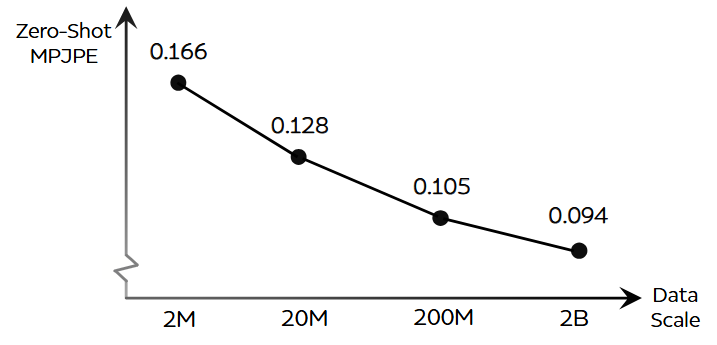
Researchers trained the Humanoid-GPT-B architecture model using data across four orders of magnitude (x-axis), with the y-axis representing Zero-Shot MPJPE (Mean Per Joint Position Error); lower values indicate more precise robotic movements. The results show a monotonically decreasing curve without a 'diminishing returns' inflection point, proving that brute-force scaling of data volume can translate into improvements in physical control accuracy, suggesting there may not be a so-called 'physical data wall.'
- 'Scaling Law' is architecture-dependent
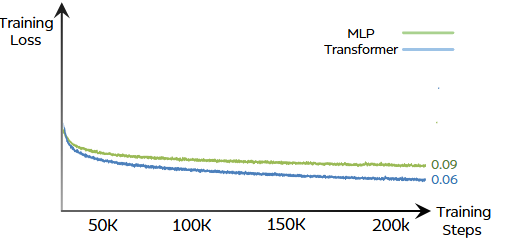
After demonstrating that scaling up data volume directly improves a model's control accuracy, we must ask: Why doesn't the MLP follow the 'scaling law'? The chart above provides a clear explanation for this issue. Looking at the loss curves, both experienced rapid declines in the early stages of training, indicating that both were quickly absorbing superficial features. However, after 50K steps, the MLP rapidly entered a plateau, while the Transformer continued to decline steadily, eventually stabilizing around 0.06.
It is precisely because the Transformer was able to maintain a continuous learning state throughout 200K steps of training that it possesses the qualifications and ability to digest massive amounts of expert data featuring long tails and heterogeneity—2000000000 frames in total. In other words, compared to MLPs, Transformers demonstrate a higher theoretical upper limit when handling high-dimensional, continuous robotic motion control tasks.
- Horizontal comparisons between different architectures and varying data volumes
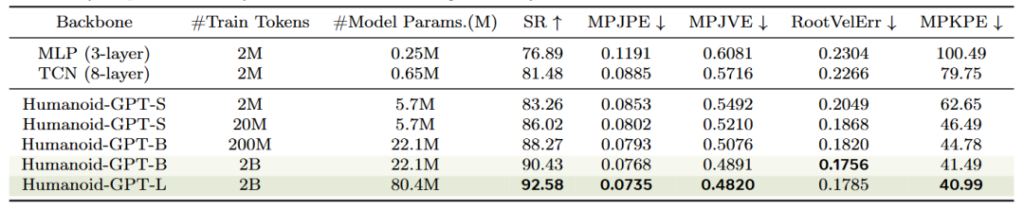
As shown in the table (SR stands for robot tracking success rate; all other metrics are errors, where lower is better), in a lateral comparison, with the same 2M tokens of training data, MLP already shows signs of overfitting (MLP-L 75.25% SR < MLP-S 76.89% SR). The same applies to TCN, whereas Transformer does not have this problem, and its performance on small datasets continues to improve steadily. In a vertical comparison, when Humanoid-GPT-L has 2B parameters, it achieves nearly the best performance across all metrics.
The core conclusion drawn from this is: The "Scaling Law" holds true for robot motion control, but its validity is conditional—it requires both a "Transformer architecture and sufficient data scale." If either element is missing, the law may not necessarily manifest.**

Robots with a "cerebellum" have better body control
AstraBrain-WBC 0.5 has been validated through large-scale data processing and the "Scaling Law." More importantly, we must examine its motion performance and generalization capabilities on real robots.

As shown in the table above, Humanoid-GPT can directly reproduce 4 completely unseen dance sequences without fine-tuning (MPJPE and MPJVE represent errors, where lower is better). This highlights its superior generalization ability compared to other models.
Additionally, Ubtech deployed Nvidia's general-purpose tracker SONIC and Humanoid-GPT separately on their robotics platform—the Unitree G1 (left: SONIC, right: Humanoid-GPT)—allowing for an intuitive sense of actual on-robot performance.
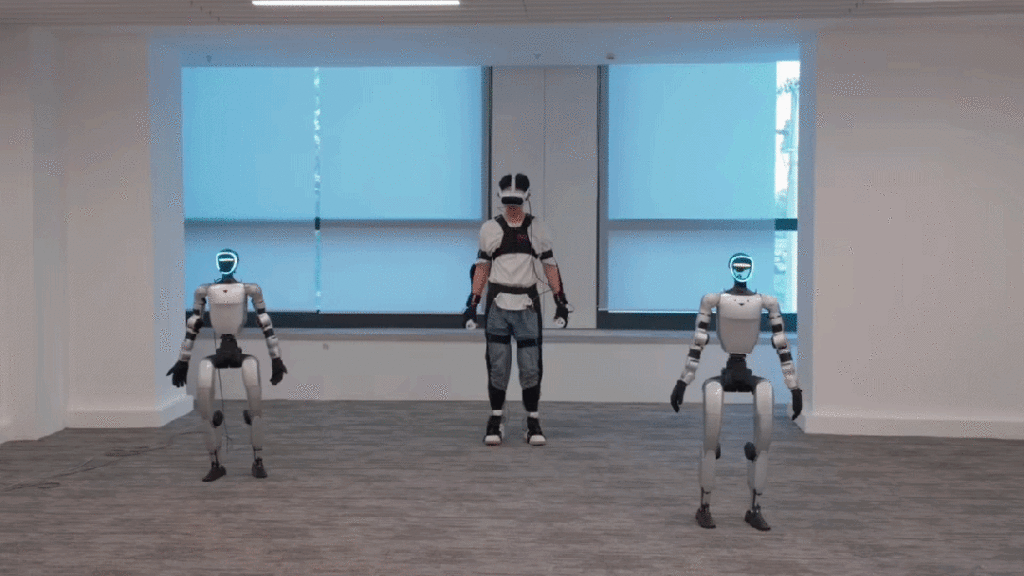
In terms of high-dynamic tasks, the comparative performance
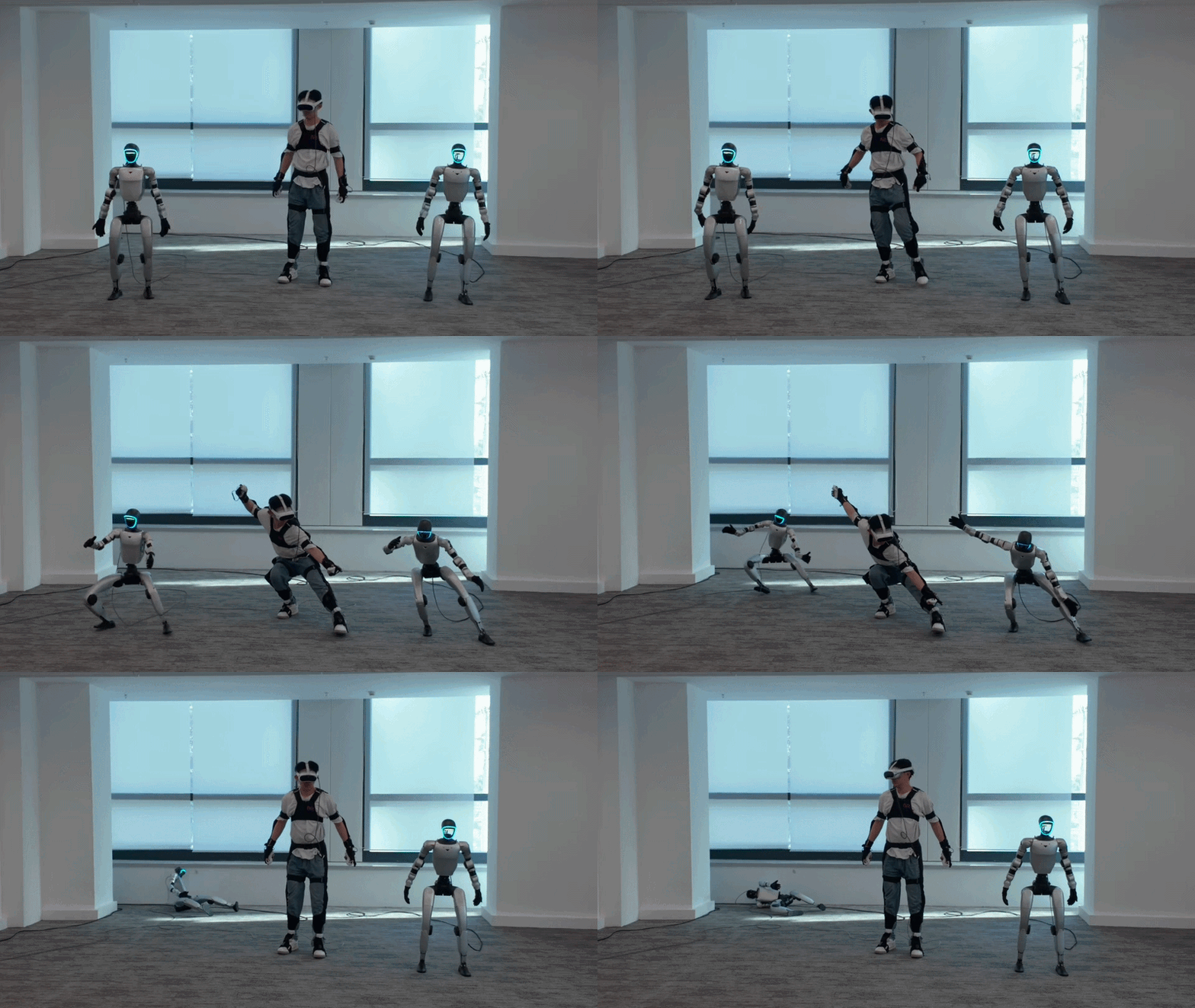
In terms of balance-sensitivity tasks, the comparative performance
The above two figures intuitively reveal the gap in capabilities between the two motion control models. Researchers at Galactic Computer have optimized their deployment pipeline to ensure that scaling up the model size does not compromise inference or communication latency. Therefore, as demonstrated by Galactic Computer's official showcases, robots equipped with the Humanoid-GPT model significantly outperform those running SONIC, whether in "teleoperation following" or "motion posture adjustment."
More notably, AstraBrain-WBC 0.5 is already capable of stably executing highly dynamic actions—such as bilateral full-body coordination tasks like construction work and soccer dribbling & shooting—that were entirely absent from its training dataset—even within complex scenarios.
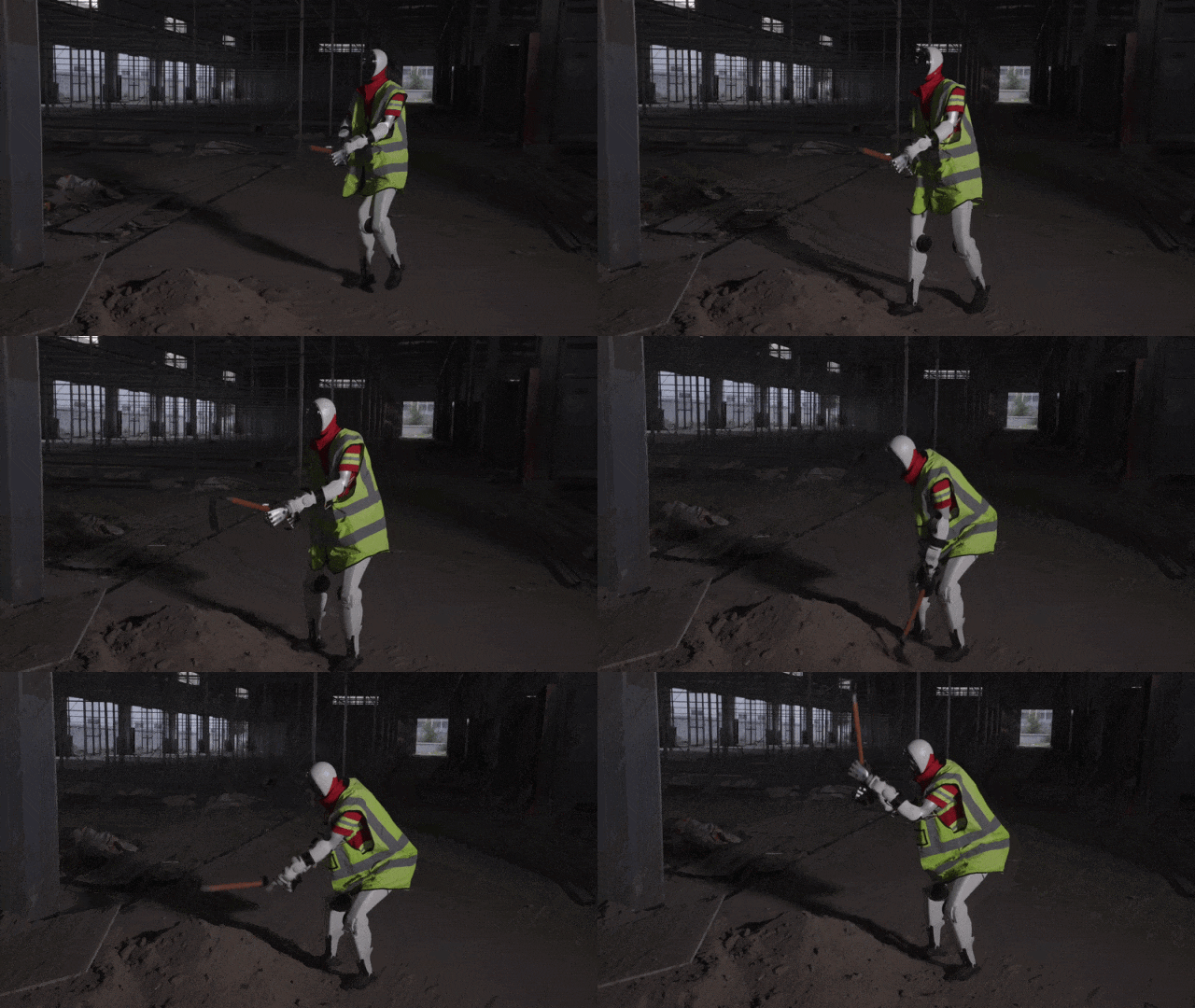
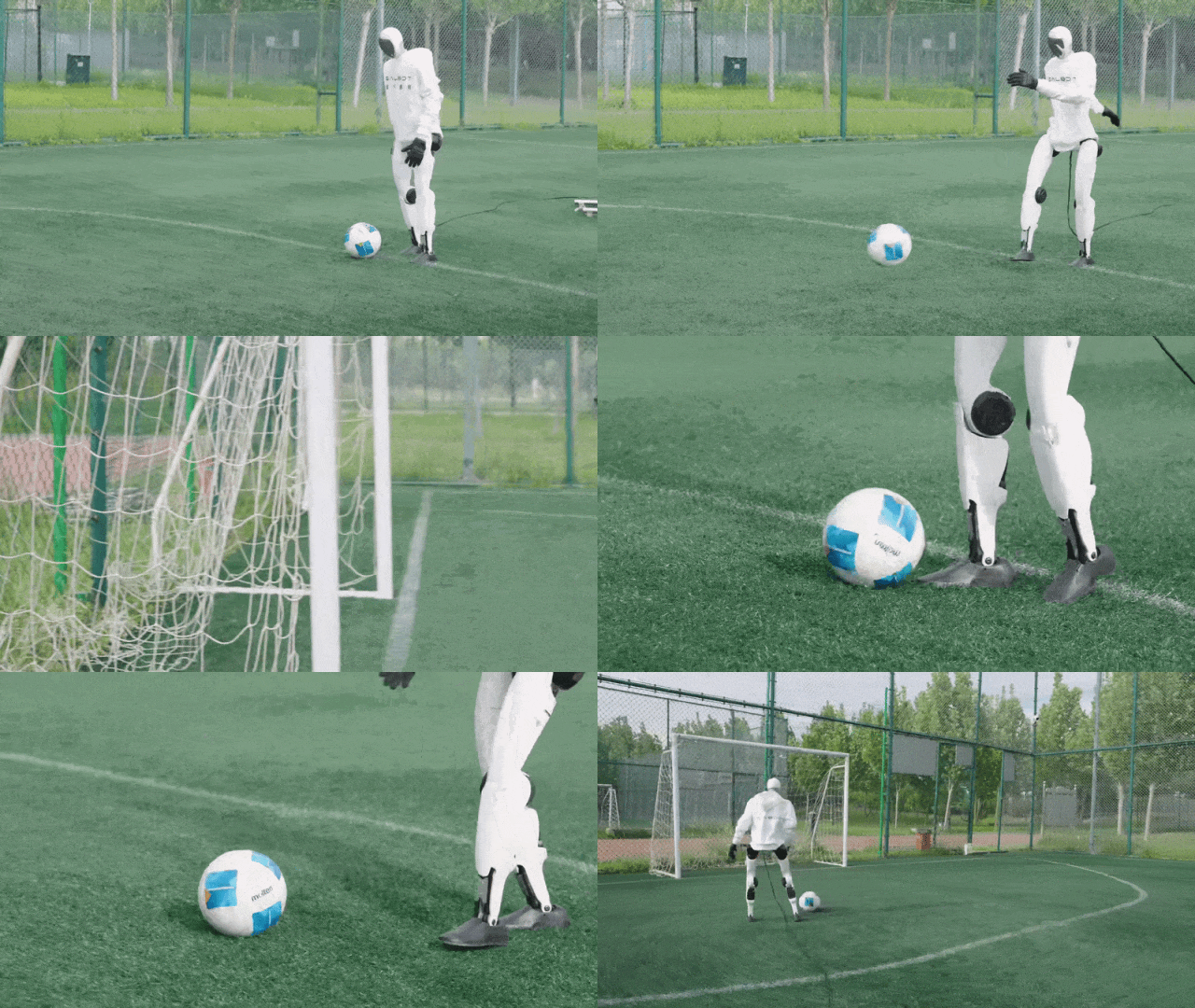
In addition, lightweight fine-tuning enables the execution of extremely high-dynamic tasks.
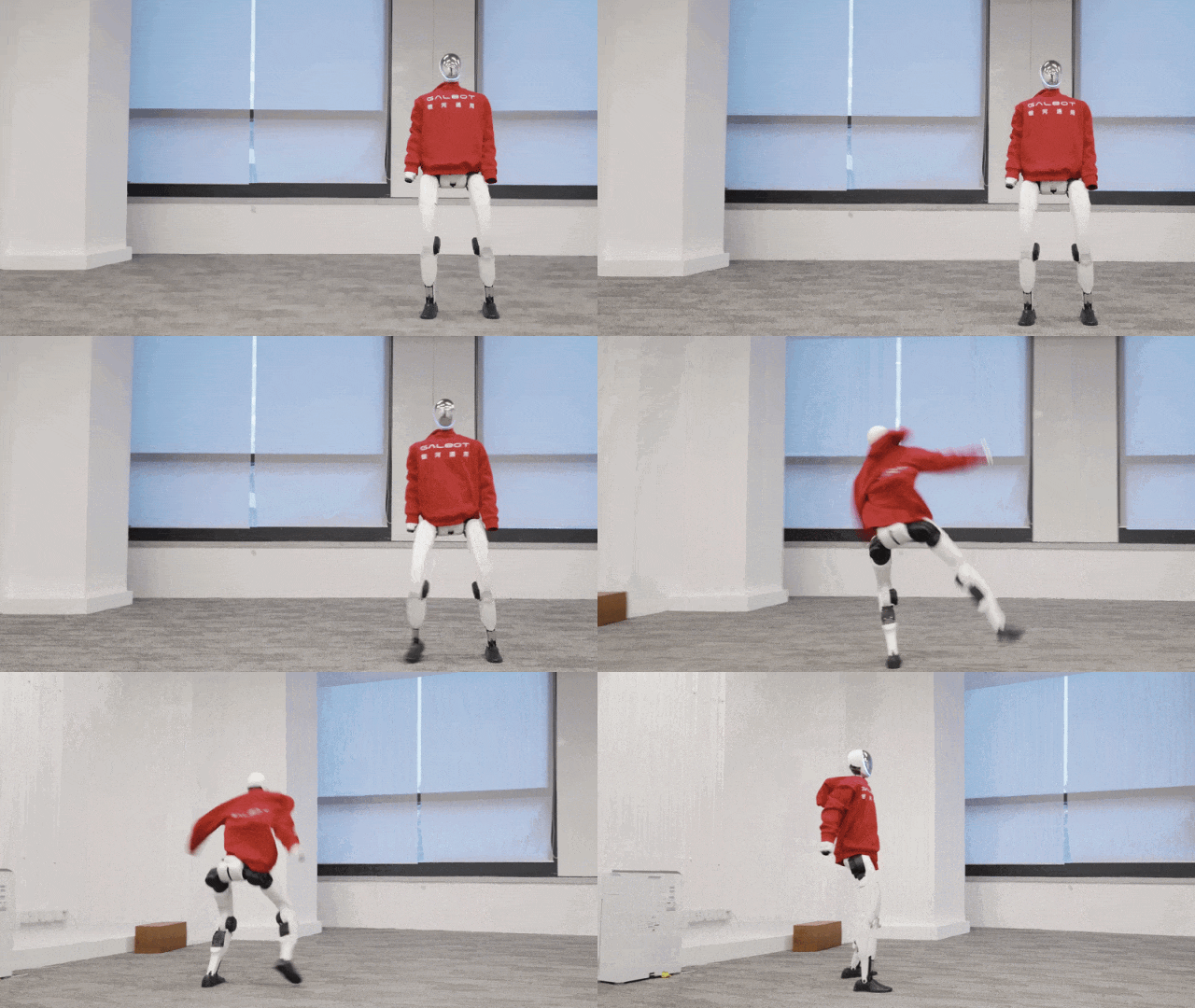
Finally, as an open-source model, Generative Robotics researchers published actual compute costs for engineers in academia and industry interested. The entire training process consumed approximately 15,000 GPU hours, with 75% allocated to expert training (RTX 4090) and 25% to Transformer distillation (H100).


Summary
Regarding the release of AstraBrain-WBC 0.5, whether you are focusing on it being the industry's first humanoid whole-body motion control large model reaching the GPT-1 level, or are astounded by the cool moves performed by robots deploying the AstraBrain-WBC 'cerebellum', you likely share my same question: Why does Generative Robotics, a pragmatic robot company sticking to 'wheeled chassis + dual-arm manipulation', compare its backflips to Nvidia Sonic?
The answer may lie precisely in that. 'Backflips' have never been Generative Robotics' commercial objective; rather, they serve as a touchstone for verifying general motion control capabilities. When a robot can stably control all body degrees of freedom under extreme dynamic conditions, it implies that the same capability has the potential to be transferred to more commercially valuable tasks such as warehouse handling, industrial operations, and retail services. Generative Robotics aims not to prove whether robots can do backflips, but to demonstrate that it is building a 'general cerebellum' adaptable to various future robot form factors.