
Robots Rentable for a Few Hundred Yuan: How Does This Business Model Work?

Robots are too expensive to buy? I only need to use them once; second-hand platforms aren't trustworthy, and manufacturer channels are too far away.
Addressing these user pain points, Embodied AI industry companies including Zhiyuan Robot and Accelerated Evolution have jointly launched the "Qingtian Rent" platform, which was officially unveiled yesterday afternoon.
The Qingtian Rent platform currently offers 16 scenarios and 8 robot models for rent, with prices ranging from 200 yuan to 100,000 yuan.

According to Qingtian Rent's plan, the platform will be deployed across 50 key cities nationwide within the first week of its launch. By the Spring Festival in 2026, it aims to cover 200 cities nationwide. Li Yiyan, CEO of Qingtian Rent, believes that the robot rental market has already exceeded a scale of 1 billion yuan this year, and expects next year's scale to be no less than 10 billion yuan.

Outside the press conference venue, products from multiple domestic robot manufacturers, including Zhiyuan Robot, Shouxing Technology, and Aosha, were on display. Zhiyuan Robot had the largest presence, featuring models such as Yuanzheng A2 and Lingxi X2. These robots demonstrated their capabilities across various scenarios, including holiday greetings, corporate exhibitions, concerts, and film and television production.
Among them, Haidilao, as one of the first customers of Qingtian Zu, has deployed the Zhiyuan Lingxi X2 in its stores to celebrate users' birthdays with graceful dances and birthday songs.
Robots are now rapidly entering people's lives, but they are not a rigid demand. Therefore, if renting a robot can be as simple as hailing a ride-hailing car or renting a power bank, it will accelerate the popularization of robots across various industries

Renting a Robot for a Few Hundred Yuan
The Qingtian Zu platform, which is already online and operational, allows users to rent various different robots by scenario or by the robot itself. Prices start from 100 yuan, making the threshold for robot rental indeed low, whether for celebrating a friend's birthday or for a company annual meeting.
The platform has designed 16细分 (subdivided) scenarios for users.
For example, the cheapest placement patrol scenario starts at 500 yuan/day. In this scenario, it is more suitable for quadruped robotic dogs or four-wheeled robotic dog forms, and the cost of the robotic dog itself is not particularly high.
If shooting short dramas, robots like the Zhiyuan Lingxi X2 can achieve realistic effects through costume changes, with prices at the 2,000 yuan level.
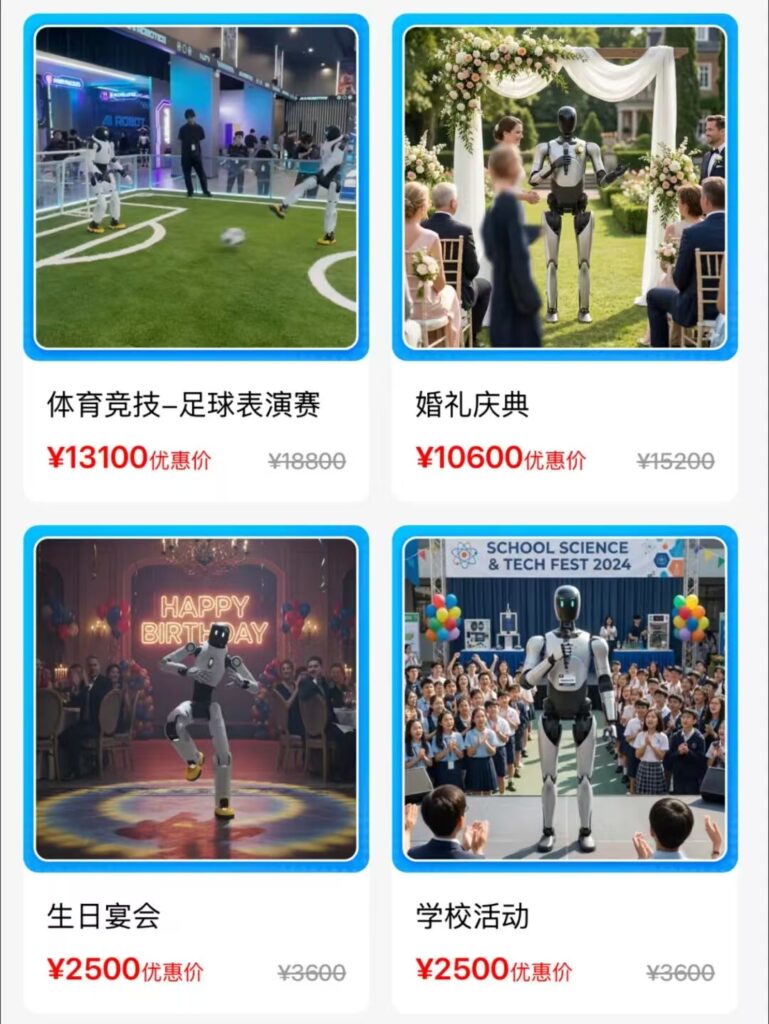
At the 10,000-yuan price point, multiple robots can jointly serve a company annual meeting or exhibition. For example, in a company annual meeting scenario costing 13,300 yuan per day, there could be one Zhiyuan Yuanzheng A2, two Lingxi X2s, and one Kutuo D1.
At the 100,000-yuan level, sports competition scenarios become feasible, featuring an indoor obstacle course and two Kutuo D1 robots.
If none of these 16 scenarios fully meet your needs, there are also robot chassis rental options available.

For instance, the Zhiyuan Kutuo D1 rents for just 200 yuan per day, while the Zhiyuan Lingxi X2 starts at 1,499 yuan per day. Shouxing Technology's two bionic robots have also been listed; the Jingling Xuan has a daily rental price starting from 5,000 yuan.

Regardless of the rental model, the robots on the platform currently focus mainly on entertainment scenarios. Jiang Qingsong, partner, Senior Vice President, and President of Marketing Services at Zhiyuan, stated that they have planned for future applications in guided tours, shopping assistance, operational intelligence, and home scenarios. He said, "Robots will be able to work in factories next year, with significant progress expected around 2027-2028. Entering homes requires more time; within 3-5 years, we will see robots performing autonomous tasks, and their presence in households will gradually increase."

What is the business model?
When discussing the business model of the Qingtianzu platform, Jiang Qingsong and Li Yiyan provided a detailed introduction on-site.
The Qingtianzu platform was only planned two months ago, after which it was quickly launched and put into operation. Li Yiyan noted that robot rentals in entertainment scenarios have already achieved a commercial closed loop. This actually emerged from the robot boom earlier this year.
However, renting robots from individual users on second-hand platforms carries significant risks. For instance, users may not know how to operate them, leading to damage or bumps during daily use. The entry of Qingtianzu has brought robot rentals into the stage of branded operations, allowing the platform to conduct market-oriented operations in a more standardized and regulated manner.
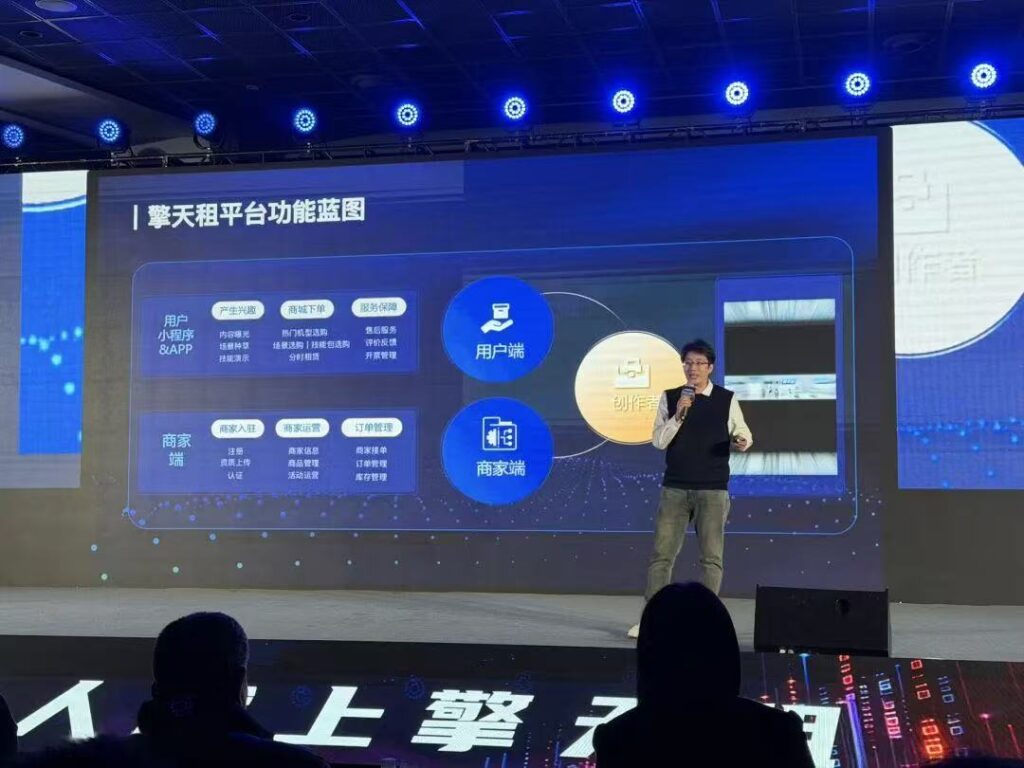
The Qingtianzu model works as follows: The platform attracts robot manufacturers and ecosystem partners to join. Among them, ecosystem partners specializing in rental services take orders on the platform to serve users; content partners provide additional content services for users, such as customizing stage design and appearance; meanwhile, insurance companies are also involved, providing insurance coverage for both the robot itself and third-party liability.
For ordinary users, they can gain an initial understanding of the robots by entering the mini-program or App, and place orders at any time if needed.
In terms of network layout, Qingtianzu plans to cover over 200 core cities with more than 600 service providers, while offering over 2,000 sets of robotic equipment for lease. Regarding timeliness, a 2-hour service response can be achieved within 100 kilometers in hub cities, with equipment arriving within 48 hours.

For merchants joining the platform, they can enter and provide services to users after completing registration and qualification review.
Additionally, the platform has introduced creators to provide content services, helping merchants attract more user attention.
On-site, Haidilao demonstrated scenes where the Zhiyuan Lingxi X2 robot danced and sang birthday songs for diners. The Haidilao birthday song is just the first step; it is believed that robots changing faces or even dancing the "Subject Three" will not be a dream in the future.

Jiang Qingsong introduced that Qingtianzu set a "1234" plan for 2026, where "1" represents that more than 10 original equipment manufacturers (OEMs) will participate in the Qingtianzu platform; "2" indicates that there will be more than 200 gold-level leasing service providers next year; "3" stands for over 3,000 content creators; and "4" represents over 400,000 leasing customers.

Final Thoughts
At the beginning of this year, robots went viral across the internet, and the robot rental market also experienced a surge. A set of robots with a purchase price of tens of thousands of yuan could have a daily rental price of over ten thousand yuan. Over the past half-year, as the market has returned to rationality, there are increasingly more cost-effective robot rental solutions.
Qingtianzu Platform's entry into the market at this time is actually setting a good example for the industry. One crucial aspect is that through standardized platform operations, it addresses user pain points, making the process of renting robots simpler and more natural.
However, for robot rentals, questions remain about who holds the heavy assets of the robots and how to balance the relationship between demand and pricing in this emerging market. Perhaps the emergence of Qingtianzu will pave a way in the robot rental market.