

UC Berkeley's SuperMimic Slashes Compute for Humanoid Whole-Body Control
By Ethan
Accepted as an oral paper at CoRL 2026, the SuperMimic framework uses a differentiable world model to train humanoid whole-body control on a single GPU in three hours, outperforming previous methods that required massive GPU clusters.
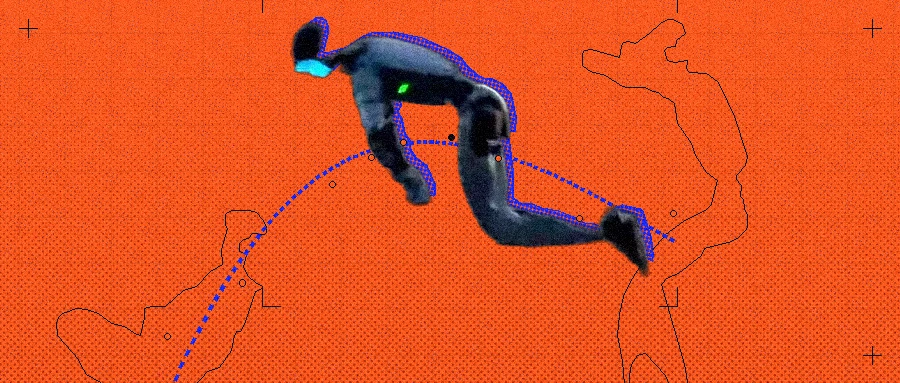
On October 21, a team from the University of California, Berkeley (UC Berkeley) released the paper SuperMimic: Scaling Humanoid Whole-Body Control with One Differentiable World Model, which has been accepted as an oral presentation at CoRL 2026. SuperMimic immediately drew widespread industry attention, with peers calling it "stunning" and "authoritative."

Project homepage: https://supermimic.github.io/
Paper link: https://arxiv.org/pdf/2610.28480
The study's core findings show that the computational power required to train whole-body humanoid movements is drastically reduced in SuperMimic. Trained on 129,514 human motion clips, SuperMimic outperformed the previous state-of-the-art method, SONIC, using just 1 GPU for 3 hours, whereas SONIC required 128 GPUs for 7 days. This represents a plummeting reduction in costs.
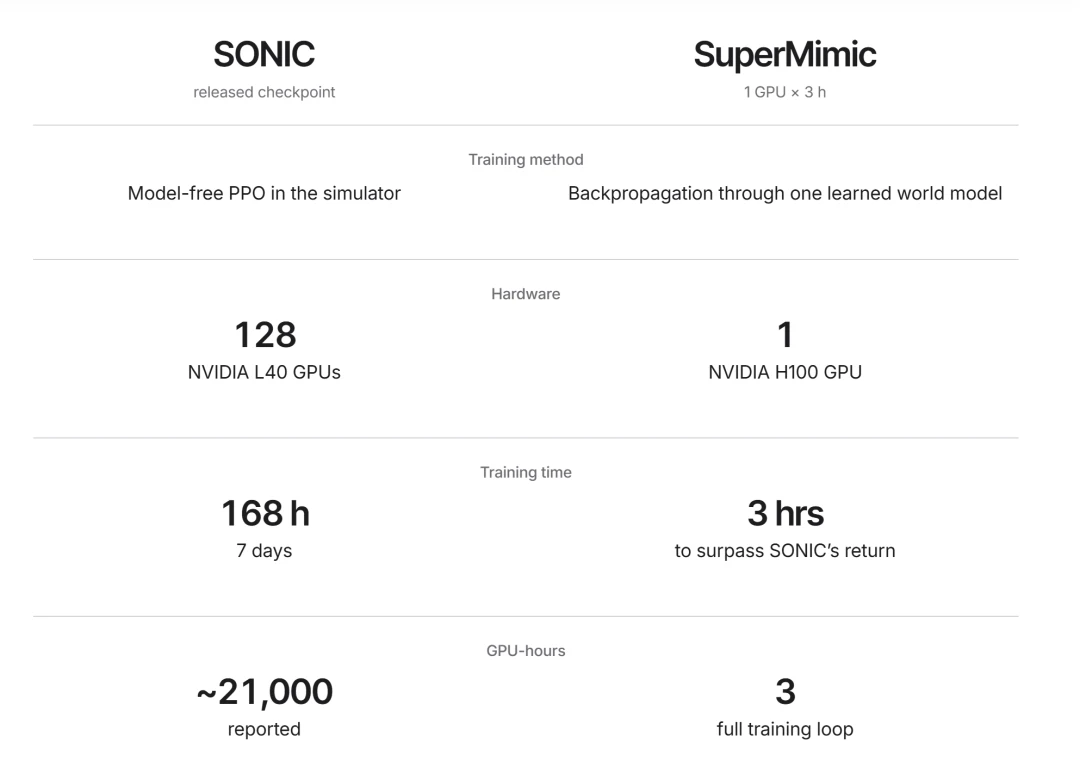
Impressively, the differentiable world model proposed by SuperMimic scales down training that originally required GPU clusters to just a few hours on a single GPU, while enabling the resulting controllers to run on physical robots. The core contribution of this study lies in innovating existing policies for robot whole-body control by using a differentiable world model to construct neural dynamics for robot movements, fitting it with state transitions recorded by a standard rigid-body simulator, amortizing the learning costs across different movements, and co-training the world model and tracking policy in the same loop with backpropagation through time on short imagined trajectories, thereby providing analytical gradients and fast imagination rollouts for the policy to significantly improve training efficiency.
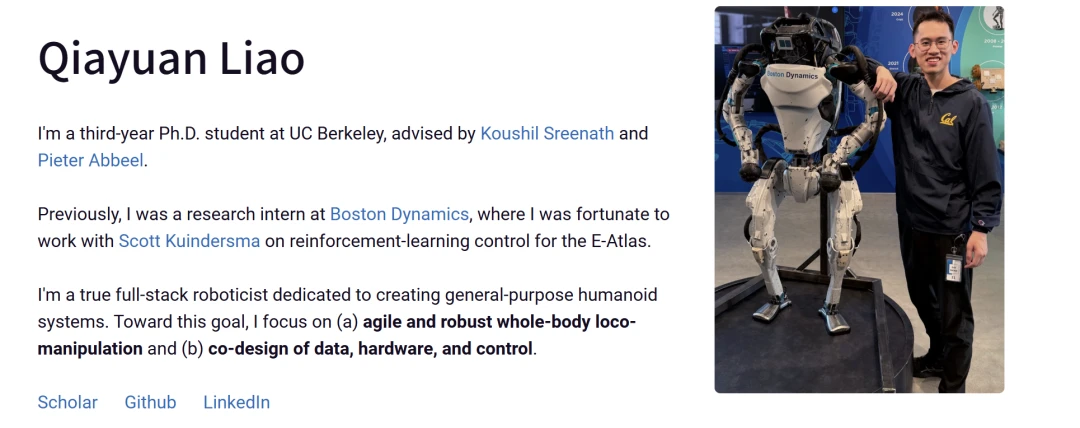
The first author of the study is Qianyuan Liao, a third-year Ph.D. student at the University of California, Berkeley (UC Berkeley). His advisors are Koushil Sreenath and Pieter Abbeel. Previously, Liao was a research intern at Boston Dynamics, where he collaborated with Scott Kuindersma on reinforcement learning control for the E-Atlas robot. His research focuses on whole-body loco-manipulation and the co-design of data, hardware, and control. Past research he has led or contributed to includes Workhorse, BeyondMimic, and Berkeley Humanoid. His open-source robot learning framework, MoJoCo Playground, won the Best Demo Paper Award at RSS 2025.

Liao has long been dedicated to building general-purpose humanoid systems, and SuperMimic is his latest stunning achievement toward this goal. Combining the technical concepts of differentiable policy optimization and reinforcement learning, the SuperMimic team claims that "compute is no longer the bottleneck." Its emergence may remove the computational barriers for large-scale training in humanoid whole-body control, and a complete, cost-effective whole-body control solution for robots may be taking shape. If the research is validated through large-scale replication, the massive GPU cluster compute previously deemed necessary by the industry will no longer be a bottleneck for scaling humanoid whole-body control, meaning that the training costs for the robot hardware will no longer be constrained by it. If this can be extended to perception-enabled robot whole-body control and walking, SuperMimic will represent the latest major technological breakthrough in the field of embodied AI.

How are humanoid robots controlled
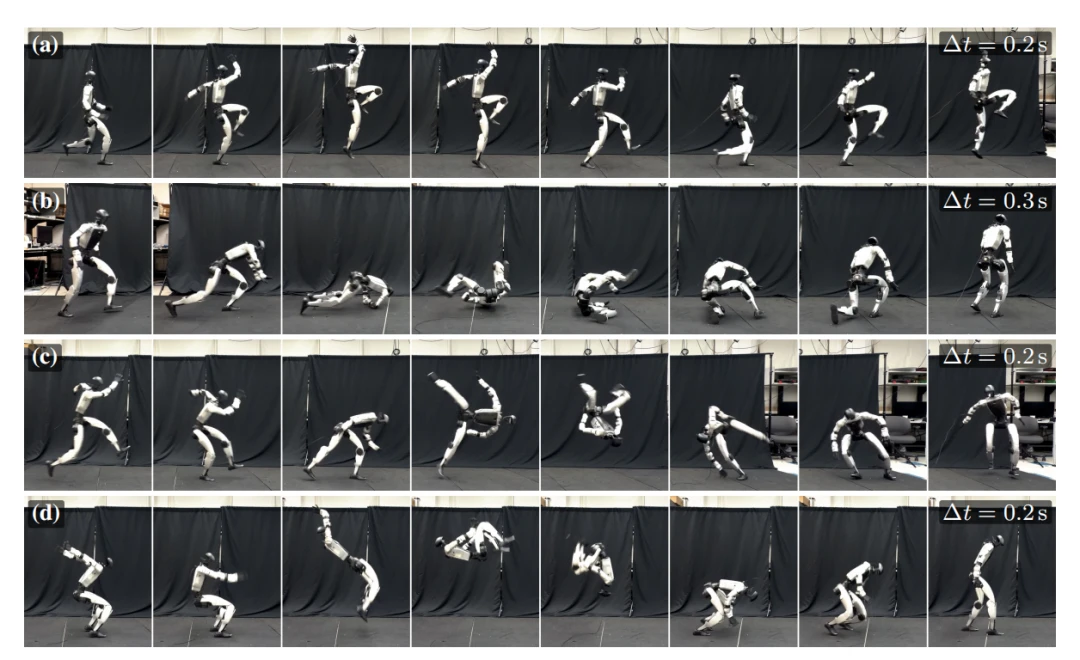
SuperMimic focuses on enabling a controller to track a vast array of reference human motions. These references dictate the robot's subsequent movements, while the controller must continuously output joint commands based on its current state to physically execute the actions. This differs fundamentally from programs that merely replay predefined joint trajectories. If the robot's body deviates from the target, the controller must adjust its subsequent actions, balancing tracking accuracy with stability.
For humanoid robots to potentially operate in human-designed environments, their whole-body controllers must cover a wide variety of human motions, ranging from walking and dancing to squatting and balance recovery. Existing research primarily expands on this concept through two approaches: either distilling a large number of expert models for specific motion segments into a single controller, or training a general policy on a large-scale motion library. In both cases, a more diverse motion library yields more capable robot behavior.
However, as the range of covered motions expands, the underlying mechanisms of both approaches dictate a continuous increase in computational costs. For example, training the advanced tracker SONIC on 128 GPUs takes approximately 168 hours, totaling about 21,000 GPU hours. Although the reference motions vary, they share the same body dynamics, so the underlying mechanism repeatedly estimates the consequences of actions through noisy simulated trajectories. Therefore, whether it is a humanoid robot executing a sideways roll, an aerial flip, or a stable landing, the few seconds on screen may be backed by days of training on a massive GPU cluster. How to make every joint of the robot coordinate in time, and how to maintain motion coherence when the feet, arms, or torso contact the ground—these seemingly mechanical structure problems have also long consumed the computational resources of reinforcement learning systems. The industry once believed that expanding the number of robot motions and achieving generalization meant that computational investment had to be scaled up.
That is not the case.
The key lies in imitation. SuperMimic formulates a reinforcement learning (RL) policy based on physics-based motion imitation, addressing this issue by tracking reference motion segments extracted from large motion capture (mocap) datasets. It leverages state transitions recorded by the simulator to fit a unified, differentiable world model, overcoming previous inefficiencies. By performing backpropagation through time (BPTT) on short imagined trajectories, the robot can obtain analytical policy gradients along the learned model, allowing a single dynamics model to amortize the learning cost across the entire mocap library. Because these gradients are derived from the learned model, SuperMimic remains compatible with rigid-body simulators, including those employing non-smooth contacts or non-differentiable implementations.

How the policy works?
Reinforcement learning transforms this coordination problem into trial and error. The policy receives the body state and the goal, and outputs actions; the simulator computes the physical consequences of these actions; and the reward function evaluates whether the body's position, orientation, and velocity keep up with the reference motion, while penalizing excessive control changes and joint limit violations. The policy gradually improves its cumulative reward through training. "Learning a motion" essentially means finding a joint coordination pattern across many consecutive time steps that balances current tracking with future stability. Taking the commonly used model-free RL algorithm PPO as an example, the policy primarily relies on sampled trajectories and return estimates to determine which behaviors should be increased and which should be decreased. This approach can be successful, but the robot must repeatedly undergo extensive trial and error for every complex motion.
The controller in SuperMimic still needs to learn this coordination. It compresses the input target into a 32-dimensional action latent variable, combines it with the most recent ten frames of proprioception, and generates a 29-dimensional joint action through a shared decoder. Proprioception includes joint positions, joint velocities, inertial measurement information, and the action from the previous time step. This historical information allows the policy to make judgments from a short sequence of body changes, rather than merely reacting to a single static "pose snapshot."
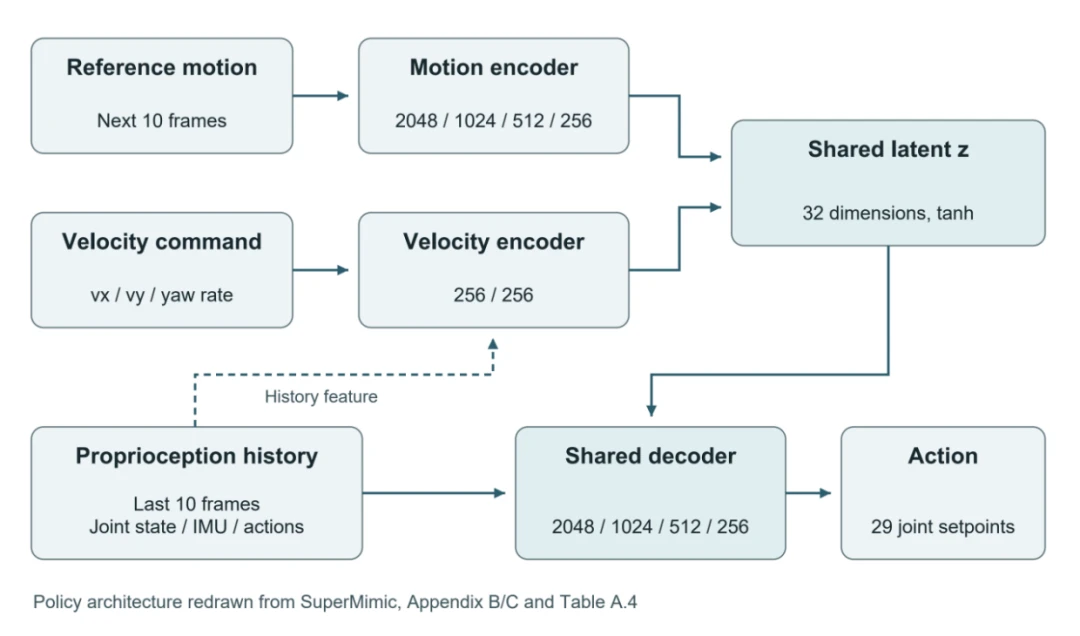
As illustrated, the motion reference encoder in SuperMimic and the velocity command encoder from the preliminary study share the same motion latent space and decoder, with the velocity encoder also taking in features from the history of body observations. A differentiable world model assists in joint training but does not need to be deployed onboard as an online planner. Together, these components form the complete control policy architecture.
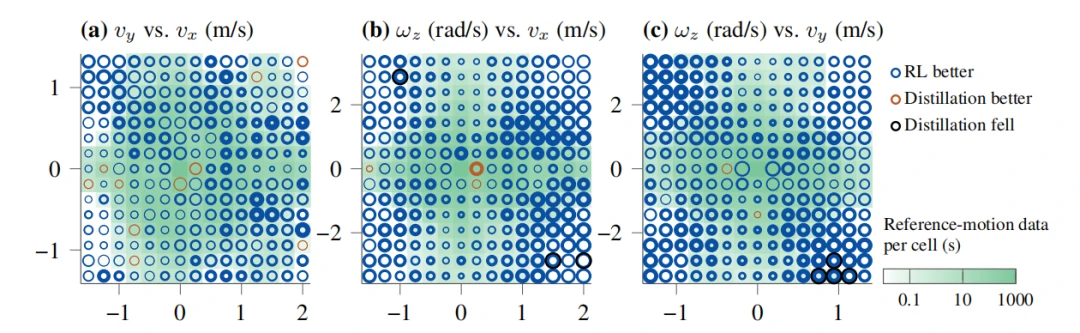
Compared to the distillation baseline, a velocity encoder trained via reinforcement learning tracks gait commands more accurately. Each subplot shows a two-dimensional slice of the command space with the third dimension set to zero, where each annular region represents a specific command. The area of the outer ring is proportional to the larger of the two policies' relative steady-state errors for that command, while the inner ring's area corresponds to the smaller error; color markers indicate which policy performs better. The same model can undergo downstream training directly using the task reward of the velocity interface itself. Today, quantifying the scaling laws of motion tracking requires only a single GPU per training run.
The default motion interface reads the next ten frames of reference motion to generate latent variables via the motion encoder. The paper also explores an alternative input pathway: feeding forward, lateral, and turning velocity commands, along with features from the history of body observations, into the velocity encoder. Both input pathways can share the same motion decoder. This design separates the objective of what to accomplish from the mechanics of how to coordinate the robot's body, allowing downstream interfaces to leverage pre-learned motion capabilities. The numerical outputs from the controller must then be converted into executable targets for the motors, using the following relationship:

The policy output, motion scaling, and reference joint posture collectively form the target joint position reference for the low-level controller. The neural network determines the target positions for the joints, while the low-level controller translates these targets into continuous motor commands. This approach eliminates the need to solve the full rigid-body contact equations at every control step.

Shared world model
SuperMimic learns shared physical dynamics as a standalone world model to govern how the humanoid robot moves, interacts with the ground, and transitions into new states after executing actions. This is not a general-purpose vision model that generates arbitrary real-world scenes from text prompts. Instead, it works in tandem with the policy, logging states, executed actions, and subsequent outcomes into a replay buffer. The model learns to predict body dynamics from these records and then helps refine the policy over short, imagined trajectories. As the policy improves, it returns to the simulator to collect new data, which in turn updates the world model, creating a continuous loop.
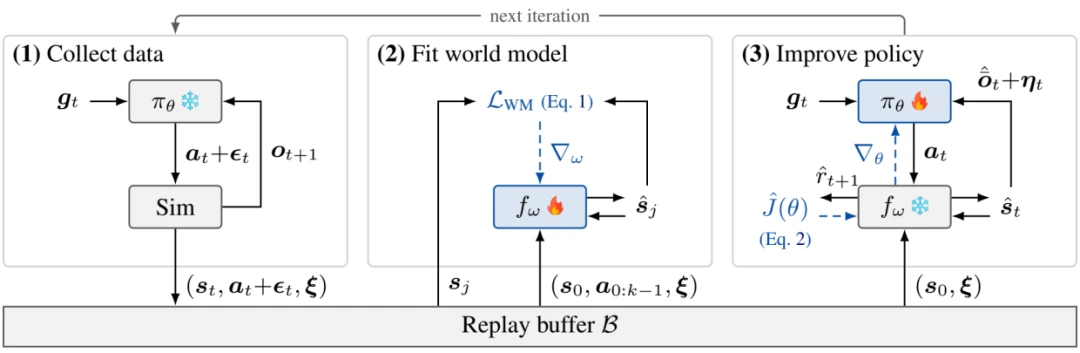
The world model updates during every training iteration. It is kept fixed only within a single policy optimization step to provide the policy with a relatively stable predictive environment. Meanwhile, the simulation trajectories required for training the model continue to be generated by the physics simulator. To ensure the imagined trajectories remain realistic, the model must do more than just predict the next frame accurately. Starting from a given state, SuperMimic predicts eight consecutive steps along the recorded actions and then verifies these predictions step-by-step against the actual simulation records.

During real-world deployment, the model cannot simply reset to the ground-truth state provided by the simulator at every step and blindly follow its own predictions until errors accumulate. Therefore, it is crucial to align states, rewards, noise-free observations, and termination labels during multi-step rollouts to minimize various types of errors. The four error terms in the equation correspond to four practical issues: whether the body is predicted to be in the wrong position, whether an action is incorrectly assigned a high reward, whether the proprioceptive feedback received by the policy is reasonable, and whether the model can correctly detect task failure. This mechanism allows the world model to constrain the compounding errors when its own predicted states are fed back as inputs for subsequent steps, forcing the model to adapt to its own minor inaccuracies and maintaining stability across longer imagined trajectories.
Additionally, the model receives environment and body parameters for each simulation episode, such as friction, joint calibration offsets, and the torso center of mass. This allows the network to learn clearer dynamic relationships under given conditions without conflating known noise sources. During real-world deployment, the policy relies solely on noisy proprioceptive observations and goals, without requiring these privileged parameters used during simulation training.
A more critical factor for improving training efficiency is that this world model is differentiable. After modifying a joint command, the model not only predicts how the body's state will change but also uses derivatives to provide local information indicating which direction to adjust the action to increase the expected return. Errors propagate backward along the predicted trajectory, sequentially tracing back to previous actions and policy parameters in a process known as Backpropagation Through Time (BPTT).

Naturally, a frozen world model does not mean halting all gradients. During policy updates, the model's own weights remain unchanged, but the system still leverages the derivatives between the model's inputs and outputs to propagate distant reward changes back to the actions. For instance, during an unstable landing, the training signal does not merely evaluate the final step; it can trace back to the joint coordination prior to takeoff, enabling process-level tracing.
This approach also bypasses the difficulty of directly differentiating through the physics simulator. Real-world contact involves collisions, friction, and support transitions, and standard simulation software does not necessarily provide implementations suitable for backpropagation. SuperMimic retains the standard simulator as a data source while computing policy gradients within the learned neural model. The resulting derivatives therefore belong to a learned surrogate of the physical simulation, with accuracy dependent on the data covered by the model and the overall training quality.

However, the longer the imagined trajectory, the more likely model errors accumulate, making backpropagation increasingly computationally expensive. SuperMimic defaults to unrolling just 32 control steps. At a 50 Hz control frequency, this equates to only 0.64 seconds. To enable the policy to account for consequences beyond this short window, the system additionally trains a value network, also referred to as an actor-critic setup, to estimate the expected future returns.

As the core objective of SuperMimic's policy optimization, this algorithm provides a reference for the model to progressively optimize the robot's body through its own imagination. The first term accumulates discounted rewards within the short trajectory, while the final term is the value beyond the window's end, estimated by the critic. Simply put, the first part of the objective function evaluates how well the immediate sequence of actions is executed, whereas the second part assesses the quality of the remaining conditions for continued action once that sequence concludes. Certain parameters adjust the weight of future returns, while others scale down the contribution of post-failure trajectories based on the survival probability predicted by the model. This allows the robot to simulate a short sequence of movements within the model, evaluate the quality of those actions, and then estimate subsequent performance. The actor-critic framework ensures that the robot's action execution remains robust during inference, preventing it from barely scraping by to complete a task.
The integration of these mechanisms forms the core technical philosophy of SuperMimic: all actions share a continuously updated dynamics model, and after obtaining policy gradients over short trajectories, value estimation is used to account for consequences beyond the short window. The innovative value of SuperMimic lies in organizing previously validated mechanisms—such as reinforcement learning, Proximal Policy Optimization (PPO), and SuperTrack—into a cohesive framework capable of covering large-scale humanoid motion libraries, thereby providing a comprehensive and resource-efficient solution for transfer to physical robots.

Remarkable Performance
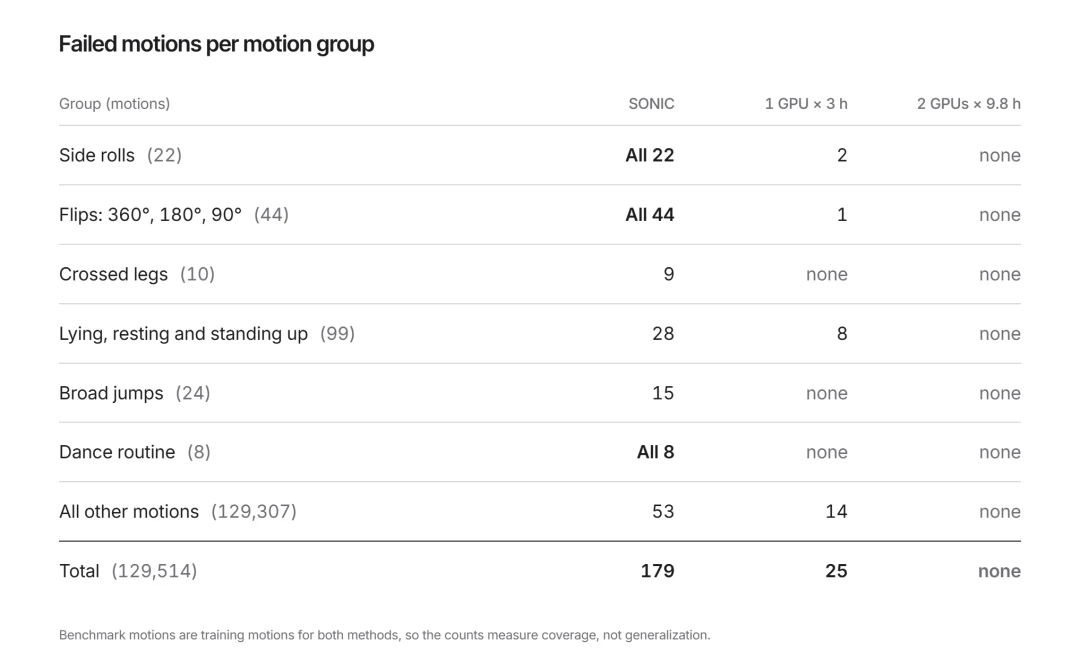
SuperMimic's most striking figures are its dual leaps in performance and training efficiency. On a single GPU, SuperMimic's training efficiency surpasses that of SONIC within just 3 hours, reducing GPU-hour consumption by more than 1,000 times. On a benchmark comprising 129,514 motions, SuperMimic had 25 failed motions after 3 hours of single-GPU training, but achieved an impressive zero-failure rate across all tasks after 9.8 hours of dual-GPU training.
Notably, when the dataset duration is increased to hundreds of times its original length, the world model's prediction error remains stable. Surprisingly, the compute required for SuperMimic to reach a fixed return shows only slow growth, and the learned policy can be transferred to the physical Unitree G1. In preliminary research on downstream interfaces, a velocity encoder trained via reinforcement learning (RL) outperforms the distillation baseline. This implies that the training cost for whole-body control of humanoid robots is significantly reduced, without being constrained by GPU compute limits.
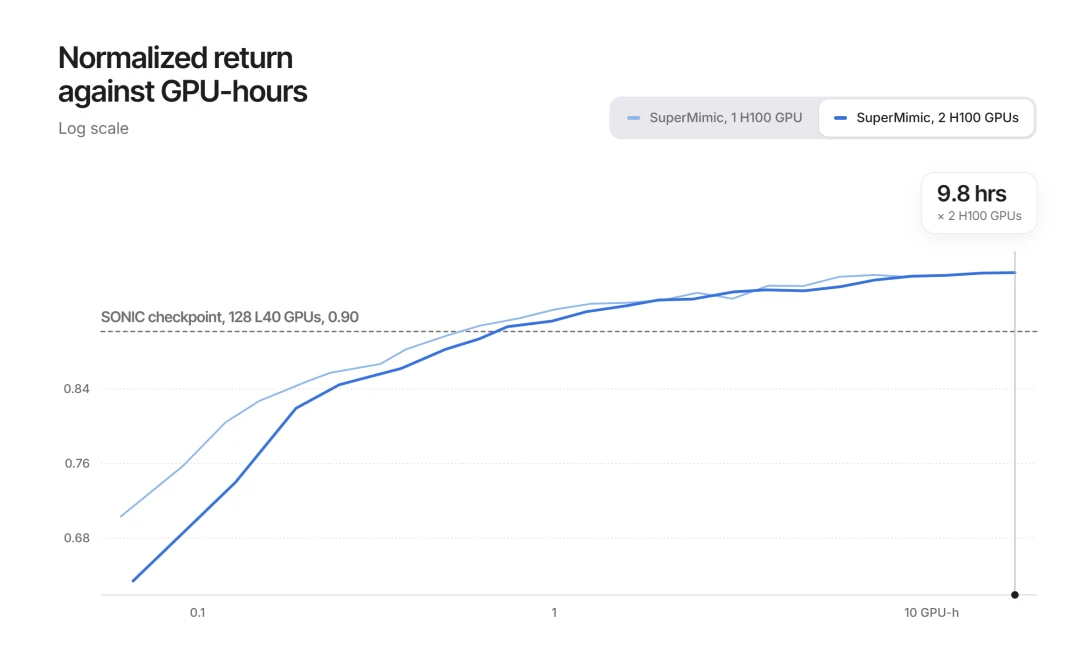
Furthermore, computational comparisons with a 100-GPU cluster corroborate SuperMimic's improvements in training efficiency. The researchers fixed 40 motion clips totaling approximately 2.45 hours, keeping the observation, reward, termination conditions, randomization, and policy network size as consistent as possible. Using a single H100 GPU, SuperMimic reached an evaluation return of 0.82 in about 1.2 hours. In contrast, Proximal Policy Optimization (PPO) in the simulator failed to reach this level within an 18-hour budget; its final returns for single-GPU, four-GPU, and eight-GPU configurations were approximately 0.60, 0.70, and 0.72, respectively. This signifies a dramatic leap in training efficiency.
Why does it save so much compute?
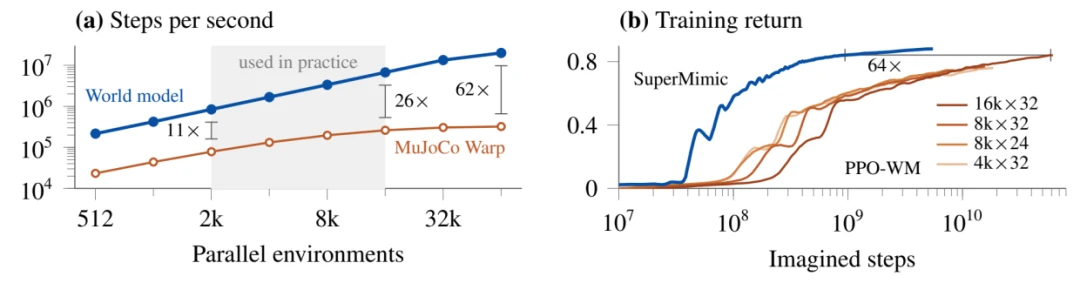
First, each practice iteration becomes cheaper. Within the practical range of parallel batch sizes, the throughput of the neural world model for generating trajectories is more than ten times higher than that of MuJoCo Warp. A standard simulator must process rigid body and contact calculations at every step, whereas a trained neural network approximates these state changes in a single forward pass. Second, the number of practice steps required to achieve comparable performance is reduced. Within the same world model, the researchers compared analytical gradient updates with continued PPO policy optimization: the former used about 1/64th of the imagination steps of the latter to reach the optimal training return of PPO-WM. This test demonstrates that the gains do not come entirely from a "faster simulation surrogate"; the policy also more effectively leverages information about the consequences of actions.
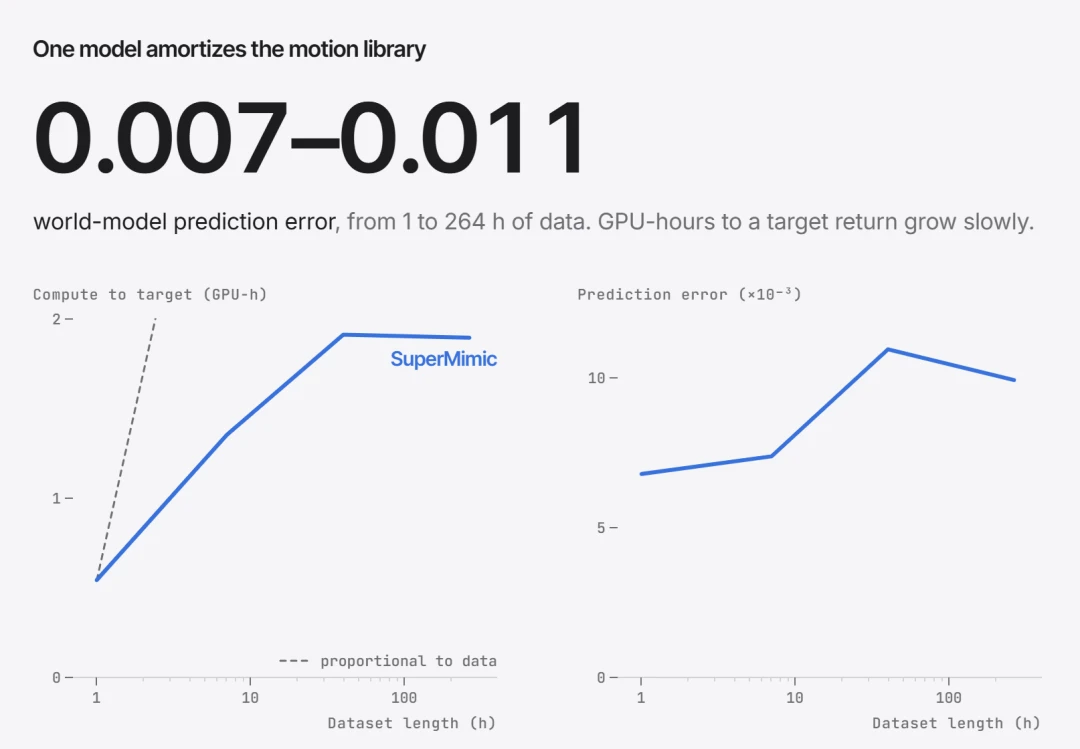
As shown in the figure, as the training motion data increases from 1 hour to 7 hours, 40 hours, and then to approximately 264 hours, the world model's eight-step prediction error remains within a narrow range of about 0.007 to 0.011, and the growth in GPU hours required to reach the target return is also relatively slow.
What is truly insightful here is that even with more than 200 times the amount of motion data, the compute resources required for the dynamics of the same robot body do not explode. The data provided by different motions can jointly train a shared model, giving new motions the opportunity to leverage established physical principles. However, these data points are not yet sufficient to guarantee that the same trend will hold at arbitrary data scales. When new terrains, objects, and contact types are introduced, the challenges faced by the shared model will also change.
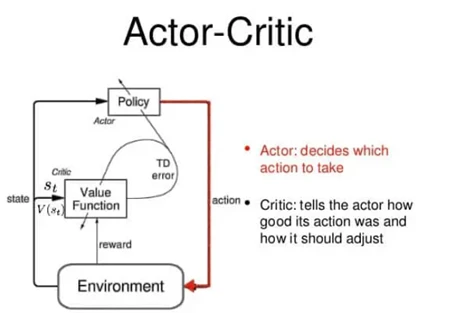
The general role of the Action-Critic is to link "fast learning" with "subsequent stability of actions". In ablation experiments, 16-step imagination with a Critic reaches the expected performance faster. For example, in a simulated push perturbation experiment, after a root velocity perturbation of 0.5 to 4 m/s, the policy with the Critic recovers stability in about 0.5 to 2.4 seconds. Without Critic supervision, however, the robot exhibits continuous stumbling and falls under larger perturbations. This indicates that the terminal value not only alters the training curve but is also related to recovery behavior after a short time window.
Shared control capabilities have also been preliminarily extended to the velocity interface. Out of 672 velocity step responses, the encoder trained with task rewards achieved lower error than the distillation baseline in 650 responses; the median relative error was 0.16, compared to 0.49 for the baseline, representing an approximately 67% reduction. Intuitively, existing motor skills do not need to simply mimic reference motions; they can also be reorganized through new command inputs.
They demonstrate, respectively, that the model can lower the cost per training iteration, differentiable optimization can reduce the required amount of practice, shared dynamics can accommodate a larger motion library, and combining short windows with value estimation can balance computational load with downstream stability. Together, this evidence substantiates a major breakthrough in embodied training efficiency.

Community buzz: what are the focal points?
Upon its release, the paper immediately sparked widespread discussion across the embodied AI communities in both China and the United States. The focal points of the debate include recognition of the study's breakthroughs, the evolution of reinforcement learning, simulator selection, replication efforts, and various points of contention.
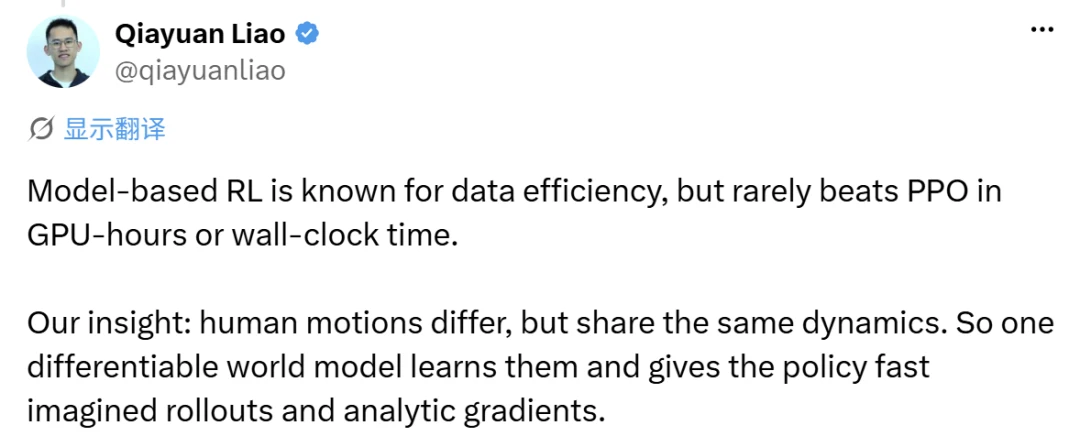
First author Qianyuan Liao stated publicly that the core technical insight behind SuperMimic lies in a certain underlying unity. Human movements vary widely, but the underlying dynamic mechanisms remain the same. By identifying and formalizing these mechanisms, world models can quickly learn them and rapidly drive policy execution, meaning the cost barriers to training on diverse reference motions are likely to simply vanish. Kevin Zakka, a co-author who helped develop MuJoCo Playground, described SuperMimic as a prime example of simulators and world models working in tandem.
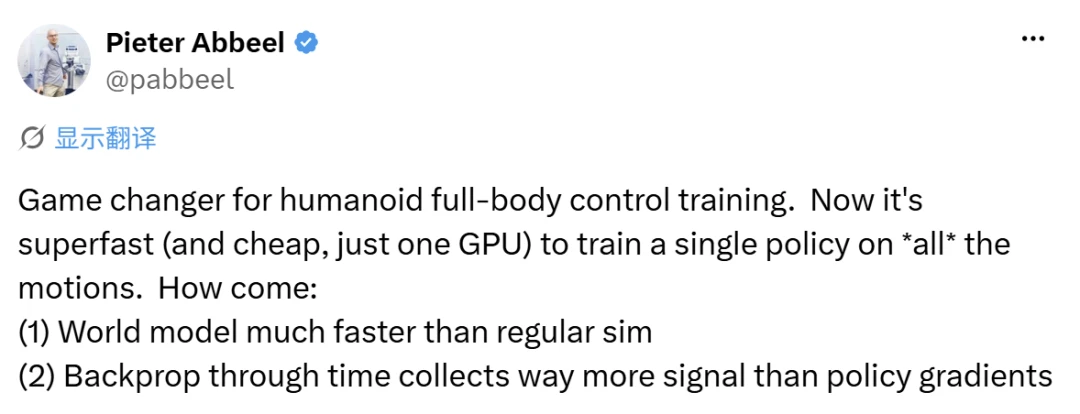
One of Liao's advisors, Pieter Abbeel, commented in a repost, affirming that SuperMimic's value for humanoid whole-body control could be truly game-changing, adding, "The rules of the game for humanoid whole-body control training have changed. You can now learn motions with a single policy, and training is fast and cheap, requiring just one GPU. There are two reasons: world models are vastly faster than conventional simulators; and the learning signals obtained by backpropagating through time are far more abundant than policy gradients."
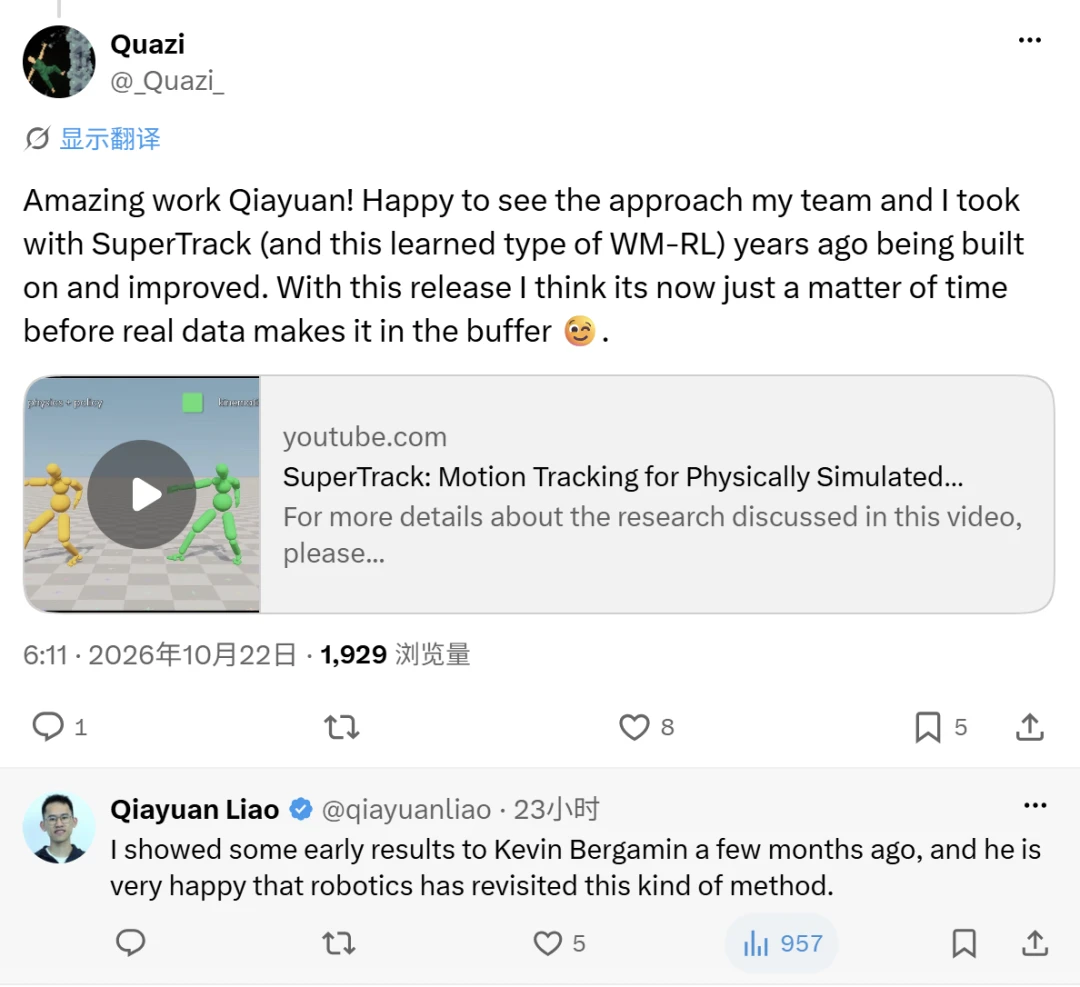
SuperMimic was not achieved overnight. From SuperTrack, which first appeared at SIGGRAPH Asia (2021), to SuperDyno (2025), and finally SuperMimic (2026), these studies have continued a consistent research trajectory among leading scholars in the robotics community: replacing simulators with world models and using backpropagation to train motion tracking. The transition from simulation to real-robot deployment took five years, driven by successive rounds of inspired experiments along this path that yielded gradual improvements. Following the release of SuperMimic, the authors of the earlier SuperTrack work also came forward to commend the research:
"This research is fantastic! I'm thrilled to see the methods my team and I used on SuperTrack a few years ago—and this general paradigm of learned world models combined with reinforcement learning—being built upon and improved. With this release, I feel it's only a matter of time before real-robot data is added to the replay buffer."
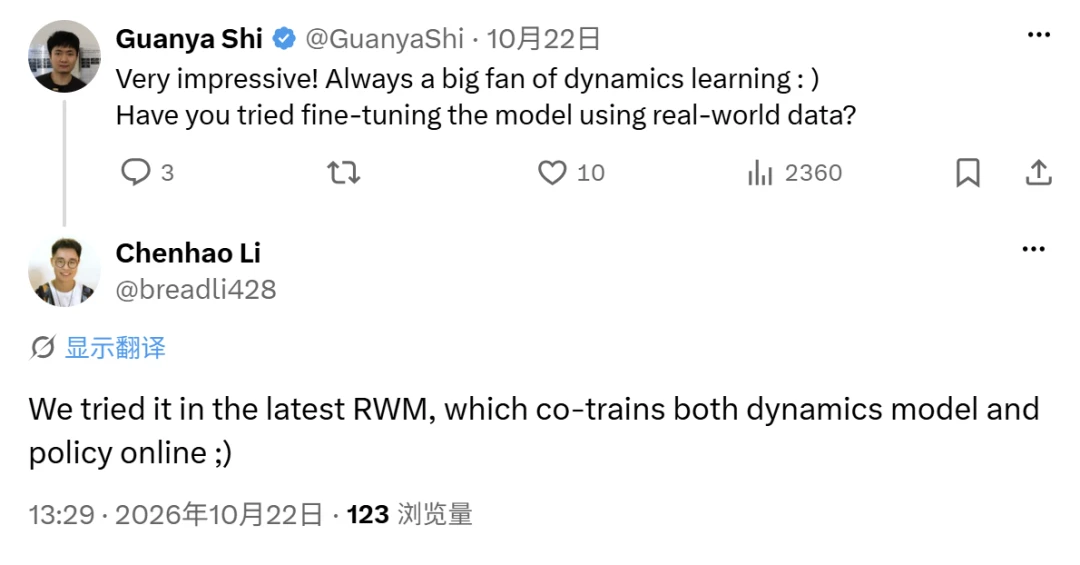
Details of the paper and its reproduction have also been discussed on both Chinese and international social media. Guanya Shi, an assistant professor at the Carnegie Mellon University Robotics Institute and head of the LeCAR Lab, asked whether the team had tried fine-tuning the model with real-robot data. He suggested that extending SuperMimic to settings involving interaction with scenes and objects would be interesting, which might require designing clever representations to make the model's performance more stable and generalizable.
Chenhao Li from Google DeepMind subsequently noted that they had attempted to jointly train the dynamics model and policy online in their latest Robotic World Model (RWM).
Erwin Coumans, author of the open-source physics engine Bullet, also praised the Qiaoyuan team's research on neural dynamics as outstanding, stating, "The gradients of analytic physics engines, whether through automatic differentiation, finite differences, or hand-coded methods, are never as smooth as those of learned engines or world models."
Yunlong Song, founding research scientist at Genesis AI, believes the next step for this research could focus on differentiable world models for whole-body control and locomotion with perception, because "it works, as we have shown that using differentiable physics can significantly scale vision-based policy learning, yielding a 50-fold improvement in sample efficiency."
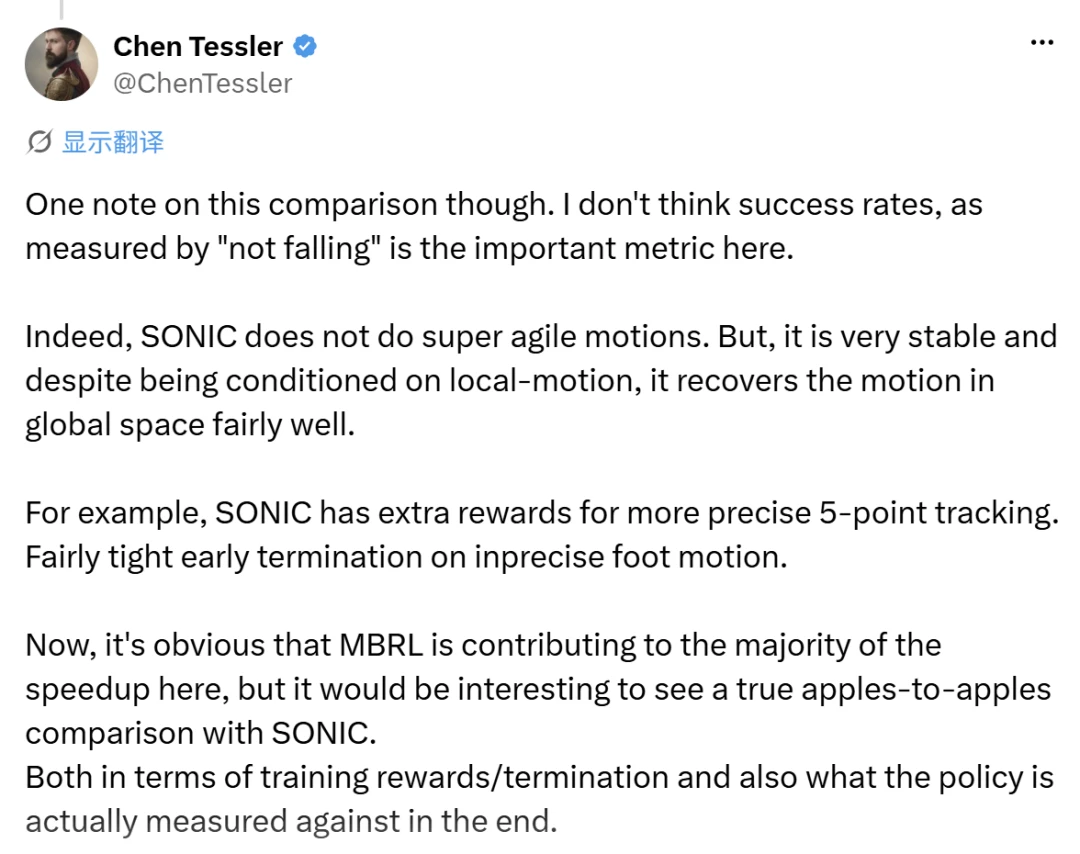
Some have also expressed dissent regarding SuperMimic or some of Qiaoyuan Liao's views. Chen Tessler, a scientist at NVIDIA's Tel Aviv Lab who helped develop ProtoMotions, MaskedMimic, and CALM, added that using the robot not falling as a measure of success in real-world tests cannot be considered a key metric. He believes that while SONIC cannot perform highly agile movements, it is highly robust, and even when conditioned on local motions, it can reconstruct the motions in global coordinates. He also stated, "The speed at which everyone has adopted and reproduced this work makes me more convinced that the conference system is broken... community scrutiny is 100 times more important than peer review, and has 100 times more impact."
Liao also argues that any online optimization used for low-level control—inverse kinematics (IK), inverse dynamics (ID), and model predictive control (MPC)—should be abandoned. Reinforcement learning policies can fundamentally achieve more precise and robust tracking, and adaptively handle unknown disturbances and uncharacterized noise, especially on low-cost hardware. Some researchers have expressed uncertainty about this.

Currently, peers have already reproduced this research. Chong Zhang, a Ph.D. student at the AI Center at ETH Zurich, has publicly released a reproduction project on GitHub, stating that using Claude on a single RTX PRO 6000 GPU for only about 1.5 GPU hours achieved similar results. He believes it learns the full state, acting as a faster, differentiable equivalent to Isaac Sim.
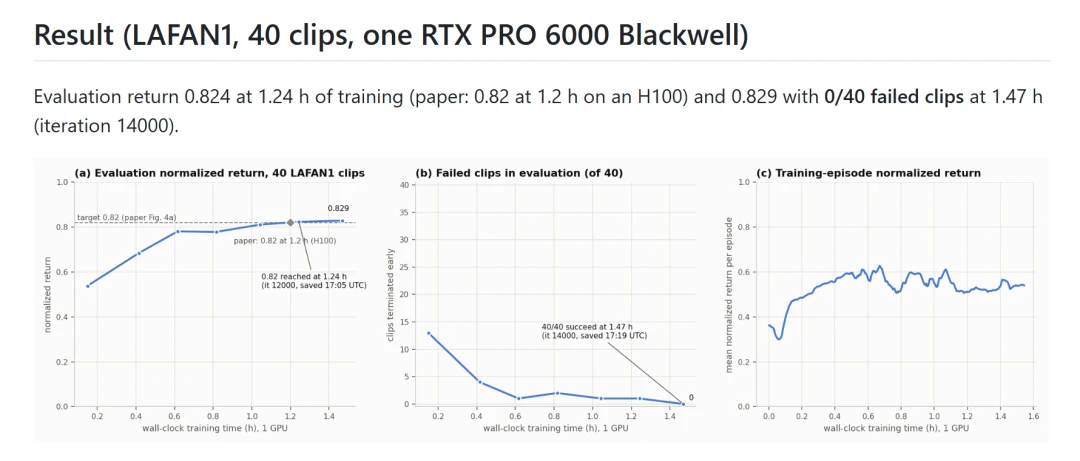
Other peers have also publicly shared reproduction results on Chinese social media, expressing astonishment at SuperMimic's training efficiency, with related posts going viral on Xiaohongshu.
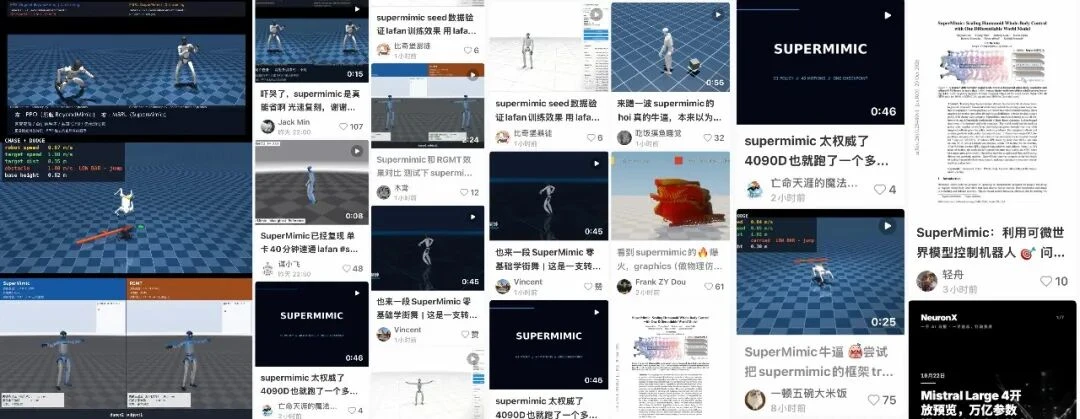
As of press time, additional teams are intensively working to reproduce SuperMimic to verify the breakthrough value of this research and transition it into practical applications.

Early signs of convergent breakthroughs emerge
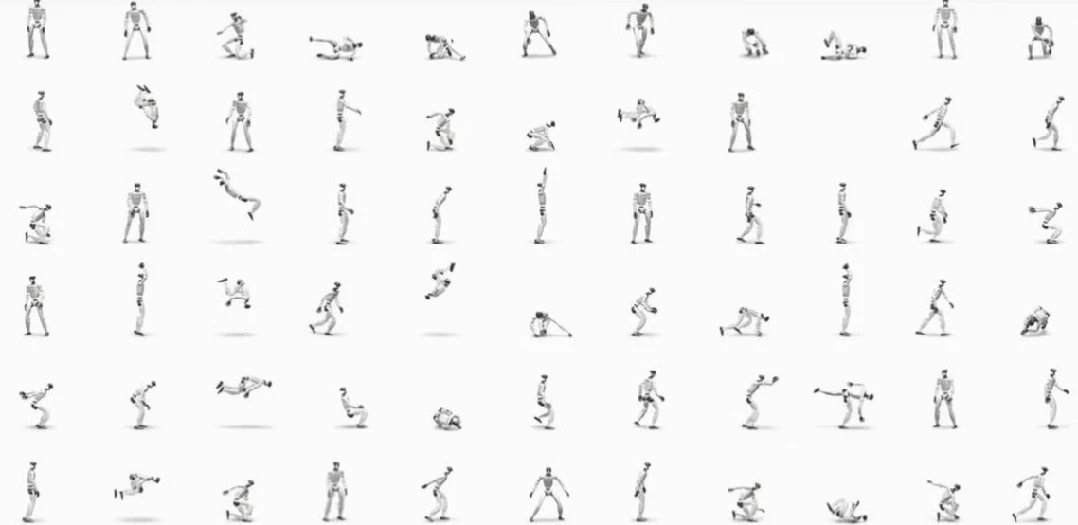
Observing the technological trends in embodied AI over the past few months, it is evident that multiple approaches—including world-action models (WAM), vision-language-action models (VLA), and joint-embedding predictive architecture (JEPA)—have made significant progress, with reinforcement learning (RL) not far behind. These approaches tackle robot body coordination, task understanding, and self-correction from different angles, drawing on and overlapping with one another. Placing SuperMimic back into the broader embodied AI research landscape, it strengthens a fundamental yet critical capability in the current robotics industry: training a robot's physical coordination and control at a manageable cost.
Currently, tight computing power demands and scarce resources in China are objective realities. SuperMimic’s major breakthrough in robotics lies in robot body training—specifically, the training efficiency and scalability of whole-body control. This technology is expected to significantly alleviate GPU computing resource constraints surrounding robot body algorithms. When extended to perceptual whole-body control, combined with other models, and tested for generalization across various scenarios, it holds substantial potential. It provides a markedly more economical approach to computing resources that were once prohibitively expensive, enabling more diverse movements, more frequent experiments, and more systematic comparisons. Moving forward, what will truly determine how far robots can go is their performance in novel interactions, new terrains, and real-world tasks. Examples include navigating complex terrains, executing whole-body contact with objects, achieving cross-robot transfer, and maintaining long-term reliability in real-world settings. The team notes that future research will incorporate real-robot data and online system identification into model training. Overall, amid the cutting-edge advancements currently being made in embodied AI, an emerging technological trend points toward convergent breakthroughs in both models and robot bodies.
Coincidentally, Unitree CEO Xingxing Wang also publicly stated at recent events, including the China International Industry Fair and the 2026 World Physical AI Conference, that physical AI is highly likely to accelerate its arrival within the next one to two, or two to three years. Today, it seems that only faith can do justice to the rapid technological progress in the AI field. Perhaps more pragmatically, we should remain hopeful about robotics and maintain strong confidence in the brilliant young Chinese students, researchers, and scientists working around the world.

The gap between human society and artificial general intelligence (AGI) is closing. Who knows? Perhaps in the blink of an eye, AGI will be as real as the ocean behind us.