
Generalists vs. Specialists: The IROS 2026 Debate on the Future of Robotics
From September 27 to October 1, the 39th IEEE/RSJ International Conference on Intelligent Robots and Systems (IROS 2026) was held at Da Wei · Lao Lun Si Hui Zhan Zhong Xin.
The last time Pi Zi Bao hosted IROS was 31 years ago, in 1995. Over those 31 years, CMU turned robotics research into a signature strength there, and the old 'Steel City' earned the nickname Roboburgh( Ji Qi Ren Zhi Cheng ). The conference chair for this edition is Howie Choset of the CMU Ji Qi Ren Yan Jiu Suo.
First, a note on core paper acceptance. This year’s IROS received 4,348 submissions, setting a new all-time high, with 1,585 papers ultimately accepted—a rate of approximately 36%. Meanwhile, the shortlist for the coveted Best Paper and Best Student Paper awards contains only 10 entries.
From 4,348 to 1,585, and then filtering down to 10 from that 1,585: this increasingly narrow funnel precisely reflects the current state of the robotics circle—rising enthusiasm alongside rising thresholds.
By convention, these 10 shortlisted papers should be the main focus of coverage. At Pi Zi Bao, we have been speaking with authors of several shortlisted and award-winning works, discussing how they identified and framed their problems, and how they refined an initial idea into a robust result. Much of what they shared goes beyond what appears in the papers themselves, and we will publish these conversations in separate articles.
In fact, beyond these excellent academic contributions, the liveliest part of IROS lies outside the papers, in the numerous roundtable forums and panel discussions. In these sessions, pleasantries are rare; exchanges between speakers and the audience are often spirited and debate-driven.
Therefore, this article will focus more on these spaces where candid insights tend to emerge. Specifically, we will delve into three key discussions that follow:
- Whether the future of robotics lies in generalists or specialists.
- How laboratory technologies can become viable businesses.
- How industry views robotics and what kind of talent it seeks.
Three discussions, three directions: debates on technical routes, questions of commercialization, and industrial needs. No matter how the topics shift, the consensus remains that embodied AI does not lack good papers; it lacks people who can turn papers into products and products into businesses. Thus, beyond being an academic conference, this year's IROS also served as a review of the entire industry, with everyone gathering in Pi Zi Bao to discuss where robotics should go next.
Generalists or Specialists?
The debate over whether robots should be designed as generalists or specialists nearly filled the main hall, which seats nearly 1,000 people. The audience consisted roughly of half students and half faculty, along with a small group of investors and startup founders, making it arguably the most heated debate at IROS.

Normally, a good debate involves back-and-forth exchanges and results in some change of perspective. However, after two votes, the proposition "robots should be specialists" received the approval of the majority of attendees. Despite a full day of debating, opinions remained unchanged.
Notably, the lineup of supporters for each approach was largely defined by age. The generalist side featured Georgia Chalvatzaki (Da Mu Shi Ta Te Gong Ye Da Xue), Katerina Fragkiadaki (CMU), Xu Hua Zhe (Qing Hua), and Philipp Wu (CEO of XDOF). These are mostly outstanding young scholars who came of age during the foundation model era, focusing their discussions on the upper limits of foundation models, data scale, transfer learning, and generalization.
The specialist side included Nancy Amato (UIUC, former president of IEEE Ji Qi Ren Yu Zi Dong Hua Xue Hui), Matt Mason (former director of CMU Ji Qi Ren Yan Jiu Suo), Fu Tian Min Nan (Ming Gu Wu Da Xue, former IEEE president), and Yu Sun. All of them are veterans who have spent decades working on motion planning, grasping, and mechatronics.
Young people bet on scale, while veterans calculate production line viability. The audience closed this generational debate with two votes.
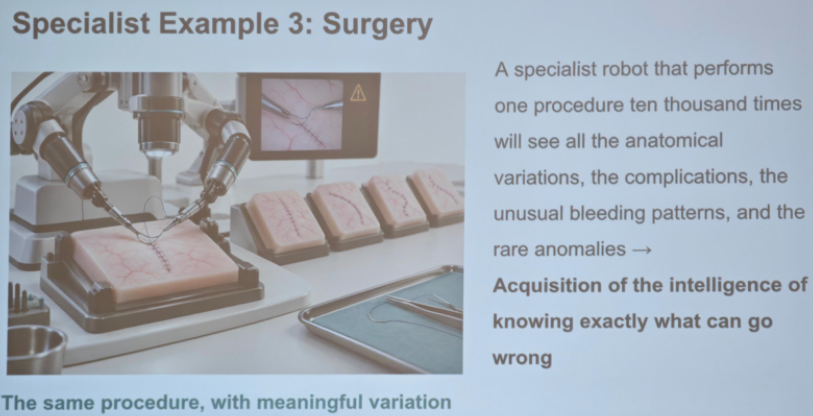
Where do specialists win? In specific scenarios. Surgery, manufacturing, and hazardous environments—these are solid examples provided by the specialist side. For surgery, performing the same procedure ten thousand times means encountering every anatomical variation, complication, and abnormal bleeding pattern; this intelligence, which knows where errors might occur, is what specialists purchase through repetition. On site, the specialist side posed a counter-question: If you were lying on an operating table, would you want a general-purpose robot to perform your surgery?
"Manufacturing" has always been the traditional stronghold of robotics. Jigs and conveyor belts on production lines are themselves forms of intelligence. When facing known tasks, eliminating unnecessary variability is undoubtedly more valuable than adding capabilities that the line will never use.
Beyond these hard demands in real-world scenarios, Matt Mason from the specialist side also critiqued generalists from a philosophical perspective: "Should all robots be generalists? It's like asking: Should all animals be human? I don't think that's a good idea, right?"
Behind this analogy lies a Western narrative logic rooted in the history of science. Mason stated that scientific revolutions often act as "decentralizing events." Before Copernicus, humans truly believed they lived at the center of the universe, with everything revolving around them. Later, we discovered that the sun is not the center either, and the universe has no center; we are merely an insignificant speck within it. With each such revolution, humanity's understanding of its own position becomes more humble.
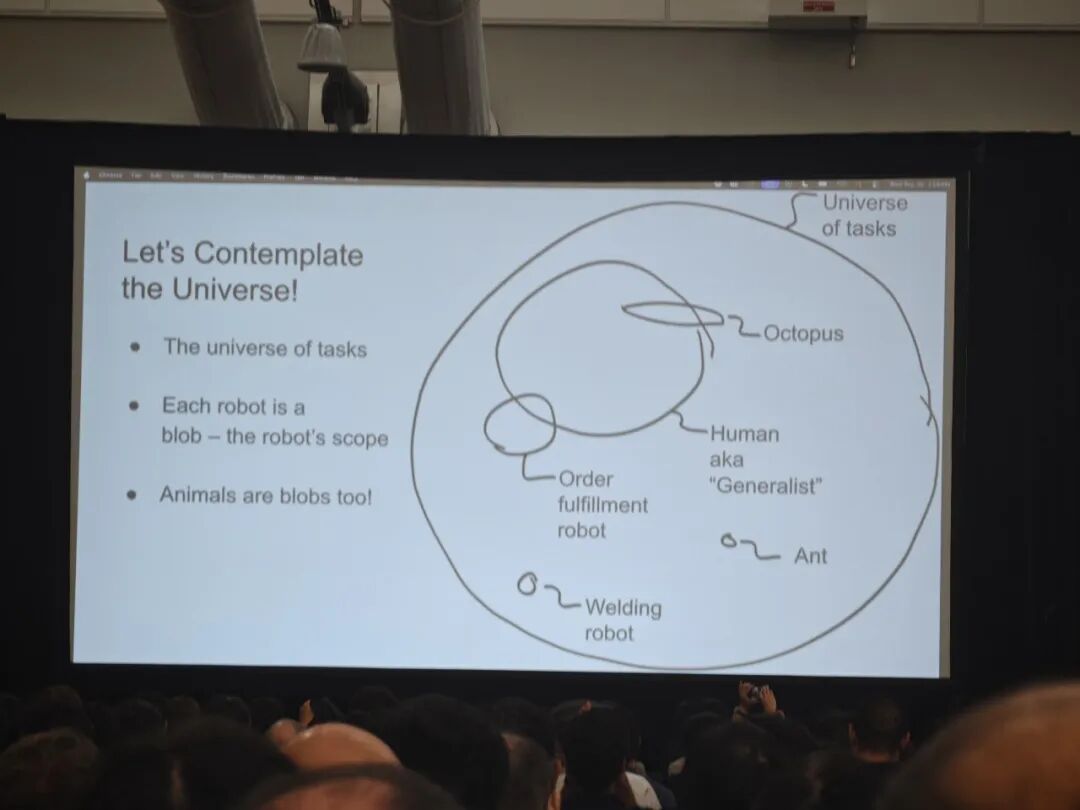
He presented the "task universe" diagram to show the audience that humans are not omnipotent generalists either. Each person is limited by their physical form and training, excelling only in certain things. "I'm not even sure the term 'generalist' holds up," Mason said. "If you want to debate whether robots should be humanoid, that is a clearly defined proposition open to debate. But the word 'generalist' is confusing."
From debunking anthropocentrism to directly deconstructing the premise of the debate itself, he became almost the most convincing speaker using analogies in the room.
The debate was heated, and the generalists were not just shouting about scale. Philipp Wu, CEO of XDOF, presented the most radical narrative. He argued that specialized algorithms and systems are merely a temporary detour in robotics history, akin to standalone GPS devices, cameras, and iPods before the smartphone era, which were eventually consolidated into a single universal terminal.
Meanwhile, the AI field holds a "bitter lesson": the most effective methods are always those that can scale and fully leverage compute power. Philipp Wu added a corollary for robotics: the most versatile hardware will also be the most effective hardware. During the free debate, he even pushed back against some of Mason’s points, saying, "I don’t actually think specialists are necessary. In an era without drills or robotic arms, humans thrived because we are generalists." He boldly predicted that within five years, shipments of humanoid or semi-humanoid general-purpose robots will exceed those of industrial robots.
Xu Hua Zhe, representing the generalist side, delivered the sharpest rebuttal with a single slide. The image suggested that specialized software would ultimately become mere "Excel spreadsheets on a computer," while hardware prices would revert to "weight multiplied by metal unit cost." His message was clear: don’t build Excel; build GPT. He added another argument for generalists as a contingency measure: Before the iPhone emerged, no one knew they needed it. Specialized systems optimize for imagined needs, but real-world demands often require general-purpose systems to handle them effectively.
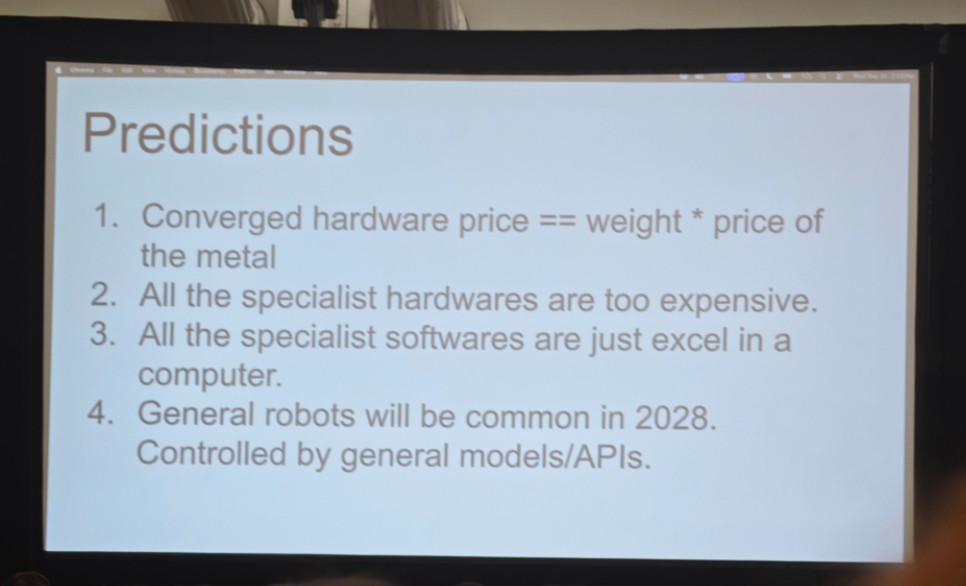
Yu Sun, representing the specialist side, pushed back immediately: specialized robots will continue to dominate, at least for the next decade. "Nothing will happen in 2028!" he declared.
During the open debate, Georgia challenged the specialists: their solutions assume there is always a person nearby to reassemble the robot, change interfaces, or swap fixtures, but such personnel may not always be available. With labor shortages in caregiving and manufacturing already evident, she asked, where will you find so many "in-the-loop" human operators over the next twenty years? Yu Sun responded that full automation is not humanity’s ultimate goal. "I won’t say humans are the center of the universe, but in factories, we are the center."
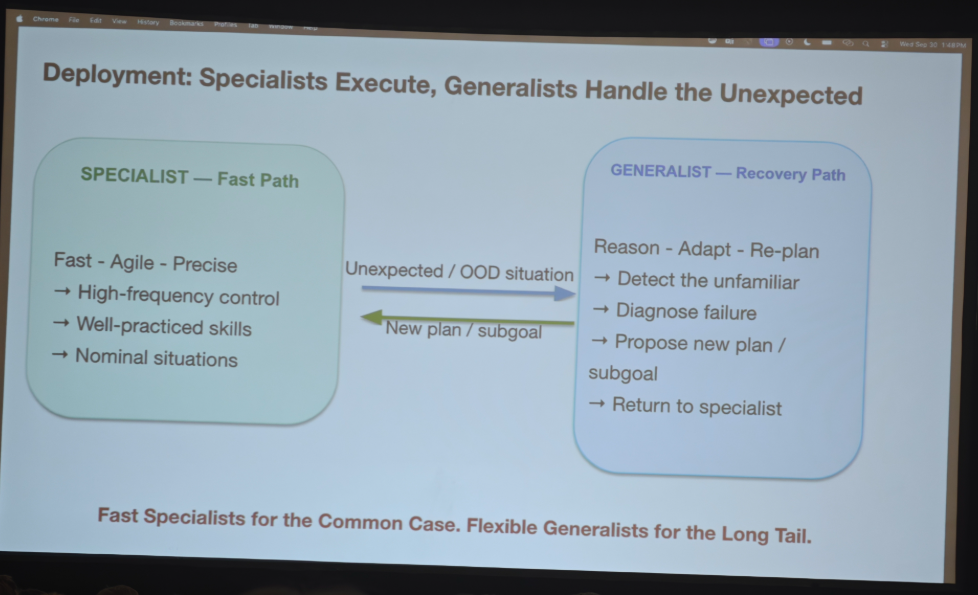
By the end of the debate, both sides had converged on a similar architecture. Katerina Fragkiadaki, from the generalist camp, presented a deployment division-of-labor diagram showing that specialists handle routine fast paths, while generalists infer, diagnose, and replan during unplanned events, before handing control back to specialists. The generalist narrative also included using general models to call robotic tools, breaking long-horizon tasks into sub-tasks, and training specialists for each specific sub-goal.
Yu Sun, representing the specialists, also outlined a nearly identical vision in his predictions: future systems will connect general-purpose perception and scheduling capabilities to task-specific skills, ontology, tools, and safety controllers. Someone tried to smooth things over, saying, "I think you might be expressing the same opinion quite intensely."
Clearly, future robots will be neither purely generalists nor purely specialists; they will resemble a brain that understands the big picture, accompanied by a team of specialized hands. As for who serves as the brain, two votes indicated that practitioners in attendance were more inclined to trust the veterans' answers. In other words, the on-device brain doesn't need to do everything; it just needs to know when to call whom into action.
Turning Technology into Business
This year's IROS also featured a roundtable discussion that likely interested most attendees, titled "Robotics Entrepreneurship and Spirit." The lineup was equally impressive.
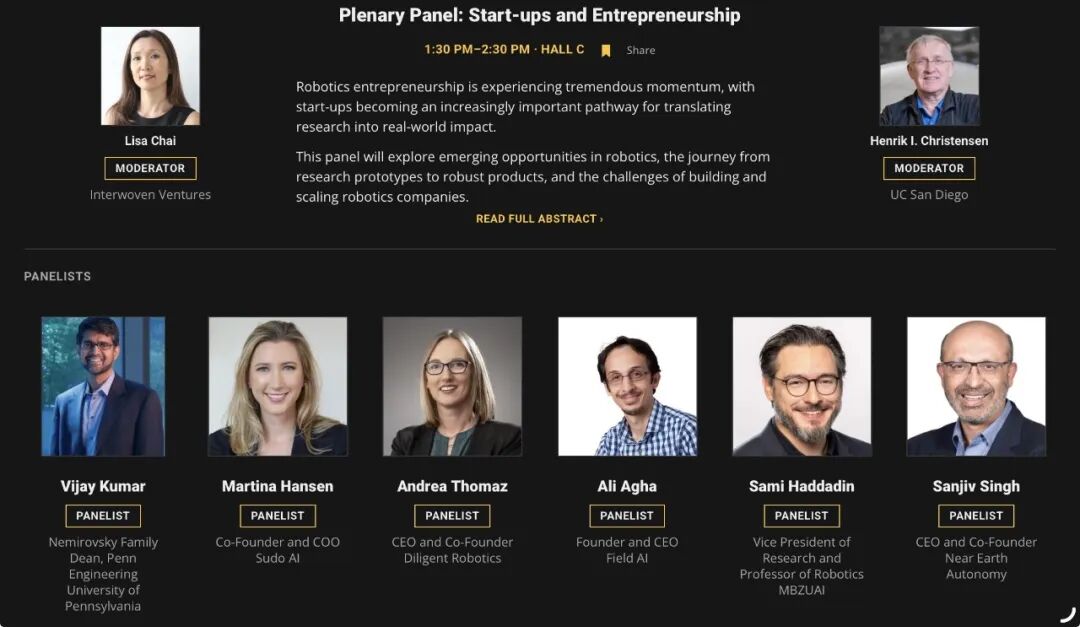
Vijay Kumar is a flagship figure at Bin Xi Fa Ni Ya Da Xue, with a name so frequently cited in the drone field it borders on cliché. Beside him sat Sami Haddadin from Mu Ni Hei Gong Ye Da Xue, the mind behind the famous experiment where a robot arm took hits without retaliating. Andrea Thomaz works with Diligent Robotics in hospital settings, Ali Agha is at Field AI, Sanjiv Singh is CEO of Near Earth Autonomy, and Martina Hansen comes from Sudo AI. The two moderators were Lisa Chai, who covers robotics investments at Interwoven Ventures, and Henrik Christensen, a leading figure in robotics research at UCSD.
The moderators set a sobering tone right at the start of the roundtable: "Not every piece of research should become a startup."
The starting point for entrepreneurship is the customer, not the technology. Academic pursuits seek "broad applicability," while companies need customers who are "impatient." Near Earth Autonomy found its true landing spot in mining, where robots are needed to enter hazardous environments; Diligent Robotics entered hospitals after discovering nurses were bogged down by low-value tasks. Therefore, it is crucial to distinguish whether you are pushing technology to the market or if the market is pulling your technology forward.
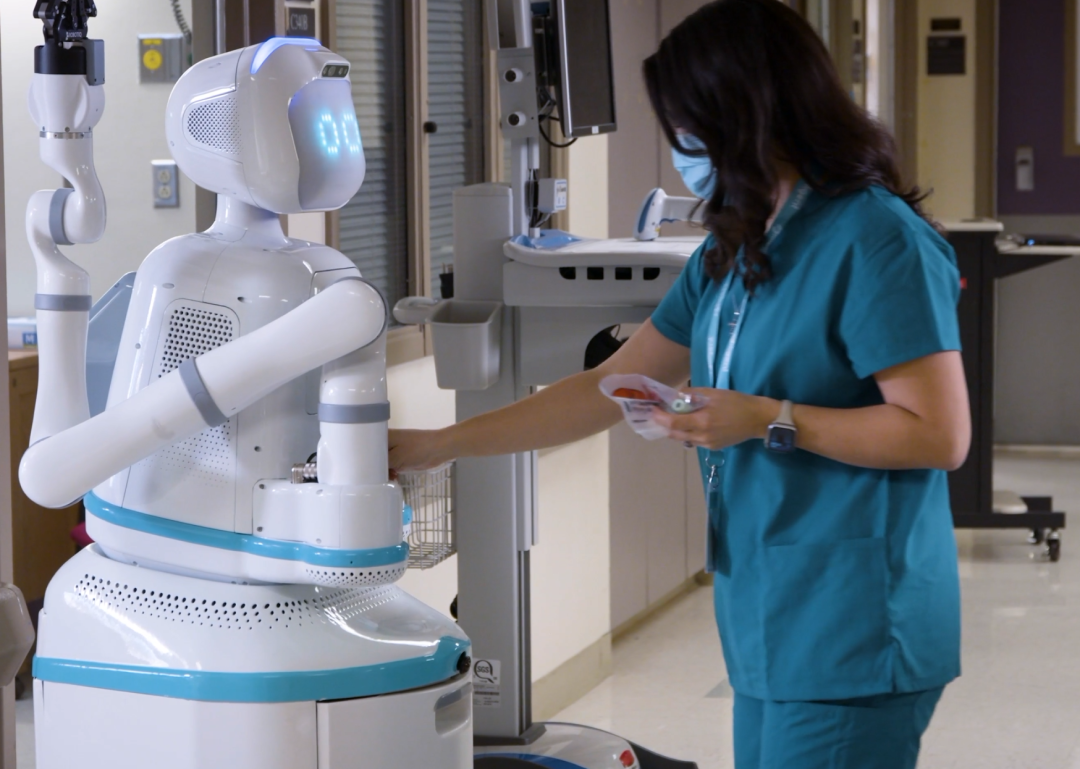
A prototype needs to run successfully once; a product must run ten thousand times. Unlike a demo that succeeds on its first try, a product requires repeated stable operation, maintainability, integrability, and on-site support. A 99% success rate sounds impressive, but in high-frequency workflows, it translates to one failure or manual takeover every few dozen cycles. Transitioning from prototype to product also means navigating the swamp of manufacturing, supply chains, regulations, and services—areas where researchers are often untrained.
The panelists’ advice is to start with a sufficiently focused scenario: select a narrow problem, collect appropriate data there, validate algorithms, and prove value. Only after gaining a deeper understanding of scaling conditions should you gradually expand, rather than attempting to deploy a general-purpose platform from the outset.
Turning technology into a business is hardest when answering “who pays, and how?” The consensus among guests was that while customers clearly prioritize return on investment, organizations typically categorize expenditures as capital expenditure (CapEx) or operational expenditure (OpEx). Customers may hesitate to purchase expensive equipment due to fears of obsolescence within a few years or assets sitting idle in storage. When feasible, charging for outcomes or services aligns pricing with the actual value delivered.
For example, mapping services can be billed by area or volume, and transportation services by distance and weight. However, service-based billing also means the startup must manage system operations and support. While this approach can help validate value early on, companies must ultimately ensure their unit economics support scalability.
The roundtable also discussed Robotic-as-a-Service (RaaS). Although customer acceptance has grown due to low upfront costs and the ability to halt deployments if they fail, RaaS hides a cash flow mismatch risk for startups: heavy initial hardware deployment costs versus limited annual service fees. This creates a situation where reported revenue does not translate to sustainable cash flow, requiring substantial capital backing. Another B2B nuance exists in healthcare settings: nurses use the robots, but other departments handle procurement. Thus, startups must win over three parties simultaneously—the end user, the budget holder, and the procurement approver.
On the topic of fundraising and professor-led entrepreneurship, the host raised a question of interest to many: “Should academic founders conduct customer interviews, secure letters of intent, launch paid pilots, or generate revenue before seeking funding?”
In fact, the guests noted there is no single correct answer. However, the most compelling market evidence has shifted away from traditional surveys or letters of intent toward customers willing to pay for pilots, as financial commitment is the sincerest expression of interest.
It is worth noting that currently only a few companies can raise large sums of capital based on vision alone. Most should follow an intermediate path: build evidence, understand the market, and raise just enough to reach the next milestone.
Regarding company composition and management, panelists suggested that professors can start with small ventures to test opportunities, but as the company scales, full-time leadership becomes essential. A CEO cannot indefinitely split time between university and the company, which also risks student conflicts of interest. Teams must be complementary, covering technology, hiring, and articulating market value; for robot deployment, this includes understanding the internal structure of client organizations.
On turning technology into a business, the roundtable consensus was that technology is merely an entry ticket. Whether customers pay, products run stably, cash flow holds up, and teams can translate technology into market language—these non-technical factors determine whether research reaches the 'company' table.
Robotics and Talent Demand in Industry
During industry discussions, a guest from Te Si La responsible for a fleet of mobile robots mentioned operating 100 units for eight hours a day. The core metric tracked is the 'autonomous operation ratio,' which directly corresponds to the frequency of human intervention.
Interventions fall into two categories: engineering interventions address defects in the robots, models, or data themselves, while operational interventions handle environmental issues. Progress is measured by a reduction in these interventions. As one guest noted, if they are constantly called in to fix problems, it indicates a systemic issue. This pragmatic standard often reflects industrial reality more accurately than success rates reported in academic papers.
Of course, sustaining a full eight-hour shift is far from a solved problem. Unlike humans, robot hardware does not recover from fatigue and requires maintenance. One guest stated that if he could choose only one capability, he would give robots a powerful memory system and the ability to learn from it—specifically, the capacity to diagnose failures and self-recover.
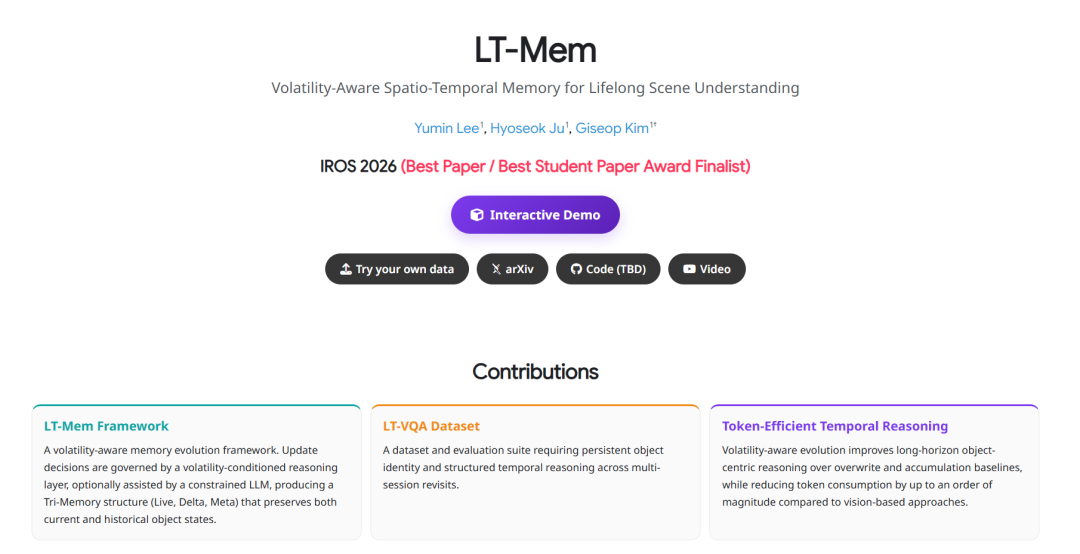
The Best Paper Award at IROS this year went to Yumin Lee, Hyoseok Ju, and Giseop Kim for their work titled LT-Mem: Volatility-Aware Spatio-Temporal Memory for Lifelong Scene Understanding. This award highlights the industry's intense focus on long-term memory and learning capabilities in robots, potentially pointing the direction for future academic research in the field.
We often hear that most in academia believe the arrival of general-purpose robots is just three to five years away. The industry, however, is not uniformly optimistic; it appears more cautious.
Regarding continuous 24-hour operation, one guest candidly admitted, "We haven't achieved that yet." Others noted that Bao Ma factories do have robots running on their lines. But for robots to enter every household like robot vacuums, it may still take a decade.
One scholar used robot vacuums as an example: similar products existed ten years ago, but users were dissatisfied. Today's new models are "very reliable; my wife is very satisfied with them at home, and we no longer use other vacuum cleaners."
Will humanoids follow the same path? No one can give a simple answer. One scholar took a roundabout approach using chairs: a single chair type has at least 500 standards covering its various aspects. Time makes these standards "effective" because people collectively agree on them. But how do we know autonomous vehicles are reliable? There is no simple answer. How do we know humanoids are reliable? There isn't one either.
The reason is that static, deterministic things are easy to standardize, while dynamic, uncertain, and constantly changing systems are much harder. From an industry perspective, they argue and call for standard-setting as a form of civic participation, including joining standards organizations, collaborating with peers, and pushing methods through voting. Humanoids are currently not strictly regulated, which presents a window period to begin establishing standards.
Since many industry professionals were present, some asked about their views on talent. Indeed, those who have navigated the industry themselves see talent differently.
A recruitment-focused guest stated directly, "We don't focus much on the number of papers; we value the quality and depth of work. We ask detailed questions to confirm whether you truly understand it." In the agent era, agents might create a false sense of accomplishment, so standards need new meanings: "But you must control the work and verify its results." He added advice for anxious students: spend more time thinking through problems thoroughly rather than just pitching yourself.
A nearby doctoral student offered a more grounded suggestion, arguing that researchers should not focus solely on models but also start building benchmarks. He noted that a well-designed benchmark reflecting key problems does not necessarily require massive amounts of data, yet it can serve as a viable entry point into research.
Another professor who supervises students also set a standard: achieving a memorable "Grand Slam" (a landmark achievement), publishing in a reputable conference, open-sourcing the code, and responding to challenges. Another emphasized the importance of disseminating one's work, as a single paper is too easily overlooked. "If you don't share it, others may never know about your results." Clear videos, websites, public papers and code, and training instructions are all ways to make your work visible.
In summary, while academia may anticipate the robot's "moment" within three to five years, industry practitioners prefer to first establish reliability, standards, and a robot capable of stable operation before discussing other matters. This perspective also shapes their view on talent: in the agent era, what is truly scarce are individuals who can master tools, thoroughly analyze problems, and know how to showcase their achievements.
**Final Thoughts
Thirty-one years later, IROS has come full circle to Pi Zi Bao. This city's evolution from steel to robotics mirrors the path of the robotics industry itself: moving from heavy, solid, and deterministic things like traditional robotic arms to light, soft, and uncertain entities such as embodied AI brains.
But after summarizing the week's discussions, it becomes clear that people are once again focusing on the "heavy" issues: discussing production line cycle times, eight hours of continuous operation, who pays, and standards and responsibilities.
Losing two votes to specialists does not mean the failure of the generalist narrative; rather, it reflects a self-correction within the robotics industry. No one doubts the upper limits of foundation models, but when lying on the operating table, no one is willing to pay for those upper limits either. Interestingly, the architecture diagrams drawn by both sides at the end of the debate were nearly identical: a brain that understands the big picture, accompanied by a group of specialized hands.
The roundtable and forum also contain grounded perspectives worth pondering. Technology is merely the entry ticket; customers, cash flow, and reliability are the chips at the table. The "autonomous operation ratio" metric from the Te Si La team is more significant than success rates reported in papers.
The Best Paper Award went to a work focused on long-term memory, signaling that academia is listening to industry. Robots need the ability to recover from failure more than they need another stunning demo.
The temperature difference between 'academia says three to five years' and 'industry says ten years' may be a healthy sign: researchers are responsible for optimism, while business people are responsible for calmness. The fact that these two groups sit in the same conference hall arguing seriously is perhaps the best indicator of an industry's maturity.
Pi Zi Bao was a steel city 31 years ago; today, it is a robotics city. This city understands a simple truth: truly valuable things are forged through endurance. Robotics does not lack good papers or smart brains; what it lacks are people who can simmer papers into products, products into businesses, and businesses into standards.
When IROS returns next time, we hope the robots we discuss now will be quietly running for eight hours straight in the places that need them.