
After Valuation Exceeds 10 Billion, This Robotics Company Unveils the 'Fastest' World Model
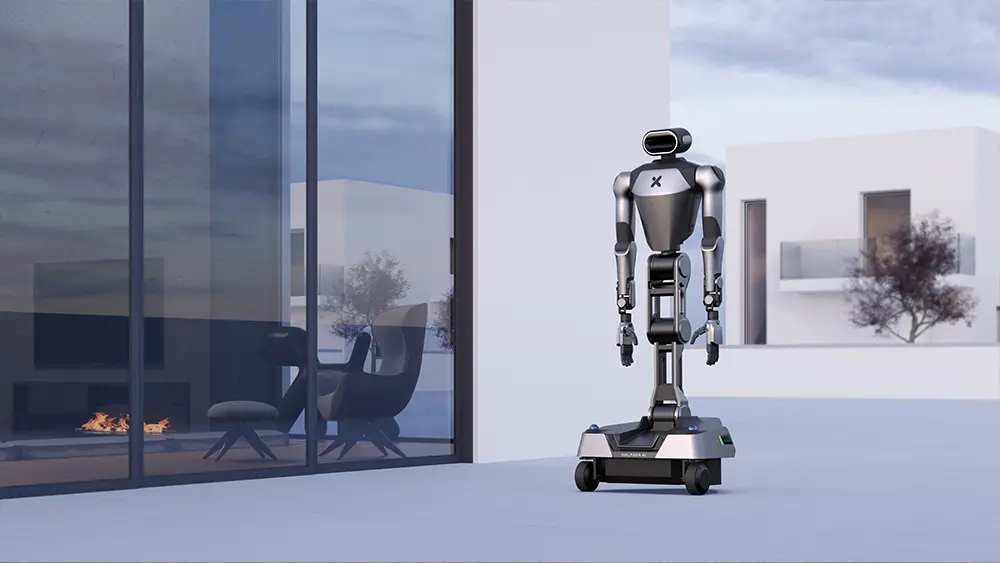
On the path to deploying robots for real-world tasks, World Models (WM) are widely regarded as a higher-potential technological trajectory. However, as the industry gradually reaches a consensus on this paradigm, Xinghai Tu's team has released its world model research成果, Fast-WAM. This breakthrough not significantly enhances robots' reaction speeds but also raises a direct question:
"Does WAM (World Action Model) really need to imagine before acting? Where does its capability truly come from?"
Over the past one to two years, the industry has gradually formed a relatively clear pathway from WM to WAM, involving perception, internal modeling, imagining the future, planning actions, and execution.
Based on these steps, many mainstream WAMs follow a unified "imagine first, then act" paradigm. During the inference phase, the model generates future video sequences based on current observations and action candidates, evaluating the optimal action among these imagined futures.
The intuition behind this method is easy to understand and appears highly logical. However, if every movement requires generating a video to evaluate which action is optimal, compounded by latencies of hundreds of milliseconds, its practicality in real-world scenarios requiring real-time response would be severely compromised.
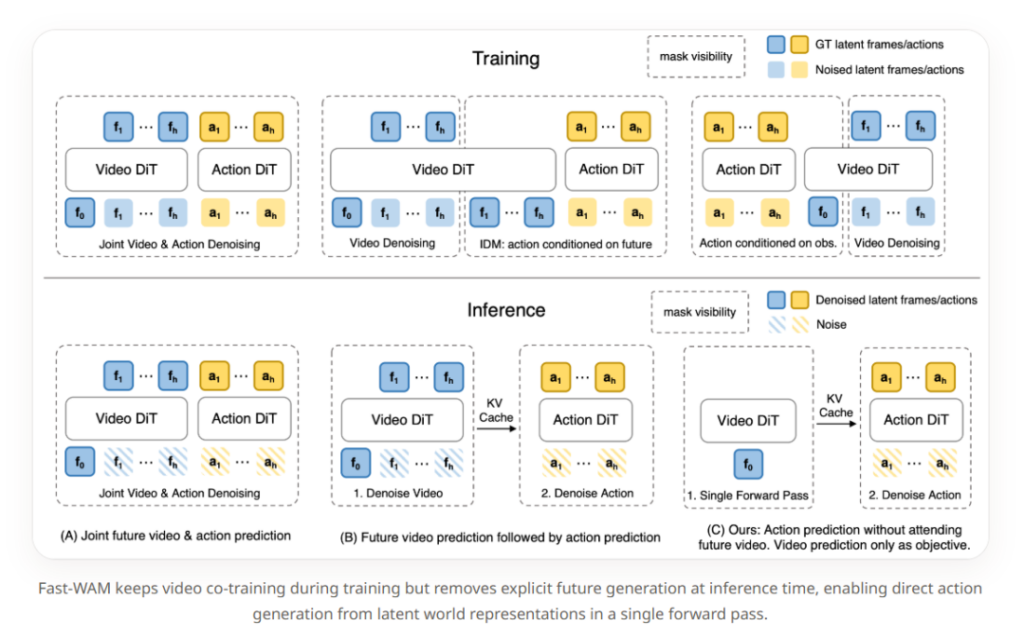
Addressing these issues, Fast-WAM offers a different answer: robots can skip future prediction during the inference phase and do not need to think before acting. Moreover, the power of world models lies in their video modeling capabilities, rather than the video generation process itself.
However, if the reasoning phase no longer imagines the future, what remains of a World Model, and how does Fast-WAM ensure that performance does not degrade?

Deconstructing the World Model
In traditional WAMs, video prediction serves as both the training objective and the inference mechanism, with these two functions tightly coupled.
The emergence of Fast-WAM involves decoupling these intertwined processes of training and inference.
- Training Phase: Fast-WAM retains the core function of a world model: modeling world dynamics. During training, it still takes current observations and actions as input to predict future visual changes. However, the focus here is not on generating videos per se, but rather using video prediction to enable the model to learn the causal structure and physical laws of the world.
- Inference Phase: When executing tasks, Fast-WAM eliminates redundant prediction branches and ceases iterative denoising. Instead, it extracts a "world representation" containing implicit physical laws through a single forward pass. The world model still exists, but no longer appears in the form of "explicitly imagining the future."
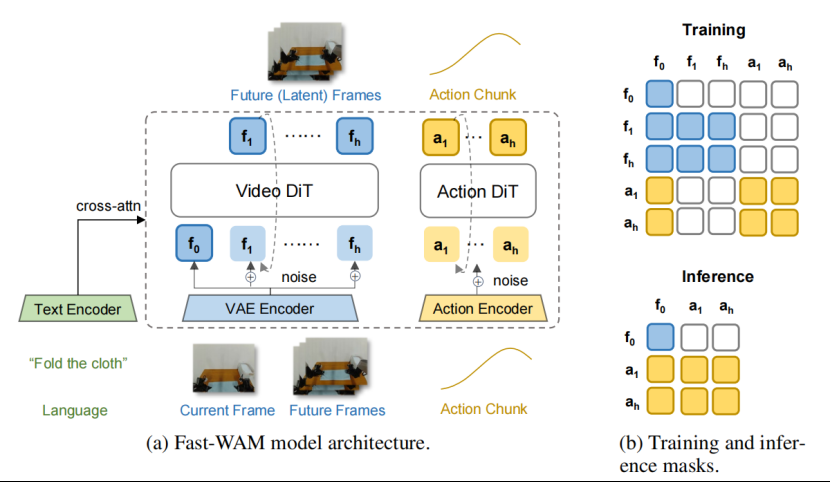
During this process, the research team conducted several control experiments, the results of which showed:
- Retains video modeling during training but removes video generation at inference; performance remains largely unchanged.
- Removing video modeling capabilities leads to a significant drop in performance.
This answers the question posed at the beginning: WAM's capabilities stem from 'learning the world,' not from 'generating the future every time.'

4x Speedup, Faster Robot Response
If the previous changes were still paradigm-level, then the most direct result of Fast-WAM is a significant improvement in inference speed.
In multiple experimental tasks conducted by the research team, Fast-WAM reduced inference latency to approximately 190 milliseconds, achieving roughly a 4x speedup compared to approaches that require imagining the future (on the order of 800 milliseconds).
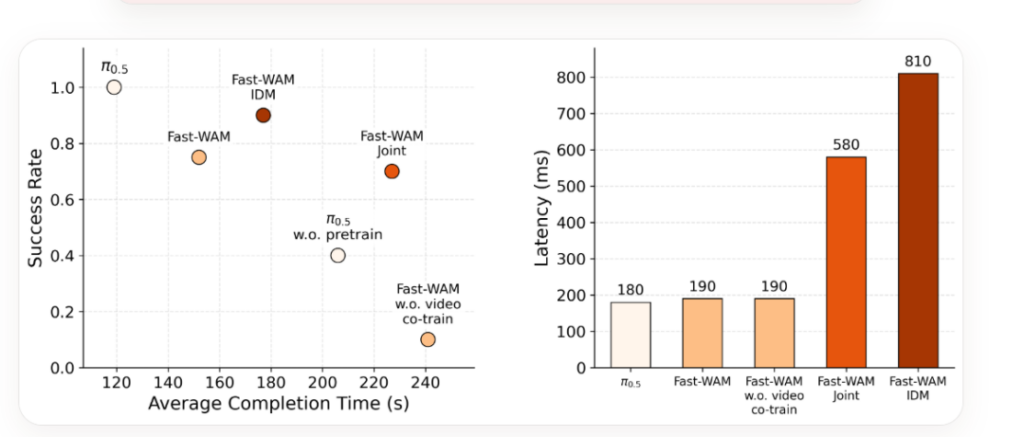
This improvement primarily comes from changes in the computational path. In traditional WAMs, inference latency is mainly consumed by multi-step rollout (expanding future trajectories) and video generation. The combination of these two factors means that each action decision made by the robot requires a round of heavy computation, and as the number of rollout steps increases, the latency grows linearly or even higher.
The acceleration of Fast-WAM essentially comes from three aspects:
- Remove multi-step rollout: change from multi-step future expansion to single-step forward prediction, eliminating one time dimension.
- No longer generate video sequences: shift from high-cost pixel-space generation to low-cost latent-space forward pass, significantly reducing computational complexity.
- Decision becomes a single forward propagation: final action selection is determined by a single forward calculation rather than a search process, making the entire system closer to a policy network.
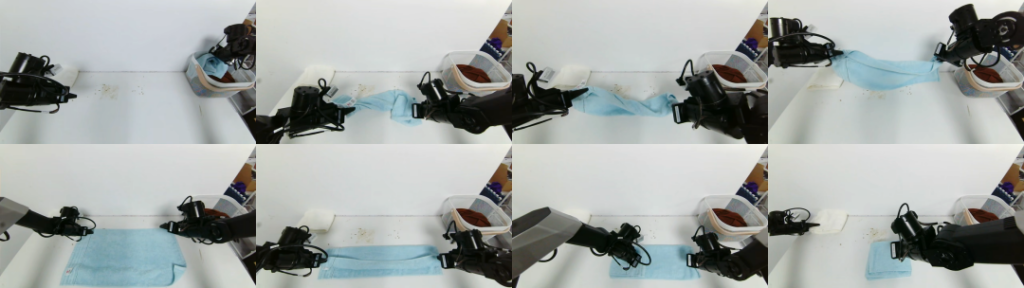
In terms of speed and real-time control, the world model approach has historically suffered from shortcomings, which is also a key obstacle preventing its deployment in real-time operation.
The problem with many world model solutions is not whether they can make correct decisions, but whether they have the ability to respond in time. After all, in constantly changing real-world scenarios, rapid adaptation largely affects the success rate of robots executing tasks.
Therefore, this 4x speedup brings the practical implementation capability that is most needed by the world model approach.

Explicit reasoning is gradually weakening
Over the past year, research on how to scale robot deployment has increased significantly. A common observation is that robots' response speeds are too slow. In this context, different technical approaches have emerged:
- One approach is the world model route represented by Fast-WAM, which skips future prediction during the reasoning stage and directly extracts a "world representation" containing implicit physical laws through a single forward pass, thereby improving reasoning speed.
- Another approach is VLA routes such as LaST₀, which choose not to rely on "explicit language reasoning," shifting the thinking process into continuous latent spatiotemporal representations. This significantly compresses the reasoning path while retaining reasoning capabilities, enabling faster robot responses.
- There are also attempts like DVA (Direct Video Action) models, where robots learn how the world changes directly from videos and then convert this predictive capability into action control, further compressing the link between perception and action.
Although their approaches differ, they are all essentially following the same trend: explicit reasoning is shifting from a necessary condition to an optional mechanism.
Compared to having a clear understanding of the problem, robots require sufficiently fast reactions and the ability for continuous adjustment in dynamic environments. Under this premise, reasoning does not necessarily need to be explicitly unfolded; instead, it can be compressed into the model itself.