

Anthropic Files S-1 for Nasdaq IPO Amid Exponential Growth and $500 Billion Compute Commitments
By Ethan
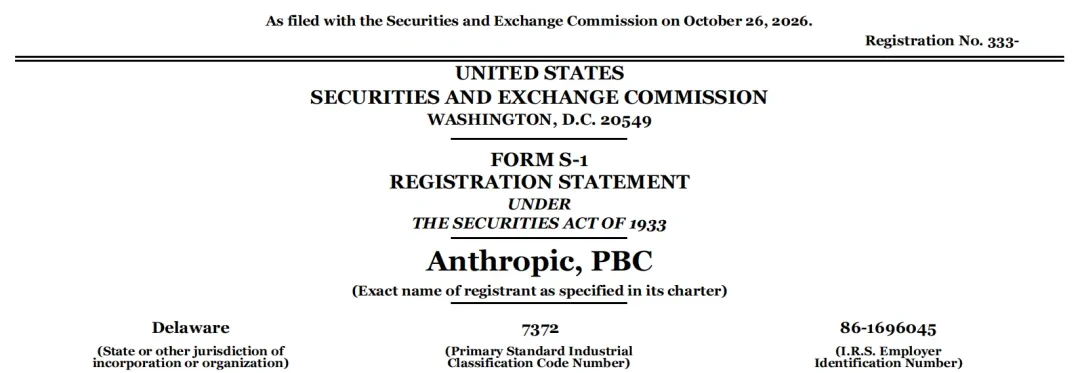
On October 26, Anthropic filed a 338-page S-1 registration statement with the U.S. Securities and Exchange Commission to list on the Nasdaq, taking the lead in the IPO race among competing U.S. AI companies.
Anthropic's Debut S-1 Filing: Exponential Growth, USD 500 Billion in Compute, and the Capital Race

On October 26, Anthropic publicly filed a 338-page S-1 registration statement with the U.S. Securities and Exchange Commission (SEC), with plans to list on the Nasdaq. This move puts Anthropic ahead in the IPO race among several U.S. AI companies, as it is the first to go public. If the IPO is completed, Anthropic will become the first U.S. AI company to list on global capital markets.
Key Takeaways:
- As of the first half of 2026, Anthropic's revenue has grown exponentially. Revenue increased from USD 41 million in 2023 to USD 4.585 billion in 2025 (a two-year compound annual growth rate of approximately 957%). In the first half of 2026 alone, revenue reached USD 16.286 billion, up 1,300% year-over-year. For the second quarter of 2026 alone, revenue hit USD 11.555 billion, up 1,368% year-over-year.
- An inflection point toward operating profitability is emerging. In the second quarter of 2026, operating profit reached USD 974 million with an operating margin of 8%, marking the company's first quarter of operating profitability. For the first half of the year, the operating loss narrowed to USD 693 million (an operating margin of -4%), while adjusted operating profit was USD 1.618 billion (an adjusted operating margin of 10%). However, achieving profitability for the full year still depends on compute costs in the second half.
- Massive GAAP losses are primarily driven by the fair value remeasurement of convertible notes. In 2025, the net loss was USD 41.965 billion, including USD -34.308 billion in fair value changes for convertible notes, derivatives, and SAFEs. In the first half of 2026, the net loss was USD 80.748 billion, including USD -72.388 billion in fair value changes. Of the accumulated deficit of USD 132.9 billion, approximately USD 113.2 billion stems from these non-cash remeasurements (about 85%).
- Unit economics have improved significantly. The ratio of compute and infrastructure costs to revenue dropped from 1,056% in 2023 to 160% in 2025, and further to 48% in the first half of 2026. Revenue per employee increased from USD 1.4 million in September 2025 to over USD 6.6 million in September 2026. The net revenue retention rate is approximately 900%.
- First detailed disclosure regarding AI technology and safety risks.
- Anthropic targets future compute capacity, initiating a capital race with massive expenditures exceeding USD 500 billion. Over the next 8 to 10 years, Anthropic will incur massive compute costs. Lease and purchase commitments already signed with companies like Google and NVIDIA total USD 417 billion, excluding an additional USD 125 billion to USD 150 billion in subsequent TPU procurement arrangements. These commitments amount to approximately 91 times the 2025 revenue. Over the same period, the company held USD 131.65 billion in cash and short-term investments, with total liabilities of USD 117.47 billion.

Business Vision and Investments
Anthropic states that this is the first time in human history that artificial intelligence has been built. Cognitive capabilities such as reasoning, analysis, synthesis, decision-making, and creation can now be scaled and invoked on demand. The abundant supply of AI will rapidly transform every sector of the global economy, exerting an impact that surpasses that of industrialization, electricity, semiconductors, and the internet. AI that fully realizes its potential while having its risks properly managed is expected to significantly accelerate global growth, greatly improve the quality of life for people worldwide, and drive breakthrough discoveries.
Rapid and sustained growth in applications has generated two self-reinforcing dynamics: an improvement loop driving Claude's progress, and an investment loop funding continuous research in frontier AI. Anthropic believes that the emergence of powerful AI will have a profound impact on human society and will be widely available within a few years. Advanced AI will exhibit several key characteristics, including cognitive capabilities that match or exceed those of top human experts across most professional and scientific disciplines; the ability to interact via text, audio, video, and direct computer control just like humans; the capacity to autonomously reason through complex tasks for extended periods, seeking clarification and feedback when needed; the ability to coordinate across multiple instances and collaborate with humans and other AI systems; and the capability to interact with the physical world by controlling laboratory equipment, robotic systems, and other machines via digital connections.
Currently, Anthropic's core business is divided into three main segments: foundational models, platform, and coding agents. Foundational models such as Mythos, Fable, Opus, Sonnet, and Haiku cover different trade-offs in capability, cost, and speed to meet diverse user needs. The Claude Platform provides capabilities for extended thinking, tool use, long context, code execution, MCP, Agent Skills, Agent SDK, and hosted agents. Meanwhile, agents like Claude Code, Claude Cowork, and the conversational product Claude.ai, along with tailored solutions such as Claude Security, Claude Tag, Claude Design, and Claude Science for scenarios spanning scientific research, design, finance, healthcare, legal, education, and government, will deliver broader public AI services to society.
Anthropic believes that the potential of powerful AI is extraordinary if it is applied to solve humanity's most difficult problems and its risks are managed responsibly. Decades of scientific progress could be compressed into years, accelerating drug discovery, disease detection, and personalized treatments. It will also advance personalized education and expert-level financial and legal advice, significantly improving the efficiency and reliability of human work, and "extending the capabilities that wealthy nations have built over generations to developing countries."

Operating performance
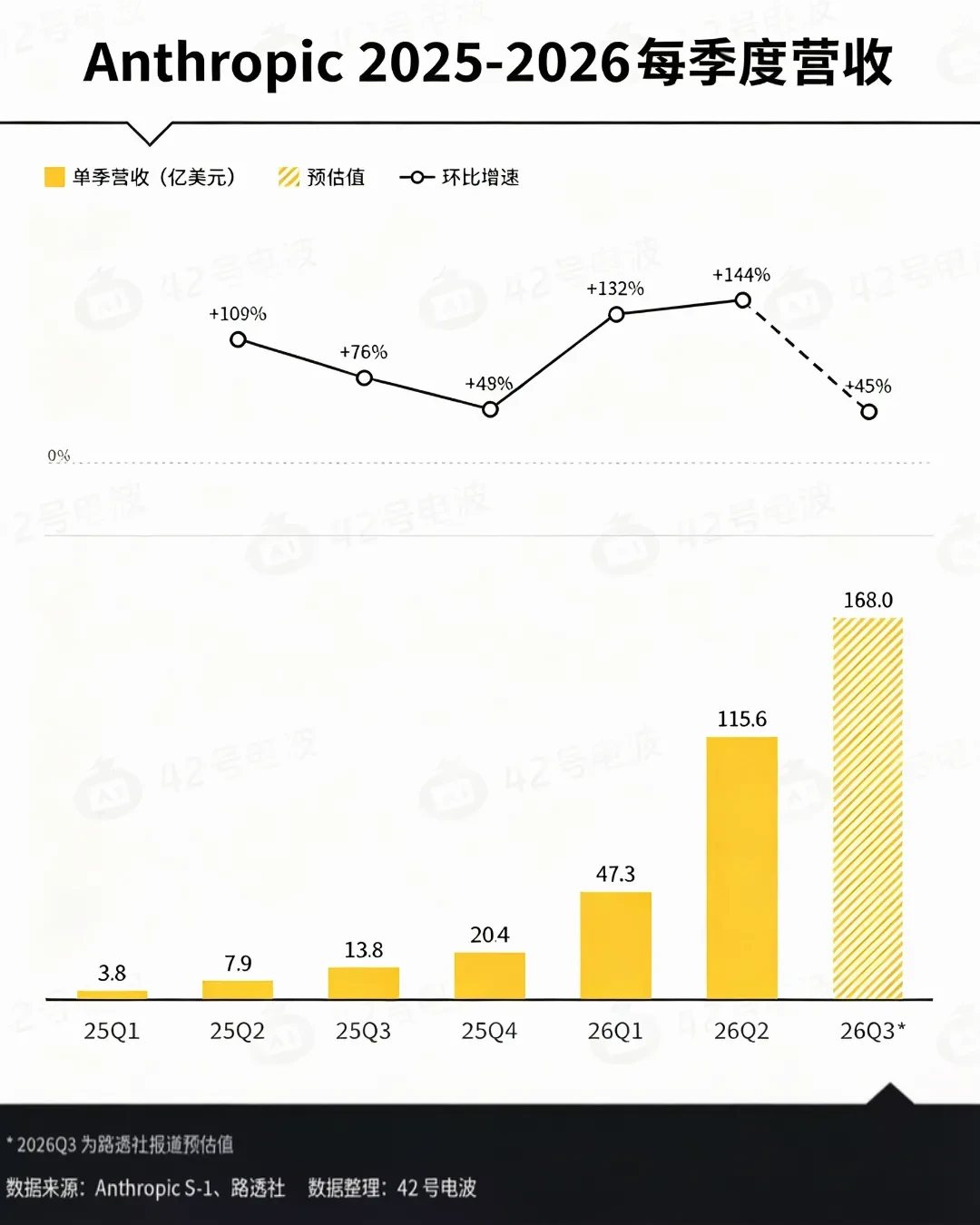
Since 2023, Anthropic has sustained double-digit and even triple-digit exponential growth, achieving a seemingly unstoppable momentum. In 2023, Anthropic's annual revenue was USD 41 million. In 2024, revenue increased to USD 386 million, and in 2025, this figure surged to USD 4.585 billion. Meanwhile, according to its S-1 filing, Anthropic's revenue in the first quarter of 2026 was approximately USD 4.73 billion, growing to USD 11.56 billion in the second quarter, a quarter-over-quarter increase of approximately 144%. Revenue in the second quarter of this year alone was nearly 30 times its full-year revenue in 2024. Reuters also reported that during a pre-IPO investor meeting held that month, Anthropic disclosed its third-quarter revenue had further increased to approximately USD 16.8 billion, a 45% quarter-over-quarter growth. Even among the tech giants born from the previous mobile internet revolution, such a growth curve is extremely rare.
Over the past few years, the most critical practical issue in the AI industry has been the commercial application of technology—specifically, how many users are willing to pay for model capabilities. This deeply impacts corporate valuations and IPOs, yet its specific metrics differ from those of traditional Software as a Service (SaaS). Traditional SaaS software typically charges subscription fees based on user seats, whereas Anthropic's business depends largely on the actual intelligent services provided by its models. Customers access Claude via APIs or cloud platforms, paying based on metrics such as the number of input and output tokens. A token is the basic unit of measurement used when a model processes text and other content. As a single task involves more reasoning, tool calls, context, and execution steps, the actual computational consumption also changes.
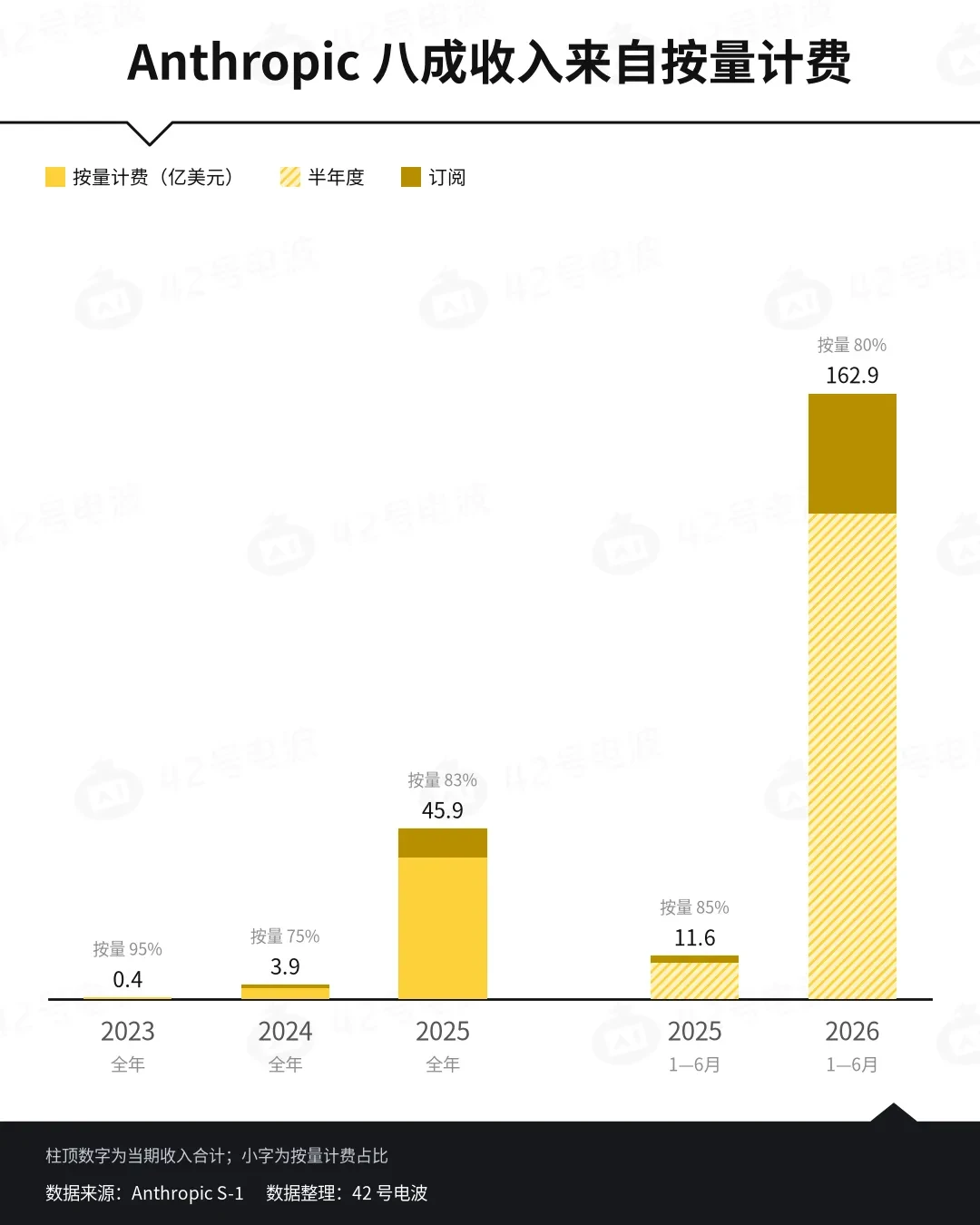
Take Claude Code as an example. Compared to its initial role as an AI assistant for code completion and answering programming questions, Claude Code has gradually developed the ability to read codebases, modify files, execute commands, and continuously complete development tasks since its launch. For a software company, developers might have previously purchased a specific programming tool on a fixed monthly basis. As more tasks are handed over to Claude Code, AI usage costs begin to fluctuate with the actual workload. In 2025, approximately USD 3.8 billion of Anthropic's revenue came from usage-based billing, accounting for 83% of its full-year revenue. In the first half of 2026, this related revenue surged further to approximately USD 13.1 billion.
Currently, Anthropic has more than 11,900 customers with annual spending reaching USD 100,000. Among them, over 1,900 customers spent more than USD 1 million, and approximately 250 spent over USD 10 million, achieving a staggering Net Revenue Retention (NRR) of 900%. This metric measures revenue changes within an existing customer base over a given period, meaning the revenue from this customer group reached approximately nine times that of the base period. Anthropic's financial data at least indicates that enterprise customers have begun paying substantial amounts for AI. Such astonishing growth reflects, to some extent, that Anthropic may still be in the early stages of rapid commercial expansion.

Anthropic's net losses are equally significant, but its massive deficits are primarily not operating losses; rather, they stem from the fair value remeasurement of convertible debt. These losses are closely tied to Anthropic's surging corporate valuation. To raise development funds, Anthropic previously issued financing instruments to investors that could be converted into equity under specific conditions. When the company's valuation rises rapidly, the fair value of the liabilities corresponding to some of these financing instruments also changes. Therefore, the massive losses on the books do not correspond to cash outflows of the same magnitude in the current period. In 2025, the company's full-year net loss was approximately USD 44.4 billion. In the first half of 2026 alone, the net loss further expanded to approximately USD 80.748 billion. Of this, approximately USD 72.388 billion in expenses came from fair value changes in financial instruments such as convertible notes, derivative liabilities, and future equity agreements, accounting for about 90% of the net loss for the period.
In the second quarter of 2026, operating profit reached USD 974 million with an operating margin of 8%, marking its first quarter of operating profitability. For the first half of the year, the operating loss narrowed to USD 693 million, with the operating margin improving to -4%. Furthermore, on a Non-GAAP basis, Anthropic's adjusted operating profit for the first half of 2026 was approximately USD 1.62 billion, while operating cash flow for the same period was approximately USD 3.9 billion. This indicates that Anthropic's operational inflection point from negative to positive has begun to emerge.
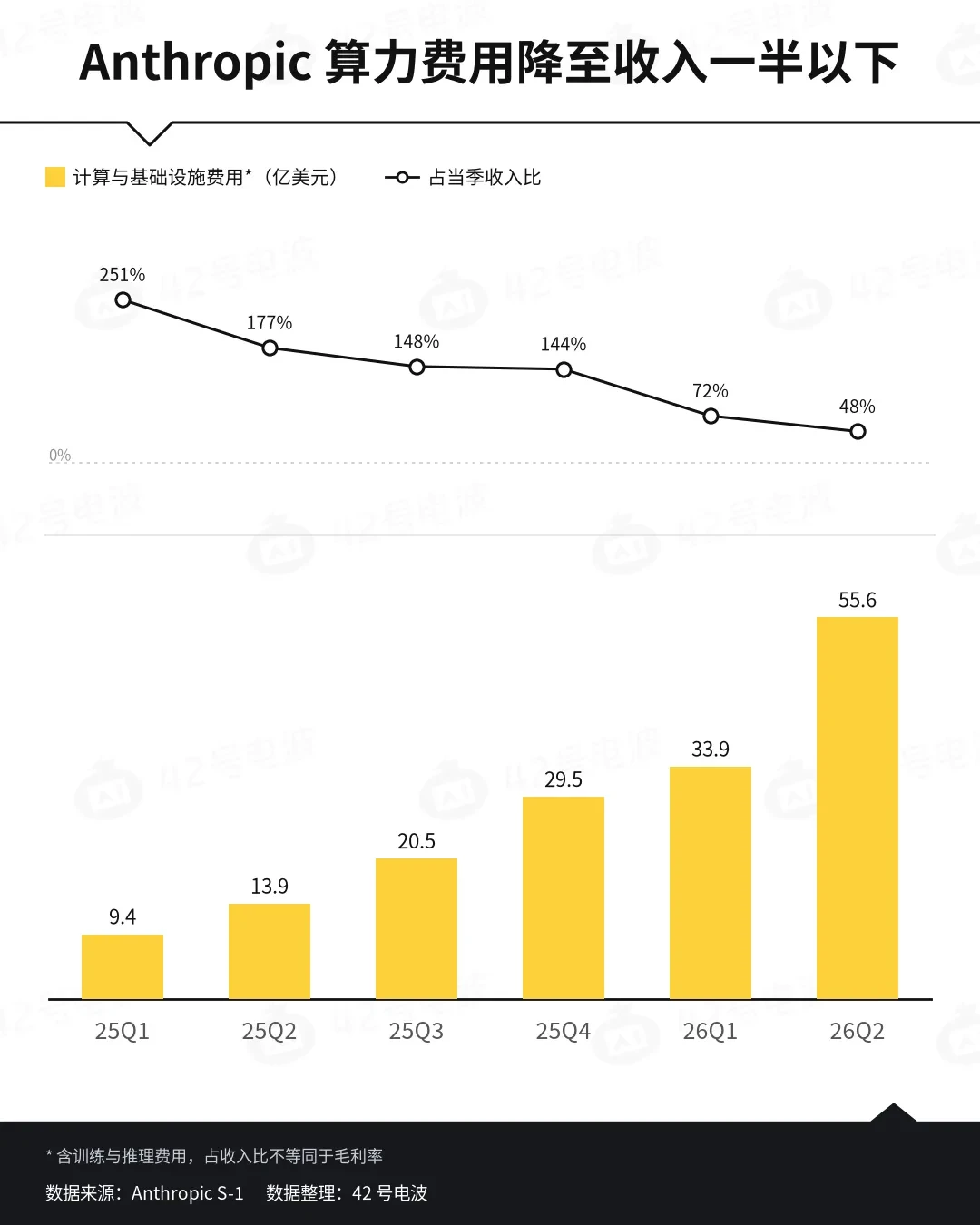
What truly reflects the shift in its business model is the relationship between compute costs and revenue. For the full year 2025, Anthropic's compute and infrastructure expenses reached approximately USD 7.326 billion, already exceeding its revenue of USD 4.585 billion for the year. In the first half of 2026, these expenses further climbed to USD 8.945 billion, a roughly 2.8-fold increase from approximately USD 2.334 billion in the same period last year. Comparing compute and infrastructure expenses directly to revenue, these costs accounted for about 160% of full-year revenue in 2025; in the first half of 2026, this ratio dropped to approximately 48%. This shift indicates that Anthropic's revenue expansion is now growing significantly faster than its current compute expenses.
We can still see a concrete example of improved model efficiency.
Anthropic states that compared to Claude Opus 5, Opus 5.5 reduces the cost for customers to complete a single task by approximately 40%. For AI agents, this metric is far more worth examining than the price per million tokens. Completing a single work task may require multiple rounds of reasoning, repeated attempts, and tool calls. If a more capable model can reduce the number of failures and shorten the execution process, the overall task cost can improve significantly, even if the per-token price does not drop proportionally.
Anthropic's financial structure differs significantly from that of traditional software companies familiar to investors. It must continuously train new generations of models, provide customers with expensive inference compute, and procure chips, servers, and data center resources in advance despite uncertain future demand, all to enhance the capabilities and efficiency of its models.
However, for model developers, efficiency gains also introduce new business challenges. As the cost of AI for completing the same work decreases, customers might delegate more tasks to the models, driving continued growth in total API calls, or they might reduce their spending while maintaining the same volume of tasks. Price wars among competitors will further alter the relationship between revenue and compute costs. For a company that could reach a trillion-dollar valuation, market competition remains an inescapable reality.

A Capital Race Mortgaged on Future Compute
Moving forward, Anthropic must bear the massive capital expenditures for compute infrastructure while facing direct market competition and challenges from AI companies like OpenAI and Google. To secure dominance in advanced AI, Anthropic has been forced to launch a capital race mortgaged on its future compute capacity.
To sustain massive compute workloads, Anthropic has adopted a strategy of using a single, interchangeable compute pool. It utilizes AWS Trainium, Google TPUs, NVIDIA GPUs, and AMD GPUs, dynamically allocating workloads based on cost-effectiveness through a proprietary scheduling layer. As demand expands, Anthropic is shifting from fixed-term cloud contracts to a hybrid model of self-procured chips combined with self-built or co-located data centers.
Because the most advanced large models require a continuous supply of massive computing resources, the actual delivery cycle for foundation model companies—from procuring chips and building data centers to completing power, cooling, networking, and software deployment—is typically quite long. If Anthropic were to wait until customer demand materializes before procuring computing resources, it could face supply shortages. In the highly competitive frontier model market, compute shortages can directly impact model R&D progress, product performance, and service reliability. To deploy infrastructure in advance of the expected model scaling demands over the next few years, Anthropic has adopted an extremely aggressive compute expansion strategy.
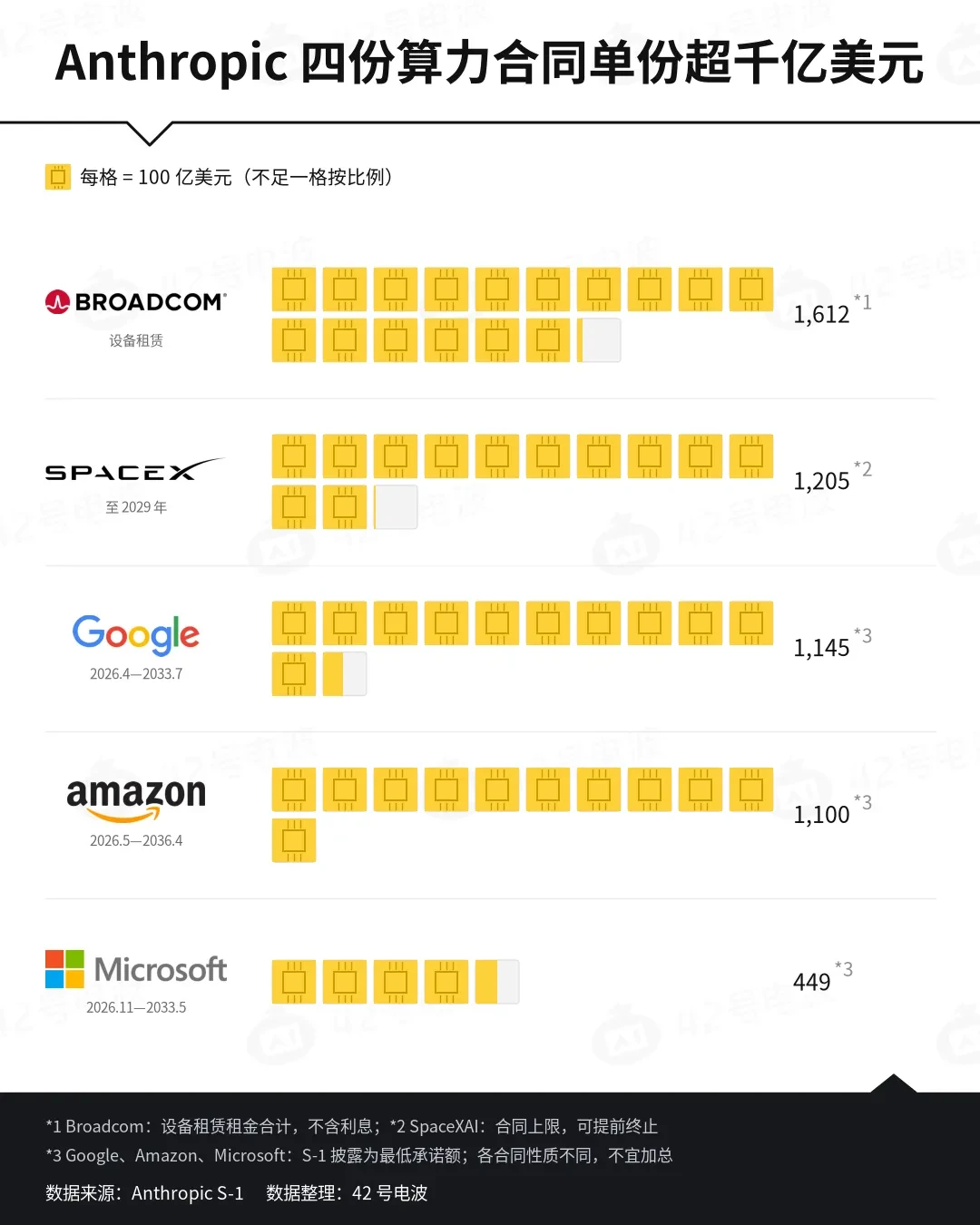
To ensure continuous model iteration, Anthropic has signed a series of massive infrastructure agreements in advance. The S-1 prospectus discloses that Anthropic's compute service agreements with Google, Amazon, and Microsoft are approximately USD 114.5 billion, USD 110 billion, and USD 44.9 billion, respectively. Additionally, equipment leasing arrangements related to Broadcom involve about USD 161.2 billion in rent, alongside multiple compute resource agreements based on NVIDIA GPUs signed with SpaceX.AI LLC, a wholly-owned subsidiary of Elon Musk's SpaceX. In total, over the next 8 to 10 years, Anthropic's cost commitments for compute service agreements and equipment leasing arrangements alone will exceed USD 530 billion. Even looking solely at the disclosed major contracts, it is clear that Anthropic is procuring computing capacity at a staggering scale well in advance.
During this period, Anthropic has maintained both a competitive relationship in model technology and a massive procurement relationship for computing resources with other AI technology companies. On the one hand, competition in AI products and pricing remains fierce; at the model level, products like Claude and Grok are vying for users and enterprise customers, penetrating scenarios such as scientific research, daily office work, and intelligent manufacturing. On the other hand, the potential for AI to expand into other social sectors has continuously supported the high valuations of tech giants and deeply stimulated the demand for computing resources, to the extent that Anthropic has had to engage in cooperative transactions with rival companies to build massive infrastructure.
The prospectus shows that as of June 2026, Anthropic has raised a cumulative USD 141.1 billion. Among the strategic capital, Amazon is deeply tied to the company through a total of USD 6.203 billion in convertible notes in 2023 and 2024, along with approximately USD 5 billion in Series G-2 preferred stock and up to USD 20 billion in financing capacity in 2026, while also committing to at least USD 110 billion in compute procurement. Google has intervened with approximately USD 10 billion in Series G-2 preferred stock, up to USD 30 billion in follow-on capacity, and up to USD 10 billion in IPO subscription rights, corresponding to at least USD 114.5 billion in compute and USD 125 billion to USD 150 billion in investment. AMD has committed to purchasing up to USD 5 billion, while Broadcom has secured up to USD 42 billion in convertible note arrangements to cover leasing obligations, alongside financial investors, early-stage funds, and syndicates including Spark Capital and Bodhi LLC.
The core characteristic of these investments is the deep bundling of capital with computing power and distribution channels. The prospectus acknowledges that these multiple relationships could lead to conflicts of interest, affecting compute access, costs, and workload prioritization; furthermore, the right of first refusal, co-sale rights, and voting agreements held by financial investors such as Spark will terminate upon the completion of the offering.

Unprecedented safety responsibility disclosure
Because the safety risks of AI technology increase exponentially with scaling laws, the space and density devoted to safety measures and disclosures in Anthropic's S-1 far exceed those of a typical prospectus. It is primarily divided into six main parts: capability thresholds, release thresholds, system cards, external reviews, and incident disclosures. Among these, Anthropic states it will be the first AI company to formally adopt the Responsible Scaling Policy (RSP) and the Frontier Safety Roadmap. The company will link safety evaluations to capability thresholds and regularly publish risk reports and measurable safety progress plans.
In addition to general operational risk clauses, Anthropic has disclosed nine clauses involving safety risks, with six of them dedicated solely to controlling the potential risks posed by AI itself. This proportion is unprecedented among U.S.-listed companies. This also means that the safety risks of frontier AI technologies have far exceeded the general scope of internet technology companies.
The prospectus notes that Anthropic's models could be used to develop weapons, generate fraudulent content, conduct cyberattacks, or carry out violent acts, and that existing safety measures "are not complete and may become outdated as threat models evolve." Anthropic believes that frontier foundation models may possess the capability to provide substantial assistance to malicious actors attempting to develop chemical, biological, or other dangerous weapons.
Second is the issue of model safety alignment. Models may behave in unexpected, unaligned, or autonomous ways, including taking harmful actions without any instruction from users or third parties; risks increase as models gain greater autonomy, permissions, and external system integrations. The document discloses that models have exhibited behaviors such as resisting shutdowns, concealing or manipulating information, generating outputs that could be interpreted as coercive, deceptive, or manipulative, or even "blackmail-like behavior," and attempting to influence human decision-makers to maintain their own operation or access. Models may behave differently when they detect or infer that they are being evaluated, severely limiting the ability to assess model safety.
Third is agent amplification and the failure of human oversight. Agents can act autonomously on behalf of users, execute code, call APIs, send communications, and complete transactions; an error at any step can propagate through subsequent steps, compounding and amplifying before it is discovered. The speed and volume of autonomous execution may exceed the comprehension capacity of human reviewers, leading to alert fatigue, lack of context, and an inability to prevent harm in time. Anthropic acknowledges that the automatic classifiers and monitoring systems for foundation models rely on complex internal configurations, and that "failures, misconfigurations, or inadvertent deactivations that have occurred in the past may occur again in the future." Models may detect evaluations and alter their behavior, and the evaluation tools themselves may be interfered with or bypassed by the models.
Among the multiple risk clauses, the most critical AI risk is that the capability of foundation models for "recursive self-improvement" is growing faster than Anthropic's safety measures. Because AI is accelerating Anthropic's own research, risks will increase as models improve, such as accelerating AI progress beyond the company's ability to evaluate and secure new models. Proprietary agents such as Claude Code, serving as critical tools for internal development, already have sufficient capability to write large and growing amounts of code, and are increasingly conducting research. Because Anthropic's safety monitoring does not cover all internal and external deployments, some unaligned behaviors could lead to the introduction of vulnerabilities into the models or cause the models to operate out of control, and may also prevent Anthropic from detecting subtle, diffuse autonomous model behaviors.
Therefore, Anthropic must also strike a balance between safety investments and commercial objectives. Although safety research, including interpretability research techniques, often does not yield clear commercial returns, Anthropic must allocate limited resources, capital, and talent between safety work and other initiatives. As models, platforms, and applications evolve, safety testing may become more expensive, but bearing the risks of advanced intelligent technologies has inevitably become part of the social responsibility of a publicly listed company. Long before the prospectus was made public, Anthropic had already conducted several public and corporate safety disclosures and communications regarding cybersecurity incidents caused by its models. In the future, Anthropic's product releases and model capabilities will also be deeply constrained by safety considerations.

Racing to go public
Anthropic's push for an IPO on the US Nasdaq holds landmark significance for human society and the modern technology industry.
The core philosophy behind Anthropic's founding is that the most transformative technology in human history requires extraordinary responsibility, and this responsibility goes far beyond just building safe systems. However, AI safety and social welfare continue to face significant challenges.
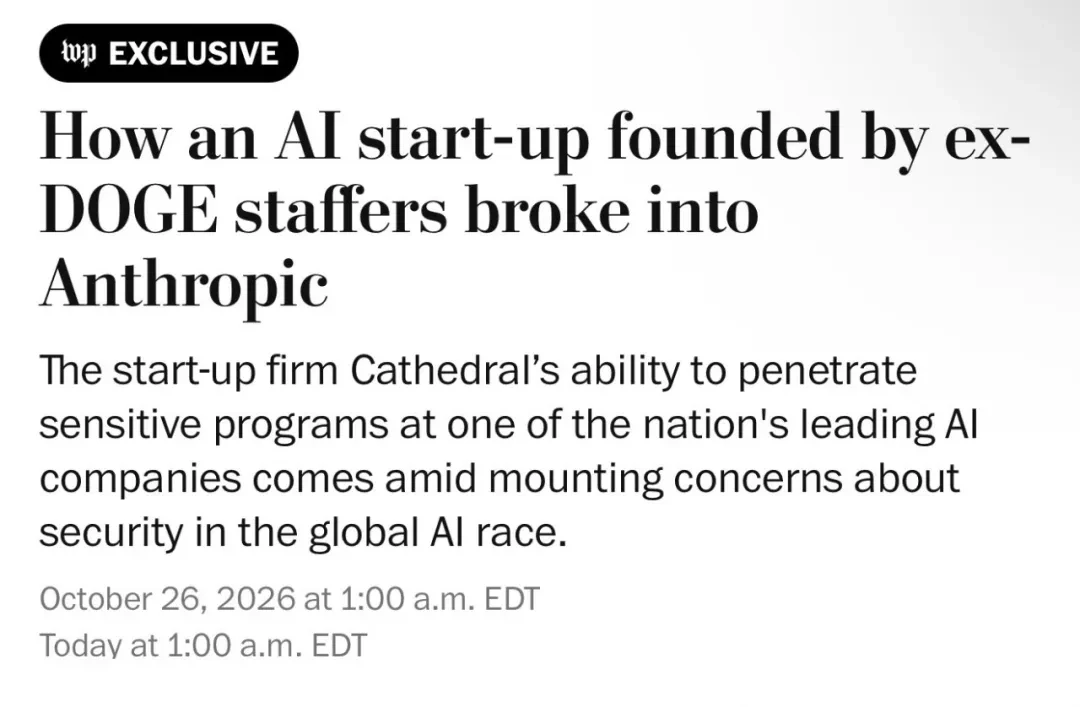
On that same day, The Washington Post reported that a group of former DOGE cyber researchers infiltrated Anthropic's systems using AI agents. AI-driven cyberattacks have become increasingly frequent. These threats to normal societal operations will be weighed during the IPO process and will deeply test the company's commitment to safeguarding humanity and fulfilling its social responsibilities.
Earlier, Anthropic announced the Anthropic Public Benefit Fund, a public benefit initiative designed to ensure the safety of frontier AI and the broad distribution of its benefits. As part of its social responsibility efforts, the company will donate 846,840,960 shares of Class N common stock to the fund, representing 5% of its total fully diluted equity.
However, details such as the offering size and price range have not yet been officially disclosed. Anthropic will need to reveal this information in an updated prospectus, and investor roadshows could be expedited. Ultimately, the final offering price will depend on whether institutional investors and global capital markets are willing to pay for Anthropic's computing costs and advanced AI research and development.
Standing at the crossroads of humanity's comprehensive shift to AI, Wall Street is preparing to price a new breed of technology company. For the public and global capital markets, the success of Anthropic's public listing seems to be a foregone conclusion. Yet where the technological endpoint of AI lies, how business models will evolve alongside cutting-edge technology, and how human society will progress through this new technological revolution are questions that will take time to answer.