

Smart Glasses Sales Doubled in the First Nine Months, Yet Manufacturers Are Still Losing Money
By Huang Si Zhe
Ahead of the Double 11 shopping festival, the smart glasses sector reported strong growth: Ray-Ban parent EssilorLuxottica recorded EUR 486 million in third-quarter wearable revenue, while China's Ministry of Commerce noted a 1.1-fold year-on-year increase in domestic smart glasses sales during the first nine months.
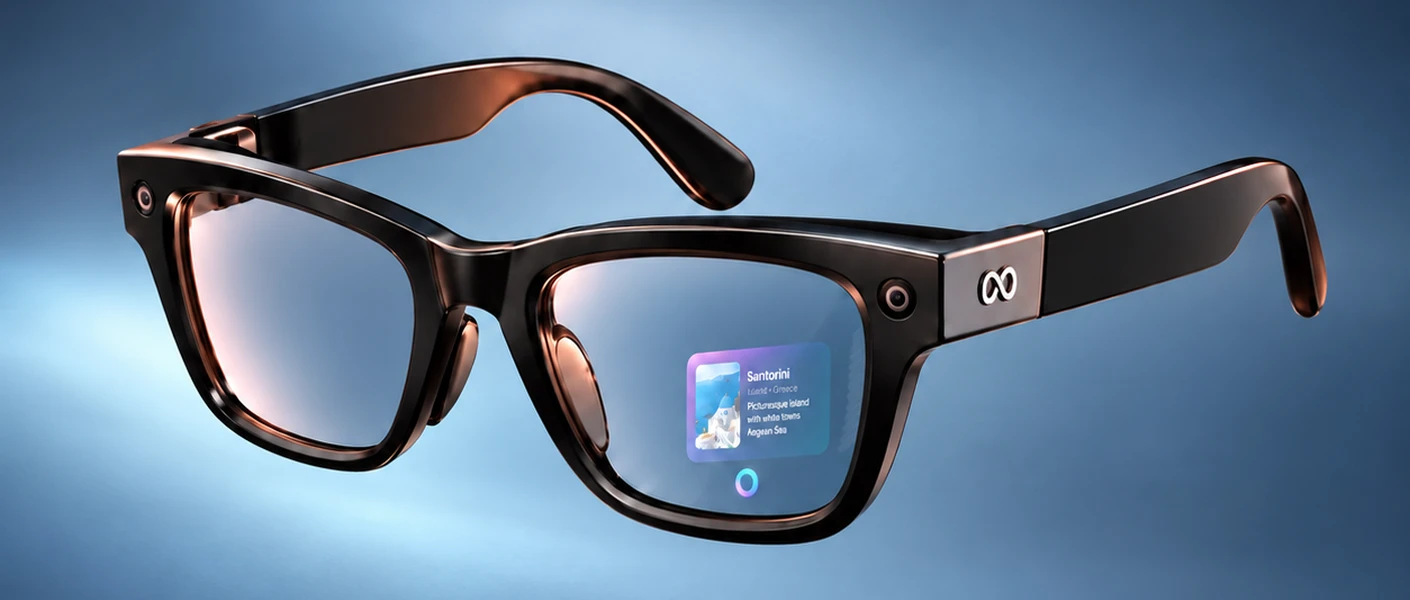
As the Double 11 shopping festival approaches, the smart glasses industry has welcomed two consecutive pieces of good news. On October 20, EssilorLuxottica, the parent company of Ray-Ban, disclosed the revenue of its wearables business—including AI glasses—in its third-quarter earnings report for the first time, generating EUR 486 million for the single quarter, a 20% year-on-year increase. Then, on October 23, China's Ministry of Commerce released data showing that sales of smart glasses on key domestic platforms increased by 110% year on year in the first three quarters of this year.
In the first half of this year alone, a total of 909,000 smart glasses were sold in China, generating RMB 1.88 billion in sales revenue—both figures nearly doubling year on year. However, when research firm Runto Technology released these figures in August, it immediately highlighted another metric: the overall return rate for smart glasses ranges between 30% and 70%, far exceeding that of digital products such as smartphones and tablets.
Data from other channel monitoring agencies reveal a similar distribution. The average return rate on JD.com and Tmall is approximately 30%, while live-commerce channels like Douyin see rates between 40% and 50%. In effect, for every two or three pairs of smart glasses sold, one is returned.

The underlying reason is straightforward. Eyewear is inherently a product that relies heavily on in-person try-ons, optometry, and physical comfort. Yet, it is now being sold in livestreams and on e-commerce platforms under the logic of consumer electronics, complete with a "7-day no-reason return" policy. Consumers see the promotional hype, find it novel, and make a purchase, only to discover at home that the fit is even less comfortable than expected, or that the voice and camera features are rarely useful. Before the 7-day return window expires, they simply request a refund.
However, even with a return, one specific cost cannot be refunded. A large proportion of smart glasses buyers are already nearsighted. The stock plastic plano lenses included with the bare device are not suitable for daily wear; to actually use the glasses, buyers must pay extra for custom prescription lenses. Once this lens-fitting step is completed, the return policy changes.
Take the after-sales policy for wearable products on the Xiaomi Store as an example. Users can return the product for any reason within seven days of the day following delivery, but it includes a specific addendum: "Xiaomi AI glasses do not support the 7-day no-reason return service after prescription lenses are fitted." This is not an arbitrary clause imposed by a single brand. According to Article 6 of the Interim Measures for the Seven-Day No-Reason Return of Commodities Purchased Online, prescription lenses ground to a consumer's specific diopter are classified as "commodities custom-made by the consumer" and are legally exempt from the 7-day no-reason return policy.
A closer look at financial statements and cash flows reveals that the smart glasses industry is still far from turning a profit directly from consumers. Hardware brands are still absorbing the costs of high return rates and R&D investments. The entities currently securing predictable revenue are upstream optical manufacturers earning from the brands' development budgets, and prescription lens retailers catering exclusively to retained users.
1. With a 30% gross margin, why are they still losing money?
Among the display-less AI glasses that are currently the best-selling in the smart glasses market, no company has disclosed standalone financial reports. Meta bundles its glasses into Reality Labs, while Xiaomi includes them in its broader IoT and lifestyle consumer products segment. The only company in the industry to publish a complete set of financials is XREAL, an AR glasses maker that filed its prospectus with the Hong Kong Stock Exchange in April this year.

According to iResearch, XREAL ranked first globally in AR glasses sales for four consecutive years from 2022 to 2025. In 2025, its revenue reached RMB 516 million, with its gross margin climbing from 18.8% two years prior to 35.2%, yielding a gross profit of approximately RMB 181 million.
Looking solely at product margins, each pair of glasses sold retains a gross margin of more than 30%, which is not considered slim in the hardware industry. However, looking further down the expense sheet reveals where the money went: in 2025, XREAL's R&D expenses were RMB 183 million, sales and distribution expenses were RMB 131 million, and administrative expenses were RMB 112 million. R&D alone consumed the entire gross profit. Combined, these three expense categories resulted in an operating loss of RMB 245 million for the year, while the adjusted net loss, after excluding changes in the fair value of preferred shares, reached RMB 250 million.
The prospectus also highlights another detail: XREAL's losses have indeed narrowed year over year, but the primary driver has been three consecutive years of expense cuts. R&D expenses fell from RMB 216 million in 2023 to RMB 183 million in 2025, while sales and distribution expenses dropped from RMB 214 million to RMB 131 million. In other words, the reduction in losses is driven by cost-cutting ahead of an IPO push, rather than sales volume growing large enough to absorb fixed costs.
We can make a highly conservative estimate based on these financials: even if R&D, sales, and administrative expenses do not increase at all in the future, remaining at the 2025 level of approximately RMB 426 million, and assuming a 35.2% gross margin, XREAL's annual revenue would need to reach at least RMB 1.2 billion. That means growing by a factor of 2.3 from its current scale just for gross profit to barely cover its expenses.
Why are these expenses so hard to bring down? In day-to-day operations, there are two inescapable costs: the first is upfront R&D, where every iteration of optical designs and chip architectures requires a fresh round of investment; the second is persistently high return-related losses. Particularly in domestic e-commerce channels, a high return rate means a massive amount of already spent livestream ad spend is written off. Returned units also require a series of manual inspections, cleaning, and refurbishment before they can be relisted. Ultimately, these losses translate into sales expenses and cost pressures on the financial statements.
II. 15-Fold Revenue Growth: Whose Money Are They Making?
Just as device manufacturers are still calculating when their revenue will break even with expenses, upstream lens makers have delivered a very different set of results.
In August 2026, Hong Kong-listed Conant Optical released its 2026 interim results. For the first half of the year, the company reported a total revenue of RMB 1.167 billion and an adjusted net profit attributable to shareholders of RMB 346 million. The most closely watched figure in the report was that "revenue generated from the XR business was approximately RMB 50.5 million, representing a year-on-year increase of 1,475.3%," nearly a 15-fold surge.
While this figure sounds exaggerated, a closer analysis reveals a more moderate reality, primarily due to an extremely low base. Working backward from the growth rate, Conant Optical's XR-related revenue in the first half of 2025 was only about RMB 3.21 million. Even after surging to RMB 50.5 million this year, it accounts for just 4.3% of the company's total revenue of RMB 1.167 billion. The company's ability to generate over RMB 300 million in net profit in a single half-year still relies heavily on its core business: traditional resin lenses, which see annual sales exceeding 100 million units.
What is truly worth dissecting is how this RMB 50.5 million was actually generated. In its interim report, Conant Optical outlined its current business progress, noting that the company has cumulatively engaged in more than 40 collaborative projects with approximately 20 leading domestic and international smart glasses manufacturers.
Among these, the projects capable of generating stable orders are primarily from two domestic clients that have secured exclusive supply agreements. As for the projects involving three other leading international clients, one is in the final sprint of mass production preparation with volume manufacturing expected in the fourth quarter of this year, while the other two have just completed pre-research verification and entered small-batch trial production.
This progress report highlights two key points. First, while lens manufacturers previously only sold lenses, their exclusive supply for domestic clients has now expanded into a comprehensive, full-process package that includes "customized lenses, waveguide bonding, and complete device assembly." Consequently, for every pair of smart glasses a client sells, the processing and supply chain revenue retained by Conant Optical is significantly higher than in the past. Second, out of the more than 40 projects, the majority are actually still in the stages of pre-research verification, small-batch trial production, or mass production preparation.
In other words, aside from the mass production shipments from the two domestic clients, a substantial portion of this RMB 50.5 million first-half revenue was earned from prototyping, trial production, and stocking fees paid by various companies ahead of their new product launches. This highlights the strategic advantage upstream optical manufacturers hold over OEMs: having built a dedicated XR production line, Conant Optical can simultaneously sell the same set of optical and bonding capabilities to 20 different clients.
Regardless of which brand ultimately succeeds at the consumer end, or even if certain smart glasses models experience high return rates, as long as these 20 companies continue to line up for project initiation, trial production, and new product releases, orders will keep flowing steadily into that single production line.
Even capital is flowing upstream as a risk-aversion strategy. According to third-party statistics, of the nearly RMB 9 billion in investment and financing raised in the domestic AI glasses sector during the first half of this year, approximately 60% was directed toward the optical, chip, and contract manufacturing supply chains, leaving less than 40% for terminal OEM brands.
Earning revenue from prototyping and inventory stocking does not mean upstream suppliers are risk-free; their risk cycles simply differ from those of device manufacturers. In its interim report, Contex stated that its current XR custom lens capabilities were built through 'nearly three years of continuous investment and iteration,' which included establishing the dedicated Neo Vision XR lens production line, cleanrooms, and a multi-site capacity layout. Long before securing this year's RMB 50.5 million in revenue, the company had already sunk capital into factories, equipment, and process R&D three years prior.
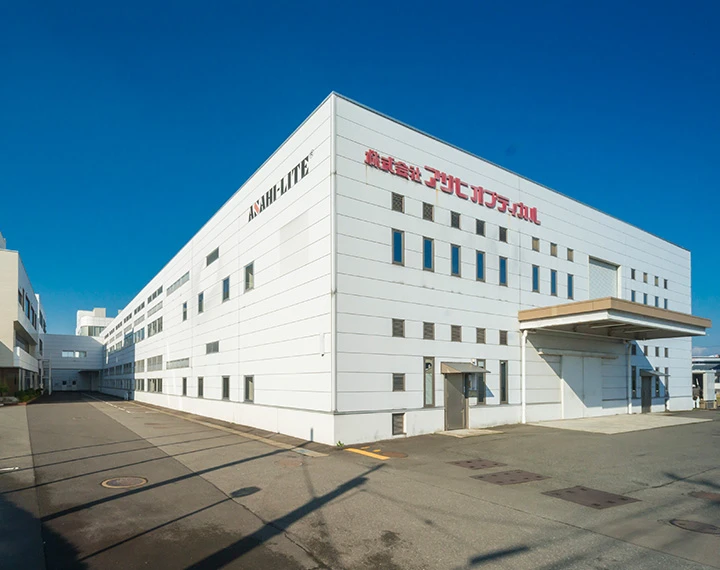
To secure upcoming large orders, Contex continued to invest heavily in capacity expansion in the first half of this year. The Shanghai facility plans to add four new lamination and final assembly packaging lines, while the Jiangsu facility is upgrading its phase two and phase three production lines. However, suppliers have no control over when clients will launch their glasses or whether those products will actually sell. For example, for its largest international client project, even though the production lines were ready well in advance, mass production will not officially begin until the fourth quarter of this year.
Device manufacturers and suppliers are essentially betting on different outcomes. Device manufacturers are betting that their current product generation will succeed; if they lose that bet, they lose the investment for that specific generation. Suppliers, on the other hand, do not need to bet on a single brand, but they are betting that the smart glasses category will ultimately move past the early-adopter phase. If 20 clients complete their first-generation products only to find they cannot retain users and consequently do not place second-generation orders, the dedicated upstream production lines built in advance will still face idle capacity.
III. The Traditional Eyewear Dispensing Supply Chain: A Risk-Free Business
While upstream optical factories earn revenue from brands' prototyping and inventory stocking, it is the traditional eyewear dispensing supply chain on the consumer end that truly avoids high return rates, ensuring that once the money is collected, it does not need to be refunded.
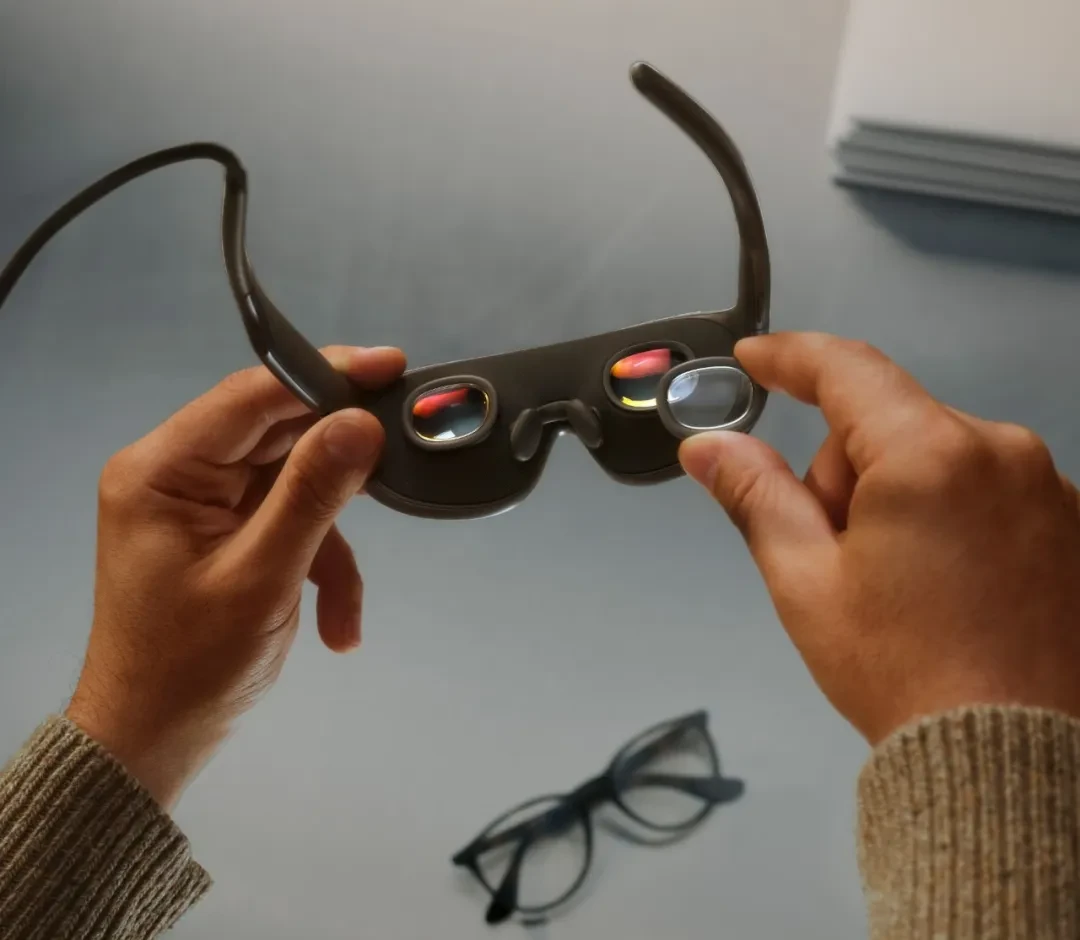
For a myopic user, spending RMB 2,000 to 3,000 on the glasses frame itself is just the first bill. To wear them outside every day, they must pay a 'second bill': getting a pair of prescription lenses with the correct diopter. However, with smart glasses, it is difficult to save on this cost at a local street-side shop the way one might with ordinary glasses.
Even for screenless camera glasses, the frames and temples are packed with flex cables, microphones, and indicator lights. A slight mistake during the heating and disassembly process can damage the circuitry, so many standard optical shops refuse to take the job to avoid liability. When consumers go to official partner channels like Mingyue or Zeiss for lenses, the price scales directly with their myopia prescription. For prescriptions under 400 degrees, a 1.60 refractive index lens still costs RMB 200 to 300. Once the prescription exceeds 600 degrees or even reaches over 1,000 degrees, users must opt for thinner 1.67 or 1.74 high-index lenses to prevent the already heavy glasses from resembling 'bottle bottoms,' causing the price of a single pair of lenses to immediately jump to RMB 700 or 800, or even over RMB 1,000.
For this year's highly popular screen-equipped optical waveguide glasses, technical barriers have completely blocked the path for third-party lens dispensing. Taking the Quark S1, which features a binocular waveguide display, as an example: to avoid the light leakage, reflections, and added thickness caused by standard clip-on lenses, it integrates the optical waveguide, display module, and myopia lenses into a single 'integrated lamination.' Because no optical shop can disassemble or reassemble the device after production, consumers must transmit their prescription data to the factory for custom manufacturing at the time of ordering.
The company that took on this exclusive business is precisely Conant, mentioned earlier. According to the official tiered pricing, the S1 standard plano version is priced at RMB 3,999. If fitted with Conant custom lenses of 1.60 refractive index for prescriptions up to 300 degrees, it costs an additional RMB 719 over the plano version; choosing a 1.67 refractive index for up to 600 degrees adds RMB 899; for high myopia above 800 degrees, which requires 1.74 ultra-thin lenses, the lens surcharge alone reaches as high as RMB 1,444, bringing the total price of the glasses to over RMB 5,400.
This exceptionally high barrier for prescription fitting and manufacturing is driving all leading tech companies to seek partnerships with traditional eyewear manufacturers.
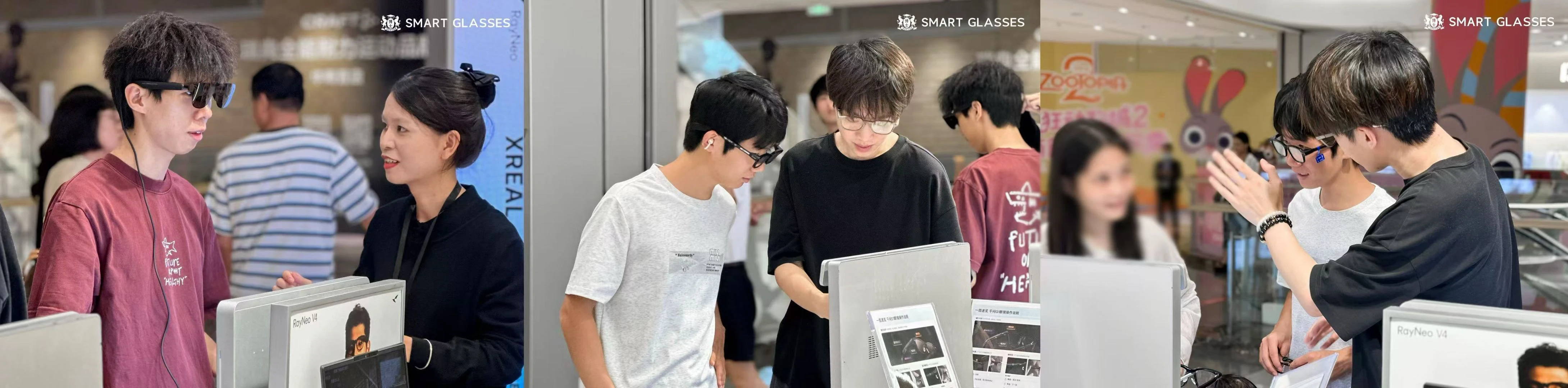
RayNeo, which holds the top domestic market share, directly established a joint venture with Boshi Glasses, placing its flagship models like the RayNeo V3 in over 100 of Boshi Glasses' flagship stores, while integrating ZEISS custom lenses online. Rokid, ranking second, is co-opening integrated fitting stores in shopping malls with Boshi Glasses and the time-honored brand Hongxing Glasses, while also securing a strategic investment of RMB 180 million from upstream lens giant Conant in March this year. When Alibaba launched the Quark AI glasses, it immediately set up 604 partner fitting stores across 82 cities nationwide, and XREAL has also granted Boshi Glasses the exclusive channel partnership for its new product launch.
Meta, which commands nearly 70% of the overseas market share, has gone even further. In July 2025, according to Bloomberg and Reuters, Meta spent approximately EUR 3 billion to acquire nearly a 3% stake in EssilorLuxottica, the world's largest eyewear group. This group owns brands like Ray-Ban and Oakley, possesses a full suite of lens technologies, and operates over 10,000 optical retail stores globally, including LensCrafters.
And let's not forget the rule mentioned at the beginning: once the grinding of custom lenses begins, unconditional returns are not supported. For instance, Rokid explicitly states that if a prescription lens order enters the manufacturing process more than 12 hours after being placed, refunds are no longer accepted.
As a result, every payment received by the fitting channels is pure revenue retention after filtering out impulse returns. Even better, glasses stores do not need to bet on which tech company will win. In January this year, Boshi Glasses opened its first smart glasses concept store in Shenzhen, placing Qwen, XREAL, RayNeo, Rokid, and Xiaomi on the same table for customers to try on, and then issued RMB 375 million in convertible bonds to plan the addition of 225 new stores. Whether RayNeo, Rokid, or Qwen becomes a massive hit, as long as consumers still need eye exams and non-returnable myopia lenses, the money will inevitably flow back to these glasses stores and lens manufacturers.
IV. When will they actually start making money?
Back to the opening question: why are smart glasses manufacturers still not making money?
The answer lies in how smart glasses differ from all previous consumer electronics: they represent the first piece of "non-standard hardware" tech companies have encountered in the past two decades.
China has nearly 700 million nearsighted individuals, each with a unique prescription, astigmatism level, pupillary distance, and nose bridge height. Even if tech companies manufacture 100,000 identical, standardized bare units in their factories, retaining a single nearsighted user ultimately requires in-person optometry and custom lenses.
Suppose a nearsighted user spends RMB 2,500 on a mainstream pair of smart glasses and decides to keep them, then spends another RMB 800 on a custom nearsighted prescription. Based on the 35.2% gross margin cited earlier, the OEM's book gross profit on selling this standardized bare unit is RMB 880. Meanwhile, the optical retail channel that solves the "one person, one prescription" problem collects the RMB 800. Applying the 69% lens-fitting gross margin from Boshi Glasses' annual report, this channel retains approximately RMB 550 in gross profit, with zero return losses.
The math reveals that the actual gross profit generated by a few grams of resin lenses already exceeds 60% of the gross profit from the smart glasses hardware itself. Is the remaining RMB 880 enough for the OEM to sustain its business? The answer becomes clear when comparing this to smartwatches, another wearable device.
In 2025, Garmin’s fitness and wearables segment, anchored by its sports watches, generated USD 2.36 billion in revenue. After deducting all R&D and marketing expenses, its operating profit margin reached 31%, yielding USD 726 million in operating profit for the year. Even Xiaomi, which pursues a value-for-money strategy, sold 20.4 million wearable wrist devices domestically in a single year. While the IoT segment housing these devices carries a gross margin of just 23.1%, it remains profitable.
Why the discrepancy? It comes down to shipment volume. In 2025, a total of 50.61 million smartwatches were sold in China, spreading R&D costs thinly across each unit. By contrast, according to IDC, global smart glasses shipments in 2025 reached only 14.77 million units. If we take XREAL’s 1.337 million units sold in 2025 and amortize its R&D expenses across them, the average R&D cost per pair of glasses amounts to RMB 1,368. This single factor alone completely wipes out the RMB 880 gross profit earned from hardware sales.
With the math laid out, the timeline for when the smart glasses industry can actually turn a profit becomes clear. Tech companies building these devices face only two paths forward. First, they must completely resolve wearing comfort and return rates, pushing the retained install base for a single model past the one-million-unit threshold to aggressively amortize the R&D cost of over RMB 1,000 per unit down to just RMB 100 or 200. Alternatively, they can follow Alibaba’s model of factory-integrated lens fitting or Meta’s strategy of investing in an eyewear giant, reclaiming the RMB 550 in lens-fitting gross profit that would otherwise go to optical stores.
Until either of these strategies succeeds, smart glasses will remain a business where "the upstream and downstream players profit first, while the OEMs in the middle subsidize the ecosystem."