

Jianzhi Robot Co-Founder: Ten Million Hours of First-Person Video Is Not Enough for Embodied AI
As embodied AI companies race to collect millions of hours of human demonstration data, Jianzhi Robot co-founder Zhu Yanming argues that scaling first-person video alone will not trigger capability emergence. The next phase of data collection requires multi-modal inputs, including whole-body motion, wrist cameras, and tactile feedback.
The next stop for embodied data isn't just selling more "hours."
The data competition in embodied AI is currently in a "benchmarking" phase.
Companies are starting to cite hundreds of thousands or millions of hours to demonstrate capacity. Data collection hardware has expanded from robotic grippers and head-mounted cameras to wrist cameras, full-body motion, and tactile sensing. Meanwhile, some model companies are buying up increasing amounts of human demonstrations, hoping that a quantitative shift will trigger capability emergence in robots similar to what has been seen in language models.
But just as the industry has finally learned to tell stories using "millions of hours," Jianzhi Robotics partner Zhu Yanming is already asking a counter-question: If ten million hours consist entirely of ego data—that is, first-person video recorded by head-mounted cameras—what exactly can a model learn from it?
In his view, ego data is like plain white rice: cheap and abundant in carbohydrates, but lacking complete nutrition. Robots only see what is directly in front of a person's eyes; they cannot see the contact points hidden by hands, they do not know how the fingers apply force, and they cannot reconstruct how a person retries after a failure based solely on successful footage. Therefore, the next step for data is not just "more," but must also incorporate full-body motion, wrist-level vision, tactile sensing, and force feedback, with all these modalities aligned within the same spatiotemporal coordinates.
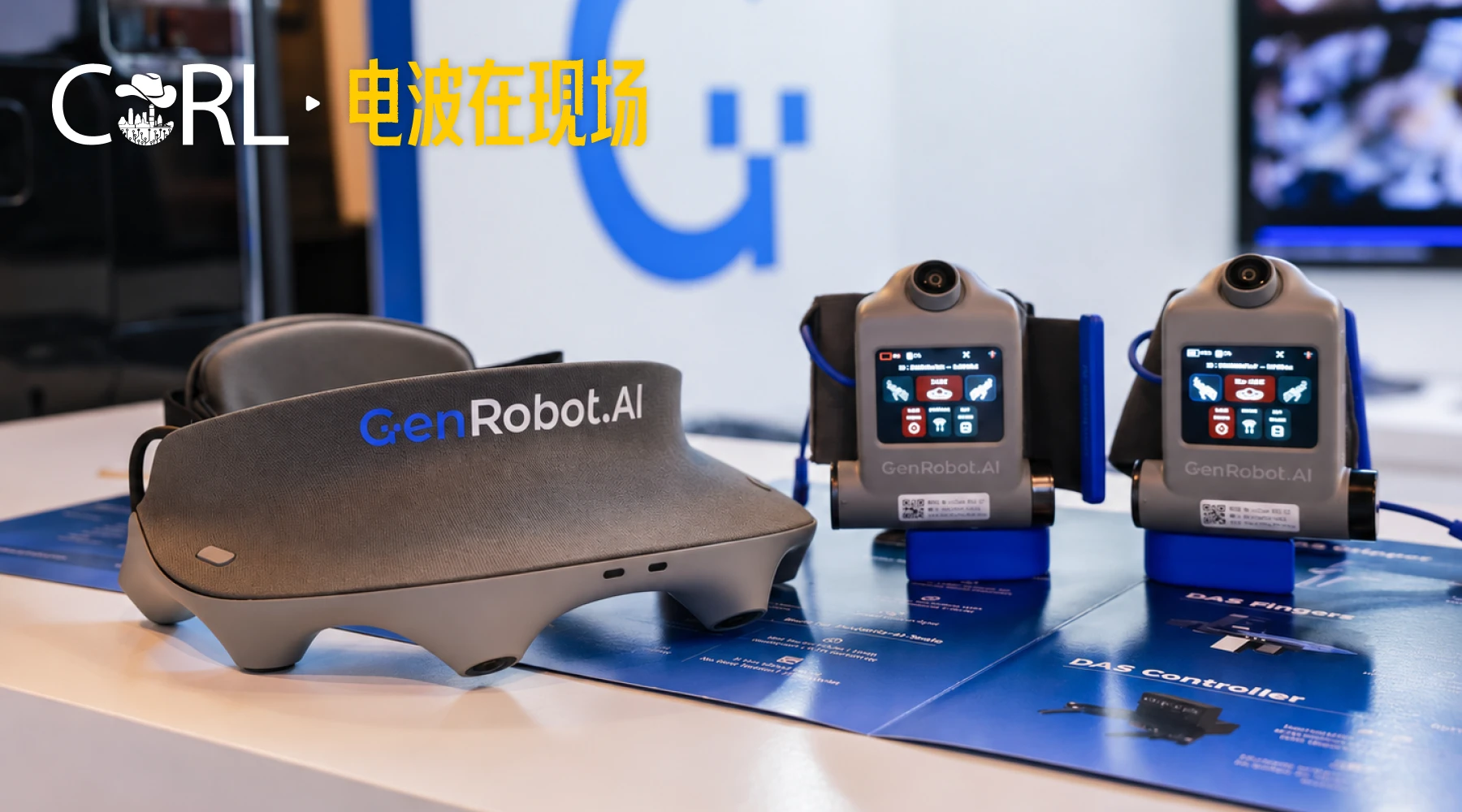
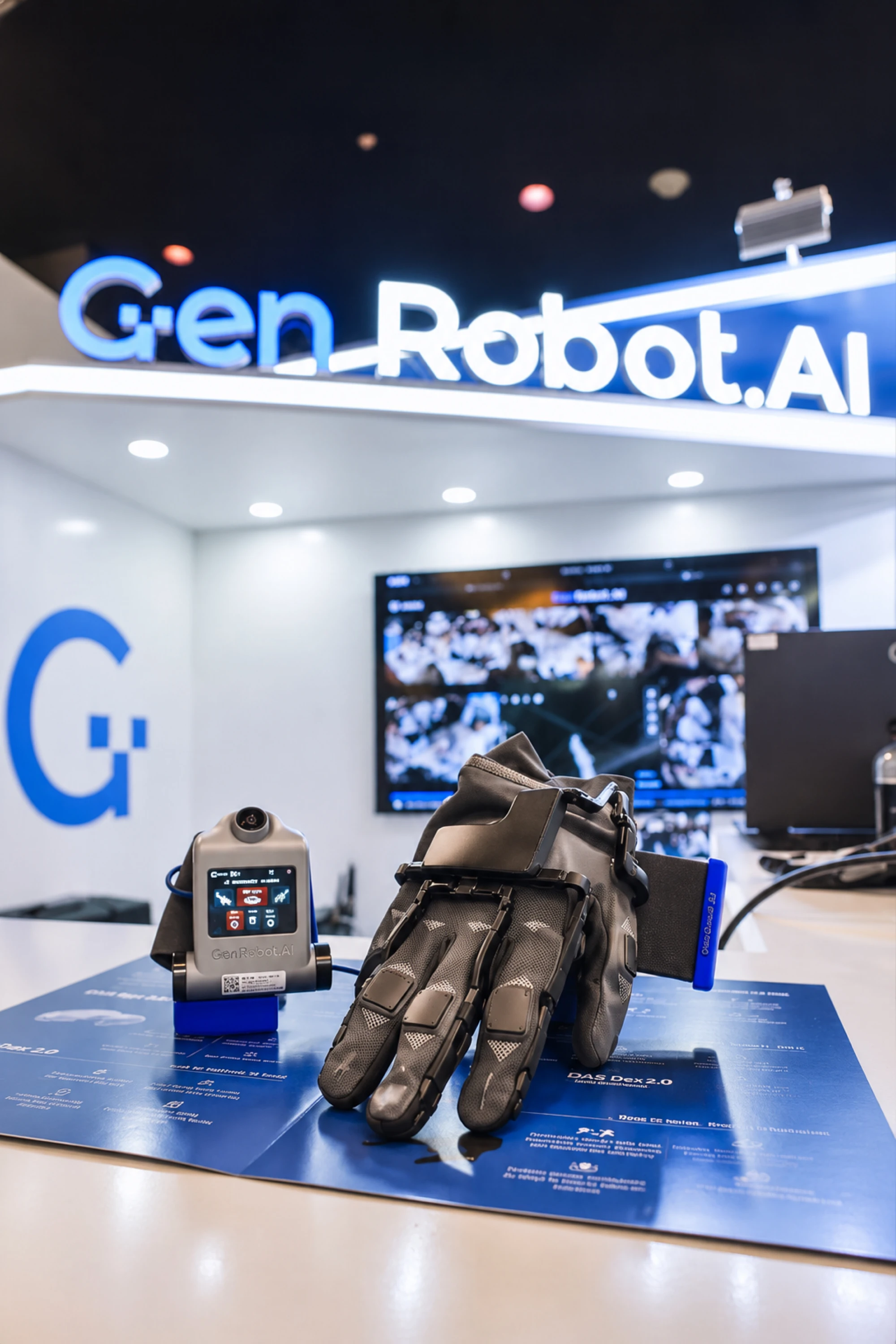
At CoRL 2026, Jianzhi turned this judgment into a new generation of products. The company officially unveiled the DAS 2.0 series, which includes the first-person multimodal collection device DAS Ego 2.0 and the dexterous data collection glove DAS Dex 2.0 paired with wrist cameras. The Ego device is responsible for recording the environment and full-body manipulation, the wrist cameras fill in the occluded details of the hands, and the Dex glove directly records full-hand configuration, contact, and tactile feedback.
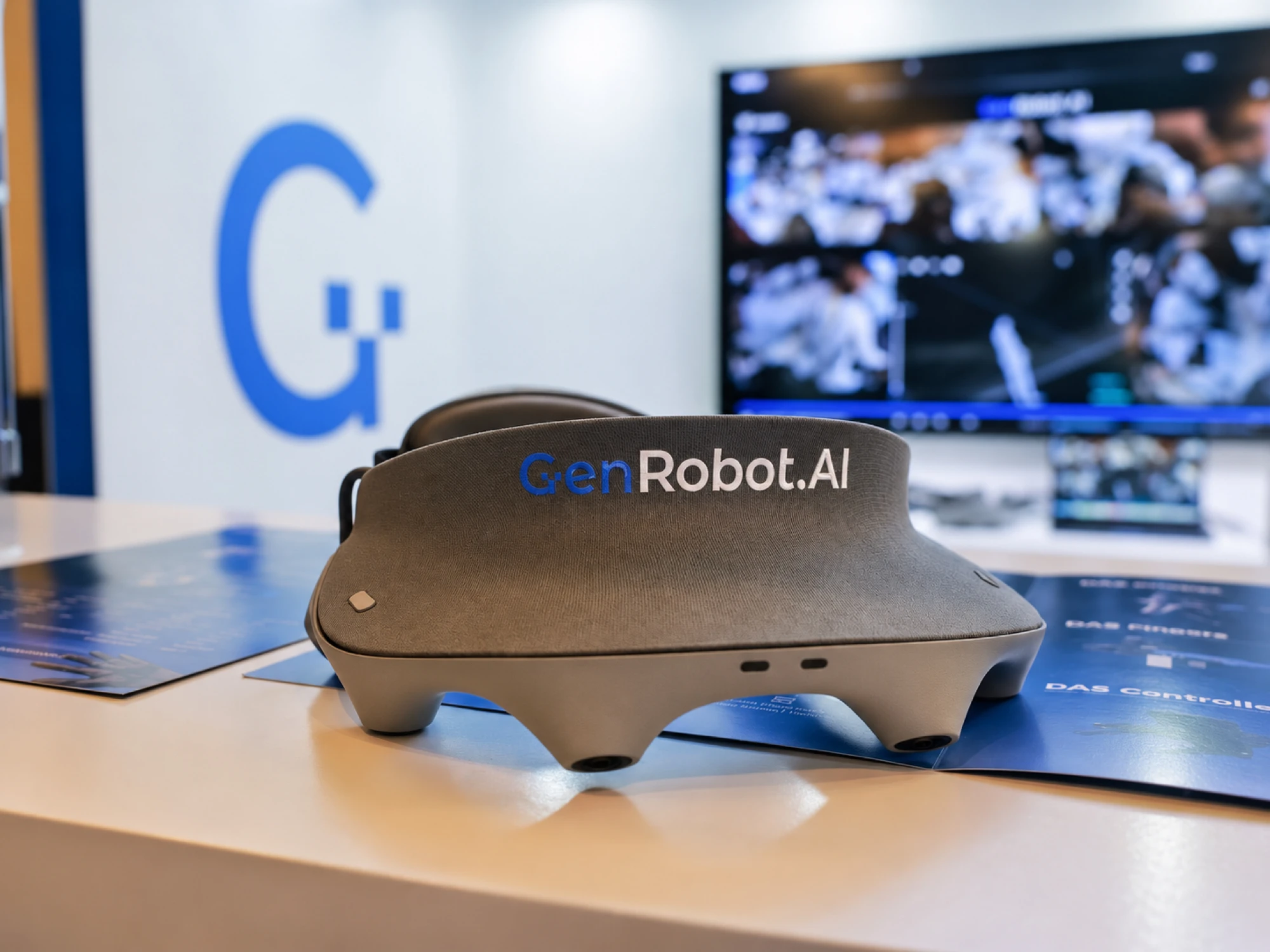
According to the company's published specifications, the two devices achieve millisecond-level synchronization between the head and hands via a wireless connection. The booth demonstration mapped human movements onto a robotic arm and a dexterous hand. While this does not prove that human data can universally replace real-robot data, it makes Jianzhi's product direction clear: rather than just recording "what humans see," it attempts to record how humans approach, manipulate, make contact with, and ultimately complete a task.
This judgment also explains Jianzhi's product form. Positioning itself as a physical AI data infrastructure company, it builds both Gen DAS collection hardware and data governance and production pipelines. The data types showcased on its website have expanded from ego data to finger-level, full-body, and tactile data, as well as structured outputs ready for model use. This is not just about "adding a few more sensors," but reflects a deeper underlying judgment: what data models need most will, in turn, dictate the collection hardware, and even determine what sensors future robots should carry.
Jianzhi was founded in 2025. Public information from November 2026 indicates the company completed a USD 100 million Series A+ funding round. According to the company, its quarterly delivery volume of valid data has increased from the hundreds of thousands of hours to the millions of hours, with ten million hours per quarter set as the next target. These figures make Zhu Yanming's rhetorical question all the more intriguing: a data company actively pursuing scale is arguing that scale is not the answer.
Zhu Yanming previously spent years working on mass-produced end-to-end autonomous driving products and now oversees Jianzhi's product, market, and North American operations. He describes the shift from autonomous driving to robotics as a "dimensional upgrade": driving primarily involves decision-making in two-dimensional space, whereas robotics requires handling three-dimensional space, physical contact, and human knowledge. If the higher-dimensional problems are truly solved, driving might just become a subset of those capabilities.
He constantly questions what exactly constitutes a model's inputs, ground truth, and evaluation metrics, while maintaining a healthy skepticism toward the real world: simulation is not reality, a demo is not deployment, and the final few steps might take just as long as the first twenty.
During CoRL 2026, we sat down for a nearly two-hour conversation over a meal in Austin. As soon as the plates were served, Zhu casually used a bowl of rice to explain Ego data. When discussing simulation, WAM, peers, and fundraising, he never softened his convictions.
The following is an edited transcript of a conversation between 42HOW Robotics and Zhu Yanming, co-founder of Jianzhi Robotics.
Beyond growth, he cares more about the "dimensional upgrade"
42HOW Robotics: Autonomous driving isn't over yet, so why are so many people still shifting from autonomous driving to embodied AI over the past couple of years? Did you leave to seek faster growth?
Zhu Yanming: Autonomous driving is certainly not over; there are still many problems left to solve.
The first reason people are shifting to embodied AI is naturally the pursuit of faster growth. In autonomous driving, improving from a score of 60 to 80 used to yield massive progress in a single year. Now, it is about going from 90 to 95, and then from 95 to 99. The effort required might be the same, but the growth perceived by the outside world is much slower.
The second reason, which is more important to me, is that embodied AI is a higher-dimensional product. People joke that if robotics is developed well enough, we might not even need standalone autonomous driving—a robot could simply sit in the driver's seat and drive like a human. That is certainly an exaggeration, but it illustrates a key point: if you fully solve a higher-dimensional problem, other tasks might just be a matter of dimensionality reduction.
42HOW Robotics: What exactly does "moving to a higher dimension" mean?
Zhu Yanming: Are you ultimately solving a larger problem or a smaller one?
Autonomous driving is essentially planning in a two-dimensional space. Robots have physical bodies, so their planning occurs in three dimensions, and they must also handle physical contact and more fundamental human cognition. The driving problem is undoubtedly difficult, but compared to the totality of problems humans navigate every day, it is likely just a small fraction.
So, while growth is a reason for my shift to this field, the more fundamental motivation is about moving to a higher dimension.
42HOW Robotics: You have been working on this for over a year. Is the industry developing faster or slower than you expected? This year has seen the emergence of million-hour datasets, as well as several new models and demos.
Zhu Yanming: I have always been quite rational. When we first started fundraising, many investors would ask: how do you view the pace of the industry's development?
Fast development has its advantages, as investors can realize returns more quickly. The downside, however, is that if the problem is solved in just three years, it implies the challenge isn't actually that difficult and the barriers to building deep expertise aren't very high.
We have always viewed embodied AI as a longer-term endeavor than autonomous driving. Autonomous driving has been in development for a decade, yet the industry is still struggling with Level 2 autonomy because real-world problems are far more complex than anything that can be exhaustively simulated in a lab. Embodied AI will be no different; I believe it will take about ten years. Today feels like the first three years of that decade: we are still debating technical approaches, as well as the infrastructure required for each one.
42HOW Robotics: There was a lot of discussion around World Action Models (WAM) at CoRL. How do you view this approach?
Zhu Yanming: Predicting actions and video synchronously is, in my view, both groundbreaking and highly inspiring.
It can add value to System 0 or specific feature modules within a system by processing spatial and video information that traditional models struggle with. However, in the long run, I believe System 1 and System 2 will be subsumed by a single end-to-end solution, with separate nodes likely needed only for high-frequency, low-level motor control.
When a human picks up a cup, hypothesis generation, planning, decision-making, and action execution are actually unified. If you separate them, the system requires constant intermediate interaction. Therefore, the ultimate solution won't be today's pure Vision-Language-Action (VLA) model, but I believe the performance ceiling of a language-based architecture remains much higher than that of a purely video-based one.
42HOW Robotics: If the ultimate outcome is a single unified model, doesn't that mean large language model companies will capture most of the value?
Zhu Yanming: That is already the trend. Today, if you deploy a large model directly onto a robot, it already works. Large model companies have a very strong foundation; if they truly commit to building robots, their starting point is already far ahead.
As we scale, we will face a highly diverse range of scenarios. An embodied AI company's domain knowledge and large-model know-how can hardly surpass that of a dedicated large-model company. Take, for instance, instructing a robot to go to 'that store' and fetch a bottle of wine: what exactly constitutes 'that store,' what defines wine, and what makes a brand? This is highly tangible value.
Data is now beginning to define hardware in reverse
42HOW Robotics: But even if large-model companies capture the 'brain,' hardware and deployment still constitute a very long chain.
Zhu Yanming: In the past, when people talked about hardware, they tended to focus solely on robot hardware. But fundamentally, it goes beyond that; much of today's hardware is actually dictated by data.
The model is undoubtedly the core of everything. The data that allows a model to grow best should be the primary criterion for many decisions. Choosing a type of data just because it is easy to collect, even if it hinders the model's growth, is tantamount to cutting off one of your own arms.
The current direction is human data, reconstructing human-world interactions from a human perspective. If the training data relies on a specific type of tactile sensor, the tactile sensors on the deployed robot will likely need to align with it to avoid distribution shift. Therefore, the industry must consider not only whether the hardware works in deployment, but also whether it can generate the data the model requires.
42HOW Robotics: You have been working on tactile sensing since February this year. For a data collection system, what is the most difficult aspect of tactile sensing?
Zhu Yanming: Tactile sensing involves a triangle of trade-offs: precision or sensitivity, reliability, and the ability to continuously and comprehensively record an operation. Extremely high precision is insufficient if it can only capture a single instant.
Traditional magnetic or capacitive solutions offer decent accuracy, but many consist of rigid boards. The human hand, however, is curved and soft; it deforms upon contact with objects, and the pressure changes continuously. A rigid board struggles to fully capture this dynamic process.
Fabric-based solutions can conform to the shape of the hand, but they struggle with accuracy and stability, often suffering from crosstalk between circuits. For instance, the exact same bottle-cap-twisting motion might yield inconsistent detection results across two attempts.
Our solution aims to balance all three factors. In our product design, we use 3D-printed graphene, a semi-flexible material. It conforms to the hand's shape while minimizing the mutual interference caused by the deformation of both the substrate and the material itself.
42HOW Robotics: We visited your booth at noon to try out the device, and it genuinely has a very low profile when worn. Did you start developing tactile sensing specifically because customers requested it?
Zhu Yanming: You have to make your own judgment calls. By the time a customer tells you about a need and you actually deliver a working solution, at least six months have passed.
That is simply how the embodied AI industry works: you have to be willing to take calculated risks. More precisely, you must first define a clear strategic roadmap, identify the capabilities required to execute it, and prepare in advance. The exact path will inherently be uncertain; if it were entirely clear, it would mean the approach is already validated and someone else has built it first.
42HOW Robotics: How did you initially settle on human data as your core strategic focus?
Zhu Yanming: We have always believed in human data. Egocentric data is just one subset of it.
To enable a model to continuously learn and evolve, the previous approach relied on teleoperation: directly learning a specific manipulation task on a specific robot embodiment. The problem is that both the data and the learned capabilities remain trapped within that specific embodiment. If you collect teleoperation data with a gripper today and switch to a humanoid robot tomorrow, can that data still be used? Much of it is difficult to apply directly.
Conversely, if you collect human data, mapping it to a gripper is entirely feasible. You can simply extract the movements of two human fingers and map them onto a two-finger gripper.
So we asked ourselves: at this stage, what is the highest-dimensional product? The answer is the human being. Humans are a type of robot, and human sensors are far superior to those of any robot today. If you can fully reconstruct human information, deploying it to other embodiments is essentially a process of dimensionality reduction.
42HOW Robotics: When you say "fully reconstruct human information," you mean more than just recording movements, right?
Zhu Yanming: The model learns not just the physical movements, but also the underlying thought process, the sensory feedback, and the subsequent retries based on that feedback. Teleoperation can teach a robot how to pick up and place objects, but it doesn't necessarily capture the full context, cause-and-effect reasoning, and the complete interaction process.
Once we settled on Human Data, we examined what was still missing. We had vision, and human logic could be expressed through text; what was still lacking were tactile and force feedback. Humans determine whether they have successfully grasped an object not just by looking, but also through the force feedback in their hands. An object might look like it has been picked up, but if it still feels weightless in your hand, you immediately know something went wrong.
42HOW Robotics: Many whole-body data collection solutions rely on attaching exoskeletons to humans, yet you primarily use video to reconstruct the whole body. Why is that?
Zhu Yanming: Exoskeletons are highly valuable; they act much like ground truth in model evaluation, allowing you to correct joint movements. However, they are difficult to scale. This is not just a hardware challenge, but also a fundamental issue with the underlying approach.
The question we must ask is whether the input to the model is merely a skeleton or an entire human body. When I reach for a cup and my arm touches the table, the actual physical interaction occurs not at the skeletal level, but through the skin and the body's surface. Furthermore, people vary in height and build; relying solely on a skeleton cannot explain why a person might stop their hand at a certain distance from the table.
That is why we focus on Whole Body modeling. We first reconstruct the volume and surface of the human body in 3D space, and then infer physical contact. While exoskeletons can serve as auxiliary ground truth, the primary interacting entity in the physical world remains the complete body.
42HOW Robotics: Will the hardware setups become increasingly complex?
Zhu Yanming: Accuracy will certainly improve, but complexity will not necessarily follow.
In my view, there are two essential primary modalities: vision and touch. Video alone can carry a tremendous amount of information, and tactile sensing can start with the hands. Many other approaches are merely transitional solutions: when visual hardware or algorithms fall short, exoskeletons or electromagnetic tracking are used to compensate for accuracy. However, if the resolution is high enough and the reconstruction of the hands and full body is sufficiently robust, these external add-ons can actually be reduced.
Simplicity does not mean compromised capability. Every component—cameras, multi-view setups, reconstruction, and tactile sensing—must be sufficiently powerful; otherwise, you will just keep adding external peripherals.
42HOW Robotics: If Whole Body modeling relies primarily on visual reconstruction, how can accuracy continue to improve? Is it just a matter of switching to higher-resolution cameras?
Zhu Yanming: There are still challenges with both the hardware and the algorithms.
On the hardware side, the first requirement is multi-view supervision. A single camera view not only suffers from occlusion but also makes it difficult to accurately recover the relative spatial positions of objects. We use self-supervised learning, deploying multiple cameras to view the same finger from different angles—essentially, multiple information sources supervising one another. The features of a finger against its background might be indistinct from one angle, but changing the lighting and perspective can make them clear.
The second factor is pixel density. The sparser the pixels, the greater the physical error represented by a single pixel in real-world space. Increasing resolution isn't about making the image look better; it's about minimizing the physical error corresponding to each pixel during spatial reconstruction.
On the algorithm side, relying on extensive handcrafted rules or traditional SLAM for human reconstruction leads to slow iteration and a high risk of overfitting to a specific scene, which degrades performance in other environments. We want to use a large model to map out the relationship between humans and space. This is a relatively unexplored problem, which raises new questions: What are the model's inputs? What is the ground truth? And how do we evaluate it?
42HOW Robotics: Have you considered electromyography (EMG) data? Some companies are currently using EMG wristbands to capture human motion intent.
Zhu Yanming: We are not considering it because it is too indirect.
EMG signals are affected by skin properties, subcutaneous fat thickness, and individual physiological states, and they do not directly measure hand motion. Since we can observe hand movements visually and directly measure joint angles using an exoskeleton, why choose an indirect signal that introduces more variables?
Sensor fusion is not about simply adding more sensors; the sensors must complement one another. Cameras, LiDAR, and millimeter-wave radar each excel in specific environments and accuracy ranges, allowing them to complement each other. If a new signal introduces more uncontrollable variables without filling the gaps in existing modalities, adding another sensor is not necessarily beneficial.
42HOW Robotics: So your reasoning approach is to first envision the ultimate model the industry will eventually need, and then define what you build.
Zhu Yanming: Yes. I've discussed a lot of technology and engineering, but the most fundamental question is: are we training a robot, or are we training a human? The robot is merely the physical body.
If a model has already approached human-level capabilities, deploying it onto a specific robot means that cross-embodiment shouldn't be the biggest challenge.
42HOW Robotics: Everyone is talking about millions of hours this year. What is your perspective on data scale?
Zhu Yanming: A million is definitely not enough. But beyond just hitting a "million," we first need to ask whether the next data product is still purely Ego, or if it requires more.
Ego alone is definitely not enough. Even at ten million hours, if it's only Ego, it's still not enough. Ego does a good job of describing the environment and linguistic information during manipulation, but it falls short in describing fine-grained hand operations. When a person grasps an object, the relationship between the object and the fingers is obscured by the hand itself, making it completely invisible from the first-person perspective.
So Ego is like the white rice we eat. It's a cheap source of carbohydrates, but it doesn't provide complete nutrition.
42HOW Robotics: Then what are the vitamins and proteins?
Zhu Yanming: Ego plus Whole Body might be the vitamins, Ego plus wrist cameras might be the proteins, and adding hand tactile data makes for a truly complete nutritional package.
Whole-body data can explain why a person performs a specific action, providing the model with a more comprehensive learning sample. I don't believe humans make "incorrect actions"; instead, we experience success, failure, and retries. For instance, if a towel drops to the floor, a person will try a different method to pick it up, unless they decide to leave it. Failures and retries themselves are valuable data to learn from.
Wrist cameras can describe in-hand space, finger movements, and contact in much greater detail. Tactile sensing, meanwhile, tells the model what happens upon contact. In the future, tactile sensing may extend from the hands to the arms, since many physical interactions during human tasks do not occur on the fingers.
42HOW Robotics: Then when will we see a truly "effective ten million hours"?
Zhu Yanming: It’s not that the industry doesn’t want ten million hours of data; it’s that having only ten million hours of egocentric data just doesn’t work. It’s not a matter of unwillingness to try, but rather that it simply doesn’t offer that much value.
A company's ten-million-hour dataset should consist of multiple modalities in a specific ratio, and that ratio must be iteratively tuned alongside model training. The core issue, therefore, isn't about throwing around a rough number, but asking: what exactly do these ten million or one million hours need to contain? If the foundational modalities and data collection hardware haven't been established yet, the number itself is meaningless.
42HOW Robotics: Many companies purchase data on a per-scenario basis. Is that the wrong approach?
Zhu Yanming: Customers will highlight high-value scenarios, but the underlying need is usually diversity, rather than just data for a single task.
The assumption that "you get out exactly what you feed in" doesn't necessarily hold true in model training. If you feed the model only one type of data, it will hit a bottleneck after an initial period of improvement on that specific task. At that point, you actually need to introduce more foundational and generalizable data.
To fold a towel well, you can't just collect data on folding towels. What does it mean to "pick up a towel"? Humans only develop the general knowledge of picking up objects after picking up many different things. The ultimate problem being solved might be folding a towel, but the training goes far beyond just the towel.
42HOW Robotics: If ranked by the order of deployment, how do you view industrial, commercial, and home applications?
Zhu Yanming: My ranking is industrial, commercial, and home. Home use is the most challenging and at least five years away, because it has the highest generalization requirements. It requires solving not just folding a piece of clothing on a table, but also interactions between people.
But industrial deployment doesn't mean simply replacing the cheapest labor on assembly lines. If a worker's daily cost is only a few dozen to 100 RMB, a robot costing RMB 200,000 to 300,000 is hard to justify commercially.
Industrial deployment comes first because the scenarios and tasks are constrained, resulting in lower generalization requirements. Within this scope, robots will first enter high-value, high-risk, and scarce-skill scenarios, such as semiconductors and biopharmaceuticals. What we are really looking for is the intersection of high value and low generalization difficulty.
Data collection is dirty, hard work; the data itself is not
42HOW Robotics: Price competition for embodied data is already fierce. Will Jianzhi lower its prices?
Zhu Yanming: We are not lowering our prices, and we have no qualms about saying so. We are likely among the most expensive in the industry, and even our existing customers will say it's expensive.
Price matters to a company, but it is rarely the deciding factor. If a firm cuts corners to save RMB 2 million or RMB 5 million on a data purchase, only to fail at training the model, the consequences for the business are severe. With models now being released on a monthly cadence, missing a release window can derail subsequent funding rounds and iteration cycles, potentially triggering a negative feedback loop.
Customers certainly care about price, but the most critical question is whether the data will actually work.
42HOW Robotics: What justifies your premium pricing?
Zhu Yanming: First is modality. It makes a significant difference to the model whether it is just Ego, or Ego combined with hand, full-body, and tactile data.
Second is the precision within a given modality. If the training data itself has an inherent error of one or two centimeters, why would you expect the model's execution error to be any smaller? Precision directly dictates the model's performance ceiling.
Third, we deliver more than just raw data in the traditional sense. We provide data that has been reconstructed, processed, and multimodally aligned so it can be directly transformed into model inputs. If we merely sold raw video, hand trajectories, and basic annotations, that data wouldn't necessarily be ready for direct model training.
Of course, the exact mixing ratios for different data types are still determined by the model companies through their own training experiments—that is the customer's recipe. Our job is to ensure that every single type of data we provide is genuinely usable.
42HOW Robotics: There are many other data companies exhibiting at CoRL this time. Do you view them as competitors?
Zhu Yanming: From a technical perspective, simulation and evaluation are tightly coupled and should be closely integrated with model iteration. The primary value of simulation lies in post-training evaluation rather than the training phase itself, which is why few companies purchase simulation data today.
Simulation data in autonomous driving is also primarily used for evaluation. Have you seen any company use simulation data as its primary training data? Real-world driving conditions are incredibly complex, so how much can simulation actually capture? This is especially true with the shift to end-to-end systems, where the input is raw video and there are no hand-coded rules in between. Feeding a model synthetic video introduces a massive distribution shift.
The same applies to embodied AI. Simulation is indispensable, but it is not the deciding factor. The information in a simulation is human-designed, and it is exceedingly difficult for humans to engineer information as dense as that found in the real physical world.
42HOW Robotics: Do you consider data work to be "dirty and tedious"?
Zhu Yanming: Data collection is—the actual collection part. But what happens after collection is not.
Once the data is collected, the challenges of reconstruction, processing, multimodal alignment, and inference are essentially algorithmic problems.
A data company's capabilities lie at two extremes. One end is operations: poor operational capability means the data cannot scale, and its diversity will suffer. The other end is data quality, which relies on algorithms and hardware. Why do we invest so much effort in hardware? Because once you truly understand what the model needs, you realize that many fundamental modalities simply do not exist yet, forcing you to build the hardware from scratch.
42HOW Robotics: The six head-mounted cameras, two wrist-mounted cameras, the IMU, and the tactile sensors all need to be synchronized on the same timeline. You claim a multi-device alignment error of less than 1 millisecond between the head and hands—how do you achieve that?
Zhu Yanming: I believe this is the best in the industry right now. We have invested a tremendous amount of effort into this.
Autonomous driving didn't face the same challenges because many sensors are integrated into a single vehicle system. But when collecting human data, the head and hands are necessarily separate devices.
One approach is to use wired connections, but cables hinder scalability and the naturalness of human movement. We insisted on a wireless solution using Sub-1 GHz communication. This ensures human movements remain sufficiently natural without compromising the diversity of the collection scenarios.
42HOW Robotics: Do you even design the CMOS and ISP in the cameras yourselves?
Zhu Yanming: Yes. Just selecting a communication protocol isn't enough; if the cameras still run on their own recording loops and clocks, each camera will just capture independently.
After recording, you could of course upload the data to the cloud and try to slice and align it, but that kind of alignment essentially just shifts different video streams forward or backward in time. It will inevitably create intervals that cannot be accurately matched. To achieve true hardware-level alignment, we had to go all the way down to the CMOS and ISP inside the cameras.
Very few data companies push their hardware development this deep, but we have invested heavily in this.
What we are doing is hardware synchronization. The six cameras on the head and the two cameras on the hands capture at the exact same time, which is then unified with the IMU clock, bringing all the data into a single spatiotemporal frame.
On the hardware side, the core lies in foundational modalities, spatiotemporal alignment, and vision. On the algorithm side, the core is the One Model—specifically, its ability to ingest multimodal inputs, generate multimodal outputs, and be driven by data. The more data we sell, the more data we accumulate for training foundational models; improved model accuracy, in turn, drives further data sales. This is the commercial and data flywheel we aim to build.
42HOW Robotics: Jianzhi describes itself as an "embodied AI data solutions company." In the legacy IT and autonomous driving sectors, the term "solutions" often implied that companies had fallen from grand technological narratives into the trap of heavy customization and low margins. Why do you proactively embrace this term?
Zhu Yanming: When we started the company, we first clarified one fundamental goal: we must create value.
Some companies simply replicate what others are already doing. If an industry leader exists, they might build a product that achieves 80% of the leader's performance, command half the valuation, and price it slightly lower. That approach can make them a market player, but it is not the path we want to take. We want to pursue something that justifies our long-term commitment and genuinely fills a gap in the industry.
Technical founders often fall into a trap: they assume that just because they possess a certain technology, it automatically becomes the company's product, even if the industry does not necessarily need it. For us, the true meaning of providing "solutions" is ensuring that the value we create integrates into the industrial closed loop and grows alongside the industry.
We do not want to elevate our slogan to the level of "landing on Mars." Our scope needs to be clear; setting the vision too high will disconnect our day-to-day work from our actual goals.
42HOW Robotics: If Physical RSI (Recursive Self-Improvement) proves viable and models begin to self-evolve, what impact will that have on data companies?
Zhu Yanming: Do not mythologize RSI. The advent of RSI does not mean we will no longer need data; rather, we will need even more of it.
Data for embodied AI is fundamentally different from that for language models or autonomous driving. While autonomous driving systems can continuously collect data on the road, much of the data with genuine training value still comes from human driving. Mistakes made by the autonomous system are primarily used for debugging.
Robotics is even more challenging. You cannot simply buy a robot and teleoperate it to redo every single human task. Robot products do not naturally generate large volumes of correct human demonstrations, making this an inherently open-loop business where upstream and downstream players will coexist for a long time.
42HOW Robotics: You and Chen Jianxing have collaborated in the past. How did you reach a consensus on your startup's direction?
Zhu Yanming: "Taste" among founders is critical—both in terms of what to build and which technical path to take.
In the embodied AI era, most people gravitate toward models or hardware because they sound impressive and look good on paper. We had that impulse too. But when you step back and ask yourself: How long can you sustain this? What is your actual advantage? Are you creating new value? If you keep pressing these questions, many initial choices start to feel increasingly shaky.
We also share a similar technical vision: we believe in end-to-end approaches and the pipeline from models to data generation. Because of this, we don't need to debate the fundamental direction for long; what matters more is whether our judgments about the future align.
The Real World Still Lacks a Reliable Benchmark
42HOW Robotics: Back in mid-year, the consensus was that evaluation had become the bottleneck for embodied AI. Several months have passed since then—why is there still no significant progress?
Zhu Yanming: First, recognizing the importance of evaluation and actually building a methodology to reliably measure robot capabilities are two very different things.
Autonomous driving models can be deployed via OTA to hundreds of thousands of vehicles, which themselves constitute a massive evaluation set while continuously collecting data. Today, however, a single robotics company might have only ten or twenty physical robots, leading to evaluations with poor generalization.
Second, real-world data itself can serve as an evaluation. By masking human actions and providing the model only with environmental information and goals, we can then measure how closely the model's output matches human behavior. If this approach proves viable, real-world data could be used for scalable offline evaluation. However, this remains extremely difficult today.
42HOW Robotics: Current benchmarks also become obsolete very quickly. How will the next generation of benchmarks evolve?
Zhu Yanming: Current benchmarks provide a crucial foundation for measuring robot capabilities. However, bridging the gap between scoring well on standardized tests and reliably performing household chores in real homes requires validating many additional capabilities.
The next phase requires two key changes: closer alignment with real-world environments and greater complexity.
For example, current evaluations of robots folding clothes often start with the garments neatly laid out beside the robot. In a real home, however, people simply toss clothes onto a bed or a sofa. The robot must first figure out how to identify a graspable point within a crumpled pile, then unfold and fold the garment. One garment might have only a corner exposed, while another might expose a completely different part, meaning the solution can no longer be fixed.
The biggest problem with many current benchmarks is that they have fixed solutions. Yet the most valuable aspect of the real world is precisely that solutions are not fixed.
42HOW Robotics: Since everyone recognizes the problem, why not just make the benchmarks harder?
Zhu Yanming: Designing a benchmark is not just about increasing the difficulty; it must also objectively measure current capability gaps. If the difficulty suddenly outpaces the current state of the art, it actually obscures the progress of different approaches and the specific areas that need improvement.
This is much like early autonomous driving evaluations, which simply involved placing a few dummies on a test track to test AEB under standard scenarios. Benchmarks must also evolve with the times.
I believe major companies will eventually create new benchmarks. They may be developing them internally for now and will release them publicly later. Evaluation is a crucial driver of model progress and a core piece of know-how. If a company builds a benchmark that is good enough, it becomes akin to open source—it effectively draws a unified starting line that everyone else must iterate upon.
42HOW Robotics: Beyond evaluation, what other issues exist in the infrastructure for embodied AI?
Zhu Yanming: Some evaluations focus solely on a model's loss and changes in specific metrics without addressing the most essential applications of embodied AI. They evaluate a model's "tactics" without answering the "strategy"—namely, whether the robot can actually solve problems in the real world.
Evaluations also need to be scaled. You might get one restaurant to deploy a robot for testing, but even if they are willing, can you simultaneously find a hundred restaurants? Scaling is extremely difficult during the cold-start phase. Figuring out how to combine real-world evaluation with scalable methods is still in its infancy.
Data is one category of challenges, evaluation is another, and model architecture is a third. For instance, the industry is still debating whether to use a VLA or a WAM. I don't think this should be reduced to a binary choice at all.
42HOW Robotics: You don't believe the future is WAM, nor do you believe it's the current VLA. So what do you think it will be?
Zhu Yanming: I believe it will be the next One Model built on VLA, but it won't be exactly the same as today's VLA.
Today's VLA relies too heavily on language, meaning language and action are not yet fully integrated. Yet when humans act, thinking and behavior always occur simultaneously; action and language do not necessarily follow a simple cause-and-effect sequence.
One possible direction is to make vision, language, and action all inputs to the model, linking them through language or higher-level logic to produce synchronous outputs. This eliminates the need to debate whether to use video or action, and removes the necessity of splitting VLA and WAM into two completely independent tracks.
WAM has its value and can be used to process spatial and video information as system features. Video is important, and language can still tie the entire logic together. There is no need to completely separate them just for the sake of a concept.
42HOW Robotics: When do you expect a larger bubble to form in embodied AI?
Zhu Yanming: Over the next two to three years, we might see an even larger bubble. The biggest bubbles typically form right when people feel they are just one step away from real-world deployment.
If a company's robot could consistently serve plates in a restaurant, how would the market value it? Once a robot reaches that level of capability, it is competing against the value of human labor on a global scale. The valuation at that point would be vastly different from today's, and market sentiment would be highly charged.
But anyone with experience in autonomous driving knows that going from looking just three to five steps away from real-world deployment to actually achieving it can take as long as the first twenty steps combined. Outsiders, however, expect it to happen next month or the month after. This drives a rapid expansion of the bubble, until the industry realizes it still requires significantly more time and a much longer development pipeline.
42HOW Robotics: What about next year?
Zhu Yanming: Next year will be a new starting point.
Found an error? Tell us