
From Zhiyuan's 6-Day Factory Operations, Viewing the 'Deployment Phase' Turning Point of Embodied AI

In the past two years, the global Embodied AI industry has experienced rapid expansion. Hardware innovations have flourished, with degrees of freedom continuously breaking records and walking speeds becoming increasingly sophisticated. However, behind a robot skillfully folding clothes, pouring coffee, or performing a backflip lies likely just one accidental success amidst countless failures.
When will robots truly achieve large-scale deployment?
The industrial inflection point for Embodied AI is being heralded by an unprecedented fully transparent live broadcast.
Starting from 6 month 23 day, 8 units of Zhiyuan's Spirit G2 robot clusters officially entered the quality inspection section of Longcheer Technology's factory. Unlike the brief, performance-oriented demonstrations common in the industry, this was an intensive practical operation lasting 6 days, running synchronously with standard factory working hours daily from 8:00 to 19:00.
As of now, the broadcast has reached its fourth day, with total operational time exceeding 40 hours. The robots have completed quality inspections for over 11000 tablets, with a total of 41000 operations performed and a success rate of 99.985%.
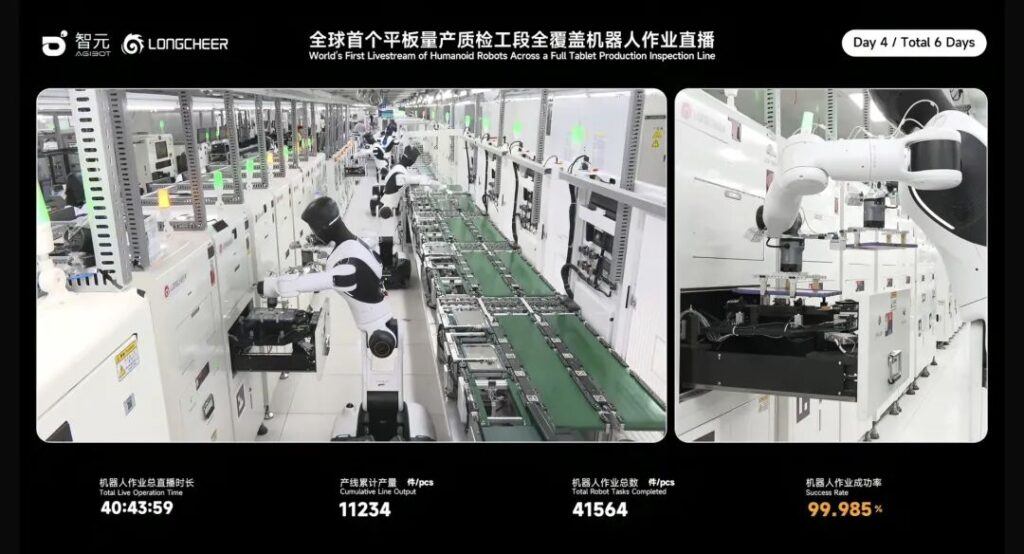
This unedited, unrehearsed, and fully transparent robot operation broadcast has attracted significant attention from netizens both domestically and internationally.
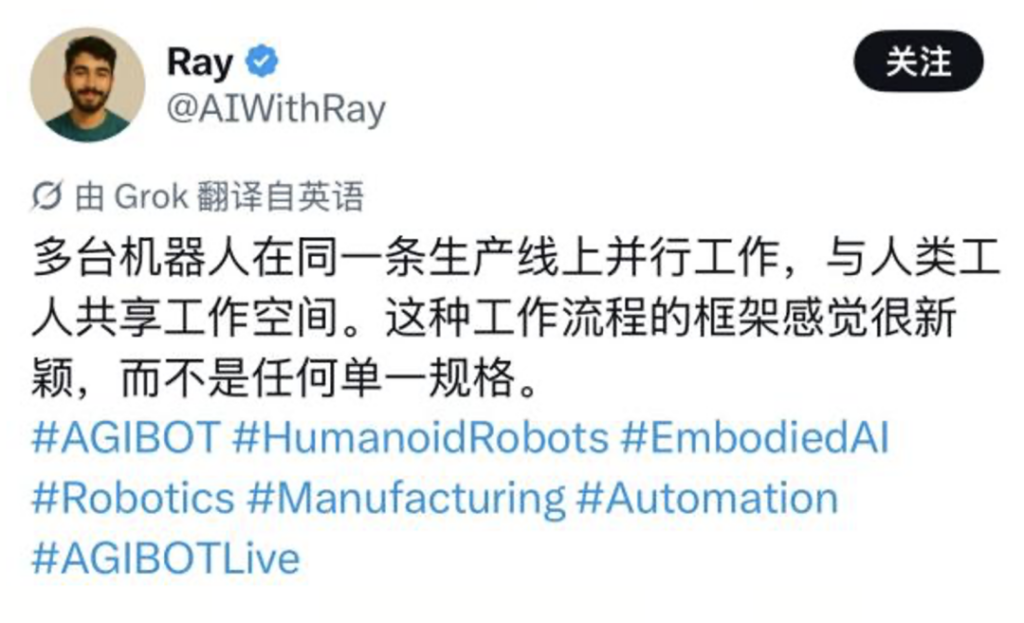
Overseas AI content creator Ray believes that what is truly novel about Zhiyuan's live broadcast is the complete workflow framework built by multiple robots operating in parallel on the same production line and sharing the same workspace with human workers.
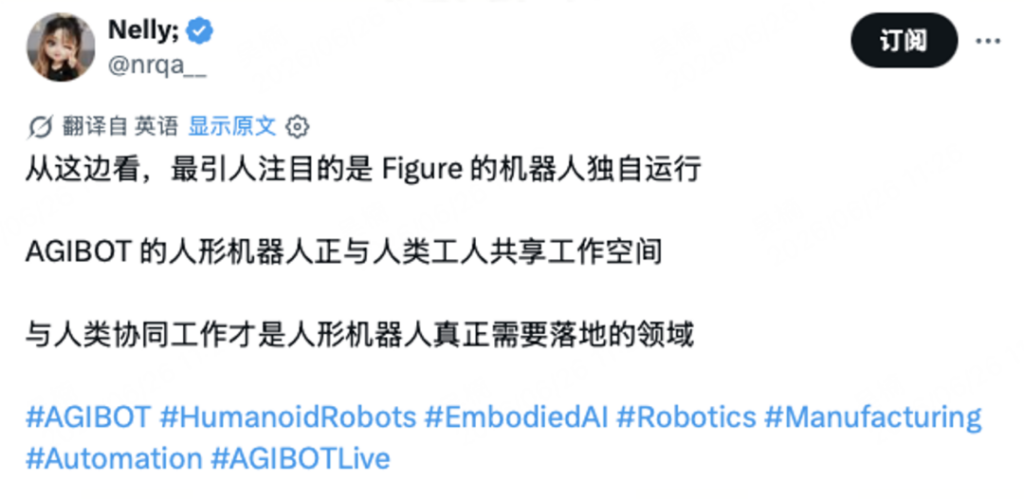
Another robotics analyst blogger pointed out: collaborating with humans is the area where humanoid robots truly need to be implemented, rather than performing alone in a laboratory environment.
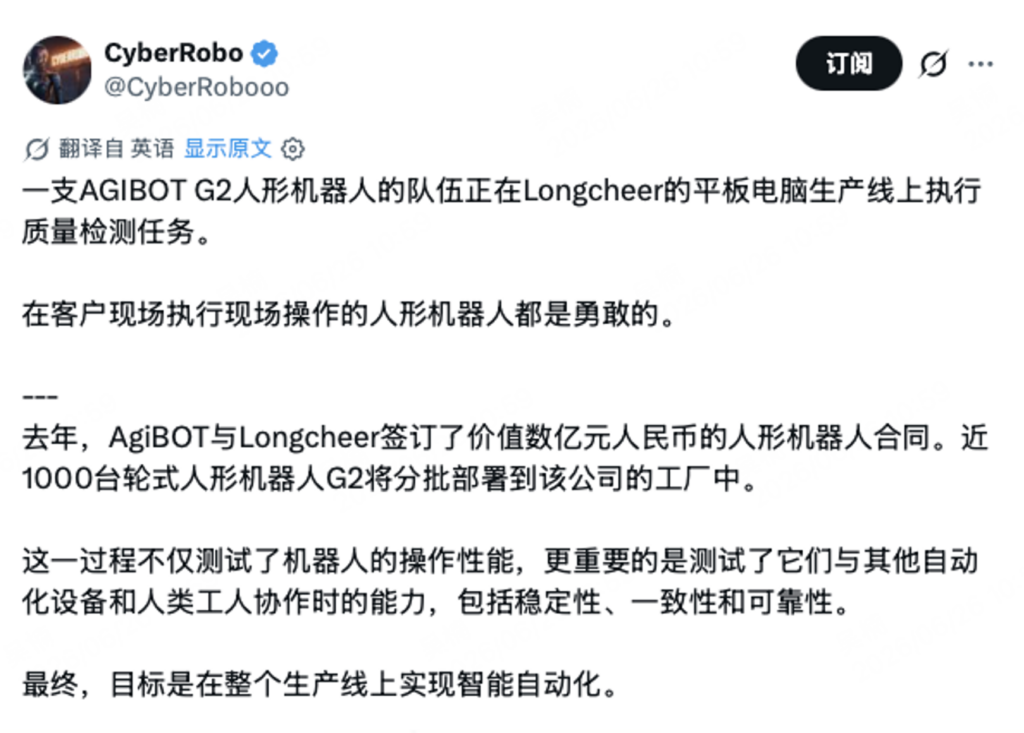
Humanoid robot observer blogger CyberRobo believes that Zhiyuan's Spirit G2 entering Longqi Technology's factory not only tested the robots' operational performance but, more importantly, tested their ability to collaborate with automated equipment and human workers, including stability, consistency, and reliability.
It is evident that Zhiyuan Robotics has provided the industry with a deterministic empirical proof: Embodied AI has begun to cross the chasm of technological bubbles, officially moving from the exploratory, trial-and-error 'development state' to the batch-production, stable, and reusable 'deployment state'. 2026 year marks the inaugural year of the robot deployment state.

Bridging the Real-World Loop for Commercial Deployment
Zhiyuan (Agibot) predicts that 2026 will mark the industry's transition from a "development phase" to the first year of the "deployment phase." The entire sector is entering a period of deployment-driven growth, following the Y-curve. From this stage onward, robots must generate value by performing tasks akin to human labor, ultimately bringing their productivity close to that of humans.
So, what is the fundamental difference between the "development phase" and the "deployment phase"?
In the "development phase," robots primarily serve to validate technological feasibility. They are typically confined to laboratories, executing predefined, fixed tasks in highly controlled, interference-free environments. Such operations require extensive engineering teams for backend fine-tuning and maintenance, and they cannot sustain long-term, stable performance on real-world dynamic production lines. Consequently, products in the "development phase" fail to deliver continuous commercial returns for enterprises.
The "deployment phase," by contrast, implies a completely different set of survival rules. It demands a certain level of maturity: robots must achieve scalable, batch-level implementation and rapid reusability across workstations with little to no human intervention. Entering the "deployment phase" means robots are no longer VIPs in the lab but must function like ordinary workers, adapting to factory dust, noise, fluctuating human traffic, and relentless production paces.
The significance of moving from the "development phase" to the "deployment phase" extends beyond commercial monetization; it also fully activates the technology flywheel of Embodied AI.
In the previous "development phase," the technology flywheel focused on bridging the gap from 0 to 1. Since robot bodies were initially immobile, the process involved data collection and model training to enable movement and establish basic operational capabilities.
The technology flywheel in the "deployment phase" addresses the transition from 1 to 10. With large numbers of robots deployed in real-world scenarios, massive amounts of data feed back into models to enhance their capabilities. These stronger models are then pushed back down to the robot bodies. This creates a cycle where model capability growth and technology flywheel iteration accelerate significantly.
The collaboration between Zhiyuan and Longcheer Technology serves as strong evidence for the inaugural year of the 'deployment phase'. In 4 this year, the Genie G2 wheeled humanoid robot entered Longcheer Technology's 3C precision manufacturing production line as a formal employee, completing precise material loading/unloading and human-robot collaborative operations.
Two months later, Genie G2 faced an even greater challenge—transitioning from a single process step to full-process coverage across tablet mass production quality inspection.
In real-world 3C manufacturing workflows, the quality inspection stage is the core gatekeeper determining whether products can leave the factory, imposing extremely stringent requirements on precision and stability.
During this 6-day live broadcast, a cluster of 8 Genie G2 robots independently undertook multiple high-precision testing tasks, including multimedia interface testing, audio testing, radiation stray emission testing, and coupling testing. They not only had to operate tablets accurately without error, identifying screen dynamics and audio feedback, but also strictly adhere to the actual takt time of the entire production line, achieving seamless coordination with workers in upstream and downstream processes.
Humanoid robots entering the core manufacturing segment of 3C consumer electronics at scale for the first time marks a阶段性 (phased) leap in the maturity of the robotics industry. Simultaneously, it has truly bridged the closed loop from robotic technology R&D to commercial implementation, making the delivery of常态化 (routine) productive capacity a reality.

The Moat of "Three Intelligences Integration"
Zhiyuan Robotics' ability to overcome the widespread industry landing gap and achieve scaled robotic deployment on 3C core mass production lines stems from its confidence in the "Three Intelligences Integration" architectural ecosystem.
In this context, 'One Body' refers to the robot's physical structure, while 'Three Intelligences' denote its operational intelligence, interaction intelligence, and locomotion intelligence. Zhiyuan is one of the few robotics companies in the industry that offers a comprehensive product portfolio and full-scenario layout.
'One Body' serves as the hardware foundation. To address the differentiated needs of various scenarios such as industrial and service applications, Zhiyuan has built a complete product lineup including Yuanzheng, Genie, Lingxi, and Kuto. This ensures that there is a suitable robot body for multiple niche markets, meeting specific market demands.
Taking the Genie G2 stationed at Longqi Technology's factory as an example, it is positioned as an industrial-grade interactive embodied operation robot. In terms of hardware design, it is equipped with high-performance joint actuators and high-precision torque sensors, featuring a total of 26 degrees of freedom across its body. More importantly, the Genie G2 is also fitted with a cross-wrist force-control arm, enabling it to delicately perceive external forces and respond smoothly. This capability forms the physical basis for seamlessly undertaking fine, high-precision force-controlled quality inspection tasks on the 3C production line.
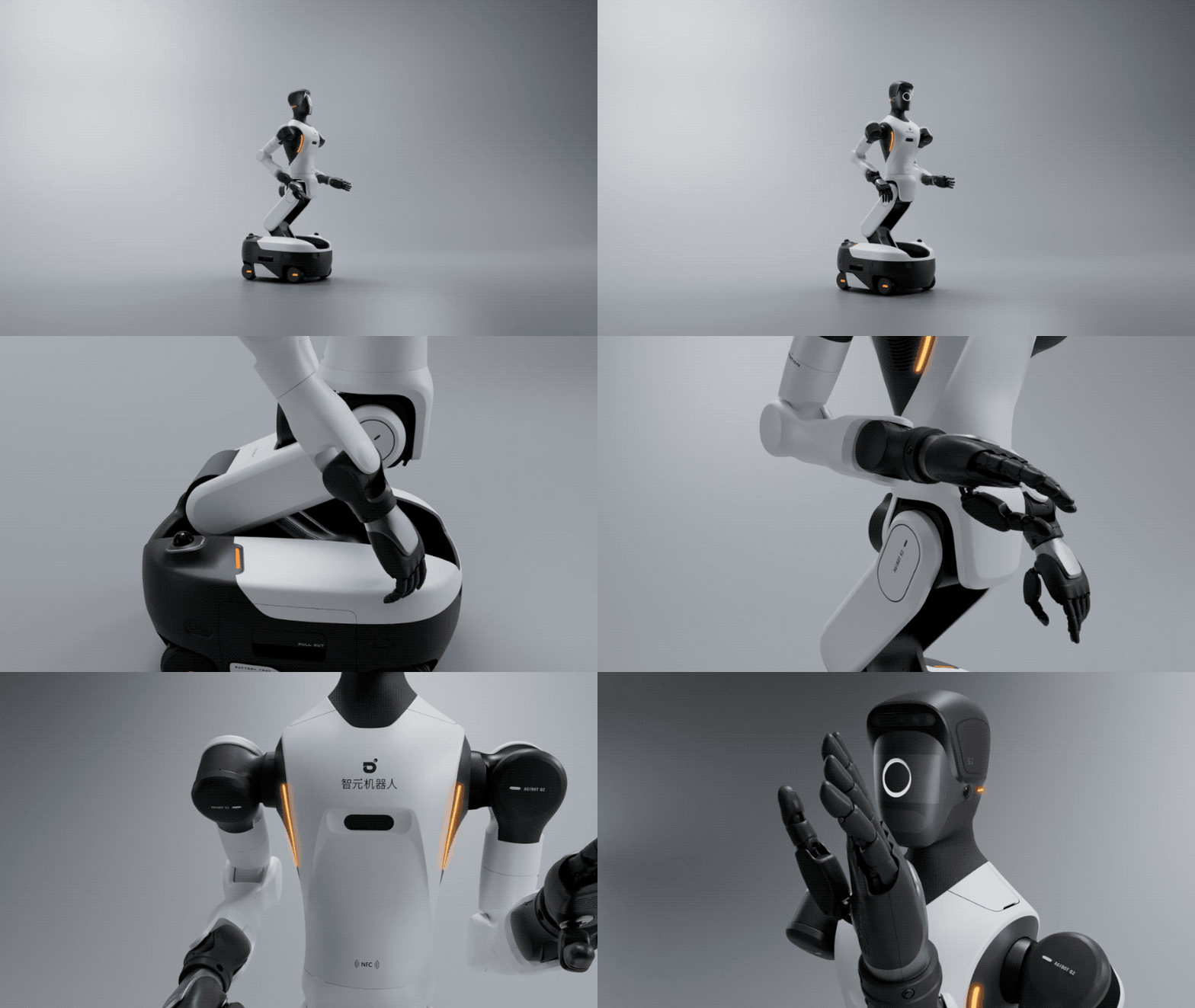
Furthermore, its waist section features a 3 degree-of-freedom design, allowing it to perform human-like agile movements even in narrow production line workstations.
With a stable and reliable physical body serving as the foundation of 'One Body', it is necessary to deeply integrate the 'Three Intelligences': operational intelligence, locomotion intelligence, and interaction intelligence. At Longqi Technology's factory, the Genie G2 primarily demonstrated its operational intelligence capabilities.
Operational intelligence is the engine determining whether a robot can work and do so effectively, representing its labor value. Through its self-developed general foundation large model GO-2 and world model GE-1, Zhiyuan has achieved an 'action chain of thought'. This allows the robot to first perform logical reasoning within the action space, decomposing complex long-range tasks and simulating future actions. Meanwhile, the 'asynchronous dual-system architecture' enables low-latency decision-making of less than 10 ms in complex and dynamic industrial environments. Ultimately, the Genie G2 can truly align with stringent production rhythms and independently undertake high-precision inspection tasks.
However, merely building and making robots look good does not solve the 'deployment difficulty' problem faced by factories. To enable efficient replication of the 'deployment state', Zhiyuan has further established a full-stack ecosystem system called AIMA, which includes Link-U OS, LinkCraft, LinkSoul, and Genie Studio. This makes developing robot applications as simple as developing mobile apps.
In traditional industrial automation upgrades, solution deployment and production line adaptation often take months or even longer. Zhiyuan's one-stop development platform achieves a high degree of standardization by encapsulating core capabilities such as highly complex VLA model inference, reinforcement learning algorithms, low-level perception and decision-making, and full-body control.
This is akin to providing factories with a "low-code" toolkit, significantly reducing the deployment logic and solution-building cycle on the factory side. This is the core logic behind Zhiyuan being among the first to enter the "deployment phase."

3C Production Line "Flexibility Revolution"
Shifting focus from the technical side to the demand side reveals that traditional 3C manufacturing stands on the eve of a productivity transformation.
As an industry characterized by the intersection of labor-intensive and technology-intensive operations, consumer electronics have short product life cycles, with iterations measured in months. This directly leads to extremely frequent changeovers on manufacturing production lines.
However, the automated equipment relied upon by traditional production lines is highly rigid, typically consisting of mechanical arms designed for "dedicated machines used for dedicated purposes." Once there are minor adjustments to product appearance, internal components, or inspection processes, the entire production line faces lengthy shutdowns for retrofitting and high reconstruction costs. Coupled with structural pain points common in manufacturing in recent years, such as difficulties in recruiting blue-collar workers and high turnover rates, the ceiling of traditional rigid automation has become clearly visible.
Against this industry backdrop, what Zhiyuan provides to Longcheer Technology is a comprehensive "flexible manufacturing upgrade solution" that directly addresses the pain points of manufacturing enterprises.
In the quality inspection stage, the Genie G2 can seamlessly switch and transition between multiple differentiated inspection processes.
Among them, the Genie G2 possesses ultra-line-of-sight high-precision teleoperation capabilities and supports dual-battery hot-swappable battery changes and autonomous charging technology, ensuring it perfectly adapts to the factory's continuous operation needs. When the production line needs to switch models, the factory does not need to dismantle or redesign large-scale dedicated mechanical structures; instead, rapid configuration of the robot's skill foundation model at the software level enables flexible reuse across workstations.
Li Long, General Manager of Robotics Business Department at Longcheer Technology, believes that traditional automation equipment is rigid with long production line changeover cycles, making it difficult to adapt to mixed-line detection requirements for multiple tablet categories. The Genie G2 can seamlessly take over multiple differentiated inspection processes, effectively addressing the shortcomings of traditional production lines, and can operate stably for extended periods alongside the production line, verifying the commercial reliability of humanoid robots.
More significantly, through this deep implementation, Zhiyuan has pioneered and validated a standard commercial deployment model in the industry: a scalable template of 'technical standards + implementation processes + commercial returns.' It demonstrates to the entire manufacturing sector that the introduction of Embodied AI is an industrial upgrade tool with clear processes, quantifiable results, and high replication efficiency.

Conclusion
From demos that stumble in laboratories and single-point technological showcases dependent on specific environments to 'formal employees' standing shoulder-to-shoulder with human workers in mass-production workshops, even having the courage to face transparent live broadcasts across the industry, the entry of Zhiyuan's Genie G2 into the Longcheer factory not only proves its technical strength but also marks a leap forward for the entire Embodied AI industry.
Currently, Chinese Embodied AI enterprises have taken the lead in completing the technical exploration of 'making robots move' and are undergoing a commercial transformation toward 'enabling robots to create industrial value'.
As the "deployment-phase" force represented by Zhiyuan accelerates its penetration into physical industries such as 3C manufacturing, automotive parts assembly, and precision manufacturing, humanoid robots are quietly shedding their sci-fi labels and injecting new momentum into manufacturing transformation. Chinese embodied AI enterprises rooted on the front lines of production workshops are also seizing the commanding heights in the global competition for embodied AI.