
Can VLA Models Finally Do Away with Post-Training? Self Variable's Open-Source WALL-OSS-0.5 Deploys Directly from Pre-training

In recent years, VLA models have grown increasingly powerful, yet a key reality persists: almost all impressive results rely on post-training. The pre-trained model itself rarely gets deployed directly onto robot bodies.
It seems that task fine-tuning is what truly enables the model to "work." Did pre-training actually teach robots how to manipulate objects? Can the model be deployed directly onto robots without post-training? Until now, there was no answer to this question.
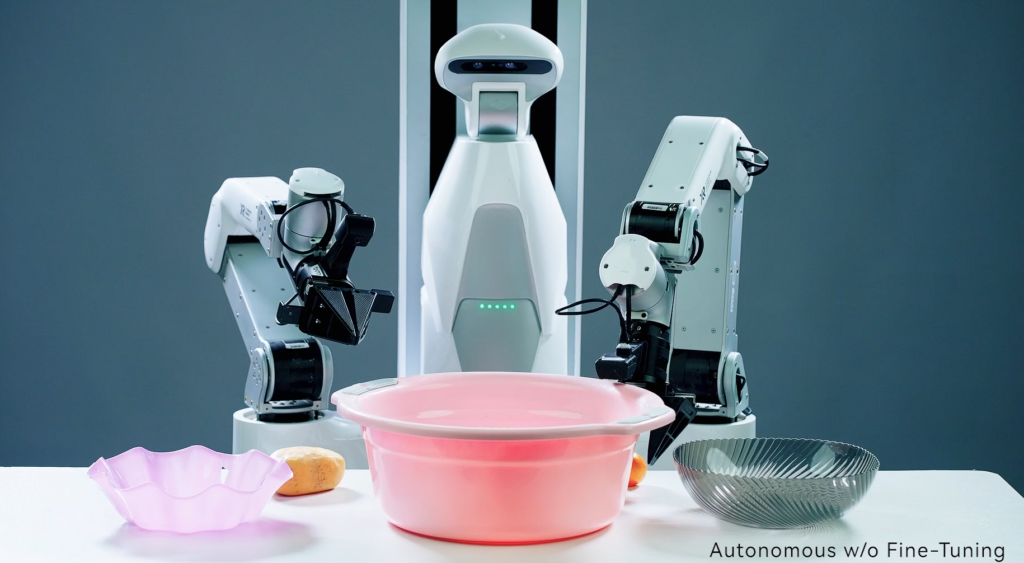
Recently, Ziyang Robotics open-sourced its embodied foundation model WALL-OSS-0.5. The pre-trained model can be deployed directly onto Ziyang's self-developed robot body to complete various operational tasks such as moving, sorting, and organizing ropes. Some of these effects even reach levels that many other models can only achieve after fine-tuning.
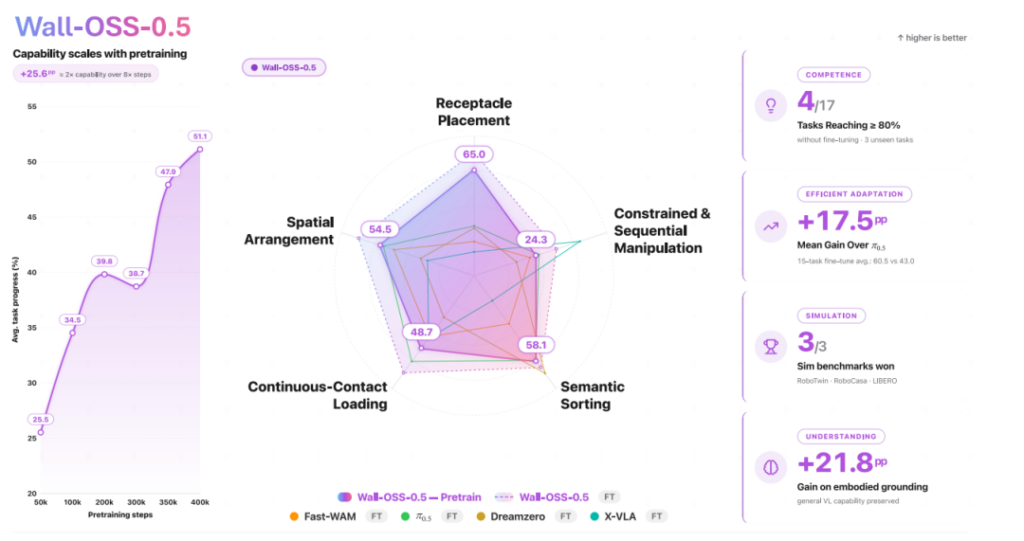
Looking at these results together, it becomes clear that WALL-OSS-0.5 is changing the ingrained mindset that "models cannot be used directly without post-training."
Against the industry backdrop where post-training is widely valued, why does the pre-trained performance of WALL-OSS-0.5 rival that of post-trained models? And in terms of design, how does WALL-OSS-0.5 differ from traditional VLA models?

Why have VLAs previously required post-training?
Over the past couple of years, the industry has seen a surge in Vision-Language-Action (VLA) models. However, the training paradigm for the vast majority of them essentially remains a visual-language model combined with an external action expert. Their typical design workflow is as follows:
- First, train a VLM (Visual Language Model) using massive amounts of internet text and image data;
- Then, attach an Action head (action expert) on top, specifically responsible for action prediction;
- Finally, train the action module separately using robot data.
While these three steps appear logically smooth, there is a hidden problem: the backbone model itself does not learn to act. It learns world knowledge, visual understanding, and language capabilities, while the ability to perform actions is relegated to an external module.
Consequently, through continuous industry practice, it has gradually become apparent that although the scale of robot backbone models continues to grow, the component actually responsible for executing actions remains that relatively small Action expert.
This is akin to having a PhD holder responsible for understanding the world and an intern responsible for hands-on work. The PhD understands a great deal but cannot perform the tasks; the actual work is done by the smaller module behind them.
Therefore, a larger model does not necessarily equate to stronger action capabilities, because "seeing" and "acting" have not truly been integrated.
This is why the vast majority of VLA models require re-post-training for specific tasks.
Because during the pre-training phase, the backbone model hasn't truly mastered how to operate; it's merely a strong vision-language understanding system.
One of the core aspects of WALL-OSS-0.5 is actually enabling the backbone model itself to learn actions.

WALL-OSS-0.5 Ensures Each Signal Finds Its Proper Place
The core objective targeted by the WALL-OSS-0.5 model is to enable VLM backbones to genuinely acquire generalizable action capabilities. To achieve this, it must sequentially address three progressively complex modeling challenges.
How to Truly Integrate Actions into the Backbone Model
For a pre-trained model to possess zero-shot capabilities, a prerequisite is that actions cannot reside solely in external modules; they must be integrated directly into the foundational model itself.
To this end, WALL-OSS-0.5 implemented a highly critical design: tokenizing actions and then incorporating them into language model training.
The team proposed a design called Gradient-Bridge. Previously, VLAs processed images into a backbone and then to an action head, with action supervision confined to the Action head.
With Gradient-Bridge, images, text, and action tokens are now fed into the same autoregressive sequence. Actions are predicted like language, with the model using cross-entropy loss to learn action tokens and allowing gradients to directly update the backbone model in reverse.
This change enables the backbone itself to learn how to act, unifying seeing, speaking, and moving within the same representation during pre-training. Robot actions are no longer external capabilities but become intrinsic abilities of the base model.
Only when the backbone truly learns actions can pre-trained models achieve zero-shot transfer capabilities; otherwise, various new tasks would rely solely on post-training adjustments.
Ablation experiments in the paper were straightforward: removing Gradient-Bridge caused a significant drop in real-world success rates, with larger models experiencing more severe degradation. This indicates that for larger models, incorporating action supervision into the backbone is even more critical.
Action Tokens Cannot Be Mere Number Compression
In the overall design, simply tokenizing actions is insufficient. There is a hidden question here: does the backbone learn 'action semantics' or merely 'action indices'?
If a token is merely a numerical ID resulting from mechanical compression, then the model predicting action tokens is essentially just guessing the next number, rather than understanding how that action will alter the visual scene. In such a scenario, what Gradient-Bridge feeds into the system is nothing but meaningless encodings. The backbone learns only statistical patterns, not the manipulable structures of the physical world.
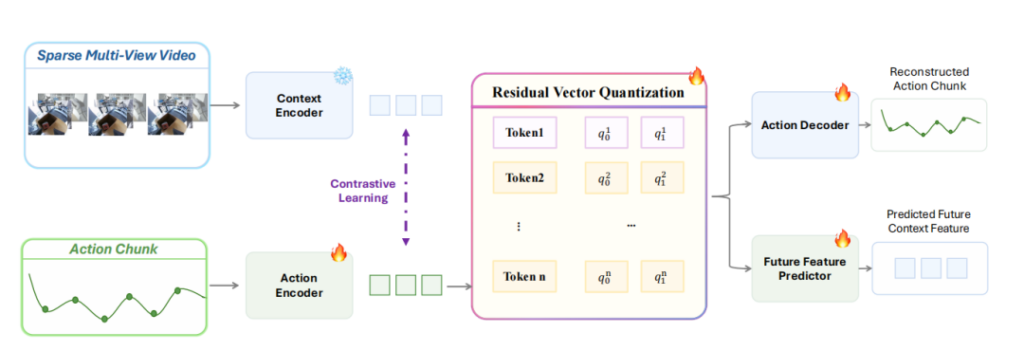
In response, WALL-OSS-0.5 chooses to retrain a vision-aligned action tokenizer. Its core logic posits that an action token represents not just the action itself, but also how that action causes the world to change.
Consequently, the team forces the token representation to align with visual features and requires it to predict the visual changes in the next frame. This design allows each action token to carry two layers of meaning simultaneously: information on action compression and information on world dynamics.
With this architecture, the robot predicts how the world will evolve next, rather than simply outputting numbers.
How to enable continuous actions to truly learn 'key trajectories'
While enabling the backbone to understand action semantics, there remains a practical issue: the robot ultimately executes continuous actions, not discrete tokens.
In this regard, WALL-OSS-0.5 employs Flow Matching. However, the design here differs from traditional Flow Matching because conventional methods often tend to 'apply uniform force' across all aspects.
Some parts of a robot's trajectory are critical, while others are insignificant. For example, in the task of a robotic arm grasping a cup, what truly matters is aligning with the cup's opening, approaching along the correct path, and achieving the proper grasping posture; high-frequency detail jitter often does not affect the outcome.
However, traditional Flow Matching spends significant computational budget fitting these high-frequency noise components, causing the model to waste considerable compute on unimportant elements.
Therefore, WALL-OSS-0.5 introduces modifications in this area: instead of predicting velocity, it directly predicts actions.
The corresponding result is that training naturally focuses more on key trajectory structures rather than meaningless jitter.
In other words, it directs the model to allocate its learning budget toward how to complete tasks, rather than replicating every minute detail.
The Final Hurdle: Actually Running the Training
After implementing these designs, making the training actually run successfully becomes even more important. However, aggregating these three improvements also introduces an accompanying engineering problem: the scale of internal model parameters and gradient strengths become highly heterogeneous because:
- The VLM backbone comes from pre-training
- The Action head is trained from scratch
- Multiple loss paths are optimized simultaneously
The gradient scale would be severely imbalanced, so the team implemented a system-level optimization called DMuon.
It essentially compresses the massive overhead of the efficient optimizer Muon to almost negligible levels. The training cost dropped from nearly 2x to 0.02x, allowing it to be plugged directly into existing pipelines.
Compared to traditional VLA models, WALL-OSS-0.5 involves significant modifications, and the capabilities brought by these changes are reflected in specific task execution.

What exactly are the results?
In experiments conducted by the team, WALL-OSS-0.5 demonstrated its core zero-shot generalization capability.
In multiple real-world robot tests covering semantic manipulation, flexible manipulation, and long-horizon tasks, the model was deployed directly onto physical robots after pre-training without any fine-tuning.
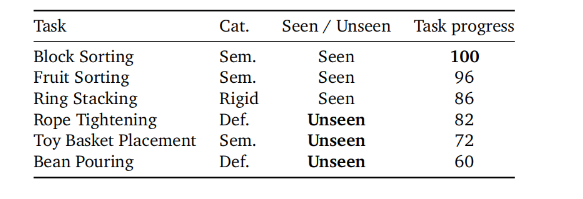
The final results show that task progress for block sorting, fruit sorting, and ring-stacking tasks all exceeded 85%. Even for deformable object tasks not present in the training data, such as rope tightening, task progress reached 82%, which is rare among currently open-source VLA models.
In fair comparative experiments across more than ten real-world robot tasks, all models used identical data and fine-tuning budgets.
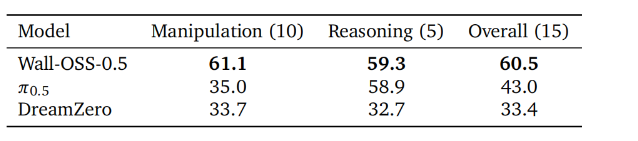
The results showed that Wall-OSS-0.5 significantly outperformed other open-source models like π₀.₅ in manipulation tasks, leading by over 25 percentage points; it also maintained a stable advantage in tasks requiring reasoning and judgment.
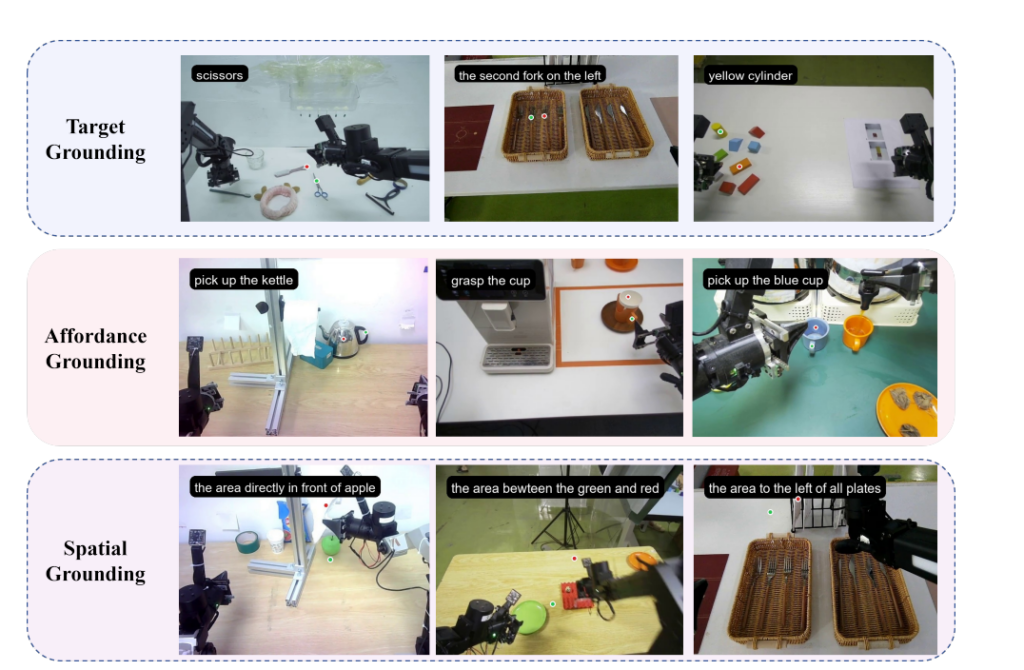
Notably, the model's multimodal understanding capabilities did not collapse due to the focus on action training. Particularly in embodied localization tasks (accurately identifying target locations from the robot's perspective), which are highly relevant to robotic execution, Wall-OSS-0.5 improved by over 20 percentage points compared to the original VLM backbone.
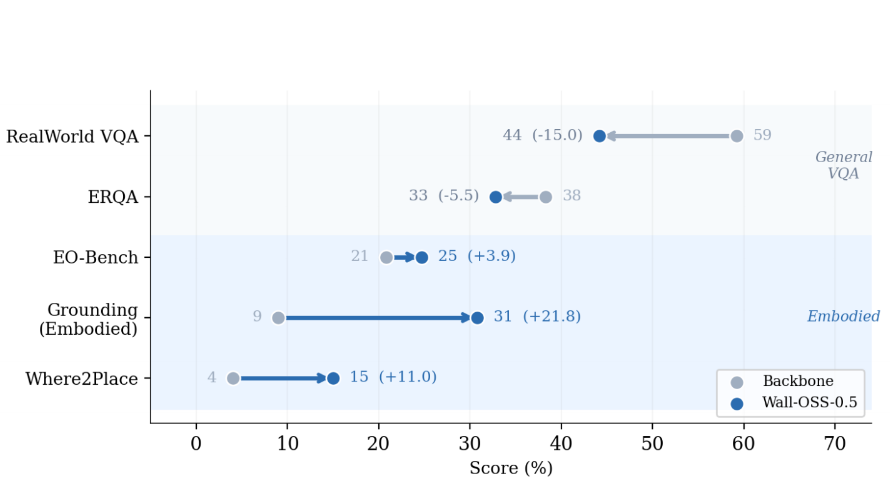
The team believes this validates the effectiveness of their 'gradient bridging' co-training approach, demonstrating that action learning and visual-language understanding are not a zero-sum game but can mutually reinforce each other.

Pre-training as Policy: A New Paradigm for the Industry
For a long time, influenced by Large Language Models (LLMs), Embodied AI's Vision-Language-Action (VLA) models have followed a similar path. Pre-training merely provides a "good foundation," while true operational capabilities are expected to be unlocked through fine-tuning on downstream tasks.
Thus, an assumption has become industry standard: no matter how strong the pre-trained weights are, they do not constitute a usable policy without fine-tuning on real hardware.
However, the release of Wall‑OSS‑0.5 is attempting to break this惯性思维 (inertial thinking).
Performance on these tasks shows that based on self-developed robot bodies by Variable (自变量), pre-trained models are beginning to demonstrate the possibility of "direct deployment." For the embodied AI industry, this represents a significant shift.
The traditional industry default path involves pre-training first, then adapting to specific tasks, and finally entering real-world scenarios.
WALL-OSS-0.5 attempts a different direction: enabling models with the capability to deploy directly after pre-training. Of course, the emergence of this capability is not simply achieved by relying on "larger models."
In response, the Wallbox team implemented relatively thorough design changes to the model. These include Gradient-Bridge collaborative training, a visual-aligned action tokenizer, Flow Matching for the action space, and the DMuon optimizer that enables actual training execution. Together, these innovations provide the industry with a new perspective on how VLA models can better integrate into the real world.
However, it is important to note that in zero-shot robotic tasks, the capabilities demonstrated by Wall-OSS-0.5 were achieved specifically on the Wallbox robot platform. To deploy across different robot platforms while maintaining performance, some degree of fine-tuning remains necessary. Experiments also revealed that significant differences between platforms may lead to substantial variations in results. Therefore, achieving cross-platform generalization remains a key direction for future research.
Furthermore, the team provided ablation studies and engineering validations for each design component, clearly explaining which problems each module solves and the performance impact of removing them.
On the engineering side, the team simultaneously released system-level infrastructure such as the DMuon optimizer. Consequently, the open-source release of WALL-OSS-0.5 resembles more than just a model release—it represents a publicly available, reproducible training methodology.
For researchers aiming to train large-scale VLA models, this foundational capability that can be directly integrated into training pipelines further lowers the barrier for community reproduction and extension.
This means the community no longer needs to reinvent the wheel, but instead has the opportunity to accelerate iteration from a common starting point.
For the broader Embodied AI industry, teams often face consistent challenges, and bringing robots into daily life remains a shared goal. Thus, open-source ecosystems and collaborative progress have become the main development trajectory in recent industry trends.
Project link: https://x2robot.com/oss#resources
Paper: https://x2robot.com/api/files/file/wall_oss_05.pdf*
Code Repository: https://github.com/X-Square-Robot/wall-x*
Model Weights: WALL-OSS-FLOW / WALL-OSS-FAST (Hugging Face)