
Starting from Bottom-Up Instincts, Oakfruit Robotics Unveils 'Instinct-Driven' Technical Route
On June 2, Oaknut Robotics released its "Instinct-Driven" technical roadmap, starting from fundamental instincts to enable robots to first acquire operational instincts and then autonomously emerge with operational intelligence through interaction with the physical world.
From an industry perspective, most companies in the field of Embodied AI currently choose a "top-down" approach: using large models to understand tasks and training end-to-end policies with massive amounts of data, attempting to have robots mimic human work. In contrast, Oaknut has chosen a "bottom-up" route.
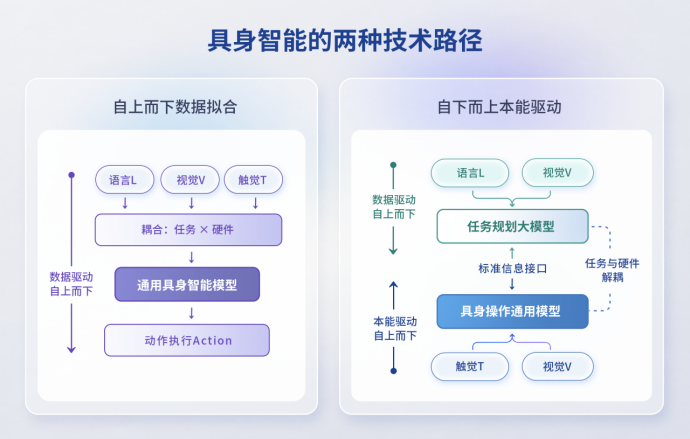
For humans, language lacks innate instinct; if a newborn does not come into contact with language, they cannot learn to speak. However, operational behavior is different. Human actions for grasping objects are highly consistent regardless of age, culture, or environment. There is an underlying instinct behind these operational behaviors that exists at birth and is unaffected by postnatal environmental factors.
This is precisely the key reason why Oaknut chose the bottom-up path.
Specifically, Oaknut's technical approach decouples task planning from operational execution, building a general-purpose operational model from the bottom up.
Task Planning Layer: Responsible for knowledge reasoning, task decomposition, and global planning. Through top-down knowledge learning, its output is not specific motor current commands or joint angles, but rather key image frames and semantic constraints. For example, for the task "carry this cup of water to the table without spilling," the planning layer outputs target images showing "where the object starts" and "where the object should ultimately land," along with the constraint "do not spill," rather than the specific action path of the end-effector.
Operational Execution Layer: Responsible for accurately and robustly executing task planning instructions in the real physical world. This is Oaknut's primary research focus, starting from embodied instincts and adopting a bottom-up, self-emergent operational intelligence technical route.
Additionally, Oakfruit has developed an edge-side autonomous decision-making model called Natus, which endows robots with human-like operational instincts and drives behavioral emergence. Leveraging exploration and interaction in the real physical world to continuously refine these capabilities, the company builds its second core model: the General Manipulation Skills Model (Magis). Magis is trained using data generated by Natus during autonomous exploration in the real physical world; this data features rich and precise tactile semantics. The visual data undergoes semantic enhancement before being used to train the skills model.
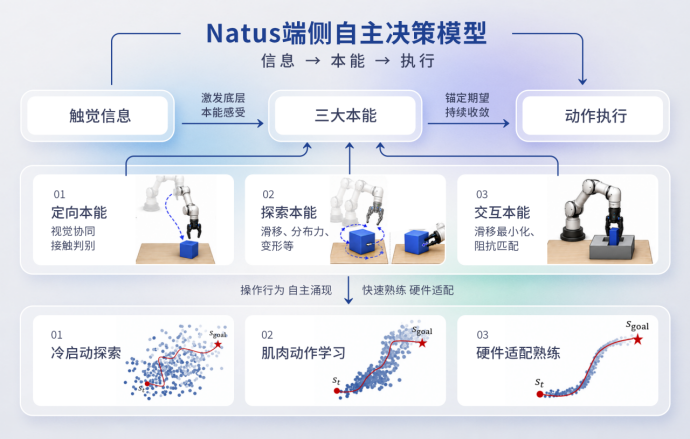
Natus is fully embedded within the terminal actuators as an edge-side model driven directly by tactile stimuli, featuring millisecond-level response times. It grants robots three fundamental instincts:
Directional Instinct: Used to establish contact relationships. Working in synergy with vision, it guides the end-effector toward target objects.
Exploration Instinct: Used to establish constraint relationships. Once the end-effector contacts an object, this instinct activates automatically. Rather than relying on preset actions, it autonomously explores along the object's surface by sensing tactile information such as slippage, contact area, distributed forces, and deformation, seeking a stable contact configuration. This is not achieved through preset programs or imitation learning, but rather emerges as an autonomous behavior driven by the instinct to "establish stable contact" (a novel strategy).
Interaction Instinct (e.g., grasping/assembly): Used to execute actions. Once the exploration instinct establishes a stable constraint relationship, this instinct activates automatically. It autonomously adjusts muscle tension in real-time based on expectations of "slippage minimization" or "impedance matching." For instance, when grasping tofu, the gain is lowered (loose); when grasping a hammer, the gain is increased (tight). All adjustments stem from real-time feedback of tactile information, requiring no training data.
The core capabilities granted to robots by Natus are zero-data cold start, hardware adaptability, and millisecond-level response. It requires no training data or fine-tuning. Instead, it relies on instinctive reflexes to build the mapping between tactile perception and muscle movements, enabling operational instincts right out of the box and allowing adaptation to the characteristics of different objects and working conditions. Furthermore, muscle memory can be formed and reinforced through continuous exploration processes.
In Oakfruit's tests, the team observed that when faced with various irregularly shaped objects never seen before, the robot would autonomously explore along their surfaces, adjusting its grasping strategy in real-time until it established a stable contact configuration and successfully lifted the object.
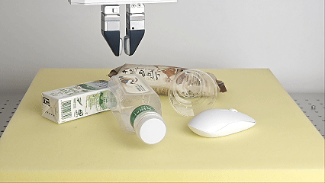
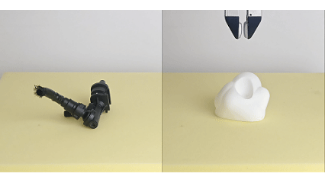
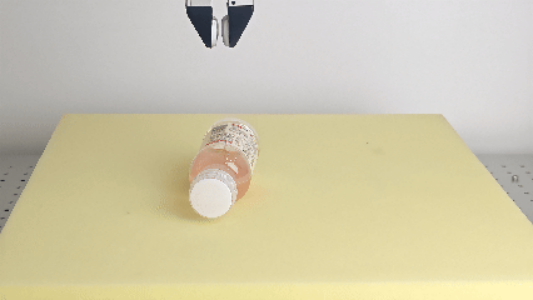
Faced with a bottle tilted halfway to spill water, it repeatedly tests its center of gravity and gradually adjusts its grip force.
Furthermore, Magis’s implementation path leverages data with rich and precise tactile semantics generated by autonomous exploration in the real physical world by Natus. This data is used to semantically enhance visual data before training skill models.
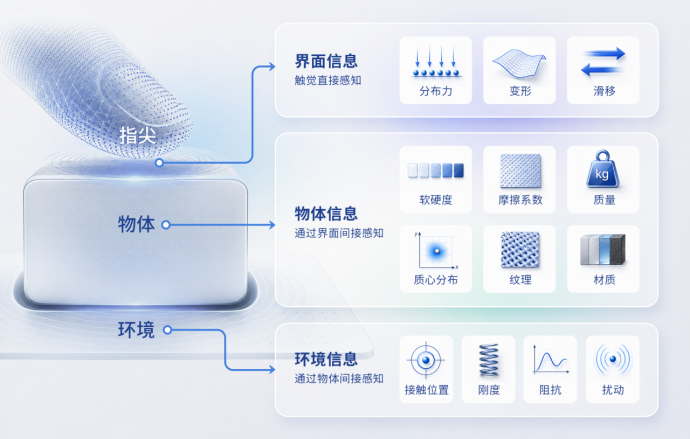
Specifically: When Natus drives a robot to successfully complete an operation in the real world, it records not just the successful outcome, but a comprehensive set of rich physical information, including the object's weight, center of mass position, surface hardness and roughness, force distribution during grasping, and slip trends. These mechanics semantics, directly perceived through touch and automatically "tagged," are overlaid and aligned onto visual data, which is then further used to train and build skill models.
In terms of tactile perception, Oakfruit Robotics has independently developed a vision-tactile sensor. This sensor adopts a scheme combining an elastomer (silicone) with a micro-camera, relying on no sensitive materials. It uses image representation and reconstruction algorithms to invert the deformation of the elastomer into the required multimodal tactile information.
It is reported that its third-generation mature product of vision-tactile sensors has been launched.
At the commercialization level, Oak Fruit Robotics is focusing on industrial flexible production scenarios (such as consumer electronics, daily chemicals, new energy vehicles, and biomedicine). It has completed POC validation on a cosmetics ODM manufacturer's production line and achieved commercial revenue.
Notably, in March this year, Oak Fruit Robotics completed a seed funding round of nearly 100 million yuan, with leading investors including Qiantang Materials Laboratory and PuHua Capital.
While most companies in the industry are choosing the "top-down" technical path, Oak Fruit Robotics is taking the less-traveled "bottom-up" technical path. Of course, the industry's technical paths have not yet converged, and it remains to be seen which one will prevail. Let's see what answers Oak Fruit Robotics will bring us in the future.