
PI Bets Everything on OS: Can One Model Adapt to All Robots?
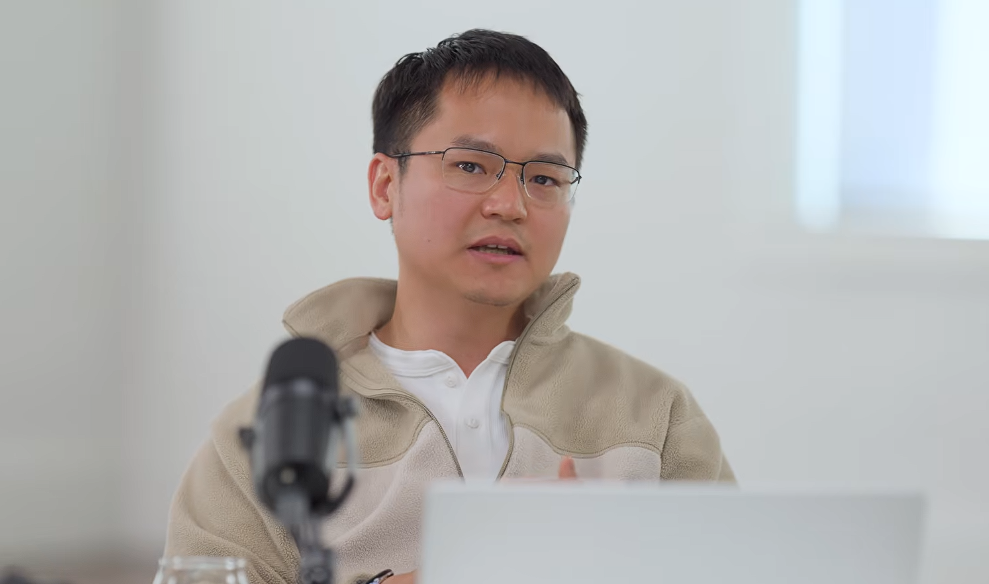
Recently, Quan Vuong, co-founder of the US embodied AI company Physical Intelligence (PI), appeared on a podcast hosted by Y Combinator. In an interview lasting nearly 1 hours, he discussed in detail topics such as the 'ChatGPT moment' for robots, data bottlenecks, and cloud-based inference.
In the field of embodied AI, PI is somewhat of an outlier; it does not manufacture robot hardware itself but focuses primarily on software.
The company aims to build intelligent infrastructure for the robotics world, providing models to hardware manufacturers. Much like cloud computing did for internet startups, it seeks to turn technology into a ready-to-use service.
Regarding the most significant challenge in training models—data scarcity—Quan Vuong believes that scaling data is crucial. With sufficient scale, models can learn universal control logic for robots, enabling them to adapt to various hardware platforms rather than being limited to a single specific robot.
Furthermore, based on the premise of controlling different robots with a single model, PI has chosen to deploy its models in the cloud, ensuring that perception, reasoning, and decision-making are all performed there.
Underlying these technical details is PI's ambition to become a robotic operating system platform.

What is the ChatGPT Moment for Robots?
In the past year, as robotic capabilities have rapidly advanced, discussions about when robots will reach their 'ChatGPT moment' have become increasingly common. While everyone has their own interpretation of this concept, it essentially revolves around anticipating a singularity of general-purpose capability.
According to PI co-founder Quan Vuong, the ChatGPT moment for robots looks like this: "Build truly intelligent models, then create a platform and open it up, allowing everyone to develop various vertical robot applications based on them."

This perspective is closely tied to PI's company positioning. In the field of Embodied AI, PI focuses primarily on the software layer, aiming to provide models to robot manufacturers—similar to companies in the autonomous driving sector that supply intelligent driving software to automakers.
Currently, many players in the embodied intelligence space choose to develop their own models in-house. Since different robot hardware platforms have vastly different requirements for these models, PI has long aimed to create a single model adaptable to various robot bodies. This explains their intense focus on cross-platform performance, as it directly impacts the company's commercial viability.
Here, Quan Vuong referenced the SayCan model proposed by teams such as Google Robotics in 2022. Its core function was to enable Large Language Models (LLMs) to 'speak' reasonable actions to robots, which would then verify whether those actions could be executed.
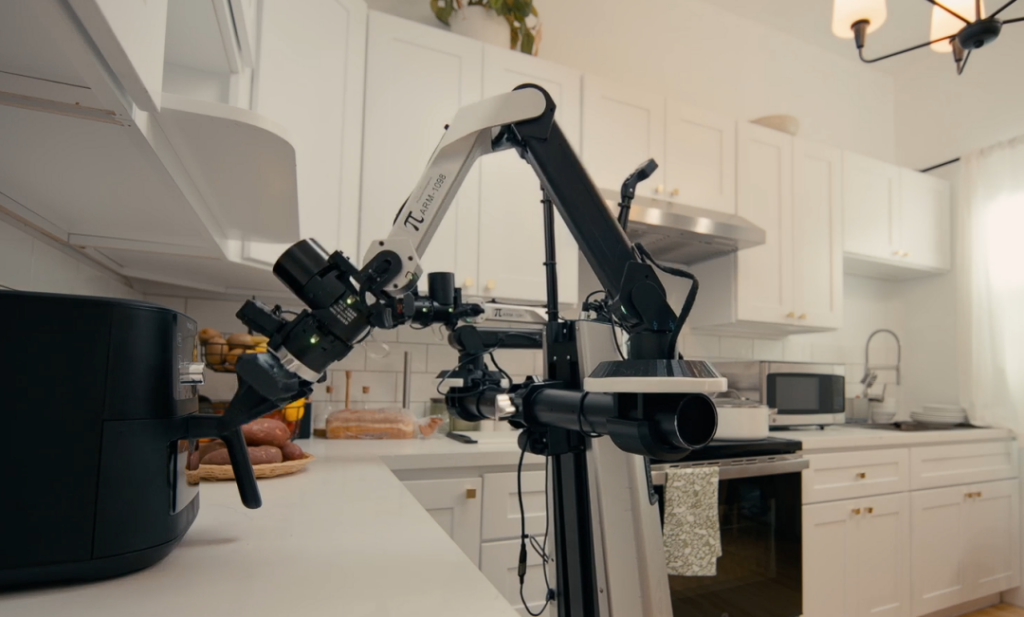
SayCan introduced a framework that serves as the prototype for many current mainstream VLA models. It demonstrated that the common-sense knowledge of large language models can be utilized by robots, thereby gradually reducing the demand for data collection in robotic R&D.
However, even with this advancement, the scale of data required for robotics remains relatively small compared to that needed for LLMs.
While LLMs leverage vast amounts of internet data, the embodied AI domain cannot rely solely on these sources. Real-world robot data and first-person human-view data are crucial information sources, requiring significant effort to collect; indeed, they have become a major bottleneck in the industry today.

Learning Control Logic from Data Scale
After early implementations like SayCan brought LLM knowledge to robots, subsequent research such as PaLM-E and RT-2 transformed planning into low-level actions executable by robots. However, these approaches were effective only for specific robots and lacked cross-embodiment capabilities.
For robotic applications to scale up, cross-embodiment capability becomes critically important. On this foundation, scaling up data collection is an urgent priority.

Quan Vuong believes that what a model learns from data is the more important question.
Therefore, he emphasized that data must be of sufficient scale; only with enough scale can the model learn abstract, general-purpose control logic from the data to control various robotic bodies.
The rise of LLMs has largely relied on the "internet" as a natural data mine. In contrast, robotics faces a wasteland that has yet to be mined by anyone.
Quan Vuong directly pointed out this issue:
- The first layer is data generation. A large amount of robot operation data is generated in the real world every day, such as mechanical arms in factories, sorting robots in warehouses, and teleoperation records in laboratories. However, most of this data is not systematically collected or organized, let alone used for training.
- The second layer is data adaptation. Even if data collection is achieved, data from different hardware platforms cannot be directly generalized. Data accumulated on a single platform may become ineffective when transferred to another robot.
These two layers combined are the key reason why the robotics "data flywheel" has not truly started spinning.
But this hurdle is not insurmountable. Quan Vuong's answer is cross-hardware training.
The specific logic is that when a model is forced to learn data from different robotic bodies, it cannot rely on the specific characteristics of any single robot. Instead, it must learn more abstract control logic: what "grasping" means, what "releasing" means, and what "applying appropriate force" means. This abstraction actually enables the model to better adapt to differences between hardware, rather than being constrained by them.
For them, this is a prerequisite for whether the company's business model can work. If the model can only work on one type of robot, PI cannot become the intelligent layer in the robotics world.
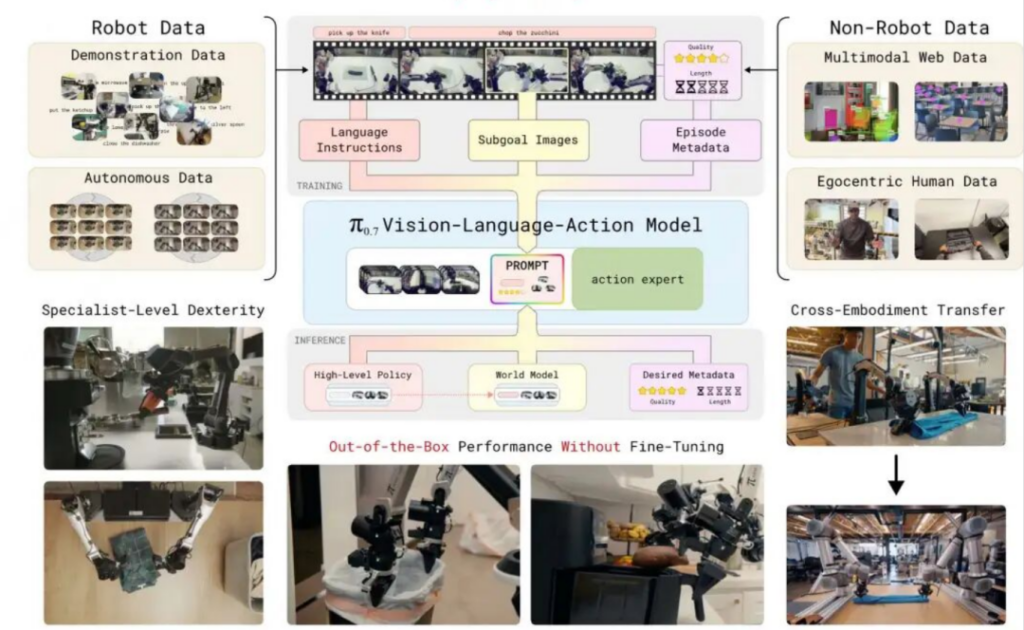
The extent to which this path has been proven is already supported by concrete evidence from PI's latest released π0.7 model performance.
In the latest demonstration, when folding clothes, π0.7 did not have samples of UR5e folding clothes in its training data, yet it achieved an accuracy of 85.6%. The success rate was close to that of a human with rich teleoperation experience trying it for the first time.
A year ago, these tasks might have required collecting hundreds of hours of data on the corresponding hardware to achieve.
Behind this, models are beginning to exhibit emergent abilities as described by Quan Vuong. Rather than simply memorizing every action in the training data, they truly 'understand' the task structure and can generalize to new scenarios.

Model Deployment on the Cloud
When it comes to the large-scale deployment of robots, many companies' first reaction is to configure computing hardware and other aspects.
This question itself may be a trap. Quan Vuong directly pointed this out in an interview: chips purchased today might already be a generation behind in two years. Betting heavily on hardware is a relatively high-risk behavior.
PI chose to go against the grain by placing the 'brain' in the cloud and keeping the robot's physical body as 'light' as possible.
All models powering PI's external capability demonstrations run in the cloud. The robot's workflow is simplified, with core perception, reasoning, and decision-making completed through API calls.
This means the robot's physical body no longer needs to stack heavy computing units or high-power-consumption chips; it only needs to retain basic execution capabilities. Hardware becomes lighter, costs decrease, and the pressure for iteration shifts from robot manufacturers to the cloud-based model side.
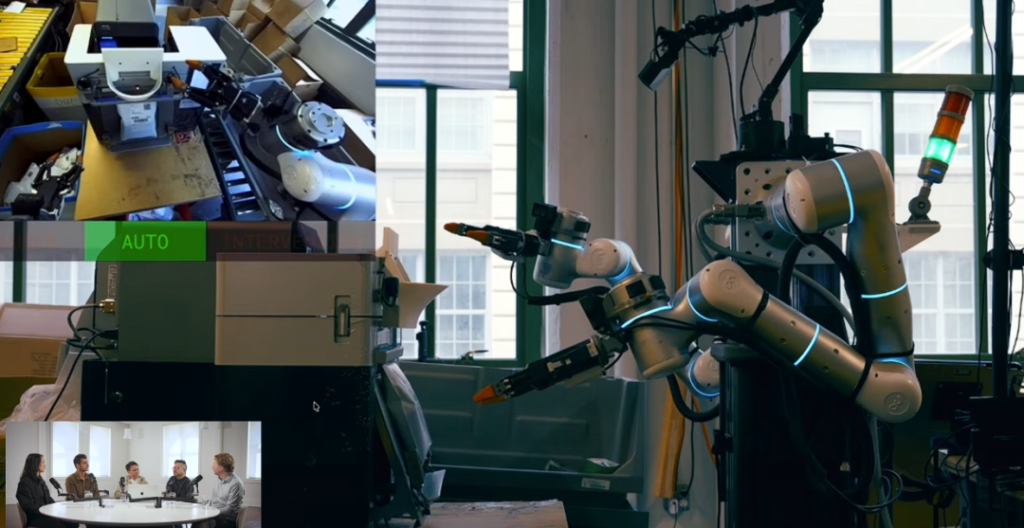
There is a story that Quan Vuong particularly highlighted in an interview, which effectively illustrates this point.
During PI's collaboration with Weave and Ultra, he deliberately avoided learning the hardware details of the partner robots' bodies. However, the models could integrate seamlessly without needing custom adaptation, allowing them to run directly.
This "hardware agnosticism" is the critical prerequisite for scaling PI's business model. If every new client requires a separate hardware adaptation, PI's approach will remain stuck as custom services rather than evolving into a platform.

In Conclusion
As an embodied AI company whose core business lies in software, PI's development logic is inherently different from that of full-stack self-developing manufacturers.
While many manufacturers emphasize designing hardware specifically for AI and consider hardware an integral part of the model design process, PI faces significant market pressure.
Whether this path succeeds fundamentally comes down to one's understanding of "industry division of labor."
Full-stack self-development relies on deep coupling between hardware and software, achieving peak performance through collaborative optimization. Manufacturers like Tesla and Figure are pursuing this route, building their own bodies and training their own brains.
PI is betting on another direction: division of labor offers greater scalability than vertical integration. Just as no one doubts the value of operating systems, decoupling the intelligence layer from the execution layer may be the true prerequisite for scaling up the robotics industry.
But for this judgment to hold, there is an unavoidable prerequisite: the model's cross-embodiment capability must be strong enough that hardware manufacturers find it "more cost-effective to use PI's model than to develop their own." π0.7 has demonstrated certain capabilities in compositional generalization and cross-embodiment, but there may still be a long way to go before large-scale implementation.
For PI, the window of opportunity to prove that the "software route can win" may be narrower than imagined.