
Xiaomi Open-Sources Embodied Model Post-Training on Real Robots: Can It Stop 'Slacking Off'?
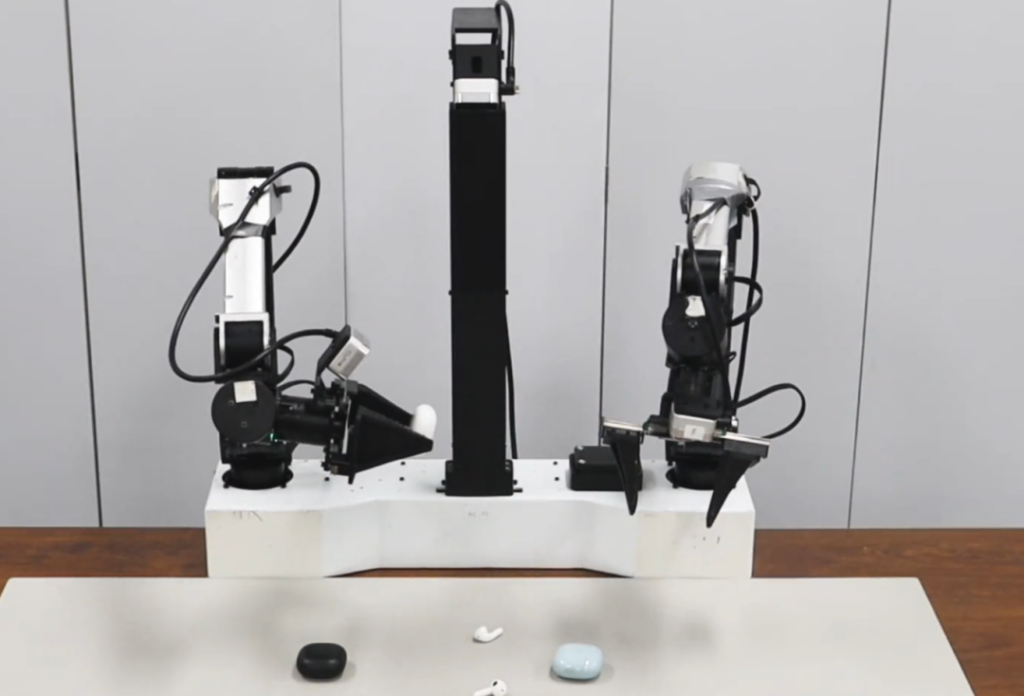
Shortly after releasing the Xiaomi-Robotics-0 embodied AI model, Xiaomi today unveiled new capability demonstrations and officially released the full pipeline for real-robot post-training of Xiaomi-Robotics-0.
In this real-robot post-training process, the Xiaomi team utilized only 20 hours of task data to enable the model to master the fine-grained task of 'placing earphones into their charging case.'
As the final hurdle for embodied models moving toward practical deployment, real-robot post-training involves targeted fine-tuning of pre-trained large models using a small amount of real robot operation data, thereby adapting them for specific scenario applications.
However, post-training is far more complex than simply 'feeding in some additional real data.' It encompasses critical aspects such as training strategies, inference architectures, and action continuity, holding a vital position throughout the training process.
Notably, starting from February this year, Xiaomi has consistently released a series of new advancements in the robotics sector. These included the TacRefineNet fine-grained grasping fine-tuning model and the VLA model Xiaomi-Robotics-0, followed by announcements in March regarding factory deployment results and dexterous hand solutions, and culminating this month with the open-sourcing of the embodied model's real-robot post-training pipeline.
These developments indicate that Xiaomi is attempting to build a complete chain of robotic capabilities, with today’s open-sourcing of real-robot post-training serving as a crucial link connecting previous achievements to future applications.

Beyond Data: Design Is Key
In a new capability demonstration, Xiaomi tasked a robot with organizing wireless earbuds. Faced with three distinct sets of wireless earbuds on the desk, the robot had to identify which earbud belonged to which case based on color and place them inside accordingly.
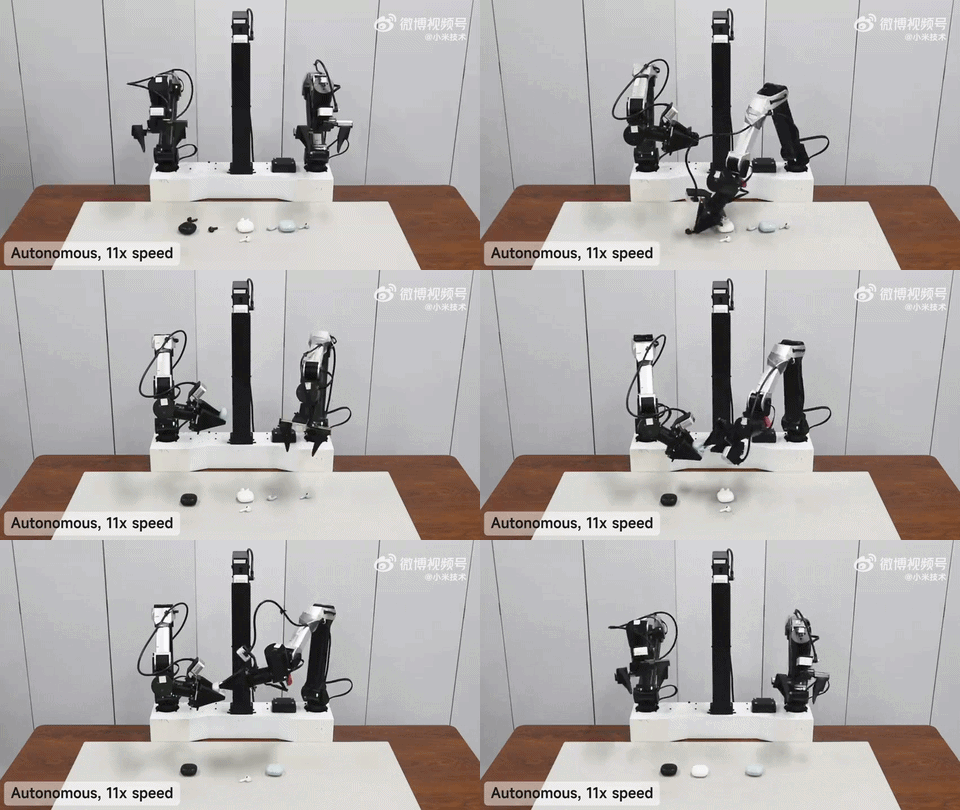
On average, it took the robot about 40 seconds to complete each packing task.
For humans, this might be a matter of a few seconds, but for a robot, executing this task is not easy.
- Precision: The tolerance between the earbuds and their slots is extremely small, requiring the model to achieve sub-millimeter alignment accuracy.
- Material Properties: The surface roughness of both the earbuds and the cases is as low as Ra0.03 μm, making them prone to displacement upon contact. The model must quickly correct action deviations to avoid assembly failures.
The combination of these two factors places dual pressure on the model's perception accuracy and motion robustness.
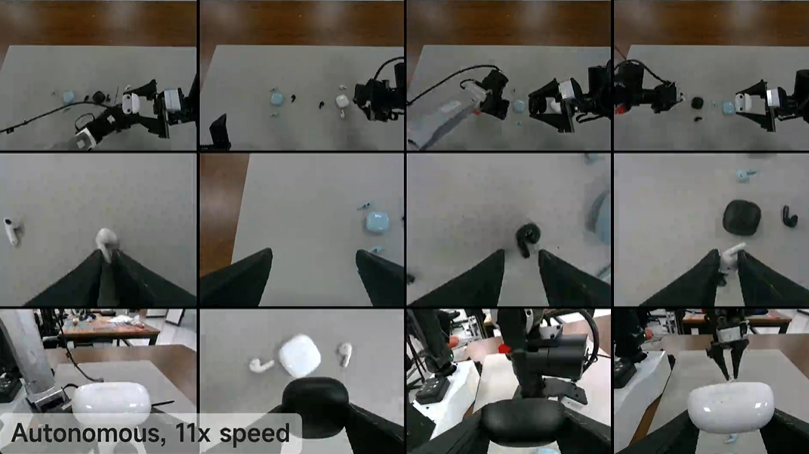
Notably, the post-training data volume Xiaomi used for this task was only 20 hours. Enabling the model to master fine manipulation tasks at this scale made the pre-training foundation design crucial.
During the pre-training phase, approximately 200 million robot trajectory time steps and over 80 million general visual-language samples were utilized, covering open-source datasets and internal teleoperation data. This allowed the model to accumulate action generation knowledge and a generalization foundation before entering task-specific training.
Therefore, these 20 hours of task data did not build capabilities from scratch. However, even with this data scale, deployment-stage design remains critical for executing fine manipulation tasks.

Can Models Also 'Slack Off'?
To ensure smooth robotic motions, Xiaomi adopted an asynchronous inference scheme during the deployment phase. This allows the robot to parallelly infer the next action while executing the current trajectory, rather than waiting for the current action to complete before calculating the next one.
But asynchronous inference introduced a new issue. As mentioned in the technical details, Xiaomi highlighted an interesting phenomenon: the model tends to 'slack off'.
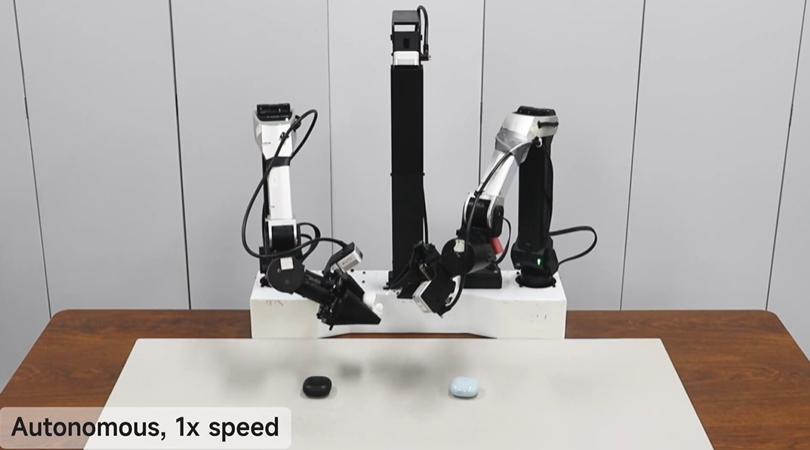
Sounds like a joke at first, but this is actually a typical structural issue with current VLA models. When you introduce an Action Prefix to ensure stable and continuous actions, the model tends to:
- Over-rely on existing trajectories;
- Ignore new visual input;
- Become an "inertial executor."
In fact, this is a classic conflict between stability and reactivity.
So, this isn't simply about making the model more obedient; the key lies in reallocating priority: during continuous action generation, should the model trust the past or the present more?
To address these issues, Xiaomi has introduced a comprehensive set of constraint mechanisms to forcibly break path dependency and force the model to remain sensitive to real-time perception. Specifically, this can be broken down into three aspects:
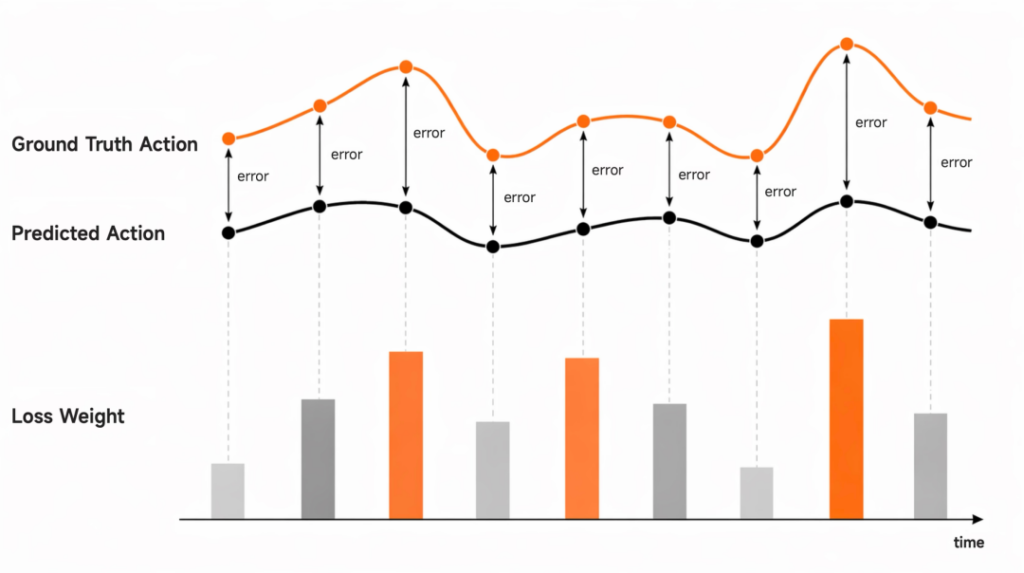
- Modifying the training objective: Through an adaptive weighting mechanism, the model no longer treats all errors equally. It dynamically adjusts weights based on the deviation between predicted and actual trajectories. In other words, it focuses its learning where errors are greatest. This prevents the model from coasting through critical nodes, forcing it to make genuine judgments based on visual signals.
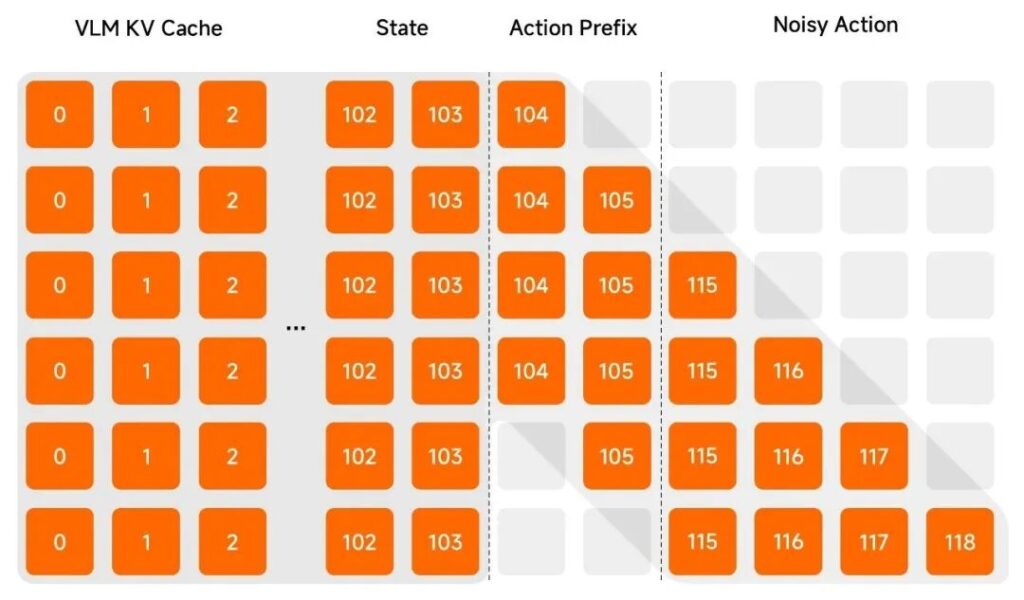
- Restricting the attention structure: By introducing a Λ-shaped attention mask, while referencing previous actions, the model is constrained to focus on current visual input. Structurally, this prevents the model from merely gliding along historical trajectories, making "seeing the present" an unavoidable process.
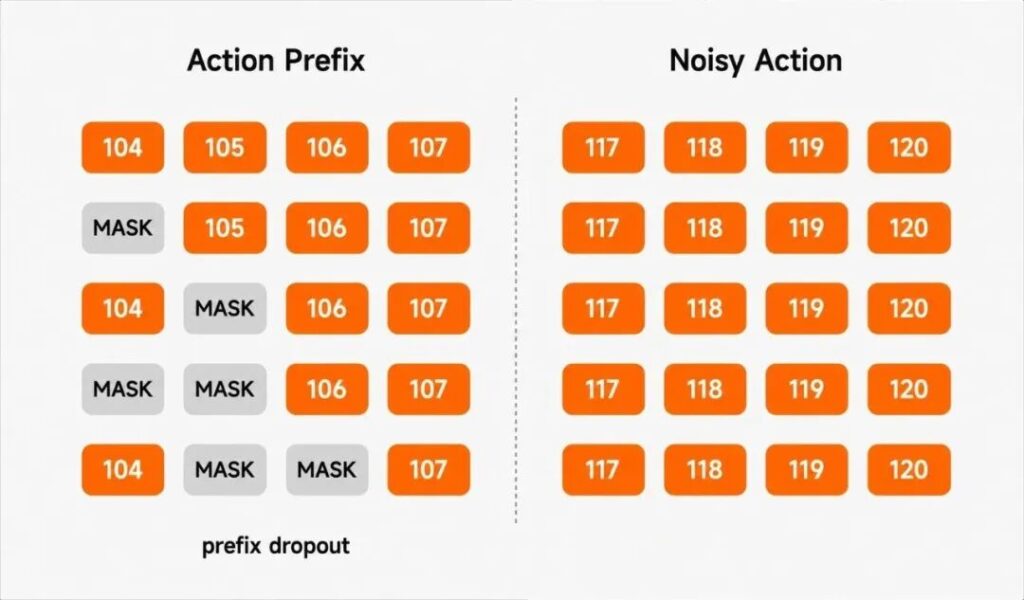
- Actively create uncertainty: By randomly masking action prefixes, the model cannot always rely on complete historical action information during training and is forced to depend more heavily on visual and sensor signals to make decisions.
These measures effectively strip away the conditions that allow the model to "cut corners." They also address a deeper, systemic contradiction: how to maintain action continuity without sacrificing the ability to respond to environmental changes.
This is an unavoidable hurdle for current VLA (Vision-Language-Action) models as they move toward real-world scenarios.

Conclusion
Entering 2026, it has become increasingly evident that Xiaomi's activities in the robotics sector are accelerating.
With the release of Xiaomi-Robotics-0 at the beginning of the year, followed by fine-tuned models for precision grasping, factory operation results, the public release of dexterous hand solutions, and now the open-source of real-machine post-training, new progress has been announced almost every few weeks. The company is also beginning to attempt the implementation of a complete set of reusable methodologies.
The broader context is that this change is not an isolated case. Over the past year, the participant structure in the robotics industry has undergone a significant shift, especially with manufacturers represented by automotive companies. Both Tesla, Li Auto, and Xiaomi are accelerating their layout in this track.
As automotive manufacturers, they inherently possess what is needed for robot R&D:
- Mature complex system integration capabilities;
- Experience in large-scale hardware manufacturing and cost control;
- Long-term engineering accumulation in automated execution.
These experiences in vehicle manufacturing and intelligent driving have, to some extent, served as a springboard for robot R&D. In this process, the challenges faced by the robotics industry are increasingly evolving into a complex systems engineering problem.